Kathmandu
Sunday, July 19, 2026





The rhythm of the Chyabrung, the words of the Mundhum, and the right to speak a mother tongue exist because generations fought to keep them alive—making identity a legacy earned through sacrifice, not bestowed by chance.
KATHMANDU: Eyes and mind, which were glued to the mobile screen, suddenly return towards the courtyard of my own childhood.
I am the daughter of a Limbu. But I had not understood the depth of this sentence. In my childhood, when someone asked what my festival was, the words Chasok Tangnam (a harvest festival that marks the end of the agricultural season) never came to my lips.
I only knew about the Newar community’s Kwanti Purnima (also known as Guni Punhi, is a festival that coincides with the Janai Purnima and Raksha Bandhan festival), the Lakhe (a vibrant masked tradition of the Newar community) dance felt like my own, and Gai Jatra (a historic Newar festival celebrated annually in the Kathmandu Valley to honor loved ones who passed away that year) used to thrill me.
Teej, Dashain, and Tihar were the festivals that fell under my priorities. While growing up under the cultural umbrella of the Newar, Chhetri, and Brahmin communities, my childhood sense of belonging was tied to all of them.
The lap of Aji (grandmother) from the neighboring Newar community was very dear to me. There were no elderly people in my house to call Boju (grandmother) in our own native language. Therefore, when friends called their relatives Aja-Aji (graandparents) or Paju (maternal uncle), the sweetness of that accent felt like music.
During Dashain, father used to say that applying white tika is our tradition, but I would smile after receiving red tika and jamara all over my forehead and temples from the hands of the Aji next door.
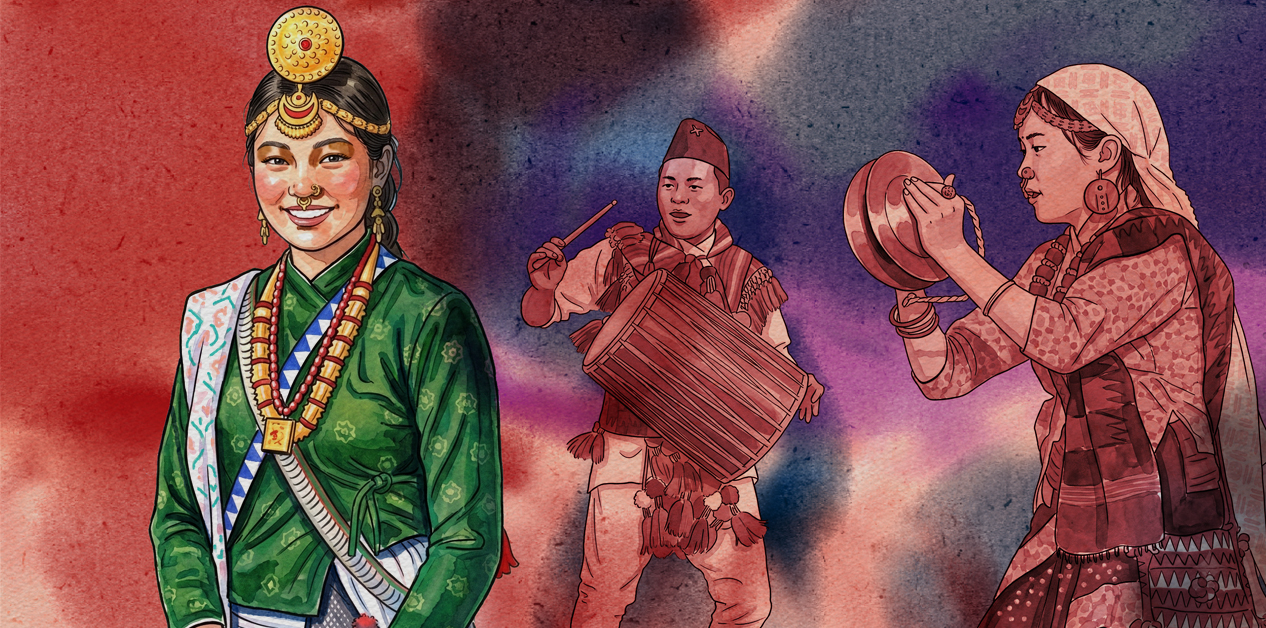
In that mixed, colourful environment, I did not know the names of the ornaments worn by the women of my own community. What our traditional attire looks like, what the meaning of Silam Sakma (a sacred protective crest and cultural identity symbol of the Kirat Limbu community) is, why Mangena (holding one’s head high) is done, and what the essence of Ubhauli-Udhauli (two major seasonal festivals celebrated by Nepal’s Kirat Indigenous communities. Derived from the Nepali words ubho (upwards) and udho (downwards), they symbolize the seasonal migration of people, birds, and animals between higher and lower elevations.) is—I only got to understand all of this very late.
My father had grown up in a geography with a majority of non-Limbu communities, while my mother was from the Yakkha community. Our house itself was a confluence of mixed cultures, but the indigenous fragrance of our own identity was a bit faint there.
For a time, I even felt that the Bakkhu (a traditional, loose, cloak-like garment) worn by Sherpa women around Bhotkhola and Kimathanka of Sankhuwasabha was my own dress, because that was what my eyes had seen for the first time.
My eyes had never even locked with my own indigenous attire, native musical instruments, and original culture. At a turning point in life, I left home. Perhaps, from the very day I left home, my invisible journey of searching for my own community started from within.
Now, when I hear the rhythm of the Chyabrung (a traditional, double-sided oblong wooden drum played by the indigenous Limbu community), why the beat of my heart changes—I am finally understanding. When I hear the melodies of the Palam, why my eyes well up involuntarily—I am feeling that.
In the words of the Mundhum (the ancient, pre-Vedic oral scripture and guiding philosophy of the indigenous Kirat peoples), I have started finding not some fairy tale, but a history written with the blood and sweat of my own ancestors. I understood that Ubhauli and Udhauli are not just festivals for harvesting or sowing crops; these are living dialogues that have been going on between nature and humans since primitive times.
I kept reading, kept searching for experts of the Mundhum, and kept mingling with scholars of culture. Gradually, the link to my language, my rituals, and my identity reconnected with me. Only after that did I begin to recognize the real me in the mirror. Having grown up saying Namaskar for years, I now feel a distinct coolness in my ears when saying Sewaro (a traditional, respectful greeting primarily used by the Limbu and Kirant communities ).
A few years ago, I had the opportunity to hold a long conversation with Bir Nembang, a leader of the Limbuwan movement. I was left speechless when listening to the tearful stories of struggle narrated by him and his wife. The state filed a treason case against him and put him in jail on the sole charge of teaching his language and script. Even after coming out of prison, he had to go underground for years. His voice gets heavy even now when remembering that harrowing time when one had to be called a traitor for teaching one’s mother tongue.
However, one sentence he said while smiling struck my brain deeply: “At that time, there was even a rumour that a price had been put on my head.”
That day, I understood a harsh truth. I was merely searching for my identity, but their generation had saved our identity by shedding blood and tears.
The rhythm of the Chyabrung that we see so easily today, the letters of the native script printed in books, and the right to speak our mother tongue are not gifts given in charity by someone.
Behind that were dark jail cells, the restlessness of underground life, the extreme humiliation by the state, and a strong faith that did not waver even in the midst of that humiliation.
Even today, my body shivers when remembering those aspects of the conflict era. Whether it was the incidents of the state side smashing madals (double-headed hand drum with a cylindrical body) while youths walked around playing them at night in the Ekadashi market, or hearing the stories of elder brothers being chased away and Chyabrung drums being smashed while performing the Dhan Nach (a traditional folk dance where participants hold hands, forming lines or circles, and move in rhythmic steps that historically mimic the threshing of rice grains) at the Trisali fair of Panchthar—it felt as though our culture would gradually disappear from the pages of history.
When the debate on federalism started in the country after the heat of the 2006 People’s Movement, the 10-year armed struggle, and the Madhesh Movement, a spark of hope was seen on the faces of the village elders.
They used to say—now our language, culture, and identity will also get a place of respect in the mainstream of this state. But all those dreams have not been fulfilled yet. The recommendations of the Language Commission are waiting to be implemented. The naming of Koshi Province has added a new and raw wound to the hearts of those protesting for identity. Many questions are still searching for valid answers.
Despite all this happening, I have felt a big change within my own life. Today, when I go out dressed in my own traditional attire, I do not hesitate even a bit; rather, my chest swells with pride.
I am learning to dance to the footsteps of the Palam (a traditional folk song of the indigenous Limbu community). When I hear the roar of the Chyabrung, I feel that this is not just the sound of a musical instrument, but the living heartbeat of my ancestors.
Now I have to learn my mother tongue. Because when a language is lost, not only do words die, the memory of an entire generation dies. When memory dies, history dies, and after history dies, an entire community gradually stops recognizing its own face when looking in the mirror.
I am understanding a saying by Bairagi Kainla (Til Bikram Nembang) even more deeply now: only if the language survives does the community survive; only if the community survives does its identity remain alive.
Perhaps this is the reason why, when I hear or read the debate on the dissolution of the provincial assembly today, I do not remember any administrative ministry or budget deficit.
I remember the youth and struggle of people like Bir Nembang. I remember all those who lost their lives in the People’s War, and those who gave up their lives in the Madhesh Movement. I get a glimpse of that little girl who was lost, not recognizing her own attire and identity, who is finally understanding her identity now.
These days, when I stand in front of the mirror adorned in cultural attire and jewelry, I feel I have not just worn pieces of cloth, but rather, though very late, I am draped in the glorious history of my own ancestors.
Therefore, the debate on the dissolution of the provincial assembly is not just an administrative or political tactic for me. It is a serious fear that the existence and identity obtained from struggle might be overshadowed again.
This fear is not mine alone; it is the shared experience of an entire generation that has awakened from its language and movement, that has grown up searching for its culture, and that has found its identity very late. Within this very experience, we find our existence. And we know—the fight fought for one’s own existence is the greatest fight in the world.