Kathmandu
Tuesday, June 16, 2026





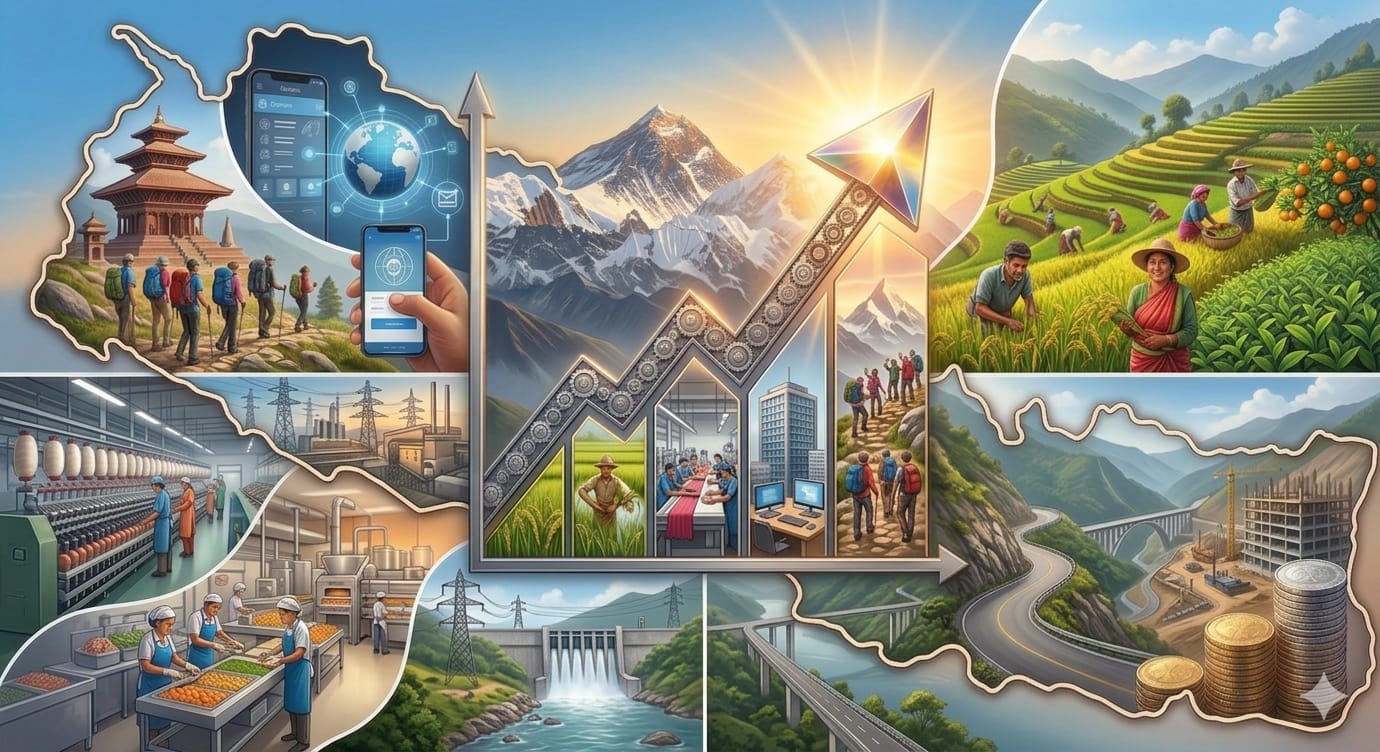
KATHMANDU: Nepal’s National Statistics Office has released preliminary national accounts estimates for fiscal year 2025/26, showing the economy growing at 3.85 percent at purchasers’ prices, with total GDP estimated to reach Rs. 6,600 billion. Electricity emerged as the fastest growing sector at nearly 21 percent, while remittances from workers abroad are now estimated at a remarkable 33 percent of GDP, the highest on record.
The data, which also includes revised figures for 2024/25 and final figures for 2023/24, paints a picture of an economy recovering unevenly, with services and industry picking up while agriculture and public administration lag.
What is the national accounts system and why does Nepal publish these numbers?
The national accounts system is essentially the economy’s comprehensive ledger. It records the value of every good and service produced within the country during a given period, tracks how income flows between households, businesses, and government, and measures saving, investment, and trade.
Nepal follows the System of National Accounts 2008, a framework jointly developed by the United Nations, World Bank, International Monetary Fund, European Union, and the OECD, which is the standard methodology used by countries worldwide.
Nepal first compiled national accounts estimates as far back as fiscal year 1961/62, but regular and systematic publication began from 1964/65. The National Statistics Office publishes these numbers each year following a standard practice of releasing preliminary estimates for the current year, revised estimates for the previous year, and final figures for the year before that, because data from surveys, tax records, and administrative sources takes time to fully compile.
The numbers matter because they form the foundation for the government’s budget planning, for the central bank’s monetary policy decisions, and for international lenders and investors trying to assess the health of Nepal’s economy.
What is GDP, how is it measured, and what figure did Nepal record for 2025/26?
GDP, or Gross Domestic Product, is the total monetary value of all final goods and services produced within a country’s borders during a specific period, usually a fiscal year. There are three standard ways to measure it: the production approach, which adds up the value added by all industries; the expenditure approach, which adds up consumption, investment, government spending, and net exports; and the income approach, which adds up all incomes earned in production.
Nepal primarily uses the production approach, presenting GDP first at basic prices, which excludes product taxes and subsidies, and then at purchasers’ prices, which includes them.
For fiscal year 2025/26, Nepal’s total GDP at current purchasers’ prices is estimated at Rs. 6,600 billion, up from the revised figure of Rs. 6,200 billion in 2024/25. These are nominal figures, meaning they reflect actual prices in the market rather than adjusting for inflation.
The real growth rate, which strips out price changes and measures actual volume expansion, is what economists look at when assessing whether the economy genuinely expanded.
What is Nepal’s GDP growth rate in 2025/26 and how does it compare with recent years?
Nepal’s economy is estimated to have grown at 3.85 percent in fiscal year 2025/26 at purchasers’ prices in real terms, slightly down from the revised 4.43 percent recorded in 2024/25.
At basic prices, the growth rate is estimated at 3.68 percent, compared to 3.80 percent in the previous year and 3.38 percent in 2023/24.
Looking at the longer trajectory, Nepal’s growth performance has been volatile. The economy expanded strongly at 8.98 percent in 2016/17, the post-earthquake reconstruction boom year, then hit 6.66 percent in 2017/18.
It then contracted sharply during the COVID years, recording negative growth of 2.37 percent in 2019/20, the worst performance since modern records began.
Recovery followed, with growth reaching 5.63 percent in 2021/22, then slowing to 1.98 percent in 2022/23, a difficult year marked by a balance of payments crisis and tight liquidity.
The 2023/24 and 2024/25 numbers showed moderate recovery, and 2025/26 continues along that modest trajectory.
Nepal’s growth, while positive, remains well below the rates needed to rapidly reduce poverty or approach the government’s own targets.
What is the difference between growth at basic prices and at purchasers’ prices?
This distinction trips up many readers of economic data. Basic prices measure what producers actually receive for their goods and services, before adding product taxes like value added tax or subtracting product subsidies.
Purchasers’ prices are what buyers actually pay, which means they include those product taxes and subtract subsidies. The GDP at basic prices is the sum of gross value added across all industries.
When you add taxes on products and subtract product subsidies, you get GDP at purchasers’ prices. In Nepal’s case for 2025/26, taxes on products net of subsidies are estimated at Rs. 804 billion, which is why the GDP figure rises from Rs. 5,796 billion at basic prices to Rs. 6,600 billion at purchasers’ prices.
The growth rates also differ slightly: 3.68 percent at basic prices versus 3.85 percent at purchasers’ prices for 2025/26.
Both measures are valid and used for different analytical purposes. When comparing the size of the economy overall and tracking living standards, the purchasers’ price figure is typically the headline number.
When analyzing which industries are doing well, the basic price measure is more useful because it strips out the distorting effect of tax policy changes.
How is the economy divided into sectors and how did each sector perform?
The economy is divided into three broad sectors. The primary sector covers agriculture, forestry, fishing, and mining and quarrying. The secondary sector covers manufacturing, electricity and gas, water supply, and construction. The tertiary sector, also called the services sector, covers everything else: trade, transport, accommodation, finance, real estate, education, health, and government services.
In 2025/26, the primary sector is estimated to grow at 1.63 percent, the secondary sector at 5.77 percent, and the tertiary sector at 4.21 percent.
The secondary sector is the strongest performer this year, driven overwhelmingly by electricity. In terms of the composition of GDP, the primary sector contributes 24.5 percent, the secondary sector 13.7 percent, and the tertiary sector 61.8 percent.
This composition has been broadly stable for several years, though the primary sector’s share has been gradually declining from around 34 percent in 2010/11 as the economy has progressively shifted toward services.
The tertiary sector’s dominance at nearly 62 percent of GDP reflects how heavily Nepal depends on trade, remittance-driven consumption, government services, and financial activity rather than on manufacturing or agriculture for its economic base.
Which sector has grown the fastest in 2025/26 and what drove that growth?
Electricity and gas is by far the fastest growing sector, with estimated growth of 20.93 percent in 2025/26. This is the continuation of a remarkable multi-year trend.
The sector grew 11.61 percent in 2023/24, 12.71 percent in 2024/25, and now 20.93 percent in 2025/26.
The driver is Nepal’s hydropower expansion. New power projects have come online, substantially increasing total installed generation capacity. The transmission infrastructure has also been extended, allowing more electricity to reach consumers and reducing losses.
Domestic electricity consumption has grown as more households and industries are connected to the grid and as electric vehicles and cooking solutions gain traction.
Nepal has also been exporting electricity to India, which adds to the sector’s revenue. Despite this impressive sectoral growth, it is worth noting that electricity and gas contribute only about 2.08 percent of total GDP.
The sector’s gross value added is estimated at Rs. 121 billion in 2025/26, up from Rs. 99 billion in 2024/25. The sector is an important signal of infrastructure development and has strong multiplier effects on other sectors including manufacturing and transport.
Which sectors grew the slowest and why?
Public administration and defence recorded the lowest growth of any sector in 2025/26, estimated at just 0.23 percent. This reflects minimal growth in government expenditure across the three tiers of government on administrative and defence functions.
Government capital spending has been chronically underperforming, and recurrent spending on public administration has barely increased in real terms.
Education came second lowest at 1.50 percent. Student enrollment in public schools has been declining as families shift to private schools or send children abroad, while enrollment in private institutions has grown only marginally.
Government spending on education has also slowed. Agriculture grew at 1.58 percent, pulled down by a projected decline of 4.16 percent in rice production due to adverse weather conditions, even as maize, wheat, and industrial crops showed moderate gains.
These three sectors, government administration, education, and agriculture, together account for a very large share of Nepal’s economy, meaning their weak performance has a significant dampening effect on the overall growth rate.
What happened to agriculture specifically and why does it matter so much?
Agriculture, forestry, and fishing is the single largest sector in Nepal’s economy, contributing 24.03 percent of GDP in 2025/26. Its gross value added is estimated at Rs. 1,393 billion in 2025/26, up from Rs. 1,337 billion in 2024/25.
It is also the sector in which the largest share of Nepal’s working population is employed, particularly in rural areas. So when agriculture does poorly, it disproportionately affects the livelihoods of the poorest Nepalis.
In 2025/26, the sector is estimated to grow at only 1.58 percent, compared to 3.05 percent in 2024/25 and 3.10 percent in 2023/24. The main drag is paddy, or rice, production, which is expected to decline by 4.16 percent.
Rice is Nepal’s most important food crop and a bellwether for overall agricultural performance. The decline is attributed to rainfall variability and weather disruption.
Other crops including maize, wheat, millet, pulses, and industrial crops are expected to show modest growth. Livestock products including meat, eggs, and fish are also expected to grow moderately.
The long-term trend for agriculture is one of gradual slowdown as a share of the economy, from 33.45 percent of GDP in 2010/11 to 24.03 percent today, as labor moves to services and remittances replace subsistence farming for many households.
How did manufacturing perform and what does it tell us about Nepal’s industrial development?
Manufacturing contributes 5.72 percent of GDP and is estimated to grow at 2.83 percent in 2025/26, up from 2.27 percent in 2024/25. Its gross value added in current prices is estimated at Rs. 331 billion, up from Rs. 309 billion.
This is a moderate improvement but not a breakthrough. Manufacturing contracted sharply by 9.03 percent in 2019/20 during the COVID disruption. It then recovered partially but contracted again by 2.02 percent in 2023/24 before returning to positive territory.
The recovery in 2025/26 is driven by growth in production of cement, ghee, concrete, soybean crude oil, iron rods, tobacco products, wiring cables, jute, and beer.
Import growth in raw materials such as soybean crude, zinc sheets, and iron rod inputs, along with demand recovery for manufactured goods, has also supported the sector.
Nepal’s manufacturing sector has long been a structural weak point. At roughly 5.72 percent of GDP, it is far smaller than in comparable developing economies.
The reasons are well understood: landlocked geography raising transportation costs, lack of cheap and reliable energy historically, limited skilled labor, and competition from cheaper Chinese and Indian goods.
The electricity sector’s rapid growth now offers hope that cheaper and more reliable power could eventually help stimulate manufacturing investment.
What is gross value added and how is it different from GDP?
Gross value added, or GVA, measures the value of output produced by an industry minus the cost of the inputs used to produce it.
It is essentially the economic contribution of each sector before accounting for taxes and subsidies on products. If a cement factory uses raw materials worth Rs. 50 million and produces cement worth Rs. 80 million, it has added Rs. 30 million in value.
Sum up all such value added across every sector and you get GVA at basic prices, which is GDP at basic prices. When you add net product taxes to this, you arrive at GDP at purchasers’ prices, the headline GDP figure.
The concept matters because it allows precise comparisons between industries. Nepal’s total gross output, the value of everything produced before subtracting inputs, is estimated at Rs. 9,923 billion in 2025/26.
Intermediate consumption, the cost of inputs used up in production, is Rs. 4,127 billion. The difference between those two figures is the GVA at basic prices, estimated at Rs. 5,796 billion.
Adding net product taxes of Rs. 805 billion brings total GDP to Rs. 6,600 billion.
How is GDP measured from the expenditure side and what does it show?
The expenditure approach to GDP adds up all spending on final goods and services: household consumption, government consumption, gross capital formation which is investment, and net exports which is exports minus imports.
In 2025/26, final consumption expenditure is estimated at 90.29 percent of GDP, down from 93.11 percent in 2024/25 and 93.31 percent in 2023/24. This decline in consumption as a share of GDP is notable and generally a positive sign, as it means a larger share of income is going toward saving and investment rather than being consumed immediately.
In rupee terms, total final consumption is estimated at Rs. 5,959 billion, of which private consumption accounts for Rs. 5,438 billion and government consumption Rs. 395 billion.
Gross fixed capital formation, investment in buildings, machinery, and other productive assets, is estimated at 26.26 percent of GDP in 2025/26, up from 23.57 percent in 2024/25.
In absolute terms that is Rs. 1,733 billion in fixed investment. However, government capital expenditure is estimated to have dropped sharply to Rs. 331 billion from Rs. 497 billion in the previous year, reflecting the government’s persistent failure to execute its capital budget within the fiscal year.
What does the data show about Nepal’s trade and the trade deficit?
Nepal imports far more than it exports, and the gap, known as the trade deficit, is a defining feature of the economy.
In 2025/26, imports of goods and services are estimated at 34.52 percent of GDP, while exports are estimated at 9.97 percent. Total imports are estimated at Rs. 2,278 billion, of which goods account for Rs. 1,933 billion and services Rs. 345 billion.
Total exports are estimated at Rs. 658 billion, of which goods account for Rs. 374 billion and services Rs. 284 billion. The net exports figure is therefore negative Rs. 1,621 billion.
The export picture has actually been improving. Exports as a share of GDP were only 5.12 percent in 2020/21 and have climbed steadily to 9.97 percent in 2025/26.
Much of this is driven by electricity exports to India and growing tourism services revenue. However, Nepal’s fundamental trade structure has not changed: it imports petroleum products, vehicles, gold, machinery, and food staples in huge quantities while exporting limited goods in return.
The trade deficit is financed largely by remittances, which is why a sudden drop in remittance inflows would create an immediate balance of payments crisis.
What is the resource gap and what does it tell us about Nepal’s financial position?
The resource gap is the difference between gross national saving and gross capital formation. When saving exceeds investment, the country is a net lender to the rest of the world.
When investment exceeds saving, it is borrowing from abroad. In 2025/26, Nepal’s gross national saving is estimated at 44.77 percent of GDP, a remarkable jump from 38.39 percent in 2024/25 and 35.60 percent in 2023/24.
In rupee terms, gross national saving is estimated at Rs. 2,955 billion. This surge in the saving rate is largely explained by the dramatic rise in remittances.
Gross capital formation is estimated at Rs. 2,108 billion. This means Nepal is estimated to have a positive resource gap of 10.51 percent of GDP, meaning it is saving more than it invests domestically.
This might sound paradoxical for a developing country that needs more investment, but it reflects the reality that remittance inflows are so large that they push up the measured saving rate even as productive domestic investment remains constrained.
Gross domestic saving, which excludes remittances, is only Rs. 641 billion, or 9.71 percent of GDP, a far more modest figure that better reflects how little is saved from domestic production alone.
What are remittances and why are they so central to Nepal’s economy?
Workers’ remittances are money sent home by Nepalis employed abroad, primarily in the Gulf countries, Malaysia, India, and increasingly in Japan, South Korea, Australia, and the United States.
In 2025/26, remittances are estimated to equal 33.02 percent of GDP, the highest ratio ever recorded in Nepal’s national accounts. In rupee terms, that translates to approximately Rs. 2,179 billion, compared to Rs. 1,723 billion in 2024/25 and Rs. 1,446 billion in 2023/24.
To put the scale in perspective, remittances at Rs. 2,179 billion exceed total government revenue, far exceed merchandise exports of Rs. 374 billion, and are nearly double the entire gross fixed capital formation of Rs. 1,733 billion. This money finances consumption of food, housing, education, and healthcare for millions of families, keeps the import bill paid, and sustains the banking system through deposits.
The dependence is also a vulnerability. Any major disruption to migration flows, whether from Gulf economic slowdowns, policy changes in destination countries, or geopolitical events, would immediately squeeze household incomes and reduce consumption spending throughout the economy.
What happened to per capita GDP and why did it actually stagnate despite overall growth?
Per capita GDP in US dollar terms is estimated at 1,513 dollars in 2025/26, slightly lower than the revised figure of 1,516 dollars in 2024/25, even though the economy grew.
This apparent paradox is explained by the exchange rate. The Nepali rupee depreciated against the US dollar in 2025/26, with the exchange rate moving from approximately Rs. 136.29 per dollar in 2024/25 to Rs. 144 per dollar in 2025/26.
Even if the economy grew in rupee terms, when you convert the per capita figure into dollars, you get a slightly lower number because each rupee is now worth fewer dollars.
In rupee terms, per capita GDP in nominal terms rose from Rs. 206,625 to Rs. 217,946. In real constant-price terms, per capita GDP grew from Rs. 93,091 to Rs. 95,789, representing 2.90 percent real growth per person.
Per capita Gross National Income is estimated at 1,535 dollars, flat compared to the previous year for the same exchange rate reasons.
The per capita Gross National Disposable Income, which includes remittances in the calculation, fares better at 2,044 dollars, up from 1,994 dollars, precisely because remittance growth more than offsets the exchange rate drag.
What is the difference between GDP, GNI, and GNDI, and why does Nepal’s GNDI look so different?
These three measures capture progressively broader concepts of national income.
GDP measures the value of production within Nepal’s borders regardless of whether the income goes to Nepalis or foreigners. GNI, Gross National Income, adds primary income received from abroad, mainly interest and dividends, and subtracts primary income sent abroad.
For most countries the difference between GDP and GNI is small. For Nepal, GNI in 2025/26 is estimated at Rs. 6,697 billion, slightly above GDP of Rs. 6,600 billion, because Nepal receives more primary income from abroad than it sends out: inflows of Rs. 145 billion against outflows of Rs. 49 billion.
GNDI, Gross National Disposable Income, takes GNI one step further by adding current transfers received from abroad, overwhelmingly remittances, and subtracting transfers sent abroad. Nepal receives an estimated Rs. 2,228 billion in current transfers in 2025/26, making GNDI jump to Rs. 8,914 billion, roughly 35 percent higher than GDP.
This is what makes Nepal unusual: most of what Nepali households actually have to spend is not generated by domestic production at all, but flows in from workers living abroad.
Measuring only GDP would give a severely misleading picture of Nepali living standards.
How did the financial sector perform and what drove its growth?
The financial and insurance sector is estimated to grow at 9.16 percent in 2025/26, the second fastest growth rate after electricity. The sector contributes 6.72 percent of GDP and its gross value added is estimated at Rs. 389 billion, up from Rs. 370 billion in 2024/25.
The growth is driven by several factors. Bank deposits have grown as households channel remittances and other savings into the formal banking system.
Loan disbursement has also picked up after a period of tight credit conditions in 2022/23 and early 2023/24. Non-life insurance premium collections have risen along with vehicle imports and business activity.
Life insurance renewal premiums have also grown. Social security fund contributions, provident fund balances, and the Citizen Investment Trust have all expanded their asset bases.
Securities market activity and merchant banking operations have contributed additional revenue. The sector’s growth of 9.16 percent in 2025/26 follows 7.55 percent in 2024/25 and 9.96 percent in 2023/24.
At consistently high single-digit growth rates, the financial sector is one of the economy’s clear bright spots and a key driver of overall service sector expansion.
What does the data say about investment and capital formation?
Gross fixed capital formation, the measure of investment in durable productive assets, is estimated at 26.26 percent of GDP in 2025/26, up from 23.57 percent in 2024/25.
In absolute rupee terms, fixed investment is estimated at Rs. 1,733 billion, up from Rs. 1,461 billion. Breaking this down by source tells an important story.
Government investment is estimated at only Rs. 331 billion, a sharp drop from Rs. 497 billion in 2024/25. This collapse in government capital spending is consistent with the persistent pattern of Nepal’s governments announcing large capital budgets but failing to spend them, particularly in the first half of the fiscal year, due to procurement delays, political instability, and bureaucratic bottlenecks.
State-owned enterprise investment is estimated at Rs. 130 billion. Private sector investment, however, is estimated to have surged to Rs. 1,273 billion from Rs. 843 billion in 2024/25.
This rise in private investment, if accurate, could reflect hydropower project construction by independent power producers, real estate development, vehicle imports, and broader business expansion.
The overall investment ratio of 26.26 percent is higher than Nepal has seen in several recent years and, if sustained, would be a positive sign for future growth potential.
What are the implicit GDP deflators and what do they tell us about inflation across sectors?
The implicit GDP deflator is the ratio of nominal GDP to real GDP, expressed as an index with the base year 2010/11 equal to 100. It is a broad measure of economy-wide price changes that differs from consumer price inflation because it covers all goods and services produced, not just those consumed by households.
Nepal’s overall implicit deflator stands at approximately 225 in 2025/26, meaning average prices across the economy are about 2.25 times what they were in 2010/11. But the deflators vary dramatically across sectors.
Public administration and defence has a deflator of 376.71, meaning prices in that sector are nearly four times the base year level, largely because of salary increases for civil servants and security personnel.
Education has a deflator of 356.67, reflecting the sustained rise in school fees and educational costs. Accommodation and food services stands at 303.90.
At the other end, information and communication has a deflator of only 107.37, meaning prices in that sector have barely risen above the 2010/11 level, reflecting the global trend of telecommunications and digital services becoming cheaper over time.
Mining and quarrying has a deflator of 136.20, one of the lowest, indicating relatively modest price increases in that sector.
What do these numbers tell us overall about Nepal’s economic trajectory and the challenges ahead?
The 2025/26 national accounts paint a picture of an economy muddling through rather than breaking out.
A 3.85 percent growth rate is positive and better than the difficult 1.98 percent recorded in 2022/23, but it falls short of the roughly 7 to 8 percent that economists generally agree Nepal needs to meaningfully reduce poverty and generate enough jobs for the approximately 500,000 young people who enter the labor market each year.
Several structural features stand out from the data.
First, remittance dependence is deepening: at Rs. 2,179 billion or 33 percent of GDP, the economy is more reliant on migrant earnings than ever before.
Second, public investment has deteriorated, with government capital spending estimated at only Rs. 331 billion, down from Rs. 497 billion in 2024/25, depriving the economy of infrastructure that would raise private sector productivity.
Third, the electricity sector’s growth of 20.93 percent is a genuine bright spot with long-term positive implications, and its gross value added has grown from Rs. 15 billion in 2010/11 to Rs. 121 billion in 2025/26.
Fourth, agriculture at only 1.58 percent growth limits income gains for the rural poor.
Fifth, manufacturing at under 6 percent of GDP and growing at only 2.83 percent remains structurally weak.
The economy needs to develop industries that can absorb labor domestically rather than exporting workers and importing their earnings to sustain consumption.