Kathmandu
Monday, July 27, 2026





Nepal News investigation traces the routes, networks, and profits behind a sophisticated cannabis trafficking operation running from Nepal’s Himalayan highlands to the heart of Bihar.
On the night of October 5, 2025, police recovered 537 kilograms and 140 grams of marijuana from a paddy field in Koshi Rural Municipality-7, Sunsari. Acting on intelligence that the marijuana stored in the field near Bhantabari—a town bordering India—was being prepared for cross-border smuggling, a police team raided the location. During the operation, Dinesh Yadav, a 45-year-old local resident, was arrested. The sheer volume of the seized contraband indicated that this was not a petty trade but the work of an organized syndicate.
Seven months later, on May 12, 2026, another shocking incident of marijuana smuggling came to light in Dharan. This time, the contraband was discovered inside an ambulance. In Dharan Sub-Metropolitan City-13, police seized 440 kilograms of marijuana from an ambulance bearing the registration number Ko 1 Cha 7359. The ambulance was being operated by Budhasubba Diagnostic Center Pvt. Ltd., Dharan.
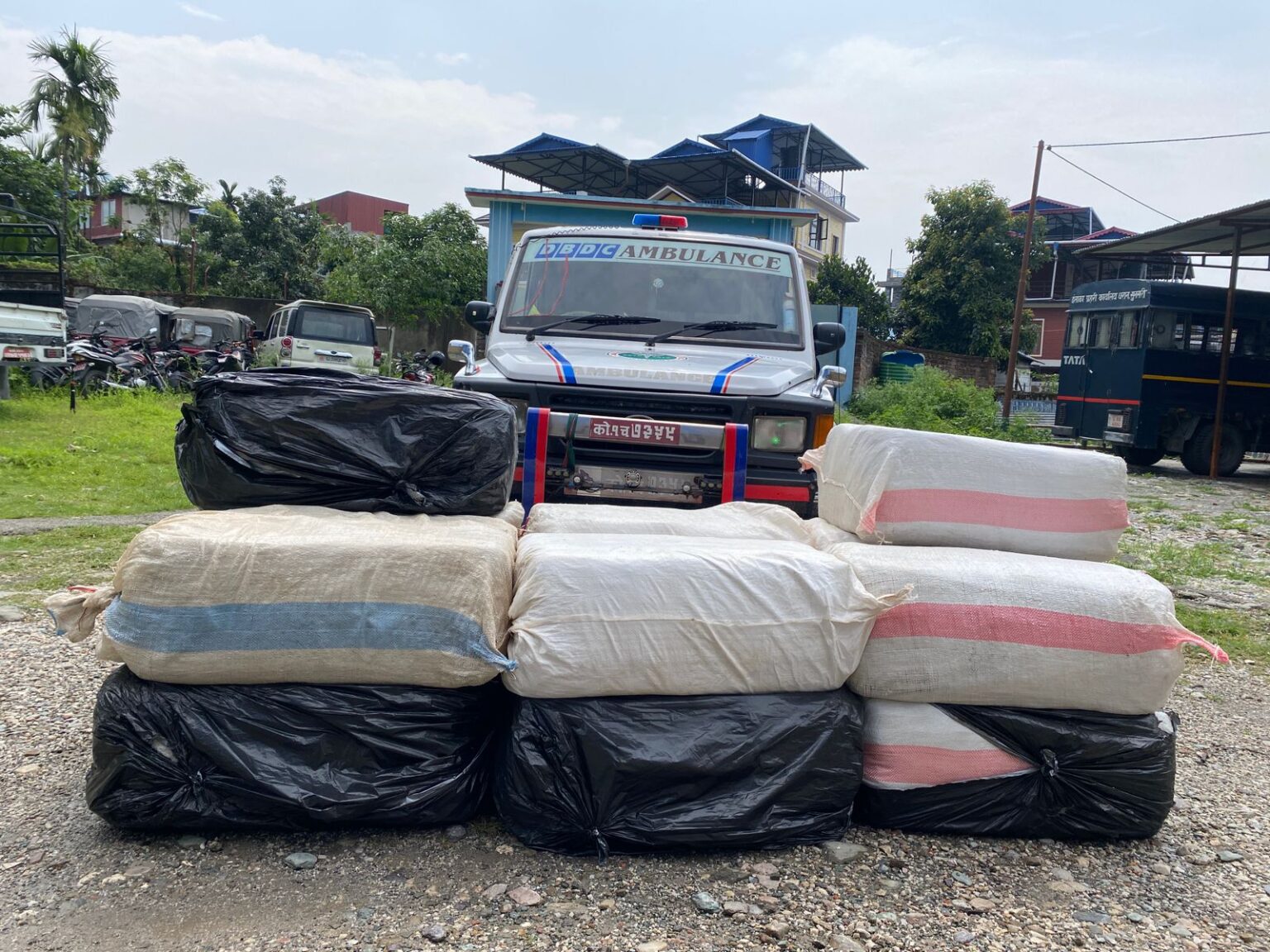
Marijuana seized from an ambulance in Dharan-13 on May 12, 2026.
On November 27, 2025, police opened fire during an operation to seize marijuana at Chandbela in Inaruwa Municipality-7, Sunsari. Acting on a tip-off that marijuana was being transported toward India, a team from the Armed Forces Police attempted to intercept a Scorpio SUV. When the driver sped away, police fired a warning shot into the air and subsequently recovered 153 kilograms of marijuana from the vehicle.
The methods employed by marijuana smugglers in Sunsari have evolved over time. Their ultimate objective remains the cross-border trafficking of massive quantities of marijuana into India. Ambulances have now become the preferred vehicle for transporting hundreds of kilograms of contraband from fields in the border regions.
According to the Superintendent of Police (SP) of Sunsari, Keshav Kumar Thebe, controlling marijuana smuggling is becoming an increasingly daunting challenge for law enforcement by the day. The constant machinations to transport marijuana from Nepal to India frequently trigger tensions between police and smugglers along the border.
Police investigations reveal that marijuana is primarily smuggled into India through Bhantabari, Laukahi, Shripur, Haripur, and adjacent areas in Koshi Rural Municipality, Sunsari. SP Thebe states, “Due to the Saptakoshi corridor coupled with an open border, smugglers believe they can easily transport marijuana into India from this region, which drives these frequent smuggling attempts.”
Sunsari: The epicenter of marijuana smuggling
Data from recent years firmly establishes Sunsari as the ‘epicenter’ of marijuana smuggling. Situated on Nepal’s southern border, Sunsari shares boundaries with Araria and Supaul districts of Bihar, India. Smugglers notably prefer the banks of the Koshi River and the Bhantabari-Birpur border point. Police conclude that massive volumes of marijuana are trafficked into India through this specific border point connecting to Supaul district.
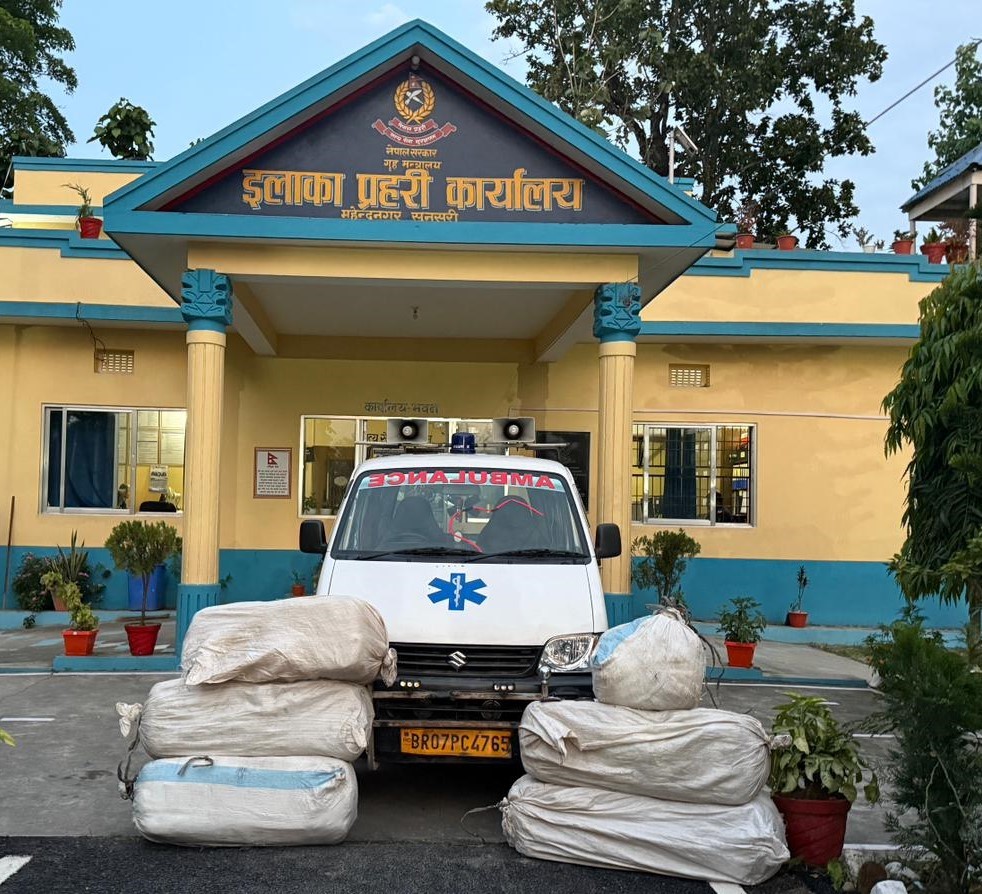
An ambulance operating in Bihar, India, which was seized in Sunsari.
District-wise data reveals that Sunsari has surpassed all other districts in Koshi Province regarding marijuana seizures in the current fiscal year 2025/26. Out of a total of 22,646 kilograms of marijuana seized across Koshi Province up to May 2026 of the current fiscal year, Sunsari alone accounted for 14,197 kilograms. This data demonstrates that Sunsari contributes to over 60 percent of the total marijuana seized across Koshi Province. The statistics indicate that Sunsari is transforming from a mere transit route into the central hub of marijuana smuggling.
According to Sunsari SP Thebe, controlling marijuana is highly challenging due to the open border, numerous rural pockets, and the shifting tactics of smugglers. “Because of the open border, marijuana smuggling occurs from everywhere. Smugglers have spared nothing—using private cars, trucks, and ambulances to transport marijuana,” he notes.
Even in the previous fiscal year 2024/25, Sunsari district led in marijuana seizures. Out of 26,687 kilograms of marijuana seized across Koshi Province that year, 12,376 kilograms were confiscated in Sunsari alone.
This meant nearly half of the province’s total seized marijuana came from Sunsari. In the current fiscal year, this proportion has escalated to exceed 60 percent.
Former Deputy Inspector General of Police (DIG) Hemanta Malla Thakuri, who spent a decade and a half working in narcotics control, describes the current state of marijuana smuggling in Sunsari as deeply alarming. “When such massive quantities of marijuana are seized from a single district, it calls for severe concern,” he warns. “Global statistics suggest that law enforcement typically manages to seize only 15 to 20 percent of the total illicit drug trade. Based on this calculation, one can only estimate the staggering volume of marijuana that goes undetected.”
As Thakuri points out, if the marijuana seized by the police represents only a small fraction of the total trade, the actual volume of marijuana trafficked into India through Sunsari could be many times higher than official figures suggest. “The police might view the increasing marijuana seizures in Sunsari merely as a success, but it should be interpreted as a warning sign that the district is becoming the national epicenter of marijuana smuggling,” Thakuri emphasizes.
Following Sunsari, Morang is the next highest district for marijuana trafficking in Koshi Province. According to the Morang Police Chief, SP Kabit Katwal, 4,851 kilograms of marijuana have been seized in Morang up to May of the current fiscal year. In the fiscal year 2024/25, the volume stood at 6,650 kilograms. It appears that marijuana traders deploy border points in Morang next to Sunsari. SP Katwal says, “We have mobilized our intelligence network to curb marijuana. This operation remains a top priority for the police.”
Dharan: The transit point for trafficking
Statistics demonstrate that Dharan has recently emerged as a primary hub for marijuana trafficking and smuggling. Analyzing data from the current fiscal year 2025/26 up to May, alongside the previous fiscal year 2024/25, identifies Dharan as the largest collection and distribution hub for marijuana. Alongside Dharan, Barahachhetra, Koshi Rural Municipality, Barju Rural Municipality, and Inaruwa Municipality serve as auxiliary nodes in the trade.
A study conducted by Nepalnews regarding locations where marijuana seizures exceeding 100 kilograms occurred in Sunsari reveals that 1,339 kilograms of marijuana were seized from Dharan up to May of the current fiscal year. Similarly, 1,037 kilograms were seized from Koshi Rural Municipality, 813 kilograms from Barahachhetra, 557 kilograms from Barju Rural Municipality, and 460 kilograms from Inaruwa Municipality.
In the data from the previous fiscal year 2024/25, a staggering 5,083 kilograms of marijuana were seized from Dharan alone. This indicates that Dharan has become the primary collection hub for marijuana arriving from the hilly districts of eastern Nepal. Statistics and events show that a well-organized pipeline has formed, where the main flow of marijuana produced in eastern Nepal moves through Dharan and Barahakshetra to reach Koshi Rural Municipality, from where it enters the Indian market. In that fiscal year, 512 kilograms were seized from Barahakshetra, 336 kilograms from Koshi Rural Municipality, and 336 kilograms from Bhokraha Narsingh Rural Municipality.
According to police investigations, Dhankuta is the primary source of most marijuana seized across Jhapa, Morang, Sunsari, and Saptari.
Police also conclude that marijuana cultivation is flourishing in Udayapur and Bhojpur. Marijuana produced in Dhankuta and Bhojpur is brought to Dharan, while that produced in Udayapur is consolidated in Barahakshetra. The marijuana accumulated via these routes concentrates around Koshi Rural Municipality before being smuggled into Bihar, India. Koshi Province Police Chief, DIG Binod Ghimire, shares, “We have intelligence that marijuana cultivation is widespread in the eastern hilly district of Dhankuta. Marijuana from Bhojpur and Udayapur is transported to the border through various means. Lately, smugglers have been deploying vehicles that the police would seldom suspect.”
On December 28, 2025, police discovered 480 kilograms of marijuana inside an ambulance with government license plates that had traveled from Dhankuta to Kerabari in Morang. Police seized the contraband after firing warning shots. The ambulance, bearing registration number Pra-1-06-001Jha005, was operated by Shahidbhumi Rural Municipality-1 of Dhankuta. The 480 kilograms of marijuana loaded onto the ambulance had been brought to Kerabari in preparation for transport to India. The plan to move it to the Sunsari or Morang border when convenient was foiled by the police intervention.
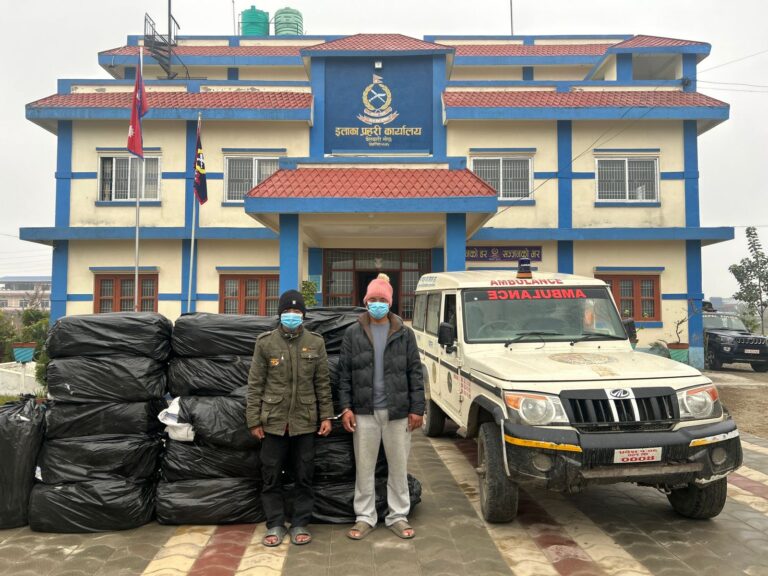
The ambulance from Shahidbhumi Rural Municipality, Dhankuta, seized at Kerabari in Morang on December 28, 2025.
However, police action against marijuana control in Dhankuta—the major production district—remains unsatisfactory. Given that marijuana is transported via road networks from remote settlements in Dhankuta all the way to Dharan, monitoring, control, and enforcement should ideally be most effective at the production source. Yet, seizure statistics present an inverted picture. Up to May of the current fiscal year, Dhankuta police have seized only 886 kilograms of marijuana. In the previous fiscal year, Dhankuta police seized 4,194 kilograms, whereas during the exact same period, 5,083 kilograms of marijuana were seized in the Dharan area of Sunsari alone.
Because more marijuana is seized in transit and border areas than in the production district itself, marijuana smuggling does not appear to be a top priority for Dhankuta police. The newly transferred SP of Dhankuta, Narayan Ranjitkar, says, “I am unaware of what happened previously, but circulars regarding marijuana have been issued by the line ministry. I will work by adopting a policy of zero tolerance.” He adds that they possess intelligence showing extensive marijuana cultivation in Shahidbhumi, Sangurigadhi Rural Municipality, Mahalaxmi, and Pakhribas Municipality.
Marijuana smuggling across all Madhesh districts
Following Sunsari in Koshi Province, police statistics show Madhesh Province as the second-largest hub for marijuana seizures. Marijuana cultivated in the hilly regions of central Nepal transits through the districts of Madhesh Province to reach Bihar. Marijuana transport and smuggling are active across all eight districts of Madhesh Province that border Bihar, India. Police state that marijuana cultivated in Dhading and Makawanpur finds its way to Madhesh Province.
Up to May of the current fiscal year, 12,750 kilograms of marijuana have been seized in Madhesh Province. Among the districts in Madhesh, Saptari records the highest volume of marijuana seizures, with 2,962 kilograms confiscated in the current fiscal year. This is followed by high seizures in Siraha and Dhanusha, with 2,170 kilograms seized in Siraha and 2,029 kilograms in Dhanusha during the current fiscal year. High volumes are also recorded in Bara and Parsa, with 1,644 kilograms seized in Parsa and 1,325 kilograms in Bara.
In the fiscal year 2024/25, 15,683 kilograms of marijuana were seized in Madhesh Province. Police data shows that 6,010 kilograms of marijuana were intercepted in Saptari that year alone. Police state that marijuana seized in Saptari and Siraha also originates from Udayapur district. Additionally, marijuana from Dhading and Makwanpur reaches the districts of Madhesh. Bara Police Chief, SP Narendra Kunwar, notes, “Marijuana seized in Bara appears to arrive in trucks from Makwanpur.”
The ‘geopolitics’ of marijuana
According to security experts, Nepali marijuana is being smuggled directly into Bihar. Bihar was the primary market for Nepali marijuana even before cultivation was banned in Nepal in 1976. The districts of Koshi and Madhesh provinces bordering Bihar offer easy access in terms of transport and movement. Sunsari connects with Supaul and Araria districts of Bihar. Supaul, Madhepura, Saharsa, Madhubani, Sitamarhi, Siwan, East Champaran, and West Champaran are all districts of Bihar. It is through these Bihar districts that Nepali marijuana eventually reaches Europe, the United States, and Canada. “It is occasionally claimed that marijuana is smuggled into Bihar for pharmaceutical manufacturing, which is incorrect,” says former DIG Thakuri. “The marijuana taken to Bihar is ultimately destined for Europe, the US, and Canada.”
Because marijuana cultivated in hilly regions is of superior quality, Nepal’s produce is highly preferred by consumers in those countries. Thakuri claims that notorious smugglers based in Bihar have directly invested in marijuana cultivation within Nepal. According to him, open cultivation of marijuana was halted in Nepal following the introduction of the Narcotic Drugs (Control) Act in 1976. He asserts that prior to that, individuals from Bihar held investments in Nepal’s marijuana-producing regions.
After the Narcotic Drugs (Control) Act became strictly enforced, the open cultivation of marijuana was suppressed, but its production began surging again from the 2010s onward, coinciding with a shift in Indian politics. Following Narendra Modi’s ascension to power, India tightened security in its northeastern states, leading to a decline in marijuana cultivation there. Prior to this, marijuana cultivation was extensive in northeastern states such as Assam, Meghalaya, Nagaland, Manipur, Mizoram, and Tripura. Former DIG Thakuri explains that Nepal’s marijuana cultivation flourished because India altered its security strategy in those states due to perceived rising Western activities in recent years. “Following the heightened security operations, organized syndicates from those states turned Bihar into a transit point.
That group now channels Nepali marijuana through Bihar to Europe, Canada, and the US,” Thakuri says. Notably, marijuana is not cultivated within Bihar itself.
In the past, movements demanding independence or autonomy were active in Northeast India. Though violence has ebbed, India has intensified security in those states on the understanding that some groups remain active, utilizing the Myanmar border region as their base. Myanmar has remained unstable since the 2021 military coup. India maintains strict vigilance, citing an increase in refugees, armed groups, and smuggling activities along the borders sharing boundaries with Mizoram, Manipur, and Nagaland.
Another reason for tightening security in Northeast India is the ‘Golden Triangle’. This region of Southeast Asia marks the confluence of the borders of Myanmar, Laos, and Thailand, with Myanmar’s Shan State serving as its core. For decades, this area has been recognized as one of the world’s primary regions for illicit drug production. From the 1950s to the 1990s, opium and heroin production was immense. In recent years, India has enhanced security on suspicions that synthetic drugs, including amphetamines, are being produced and smuggled alongside opium. Illegal immigration has also become a political and security issue in Assam and Tripura. Northeast India is a sensitive zone bordering China, Myanmar, and Bangladesh. India has upgraded security there keeping in view Chinese influence, border disputes, and regional competition.
In past March, India arrested six Ukrainians and one American. Three Ukrainians were arrested from Delhi and three from Lucknow, while the American was apprehended at the Kolkata airport. India accused them of entering on tourist visas, traveling to Myanmar via Mizoram, establishing contact with ethnic armed groups, and smuggling drones from Europe into Myanmar. Because such activities occasionally come to light, India has overhauled its security strategy in the Northeast. “Consequently, organized syndicates operating across the Northeast and Bihar have turned Bihar State into a transit hub to expand marijuana cultivation in Nepal and orchestrate smuggling back into that state,” former DIG Thakuri observes.
Marijuana in Nepal: The debate to open vs. the struggle to stop
Nepal’s Narcotic Drugs (Control) Act, 1976 contains provisions allowing marijuana cultivation for medicinal, research, and scientific purposes under proper licensing. Nepal also voted in favor of relaxing international restrictions on marijuana for medicinal and research purposes at the United Nations. Debates surrounding the legalization or decriminalization of marijuana occur periodically in Nepal.
In 2020, the debate gained momentum when Birodh Khatiwada, a Member of Parliament from the then-ruling Nepal Communist Party (NCP), registered a proposal in the House of Representatives demanding that the ban on marijuana be lifted and regulated cultivation be permitted.
According to the Narcotics Control Bureau, there are 23 districts in Nepal where marijuana is cultivated. In Koshi Province, commercial marijuana cultivation is active in Dhankuta and Udayapur districts, while cultivation also exists in Ilam, Bhojpur, and Taplejung. In Madhesh Province, moderate cultivation takes place in Bara, Parsa, Sarlahi, and Mahottari districts.
In Bagmati Province, minor cultivation is observed in Kathmandu and Chitwan, while the Bureau notes commercial cultivation of marijuana and opium in Makawanpur, Dhading, Sindhuli, and Nuwakot.
In Gandaki Province, commercial marijuana cultivation exists in Baglung. In Lumbini Province, commercial opium cultivation is found in Rolpa and Eastern Rukum. In Karnali, opium cultivation occurs in Dailekh, Kalikot, Jajarkot, and Jumla. In Sudurpashchim Province, minor marijuana cultivation exists in Bajhang. The police do not possess official data regarding the exact land area covered by marijuana and opium cultivation in these districts.
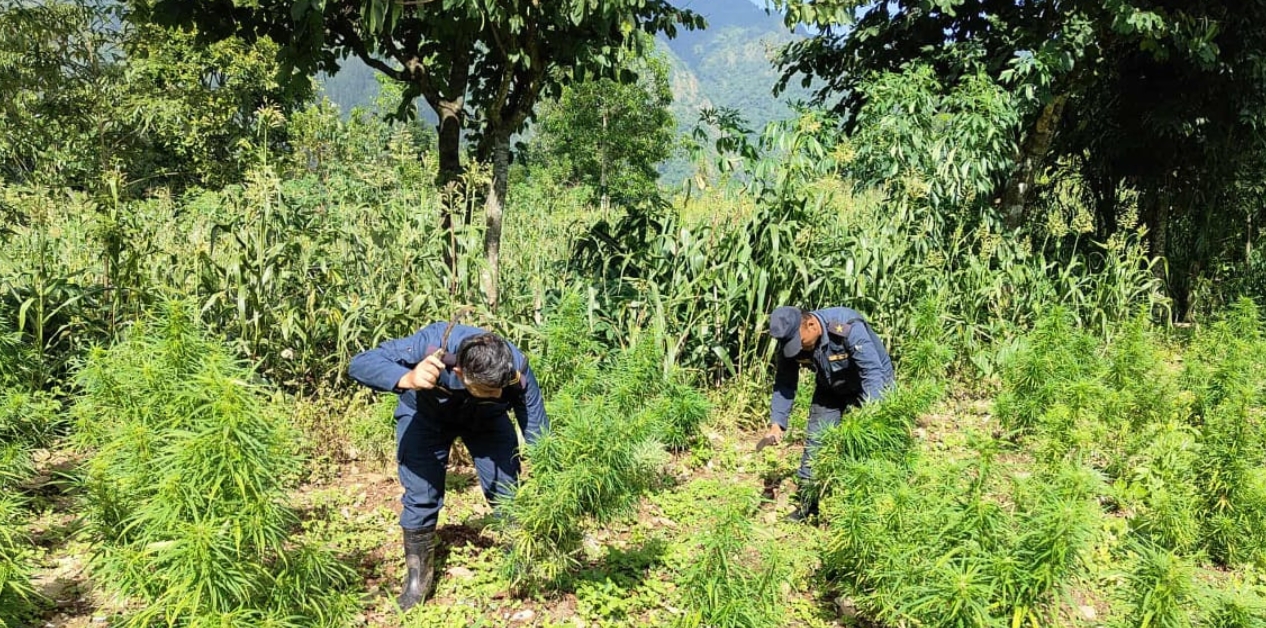
Nevertheless, the police have carried out extensive eradication drives against marijuana cultivation over the last four years. According to Nepal Police Spokesperson, DIG Abi Narayan Kafle, from the fiscal year 2022/23 up to May of the current fiscal year, police have destroyed marijuana cultivation across 7,612,435.45 square meters and 𝟔,𝟎𝟒𝟒,𝟏𝟎𝟐.𝟑𝟐 square meter of land. Central police data states that 6,749,817 marijuana plants were destroyed during these years.
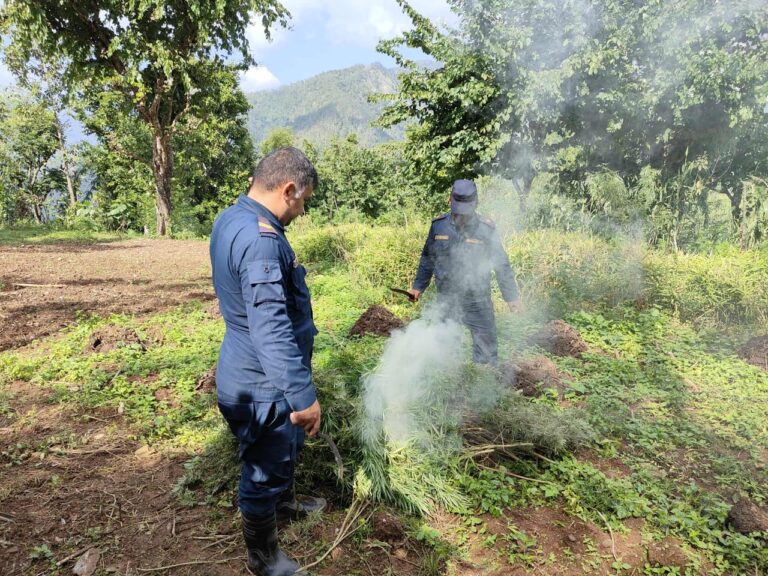
Police destroying marijuana cultivation in Dhankuta.
In June 2018, Canada’s Parliament passed legislation legalizing the non-medicinal use of marijuana. Following this, Western nations have fostered the perspective that marijuana should no longer remain prohibited due to its medicinal properties. As Western countries began advocating for lifting legal restrictions, prohibitions on marijuana were removed across Canada, Georgia, South Africa, Uruguay, and numerous states in the US. With this growing trend of lifting restrictions, the World Health Organization has also requested studies and recommendations on the matter.
However, Nepal’s hesitation to permit marijuana cultivation for commercial purposes stems from the fear that an increase in smuggling and associated criminal activities could trigger a catastrophic domestic situation. Former DIG Thakuri warns, “The smuggling of narcotics can invite other organized criminals into the country. While citizens would do the farming, politicians, police, and the administration could become entangled, creating a significant risk of institutional corruption.”