Kathmandu
Tuesday, July 21, 2026





The Pokhara waste processing project, envisioned as a modern, revenue-generating facility, has been stalled due to political interference, lack of transparency, and local opposition. Despite agreements and planning, unresolved disputes continue to delay its implementation.
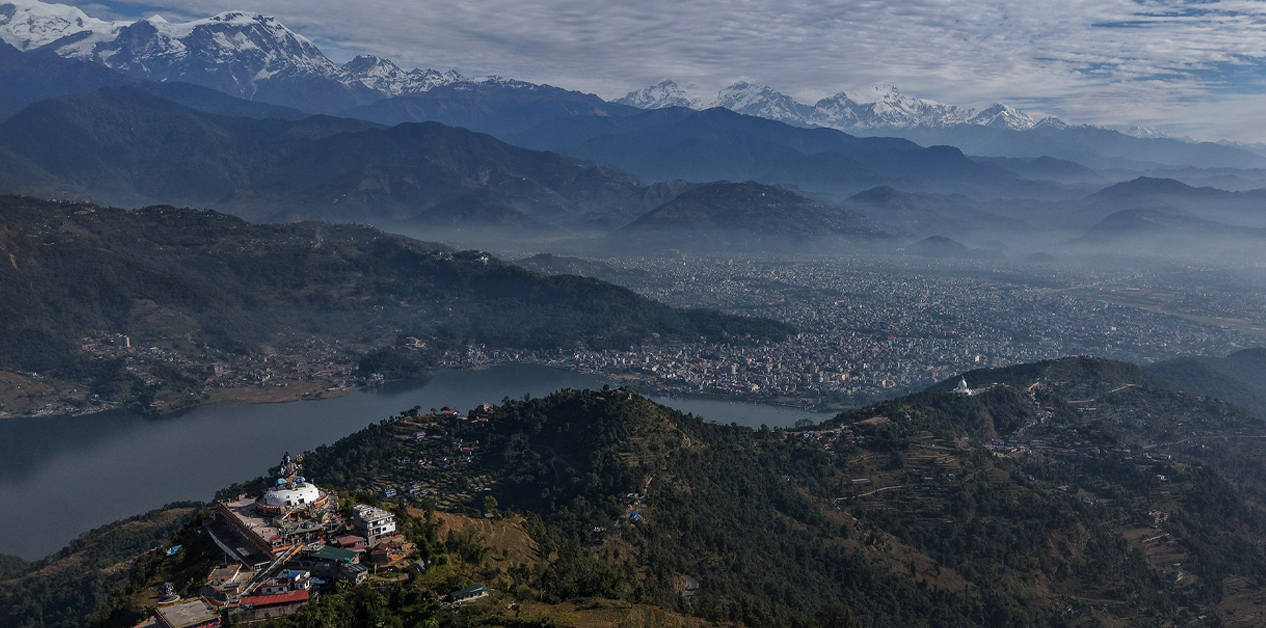
POKHARA: Although Pokhara Metropolitan City Mayor Dhana Raj Acharya succeeded in relocating the landfill site by clearing obstacles to the operation of the airport, he has failed to establish a waste processing plant.
Even before the official announcement of the election results, Acharya traveled to Kathmandu to meet then Finance Minister Janardan Sharma regarding Pokhara’s main problem. He requested budget allocation for relocating the landfill site, which was necessary to shift the landfill at Banchchhebaduwa for the operation of the airport.
After being elected mayor, the first executive meeting decided to conduct a study for landfill site construction. According to decision number 11 of the executive meeting held on June 9, 2022, it was stated that studies, land acquisition, and related work would be carried out for the construction of a landfill site.
The decision noted that to manage household, human waste, and biomedical waste generated within Pokhara Metropolitan City, the 55th executive meeting had decided to establish a sanitary landfill site at Tiurpata in Ward No. 33 (formerly Bharatpokhari VDC wards 5 and 6), and to proceed with land acquisition. It further directed the immediate implementation of a work plan including study, land acquisition, road infrastructure, and operational preparation.
However, despite the mayor’s commitments, the work of building a processing plant has not even begun. Instead, various controversies have emerged over the past three years. After deciding to build the plant, the metropolitan city froze 96 ropanis of land belonging to 17 landowners in Jhankrikhola of Ward No. 33.
On January 13, 2023, Rs 5.5 million was transferred from the metropolitan account to the personal bank account of Ward Chair Ram Chandra Adhikari as an advance for land management. After this became public, two differing views emerged: one group saw it as manipulation, while another perceived it as a dumping site project.
Two years after freezing the land, the metropolitan decided to award the construction and operation of the processing plant to Terasolve Renewable Pvt Ltd. However, despite attempts to move forward, obstacles persist. Due to these hurdles and political interference in waste management, the project has not progressed.
On November 18, 2025, the metropolitan signed an agreement with Terasolve to provide land within one month. Under the Public-Private Partnership (PPP) model, the metropolitan committed to providing at least 70 ropanis of land. The estimated project cost is Rs 800 million. However, after the agreement, the issue resurfaced, and residents of Ward No. 33 protested by surrounding the ward office. The metropolitan failed to provide land within the two-month deadline set for the company.
According to the agreement, the company must submit a detailed project report within 12 months and complete construction within 26 months. After 21 years of operation, the project must be handed over to the metropolitan along with the land. The company is also required to pay 3% royalty of its income. Despite aiming to generate revenue alongside waste management, the project has stalled due to opposition and disputes.
The metropolitan has been trying to move the project forward by holding all-party meetings to resolve the deadlock. Mayor Dhana Raj Acharya believes that although political parties express their support during meetings, the work still fails to progress. This has been the fate the metropolitan has faced in both temporary waste management and the construction of the processing plant.
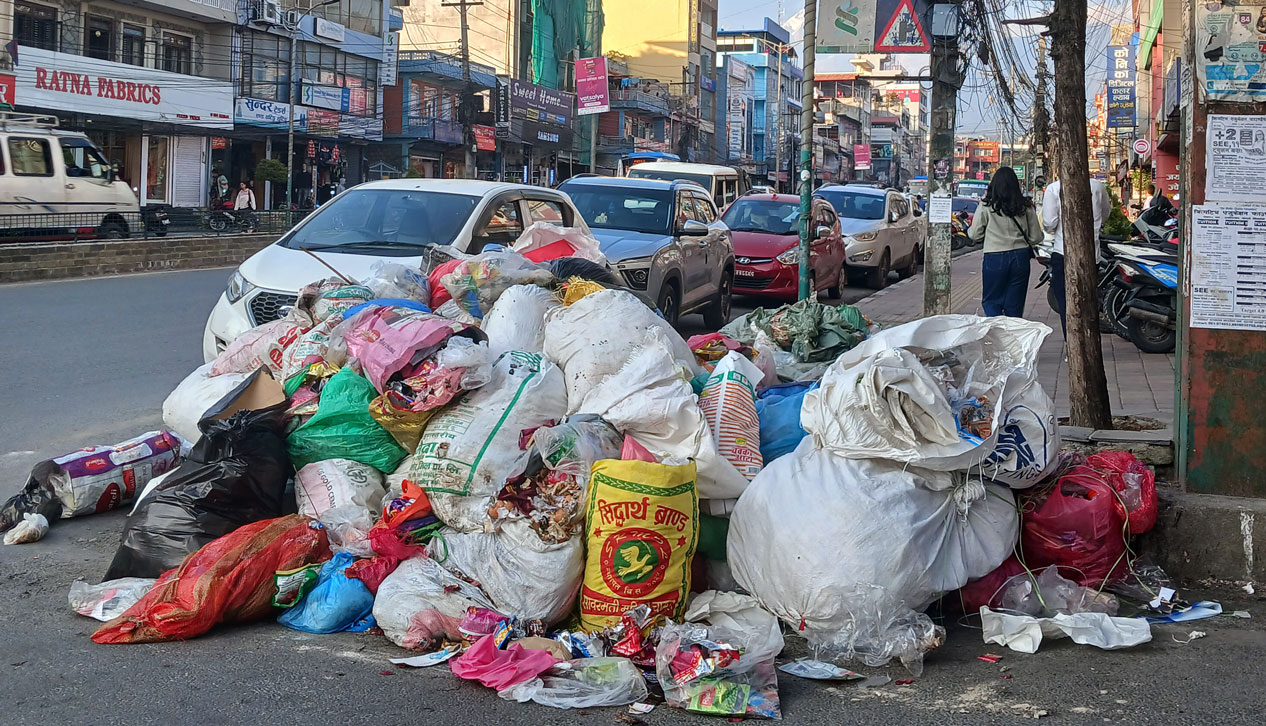
Garbage piled up in Pokhara metropolis. Photo: Rina Thapa
An all-party meeting held on March 23 also decided to support moving forward with the processing plant in Ward No. 33. Following that, the mayor appears more confident.
“I am confident that the work on the processing plant will move ahead. I am hopeful that the old pattern of temporary waste management will not be repeated,” Acharya told Nepal News. “Let us hope that doesn’t happen again. The distrust among political parties has existed for a long time and has been caused by such activities. Everyone must learn from this. Both new and old parties should stand by what they say and help facilitate the process.”
Despite his confidence, challenges remain. The land in Punditar, Ward No. 33, has been frozen for two years, but disputes persist. On January 9, 2026, locals protested in front of the ward office and even vandalized the ward chair’s vehicle. The land issue must still be resolved. The mayor claims the project could be completed within a year if these problems are addressed.
According to Acharya, if the European-technology-based company fulfills its responsibilities, it would become Nepal’s first processing plant of its kind. However, even if political coordination is achieved, convincing local residents remains a challenge, as many misunderstand the project.
“If we can work smoothly, the project can be completed within a year. People think it is a dumping site, but it is actually an industry,” Acharya said.
What is a processing plant like?
The metropolitan mayor has repeatedly said, “I will build a processing plant worth buying a ticket to see.” However, locals are not well informed about what such a tourist-attracting processing plant actually is.
According to Netra Timilsina, the focal person for public–private partnership, biogas will be produced from the processing plant. The plant will generate biogas and fertilizer from organic waste.
According to him, 70 percent of the waste produced in Pokhara is biodegradable. If managed properly, it can be turned into fertilizer. Additionally, the metropolitan has a plan to upcycle the remaining 10 to 15 percent of waste.
If the processing plant functions as envisioned by the metropolitan, Pokhara would achieve success in waste management. However, due to misunderstandings among locals and lack of cooperation from political parties, the work has not progressed. Residents believe that if waste management starts in their ward, it will cause foul odor or destroy open spaces.
Timilsina says that the processing plant will not operate in an open space as residents assume.
“It will not be open; it will be closed, built with sheds, and designed in a way that will not significantly affect others. If people want to understand, we can explain it to them; if they don’t want to understand, we cannot make them understand. Open dumping and closed processing are completely different,” he says.
Mayor Acharya says the plant will produce cooking gas. To study waste management, a team from Pokhara Metropolitan visited Hetauda and India. After studying a company in Indore, India, that produces biogas from waste, the mayor believes it is possible in Pokhara.
The plant referred to by the mayor is the Gobardhan Biogas Plant operating in Indore. It is run by the Indore Municipal Corporation in partnership with a public company. The municipality supplies city waste to the partner company, generating revenue. The company also sells the produced gas at a low price, benefiting consumers.
The gas produced from this plant is being used to operate vehicles. This reduces the use of petroleum fuels and promotes environmentally friendly transportation. The processing plant planned for Pokhara is based on this same model.
Ward No. 33 Chair Ram Chandra Adhikari believes that the long process created space for negative narratives. “The pre-project procedures took time, which created an environment for negative things to emerge,” he says.
He believes there would have been no opposition if all political parties had cooperated.
“If all parties had supported it politically, this situation wouldn’t have arisen. Everyone in the community is affiliated with some party. This is an industry, not a dumping site. If all parties had gone to the people along with their cadres and explained this, the situation would not have reached this point,” he says.
“The metropolitan did not work transparently in the land acquisition process. Locals protested. The mayor failed to seek cooperation. Instead of properly explaining the project, he approached through land brokers. That is where the dispute seems to have started,”
The proposed site for the processing plant lies a short distance from the ward chair’s home. He says he gathered locals and informed them about the project once it was planned near his residence. He also claims to have taken locals on a study visit to Dharan to address their concerns. After coordination with locals, the executive moved forward with the process. Later, the executive decided and wrote to the Government of Nepal to freeze the land. However, he says problems arose during implementation due to vested interests and retaliation.
“It is also about revenge and blaming others. In my understanding, some elements do not want to see Pokhara succeed,” the ward chair says. He adds that he even requested in an executive meeting to look for alternative locations for the processing plant.
“I have become somewhat exhausted due to attacks from all sides. I even requested in the last meeting that since such a large community has not understood it, we should look for another location to establish it as an industry,” he says.
What do the locals say?
Local residents, however, have a different opinion. Resident Amod Thapa believes the problem arose due to the metropolitan’s lack of transparency. “The metropolitan did not work transparently in the land acquisition process. Locals protested. The mayor failed to seek cooperation. Instead of properly explaining the project, he approached through land brokers. That is where the dispute seems to have started,” he says.
He adds that the issue worsened after money was transferred to the ward chair’s personal account.
Deepak Lamichhane agrees: “We see a weakness in the metropolitan regarding the transfer of Rs 5.5 million to the ward chair’s account two years ago. The process of paying advance to landowners and freezing land was started internally,” he says.
He also accuses the metropolitan of failing to explain the nature of the processing plant to locals.
Ajay Thapa, a resident of Pokhara-33, suspects political manipulation: “The mayor we elected is our own, but we cannot live with foul smell. It’s all a game of commissions. This is not a processing plant; it is a landfill. We oppose it. Political maneuvering is going on,” he says.