Kathmandu
Monday, July 20, 2026





In "Soccer in Sun and Shadow," Eduardo Galeano explores football as history, poetry, politics and passion—revealing a game shaped as much by culture, power and memory as by goals and trophies.
KATHMANDU: The masterpiece Soccer in Sun and Shadow by the acclaimed Uruguayan writer Eduardo Galeano (1940–2015) is a grand epic of football. He painstakingly examines the sport’s most intricate and microscopic dimensions, parsing its journey from ancient history to the contemporary era. The book also encapsulates the distant past of football—a time when it was neither called football nor was it even round. Through the book’s brief, elegant chapters, one hears the passionate voice of a hopeless romantic at one moment, and the razor-sharp wit of a biting satirist the next. Galeano voices a fierce objection to how profiteers are systematically stripping the sport of its inherent beauty.
Originally published in Spanish in 1997, the book was translated into English by Mark Fried in 2013. Presented below are selected excerpts from the English edition:
The Referee
In Spanish, he is called the árbitro. The very name reeks of arbitrariness! The referee is an abominable dictator who wields his tyranny without restraint. Exhibiting theatrical grandiosity, he is the arrogant executioner who exercises absolute power. When he blows the whistle clamped between his lips, he unleashes a ruthless storm that decides the fate of a goal—validating one, obliterating another. With the cards held in his hands, he displays the colors of doom: yellow to penalize the guilty and force penance, and red to cast them into exile.
The linesmen are merely accomplices. They hold no real dominion; they simply watch from the margins. The moment he steps onto the pitch, confronting a roaring crowd engulfed in thunderous clamor, the referee prays to God—a plea that is entirely justified. His very job description is to make himself an object of universal scorn. If there is a single truly global sentiment in football, it is that everyone detests the referee. He never receives praise; he is showered only with curses, grievances, and condemnation.
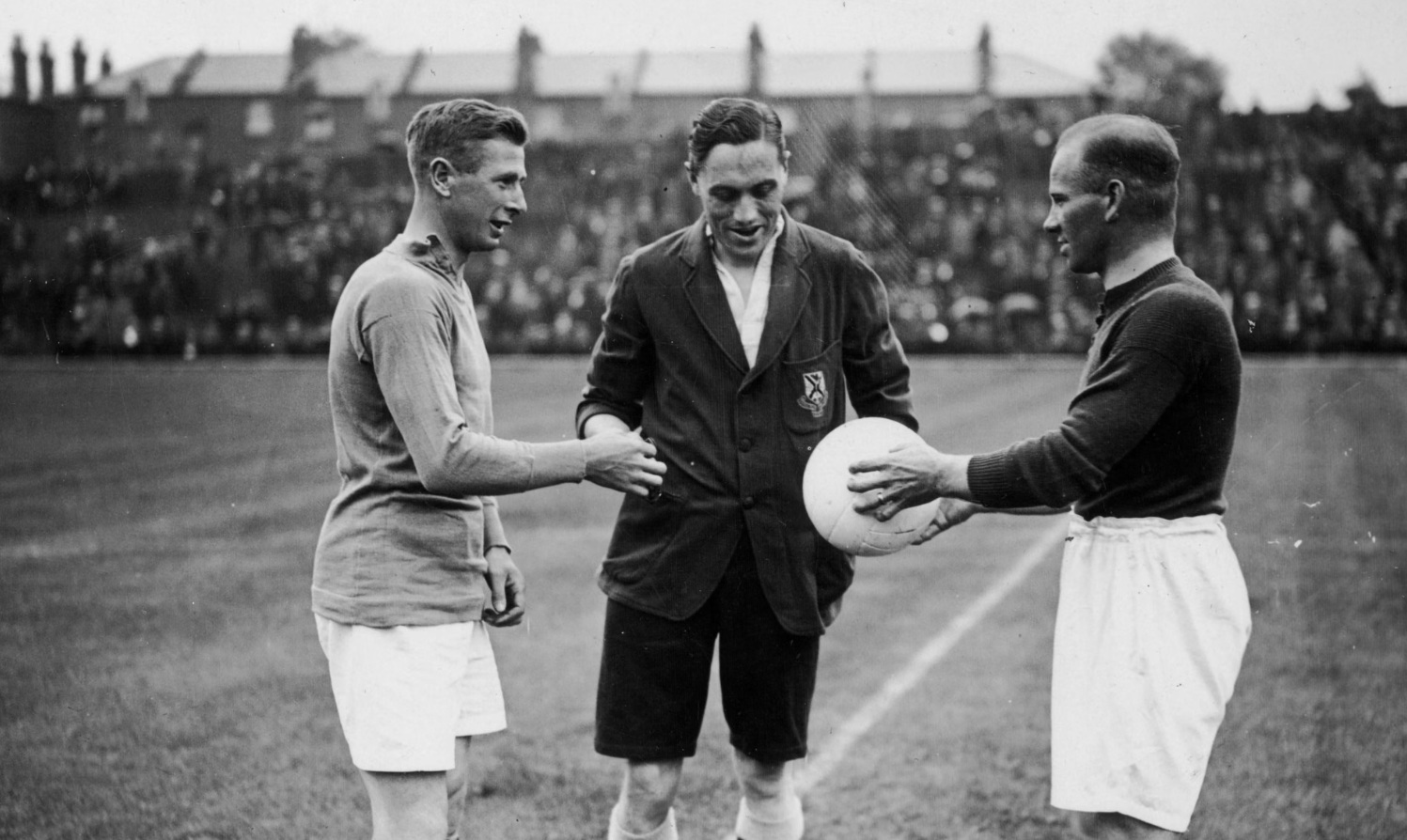
Arsenal FC players Kennedy and Blyth before a pre-season match between the first and second teams at Highbury on August 13, 1927. The match tested a white ball as an alternative to the traditional brown leather ball. Photo: Edward G. Malindine/Getty Images
Who else runs as much as he does? His heavy panting echoes in the ears of all twenty-two players. This intruder is condemned to run without a single moment of respite throughout the entire match. He gallops like a horse, straining his spine. And what does he get for all this torture? Nothing. Instead, the crowd shrieks, wishing for his utter ruin. From the opening whistle to the final seconds, he chases the ball, sweating oceans. Yet, the ball dances exclusively at the feet of others—now with this player, now with that one. Naturally, he longs to play too, but that is a privilege he will never taste. If by some rare misfortune the ball strikes his body, the entire stadium erupts, hurling vile insults at his mother. Despite all this, he remains ready to endure humiliation, mockery, slander, and even flying stones. For what? Simply to be present on that sacred green pasture where the ball floats, flies, and converses with the wind.
Occasionally, his decision aligns with the desires and biases of the fans. Yet, even then, he is neither safe nor absolved. The losers hold him entirely responsible for their defeat, while the victors believe they won despite his constant meddling. He bears the cross for every blunder; he is the root cause of every misfortune. If he did not exist, the fans would have to invent him. Thank heavens he is there! The more football lovers despise him, the more they realize they cannot do without him. For over a century, the referee clothed himself in black—a perpetual state of mourning. Mourning for whom? For himself. Nowadays, to mask his inner agony and sorrow, he decks himself out in bright, flamboyant colors.
The ball
Long ago, the Chinese played with a leather ball stuffed with hemp fiber. During the era of the Pharaohs, the Egyptians stuffed straw, reeds, or husks into colorful cloth bags to make balls. The Greeks and Romans, however, utilized a bull’s bladder—inflated, stitched up, and presto, the ball was ready! Europeans of the Middle Ages and the subsequent Renaissance played with oval-shaped balls stuffed with horsehair. Meanwhile, in America, the rubber ball was born—a marvelous thing that bounced miraculously. Chroniclers of the Spanish court narrated a legendary tale about it: the conquistador Hernán Cortés bounced a Mexican rubber ball before Emperor Charles. It struck the ground and soared so incredibly high that the Emperor was left staring in utter disbelief.
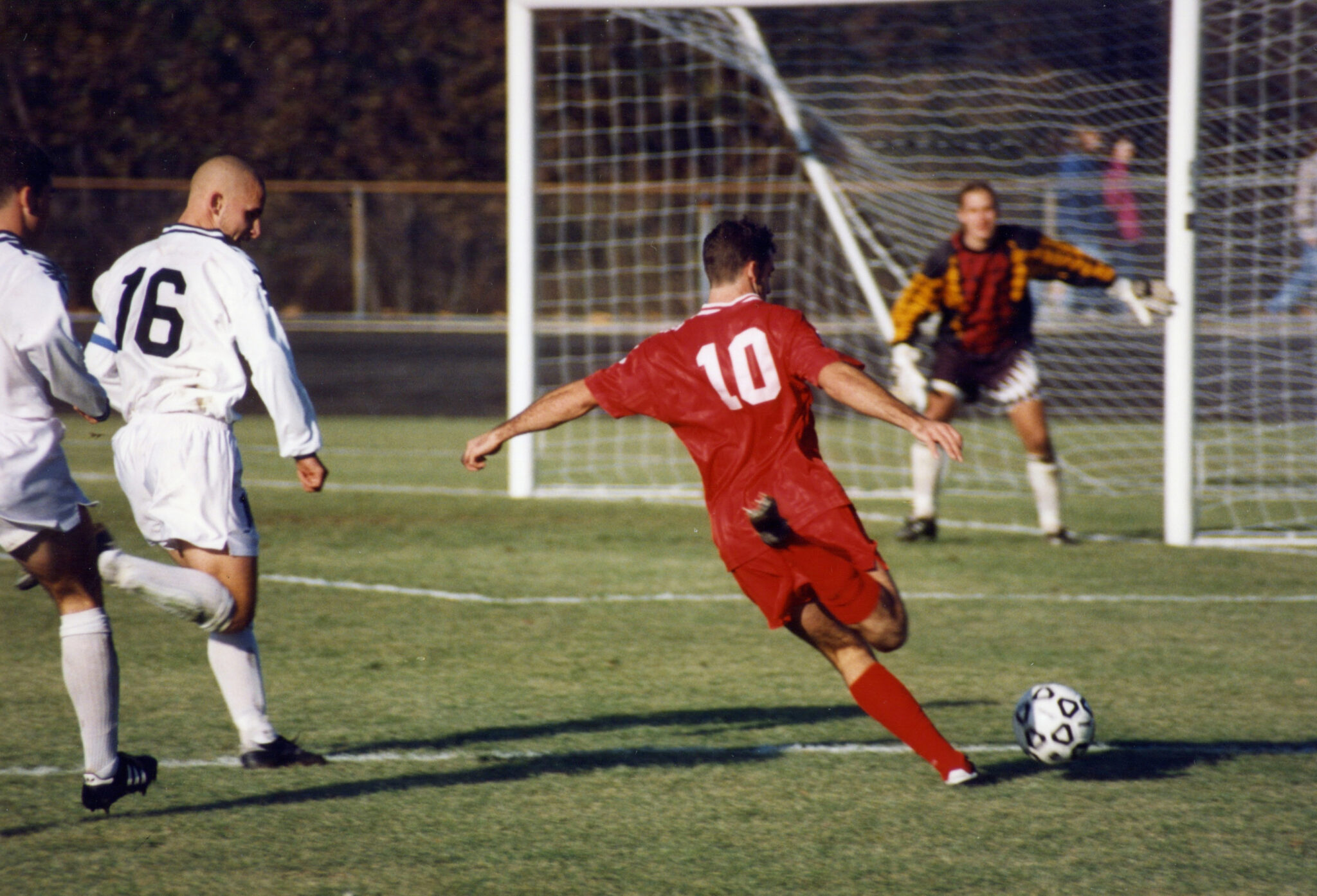
Indiana Hoosiers player Chris Klein (in red jersey) passes or shoots at the goal during a match in Bloomington, Indiana. Photo: Wikipedia
The modern ball—conceived by inflating a rubber bladder and encasing it in leather—was born in the mid-nineteenth century. A salute to the genius of Charles Goodyear, an American from Connecticut! Much later, three Argentines from Córdoba—Tosolini, Valbonesi, and Polo—emancipated the ball from laces and outer threads. They invented a bladder equipped with a valve that could be inflated with a pump. It was thanks to these three visionaries that, from the 1938 World Cup onward, players could confidently head the ball without fear. Previously, the heavy laces used to stitch the ball together used to cause nasty head wounds and gashes.
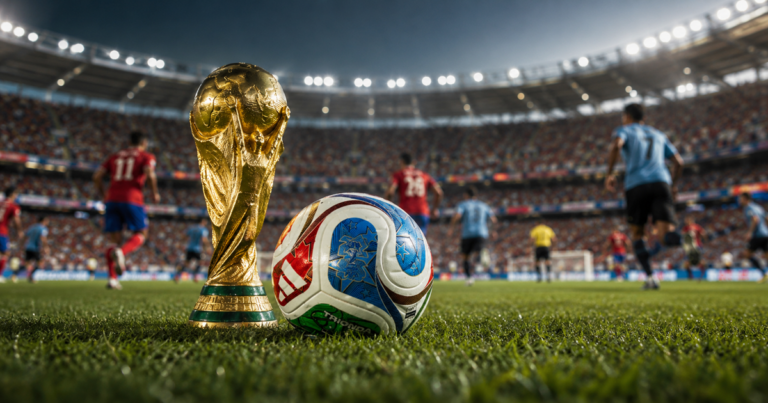
Until the mid-twentieth century, the football was brown. Then it became white, and later, black patches on a white background. Today, it has become a multi-colored spectacle. Wrapped in a polyurethane attire, it presents itself with a sixty-centimeter waistline. Compared to the heavy leather balls of the past, it is incredibly light, weighing barely four hundred and fifty grams. Water cannot affect it; in the old days, a downpour would render a leather ball completely unmovable. Today’s ball, by contrast, travels at a vastly superior velocity.
People have given it countless names based on its appearance, design, and speed. In some places, they even call it a cannonball. In Brazil, no one harbors the slightest doubt that the football is female. That is why Brazilians address her as “the fat one,” “the little one,” “the sweetheart,” or “the beauty,” bestowing upon her names like Maricota, Leonor, or Margarita.
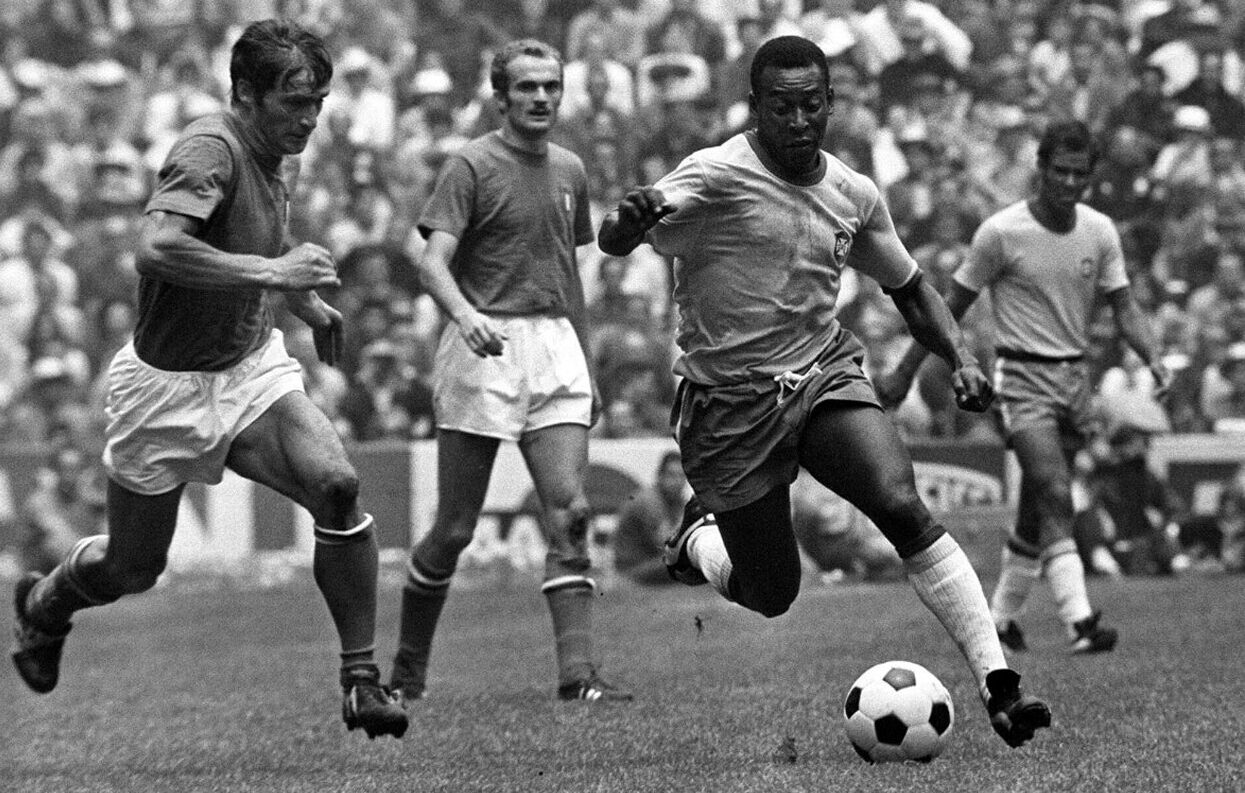
When Pelé scored his thousandth goal at the Maracanã Stadium, he kissed her. The Argentine maestro Di Stéfano erected a monument of a bronze ball right in front of his house. On the plaque beneath it, he inscribed: “Thank you, my dear!”
She is loyal. She is faithful. During the final match of the 1930 World Cup, Argentina and Uruguay both stubbornly insisted on playing with their own respective balls. The referee, possessing the Solomonic wisdom of a sage, decided that the first half would be played with the Argentine ball and the second half with the Uruguayan one. Argentina won the first half, and Uruguay won the second. That is why they say she is loyal. Yet, she can turn fickle in the blink of an eye. She can stubbornly refuse to enter the goalposts. For on her trajectory toward the goal—say, in mid-flight—she might change her mind and veer elsewhere.
As you can see, she requires no grand excuse to get offended. She cannot tolerate kicks and strikes delivered out of malice or spite. Instead, she yearns for a tender touch, a gentle caress, and a kiss. All she demands is for someone to gently cradle her and let her rest against their chest or foot; that is the extent of her stubborn whim. She is proud—you might even call her vain. And it is easy to understand why. She knows her own power all too well. When she sways gracefully and beautifully, countless hearts swell with pure ecstasy. But when she lands clumsily and awkwardly, a million hearts shatter into pieces.
The theater
How many miniature theaters must reside within the grand theater of football? How many stages can fit inside that rectangular green lawn? Not all players play solely with their feet; some have mastered the dark art of inflicting torture on others. Such a player might don the mask of a saint who wouldn’t even harm an ant, yet his true deeds remain unspeakable. A maestro of the art of injury, he spits at his opponent, hurls vulgar obscenities, and shows utter disrespect. He employs every underhanded trick in the book. Shoving is merely routine; he plants a sharp elbow directly into the opponent’s jaw, and if that isn’t enough, drives another into the ribs. He yanks at hair and jerseys. If the opponent is standing, he stamps on their feet; if they are down, he stomps on their hands. He orchestrates all these antics right behind the referee’s back. As for the linesmen, he dupes them effortlessly—after all, when are they ever free from staring at the clouds in the sky?

Eduardo Galeano.
Then there are those who are experts in the art of exploitation. A player of this character puts on the mask of a helpless, naive fool, but is entirely cunning. The sheer cleverness he displays while taking penalties, free-kicks, and throw-ins is quite a sight to behold. He invariably steals a few extra paces from the spot designated by the referee. When the opposing team gets a free-kick and he must stand in the defensive wall, he edges forward without seemingly lifting his feet, arriving at the exact spot that obstructs the player preparing to strike the ball. He executes this maneuver so smoothly, it is as though a magic carpet carried him there.
The theater of football also boasts certain artists who are peerless in the art of wasting time. A master of killing time, this particular actor dons the mask of a martyr freshly hoisted onto the gallows. He writhes in agonizing pain, rolling across the pitch. Clutching his knee or head, he puts on a masterclass in faking an injury. He lies face down on the grass. One minute, two minutes, three minutes tick away. Then enters the heavy-set masseur with the holy hands. He comes “running” at a snail’s pace, panting heavily, a towel slung over his shoulder. A pungent odor of ointment radiates from his body. In one hand he holds a flask, and in the other, a miraculous remedy. Hours seem to pass, years seem to roll by alongside the fallen martyr on the field… Finally, the referee orders the corpse to be carried off the pitch. And suddenly, the player springs up from the stretcher with absolute vitality. Thus, the miracle of resurrection unfolds.
The British incursion
In Buenos Aires, the capital of Argentina, on an open lot right in front of a lunatic asylum, ten or twelve blonde boys were kicking a round object, hurtling it back and forth. Watching this spectacle intently from a distance were a man and his young son.
“Who are they, Papa?” the boy inquired.
“Who else, my son? The madmen,” the father replied, “the crazy Englishmen.”
This is a childhood memory of the Argentine journalist Juan José de Soiza Reilly. On the River Plate, football initially looked like a game reserved for the mad and eccentric. As the Empire expanded, the sport became a British export. Alongside Manchester textiles, railways, commercial loans, and the doctrines of free trade, the British exported football. And so, it arrived at the feet of sailors. Queen Victoria’s ships would dock at the ports of Buenos Aires and Montevideo, the capital of Uruguay. Laborers unloaded blankets, leather shoes, and flour from the vessels, only to load them back up with wool, hides, and wheat. After all, the other side of the world needed to consume more blankets, shoes, and flour. While the laborers loaded and unloaded cargo, the sailors passed their time playing football on the docks.
The English established the first local football clubs in Uruguay and Argentina. Diplomats, railway executives, and gas company bosses formed the club membership. In 1889, the English of Montevideo and Buenos Aires organized Uruguay’s first international football match. A colossal portrait of Queen Victoria hung over the stadium, her eyes looking down with an expression of aristocratic disdain. A similar portrait of the Queen of the Seas watched over the first Brazilian football match in 1895, played between the British subjects of the gas company and the São Paulo Railway.
In old photographs, these pioneers appear in sepia tones. They were warriors trained for battle, their bodies clad in armor of cotton and wool. There was a reason for this. The spectators included high-society ladies shading themselves under silk parasols and waving lace handkerchiefs. Out of respect for their modesty, players had to cover themselves from head to toe. Only their faces were visible, frozen in solemn gravity, with heavily waxed, curled mustaches peeking out from beneath their hats. They played with their feet crammed into heavy, formidable boots manufactured by the Mansfield Company.
The contagion of football did not take long to spread. The native elite lost no time in picking up that peculiar English game. They ordered their football jerseys, boots, thick socks, and trousers directly from London. The trousers were so high they started at the chest and extended well below the knees. The ball had finally ceased to bewilder customs officials, who initially had no inkling as to what species of goods it belonged to. Along the distant shores of South America, ships also brought rulebooks of the game. Along with them arrived words destined to endure for generations: field, score, goal, goalkeeper, back, half, forward, out ball, penalty, offside.
According to the first football rulebook distributed in the River Plate, a “foul” decreed by the “referee” could be forgiven by the injured or aggrieved player, under one sole condition: “The offending player must offer a sincere apology, and the apology must be delivered in proper, elegant English.”
Meanwhile, in the vernacular of the Latin American countries around the Caribbean, entirely different English words were infiltrating the vocabulary: pitcher, catcher, innings. Under the sphere of influence of the United States, these nations learned to strike a white ball with a round wooden bat. The American marines who arrived to impose imperial hegemony carried bats slung over their shoulders alongside their rifles. What football is to us South Americans, baseball became to the people of the Caribbean.
Camus
In 1930, Albert Camus was the Saint Peter of the Algiers University football team. Peter was the guardian of heaven’s pearly gates; Camus was the goalkeeper. He had occupied this role since childhood, primarily because the goalkeeper didn’t have to run much. The marvelous advantage of this was that his shoes wouldn’t wear out quickly. Born into an impoverished household, Camus could hardly afford the luxury of sprinting frantically across the pitch. Every evening, his grandmother would inspect the soles of his shoes. If she spotted even the slightest crack, Camus’s back would pay a painful price.

Albert Camus.
The years spent guarding the goalposts taught Camus a great deal. “I learned that the ball never comes from the direction you expect it to,” he once remarked. “This lesson helped me immensely in life, particularly in understanding people in big cities. They are seldom who they claim to be.”
He learned another profound truth: to win without assuming he was God, and to lose without feeling worthless. This is no easy skill to acquire. Camus learned to unravel the mysteries of the human soul. A little later, perhaps largely due to this very football background, he was able to navigate and explore the labyrinth of human existence through the perilous journey of words and pages.