Kathmandu
Sunday, June 14, 2026





What appears to be pure entertainment unfolds as a sharp portrayal of Nepal’s political direction and its growing culture of populism
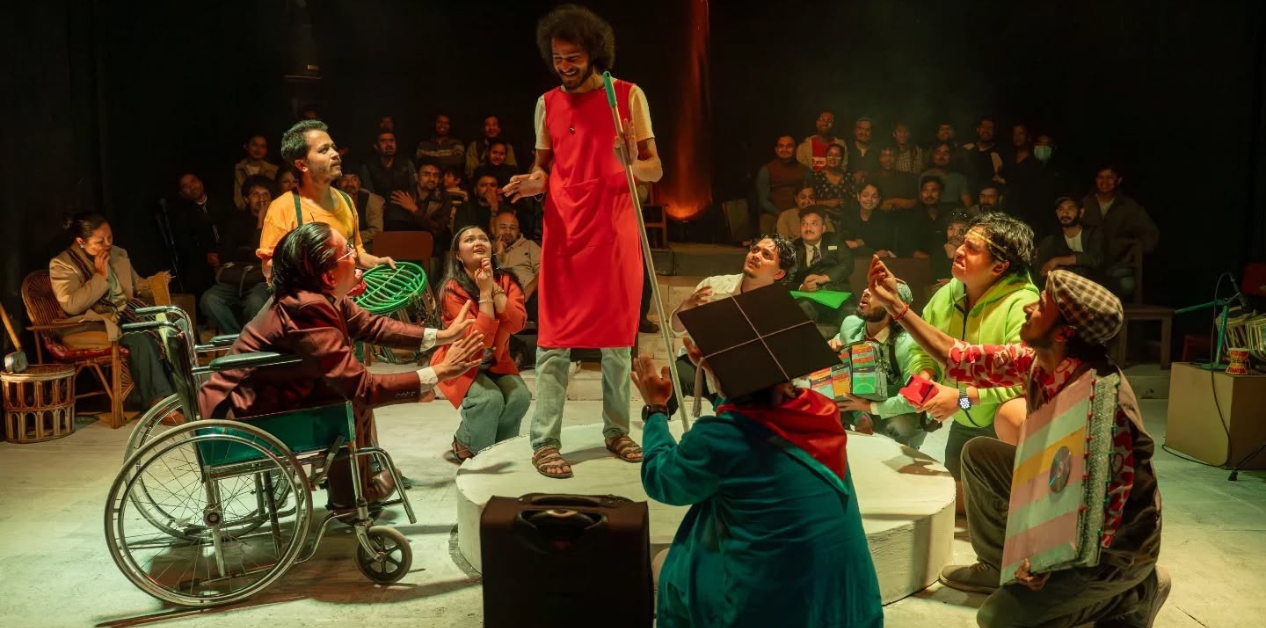
KATHMANDU: A grand musical spectacle, ‘Osan Das Ko Concert,’ meaning ‘Osan Das’s Concert,’ unfolds before a restless crowd. The audience waits, almost reverently, for their elusive star, Osan Das. Whispers ripple through the venue that he is not one to appear easily, that his arrival is part of the mystique.
In the lull before the show, the crowd reveals itself as something more than a gathering of fans. Some weave through the audience pitching insurance plans; others scan faces in search of a potential spouse. Even here, anticipation is transactional. The concert is not just entertainment; it is opportunity.
The fans themselves mirror a fractured society. They range from a student, fresh from a university convocation and bound for the Gulf, to a scientist with a mind fixed on preservation and profit. The student reveres Osan Das as a patriotic singer, clutching onto one song even as he prepares to leave the country behind for foreign employment. A couple, their relationship fraying, turns to him for emotional repair, believing his poignant melodies might restore what is slipping away. Others project their own meanings onto him, rockstar, classical purist, or something in between. No one, it seems, truly knows who Osan Das is.

Photo courtesy: Photo: Mandala Theatre/Facebook
This ambiguity sits at the heart of Atiranjan ko Manoranjan, meaning ‘Entertainment of Exaggeration,’ now staged at the Mandala Theatre. Running since April 1, the play presents itself as light, even apolitical. Yet beneath its theatrical surface lies a sharp reflection of a nation shaped by populism. In Osan Das, the narrative finds its emblem: a figure molded overnight into hero or villain by a society eager for both.
Known variously as O’Das or OSD, his presence electrifies the hall. When he finally appears, the audience surges with excitement. However, the performance unexpectedly shifts. Mid-song, Osan Das collapses on stage. For a brief moment, there is chaos.
Then, just as quickly, calm returns. And with it, an unsettling shift. The content creator in the crowd seizes the moment, turning collapse into viral currency. The scientist finds satisfaction in having archived the star’s work for future gain. Those tasked with his security quietly claim his valuables. A sponsor sees branding potential even in death, placing a cement company banner over his body. Around them, a strange consensus forms. Tragedy has become utility. They are ready, almost eagerly, to commemorate his death.
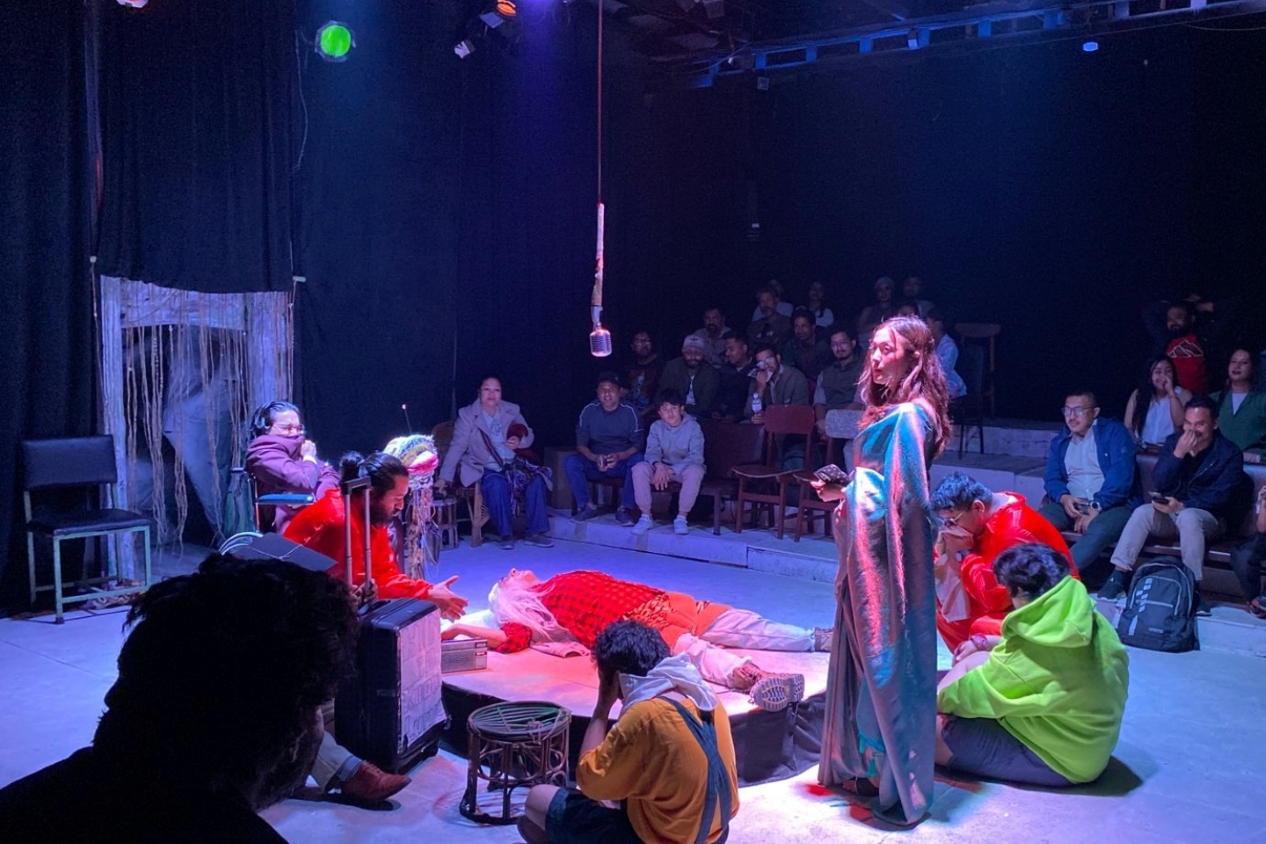
Photo: Gopal Dahal
But the story refuses to end there. By the next morning, Osan Das awakens. Alive. Watching. Understanding.
From this vantage, he begins to see clearly the machinery that built him and the hunger that sustains it. The same hands that elevated him now reach, just as urgently, to extract from him. It is a realization that extends beyond the stage. In contemporary Nepal, the play suggests, figures are manufactured, celebrated, and consumed with similar intensity.
Without ever naming politics or leaders outright, Atiranjan ko Manoranjan delivers a precise and piercing satire. It exposes not just the making of a star but the fragile, often opportunistic ecosystem that surrounds one.
The illusion of divinity does not hold for long. Osan Das, once elevated to near-mythic status by his audience, begins to unravel under the weight of his own making. Lacking true originality, he has risen on borrowed brilliance, others’ words, melodies, and instrumentation, yet carries himself with the certainty that anything he does will succeed. It is this unchecked confidence that defines his rule, even as he sidelines the very collaborators who helped build him, refusing to share the stage with his own talented bandmates.
The rupture comes swiftly. His colleagues push back, exposing the carefully constructed façade. Their rebellion forces Osan Das into an abrupt confrontation with himself. What follows is as symbolic as it is unsettling. One by one, he strips away his clothes, shedding not just fabric but illusion, authority, and identity. In that stark moment, he turns his gaze outward, offering a biting satire of a society eager to crown figures like him as heroes. And then, as if consumed by the very emptiness he represents, he disappears into the void of a ‘black hole,’ the concert stage collapsing into a swirling vortex of absence.
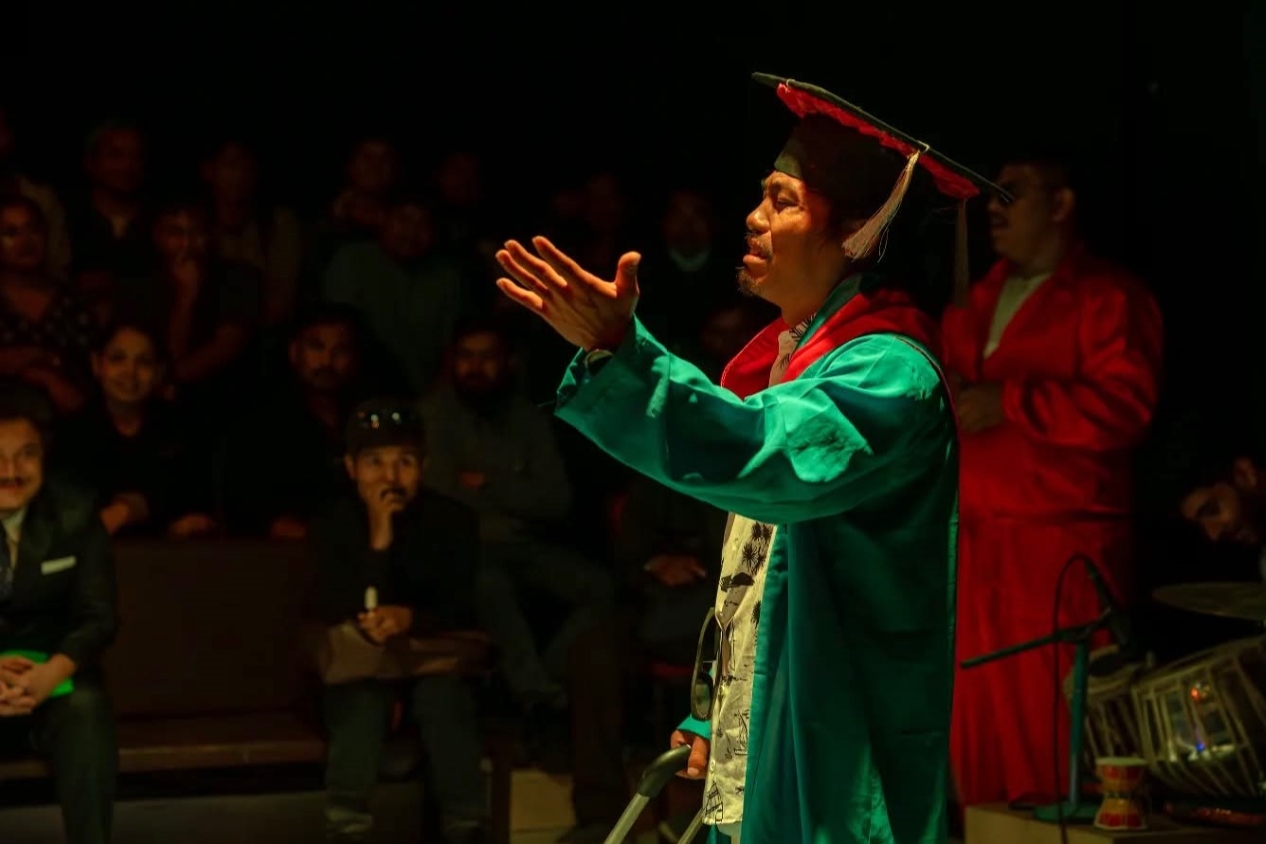
Photo courtesy: Photo: Mandala Theatre/Facebook
At the center of this demanding role is Som Nath Khanal, whose performance anchors Atiranjan ko Manoranjan. After years of intermittent appearances in street theater and smaller productions, he delivers a compelling return following a six-year gap since the acclaimed Mahabhoj. Around him, a large ensemble sustains the play’s energy, including Sandeep Shrestha, Swapnil Ghimire, Roshan Adhikari, Yasoda Gurung, Sanam Shrestha, Chakra Bista, Rijan Thing Lama, Indra Bahadur Rai, Samir Bhattarai, Amrit Sunar, Roshan Murmu, Bhaskar Budha, Susmita Karki, Sayujya Bhandari, Tarun Deuba, Mridul Krishna, Saurav Chalise, and Nimish. Though many belong to a younger generation of performers, the collective delivery remains assured and engaging.
Penned by Samyog Guragain and directed by Sagar Khati Kami, the play embraces an experimental form that blurs the line between performer and spectator. The moment audiences step into the theater, they are no longer passive viewers but participants, transformed into attendees of the ‘Osan Das Ko Concert.’ It is an immersive device that deepens the play’s central critique.
Sagar Khati Kami, known for earlier works like Khopadibhitraka Manchhchheru and Ticket to Hollywood, uses this production to quietly but effectively gesture toward the direction of the country’s politics. Through music, performance, and spectacle, he constructs a narrative that reflects a broader political landscape, one shaped by projection, performance, and public appetite.
Atiranjan ko Manoranjan continues its run with evening shows at 5:30 PM through April 26, alongside a special Saturday matinee at 1:30 PM, according to the organizers.