Kathmandu
Saturday, June 20, 2026





The leap from analog to digital in music is not just a matter of technology. In fact, it is a human, or rather, a spiritual deviation.

KATHMANDU: The song “Himalako Kakhma Chha Sano Mero Gaun, Parbataki Chhori Hun Ma Parvati Ho Naun” (In the Himalayas rests my village, small and fair, I’m a mountain maiden, Parvati is the name I bear)—with words by Kiran Kharel, music by Shiva Shankar, and the voice of Tara Devi—is currently trending. Recorded during an era meant for listening, people today do not just hum this song; they visualize it and post it on various social media platforms. When gripped by the nostalgia of old days, they dive deep into old music. They hover in the sky of cinematic imagination. The rural attire, the black-and-white screen, and the expressions are a nostalgia of the past, which has been tied into a thread by music. Music has refreshed the collective memory of the past.
It feels as though there is nothing greater for humans as a second nostalgia than music. The moment one remembers a tune played on the radio, one goes wandering into the world of the past. In my childhood, there was no other object as enchanting as the radio. Radio, meaning ‘Radio Nepal’, was the natural, alternative-less musical courtyard available during the partyless regime, much like saying “Cold means Coca-Cola”. It wasn’t that other radio stations wouldn’t play on the radio set, but Radio Nepal possessed a sense of belonging; there was bliss.
That was a time when a person walking in a hurry would stop dead in their tracks right on the path just to listen to a song playing on the radio. That was not the era of YouTube and Spotify, where one can listen to desired music whenever one wants. The radio was such a supernatural machine that it made one blissful, thrilled, delighted, and moved.
In that era before the invention of the digital watch, a wristwatch used to be an indicator of prosperity. For those who did not have the good fortune of binding a watch to their wrist, two methods were in practice to find out the time: either looking at the position of the Sun God in the sky or listening to the radio. The time for news was fixed, as was the time for religious or literary programs, children’s programs, or requested songs. In a country where the government changes every year and the constitution changes every decade, the timings of these programs never changed unless people changed the radio set itself.
Today, it is not just the radio set that has changed; the very method of listening to music has completely transformed. Music has now become a thing to be seen rather than just heard, just as news nowadays is watched rather than listened to. A radio that used to weigh approximately 5.5 pounds can now be listened to on an app taking up space as small as the tip of a needle.
The era of having to travel to Bombay or Calcutta for recording songs ended decades ago. Now, that recording has reached every house via the radio studio.
Recording has become a game of software rather than instrumentation and singing. Whatever kind of music is required, the computer fills it in on its own. If the voice cracks or the breath falls short, autotune sews or stretches it out. The capability or the illusion of AI is beyond words. To test whether a voice is authentic or artificial, another software has become necessary.
The leap from analog to digital in music is not just a matter of technology. In fact, it is a human, or rather, a spiritual deviation. The musical creators I have read about, met, and associated with were and are in the nostalgia of analog. In 2010, while making a documentary on Nepal-born talents (not of Nepali linguistic origin) who had earned a name in Bombay’s art sector, I found many in the nostalgia of the analog era.
Breaker: A hit song is a history in itself. And it is natural to have nostalgia with history.
Manohari Singh, regarded as the synonym for the saxophone in India and the chief arranger for composer Rahul Dev (RD) Burman, was overwhelmed by the nostalgia of analog during the final days of his life. Manohari, who dedicated his entire life to film music, had become detached from film music by the time of my interview. He preferred playing the saxophone, flute, and clarinet in stage shows rather than scoring music for films. The main reason for his detachment was the track system of digital recording. That meant reaching the studio and recording one’s portion of music completely alone.
Since the rise of the digital system, a song is prepared only after the recording engineer and arranger mix the tunes played individually by each instrumentalist. The digital system has made recording easy, but it has increased the physical as well as emotional distance between people.
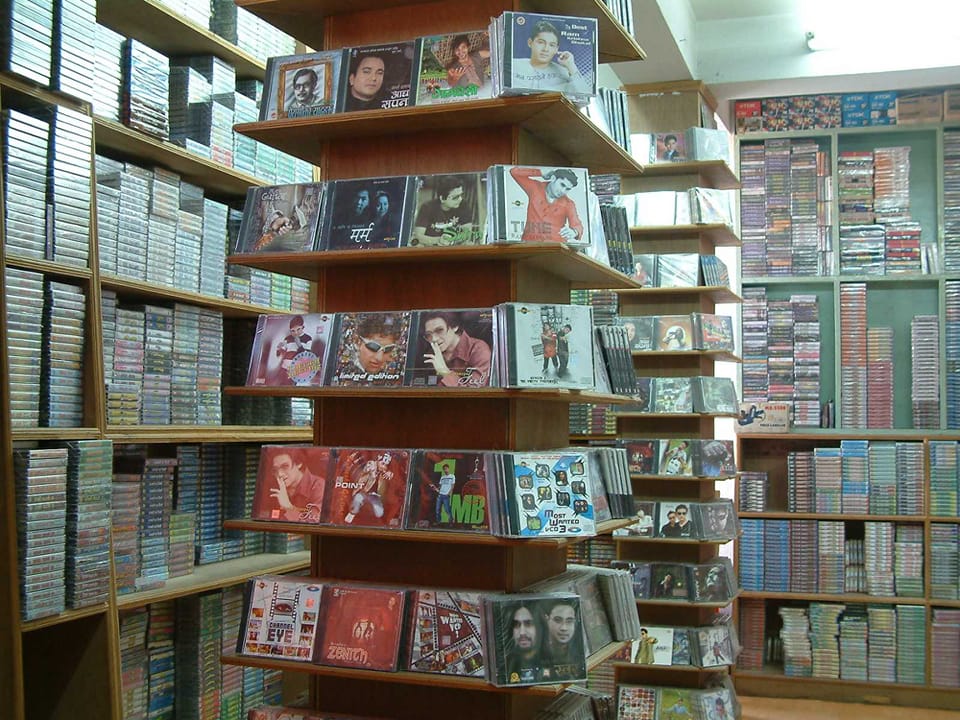
CDs and cassette tapes of modern and pop music. Photo: Anil Sthapit.
Manohari would drown in the nostalgia of the past and share anecdotes of recordings: the fun-loving nature of Kishore Kumar, the politeness of Mohammad Rafi, the gravity of Mukesh, and the countless stories of simplicity of sisters Lata and Asha. How enchanted those musical savants would get by the tune of his saxophone and shower flowers of praise—while telling these stories, one could feel the musical instruments dancing on Manohari’s face.
RD Burman’s music practice, which was called a ‘sitting’, and the recording subsequent to it, used to be extremely lively. Because they had to rehearse and record the whole day, instrumentalists would reach the studio having packed their lunch right from home. Pancham Da (the name used to address RD affectionately) would search through those instrumentalists’ lunches in their absence and clean out the delicious dishes. But when it was lunchtime, various dishes would arrive at the studio from restaurants. Everyone would eat together amidst jokes and laughter. In the analog era, where physical presence together was mandatory, the vibrancy and fun of creating music was entirely different.
The transaction of cassettes used to be a means to earn both friends and enemies. Kind-hearted people would do favors by giving cassettes to listen to, whereas wicked ones would embezzle cassettes ‘earned with no small hardship’.
Analog also made humans hardworking and responsible. During the time of collective recording, a small mistake by any single member of the orchestra would require re-recording. Imagine, if a re-recording had to be done due to a mistake in just one beat of the tabla in a duet singing by Mohammad Rafi and Lata Mangeshkar, how much guilt the tabla player must have felt! Not only the instrumentalists, but the singers themselves also practiced extensively before recording. They remained vigilant toward their work. Due to analog, a creative rivalry regarding who was better than whom existed between the instrumentalists and the singers. In digital, since one is concerned only with one’s own work, it is fine to remain indifferent toward the work of others. After all, the remaining work belongs to the arranger!
Manohari used to tell an amusing anecdote of a recording. Lata Mangeshkar was singing a song with absolute absorption. Manohari Singh, who was playing the saxophone when she started the song, was blowing the clarinet by the time the song was ending. Lata had no inkling at what moment he put away the saxophone and picked up the clarinet. That was the fun of analog. And why then would Manohari choose film recordings?
In the past, every song was a history in itself. More interesting than the song was the story of its creation. A hit song is a history in itself. And it is natural to have nostalgia with history.
Music possesses the strength to connect the mind and the heart. We grew up in a time when reaching the music of one’s interest was a major enterprise, rather than just listening to music. There was certainly an impatient waiting for songs to play on the radio, but one had to endure no small amount of hardship for a favorite song. The family would manage to provide a tape recorder, but to buy the cassettes to play on it, one had to collect small coins in a piggy bank. The transaction of cassettes used to be a means to earn both friends and enemies. Kind-hearted people would do favors by giving cassettes to listen to, whereas wicked ones would embezzle cassettes ‘earned with no small hardship’. The journey from cassettes to CDs, DVDs, iPods, and finally to smartphones has its own turnings. However, the taste that was there in the radio and cassettes is not there today.
Who indeed wouldn’t be nostalgic about the music of the old days?