Kathmandu
Sunday, July 26, 2026





In the first nine months of FY 2025/26, exports grew faster than imports, yet a massive import bill—driven by fuel and raw materials—pushed the trade deficit to Rs 1.268 trillion, revealing deep structural imbalances in the economy.
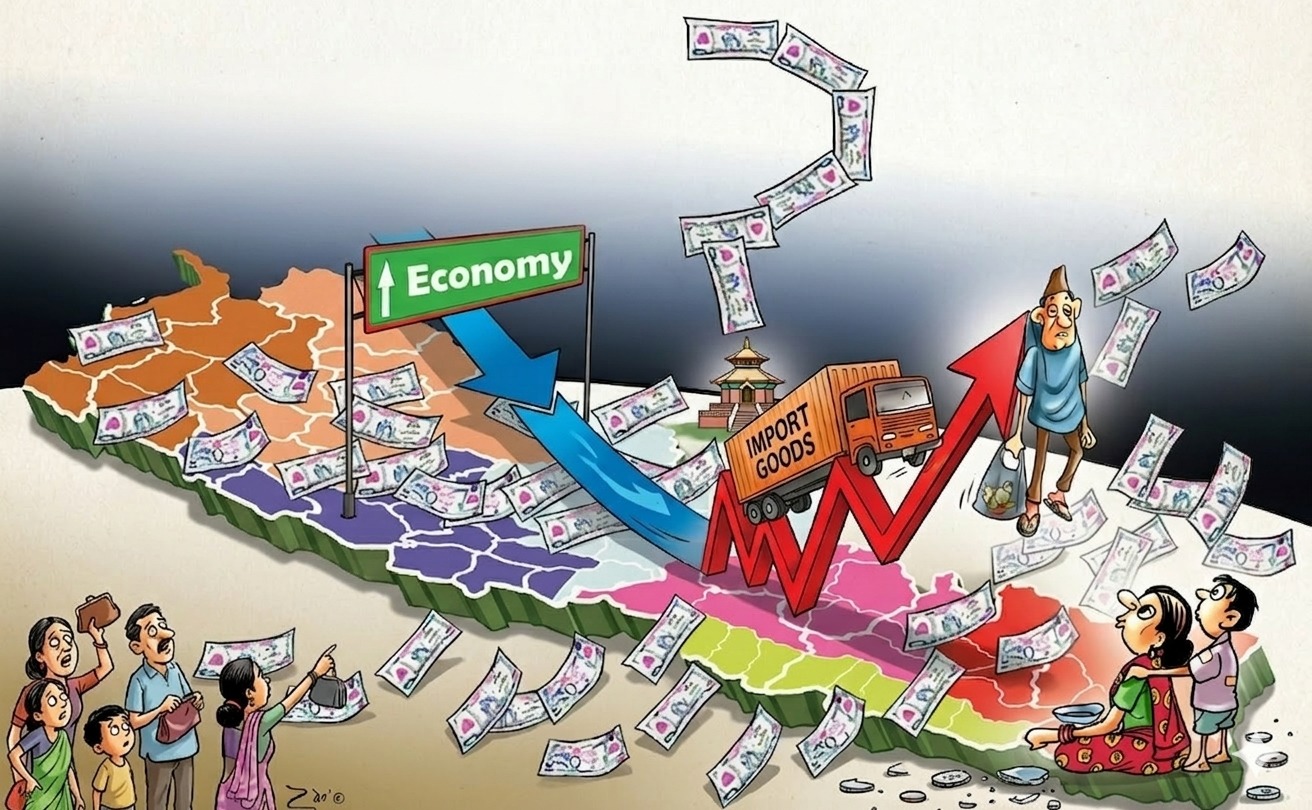
KATHMANDU: In the first nine months of fiscal year 2025/26 (up to mid-April 2026), Nepal’s imports reached Rs 1.4905 trillion, up 13.82% from Rs 1.30953 trillion in the same period last year.
Exports stood at Rs 222.94 billion, rising 18.46% from Rs 188.195 billion. Total trade volume is approximately Rs 1.713 trillion. The trade deficit widened to about Rs 1.268 trillion.
Exports grew faster than imports, but the massive import bill — led by diesel (Rs 103.31 billion), crude soyabean oil (Rs 96.72 billion), petrol (Rs 50.40 billion), and LPG (Rs 41.65 billion) — highlights continued heavy reliance on foreign goods.
What was Nepal’s total foreign trade volume in the first nine months of FY 2025/26, and how does it compare to last year?
Nepal’s total foreign trade (imports + exports) reached approximately Rs 1.713 trillion in the first nine months (mid-July 2025 to mid-April 2026). Imports were Rs 1.4905 trillion and exports Rs 222.94 billion.
According to data released by the Department of Customs, total trade increased by around 14% compared to the same period last year, supported by a 13.82% rise in imports and an 18.46% growth in exports.
This performance reflects recovering economic activity, sustained domestic demand fueled by remittances, and some improvement in export sectors.
However, the trade structure remains heavily import-dependent, which continues to exert pressure on the balance of payments despite adequate foreign exchange reserves supported by remittances.
How much did Nepal export in the first nine months, and what was the percentage growth?
Exports totaled Rs 222.94 billion during the nine-month period. This represents a healthy 18.46% increase compared to Rs 188.195 billion in the corresponding period of the previous fiscal year.
The faster growth in exports relative to imports is a positive signal, likely supported by higher shipments of items such as soyabean/palm oil, jute goods, cardamom, polyester yarn, and other traditional as well as processed products.
This growth helps earn valuable foreign currency and slightly improves the export-import ratio. Nevertheless, the absolute value of exports remains small compared to the economy’s size and the import bill.
Sustained momentum will depend on diversification, quality enhancement, better market access, and addressing supply-side issues like infrastructure and energy reliability.
What were the total imports in the nine months, and by what percentage did they rise?
Imports reached Rs 1.4905 trillion up to mid-April. This is 13.82% higher than Rs 1.30953 trillion recorded in the same nine months of the previous year. The steady rise reflects strong demand for essential items including fuel, raw materials, vehicles, machinery, and consumer goods.
Remittance inflows continue to fuel domestic consumption, while limited local production capacity keeps import dependence high.
Although this supports infrastructure and industrial needs, it widens the trade gap significantly. Import substitution policies focused on agriculture, light manufacturing, and renewable energy could help moderate future growth in the import bill without disrupting essential supplies.
What is the size of Nepal’s trade deficit in the first nine months of FY 2025/26?
The trade deficit stood at approximately Rs 1.268 trillion (imports of 1.4905 trillion minus exports of 222.94 billion). This is larger in absolute terms than last year’s corresponding deficit despite stronger export growth.
The gap persists because the base of imports is vastly larger — roughly 6.7 times the value of exports. While remittances and other inflows help finance this deficit and keep reserves comfortable, a persistently high deficit remains a structural vulnerability.
Long-term reduction requires boosting export competitiveness, attracting FDI into export-oriented and import-substituting industries, and rationalizing non-essential imports through targeted policies.
How does the export growth rate compare with the import growth rate?
Exports grew by 18.46%, outpacing imports which increased by 13.82%. This is an encouraging development as it shows export performance gaining stronger momentum. The differential helps improve the overall trade balance ratio marginally.
However, because imports start from a much higher base, even the lower percentage growth in imports adds a far larger absolute amount (about Rs 181 billion additional imports) than the export increase (about Rs 34.74 billion).
This dynamic keeps the deficit widening. Maintaining and accelerating export growth will require focused interventions in logistics, financing, quality standards, and trade facilitation to translate percentage gains into meaningful reductions in the trade imbalance.
What are the major imported commodities in the nine-month period?
The highest import value was recorded for diesel at Rs 103.31 billion, followed by crude soyabean oil at Rs 96.72 billion. Other major items include petrol (Rs 50.40 billion) and LPG (Rs 41.65 billion).
These energy and raw material imports dominate the bill, reflecting Nepal’s heavy dependence on imported petroleum products for transport, industry, and household use, as well as raw materials for edible oil processing.
Such imports are essential for daily economic functioning but significantly strain foreign exchange. Promoting renewable energy, domestic oilseed cultivation, electric vehicles, and energy efficiency measures could gradually reduce this burden while supporting green growth and job creation.
Why did the trade deficit widen even though exports grew faster?
Although exports rose by 18.46%, the trade deficit expanded because of the enormous scale of imports. The absolute increase in imports (Rs 181 billion) far exceeded the absolute rise in exports (about Rs 34.74 billion).
Nepal’s export basket remains narrow and low in value addition, while imports cover a wide range of essentials and capital goods with limited domestic alternatives. This structural imbalance means faster percentage growth in exports has only a modest impact on the overall gap.
Addressing the deficit requires simultaneous efforts on both fronts: aggressively expanding and diversifying exports while promoting local production to substitute key imports.
How does this year’s nine-month trade performance compare with the previous fiscal year?
This year’s nine-month imports are 13.82% higher than last year’s corresponding period (from Rs 1.30953 trillion to 1.4905 trillion), while exports have grown by a stronger 18.46% (from Rs 188.195 billion to 222.94 billion).
Overall, the performance shows improved export momentum compared to earlier subdued periods, but the absolute trade deficit has still widened due to the dominant import base. This indicates partial recovery in external sector dynamics, yet deep-rooted issues like limited industrialization and export diversification persist.
The remaining three months of the fiscal year will determine whether this export growth can be sustained or accelerated.
What does the trade data reveal about Nepal’s economic vulnerabilities?
The figures underscore Nepal’s ongoing structural vulnerabilities: a narrow export base, overwhelming dependence on imports for energy, raw materials, and consumer goods, and a massive deficit financed largely by remittances.
While reserves remain adequate, over-reliance on invisible earnings (remittances and tourism) exposes the economy to external shocks such as global slowdowns or shifts in migrant worker conditions.
The faster export growth offers hope, but without broader diversification and productivity gains, Nepal risks remaining locked in a high-import, low-export cycle.
Building resilience demands investment in infrastructure, skills, technology, and policies that encourage domestic manufacturing and value-added exports.
Why is stronger export growth important for Nepal despite the large deficit?
The 18.46% export growth generates foreign currency, creates employment, stimulates industrial activity, and brings market discipline and technology exposure. It helps offset part of the import bill and gradually improves the export-import ratio.
For a landlocked country with limited natural resources, robust exports are essential for sustainable growth, reducing remittance dependence, and achieving greater economic self-reliance. Even with a large deficit, rising exports signal improving competitiveness in certain sectors.
Continued policy support — including better logistics, access to finance, trade agreements, and quality certification — is needed to build on this momentum and convert it into broader economic benefits.
What are the likely main exported items contributing to the growth?
Although a detailed item-wise breakdown for the full nine months is not provided in the latest news, growth has likely come from traditional and processed items such as soyabean/palm oil, jute goods, cardamom, polyester yarn and thread, tea, and woolen carpets.
These categories have shown resilience or expansion in recent periods. The export basket remains concentrated on a few medium-to-low value products, making it vulnerable to price fluctuations and external demand shifts.
To achieve higher and more stable export earnings, Nepal must move toward higher-value manufactured and processed goods, invest in branding, comply with international standards, and explore new markets beyond traditional partners.
What policy measures can help reduce Nepal’s trade deficit going forward?
Key strategies include promoting import substitution through incentives for local production of high-import items like edible oils, agricultural produce, light engineering goods, and consumer durables.
Simultaneously, export competitiveness must be enhanced via improved infrastructure (roads, dry ports, reliable electricity), simplified procedures, trade facilitation, and better access to finance for exporters.
Diversifying both products and destination markets, negotiating favorable trade agreements, and attracting FDI into export-oriented industries are crucial.
Support for SMEs with technology and skills development, alongside prudent management of domestic demand to moderate non-essential imports, will be important. Coordinated efforts between government, private sector, and development partners are needed for sustainable rebalancing of trade.