Kathmandu
Sunday, July 19, 2026





The proposed Nepal Air Services Authority Bill would transfer airport and air navigation operations to a new agency while leaving licensing and safety oversight with a separate aviation regulator.

KATHMANDU: The draft Nepal Air Services Authority Bill proposes establishing a new autonomous body to construct, operate and manage Nepal’s airports and air navigation services.
The new Authority would assume operational responsibilities currently carried out by the Civil Aviation Authority of Nepal (CAAN), which was established in 1998 under the Civil Aviation Act, 1996, while a separate regulatory body would continue to oversee aviation safety standards and licensing.
The bill also sets out the new Authority’s organizational structure, governance framework, management committee, managing director, funding mechanisms, offenses and penalties, as well as provisions for transferring existing CAAN staff to the new organization.
What is this bill proposing to create and what would the new body be called?
The bill would establish an organization named the Nepal Air Services Authority, referred to in English as the Air Services Authority of Nepal, with the abbreviation A.S.A.N. Its central office would be based in the Kathmandu. The stated purpose in the bill’s preamble is to develop airport infrastructure and air navigation systems that meet international standards, so that Nepal’s air services become safer, more standard, more reliable and better able to serve passengers, while also building skilled manpower for the sector.
The Authority would be an autonomous, organized institution with perpetual succession and its own legal personality, meaning it can sue, be sued, hold property and enter contracts independently.
In practical terms, the bill hands this new body responsibility for building and running airports, managing airspace navigation services, coordinating search and rescue, setting flight procedures, and handling most of the day-to-day operational work currently associated with Nepal’s civil aviation infrastructure.
Why is Nepal separating airport operations from its existing aviation authority?
The main reason behind the proposed restructuring is Nepal’s long-standing commitment to meet international aviation safety standards. Since 2014, the International Civil Aviation Organization (ICAO) has urged Nepal to separate the regulatory and operational functions of its civil aviation authority so that the same institution is not responsible for both providing aviation services and regulating their safety. Nepal has yet to implement this reform, and Nepali airlines remain on the European Union Air Safety List, commonly known as the EU blacklist, which has barred them from operating flights to EU member states since 2013.
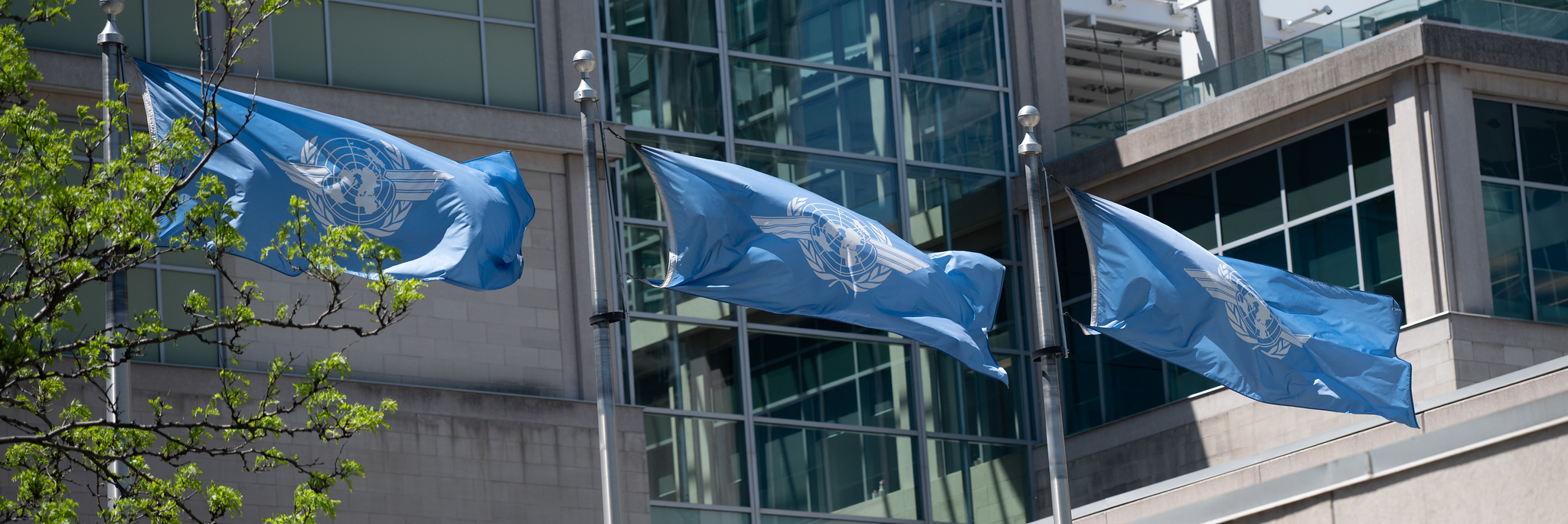
Since 2014, the International Civil Aviation Organization (ICAO) has urged Nepal to separate the regulatory and operational functions of its civil aviation authority.
The bill seeks to address this by separating the functions currently carried out by the Civil Aviation Authority of Nepal (CAAN). Under the proposed arrangement, the new Nepal Air Services Authority would take over airport infrastructure, airport operations, air navigation services, ground handling and other operational responsibilities, while a separate regulatory body established under prevailing law would continue to oversee aviation safety, licensing and certification.
This institutional separation is an internationally accepted model designed to ensure independent safety oversight and eliminate conflicts of interest. The bill’s staff transfer provisions further reinforce the reform by allowing existing CAAN employees to either join the new Authority or remain with the regulatory body.
What happens to the existing CAAN and its staff?
Civil Aviation Authority of Nepal was originally established under the Civil Aviation Authority of Nepal Act, 1996. Under the new bill, permanent staff currently working at that authority when the new law commences would automatically become permanent staff of the new Nepal Air Services Authority. However, those who instead wish to remain with the regulatory body established under prevailing law can apply through the Authority to the Ministry within sixty days of a Nepal Gazette notice.
The Ministry would then place employees into either the regulator’s or the Authority’s approved organizational structure based on seniority, qualifications, work experience and the nature of their duties. Staff who do not apply within that window can still be assigned positions based on their competency and experience, at the Ministry’s discretion.
Land, buildings, airports, air navigation assets, other movable and immovable property, and outstanding debts and liabilities of the old authority would all transfer to the new Authority.
How would the new Authority be governed on a day-to-day and policy level?
Governance operates on two tiers. At the top sits a management committee chaired by the Secretary of the Ministry overseeing civil aviation, with members including joint-secretaries from the Ministry itself, the Ministry of Home Affairs and the Ministry of Finance, plus two experts nominated by the government from people holding postgraduate degrees and at least ten years of relevant experience in areas such as air service management, aircraft operations, ground handling, air traffic control or navigation aid maintenance, with at least one woman among the nominees.

Grounded wide body plane of Nepal Airlines. File photo
The Managing Director serves as member-secretary of this committee. Nominated expert members serve four-year terms and can be reappointed once. The committee approves annual budgets and programs, sets human resource and financial policies, oversees audits, and can remove nominated members for dishonesty, incompetence or incapacity after giving them a chance to respond. Day-to-day administration, however, falls to the Managing Director, who reports to and implements the committee’s decisions.
What are the Authority’s core functions and powers under the bill?
The bill gives the Authority a wide mandate covering construction, upgrading, operation and management of airports; providing air navigation and related facility services across Nepal’s airspace and airports; running air traffic services and flight information services; and operating fire prevention and rescue services at airports.
It also covers ground handling, fuel supply, flight catering and cargo services, setting visual and instrument flight procedures, preparing aeronautical charts, coordinating search and rescue operations, and approving flight schedules and granting flight permits.
Additional responsibilities include setting airport and heliport construction standards for submission to the regulator, implementing safety and quality management systems, managing wildlife risks near runways, controlling environmental pollution to standards set by the regulator, and reporting unauthorized airspace use to the government.
The Authority is also tasked with prioritizing passenger service and facilities, coordinating among various government and non-government bodies operating within airports, and following directions issued by the government and the Ministry.
Who runs the Authority day to day and how is that person selected?
A Managing Director serves as chief executive responsible for daily operations. This person must be either a senior officer already employed by the Authority or hold a postgraduate degree from a recognized university, combined with at least five years of managerial experience in civil aviation and fifteen years of overall work experience.
Selection happens through open competition, run by a recommendation committee coordinated by the Ministry secretary, alongside one expert appointed by the Ministry and a joint-secretary handling the relevant subject as member-secretary.
This committee screens out disqualified candidates, such as non-citizens, those convicted of serious crimes involving moral turpitude, blacklisted defaulters, or people with conflicts of interest tied to service providers doing business with the Authority, before recommending a suitable candidate to the government for appointment.
The Managing Director serves a four-year term, renewable once if performance is judged satisfactory, and can be removed for incompetence, dishonesty, poor performance or disqualification, after being given a chance to respond.
How will the new Authority be funded?
The bill establishes a dedicated fund for the Authority, separate from general government revenue. Its sources include fees collected under the Act’s fee provisions, covering things like aircraft landing and parking charges, passenger service fees, cargo handling, ground handling, fuel sales, flight catering, terminal access fees, retail and advertising space rent, and utility charges within airports.
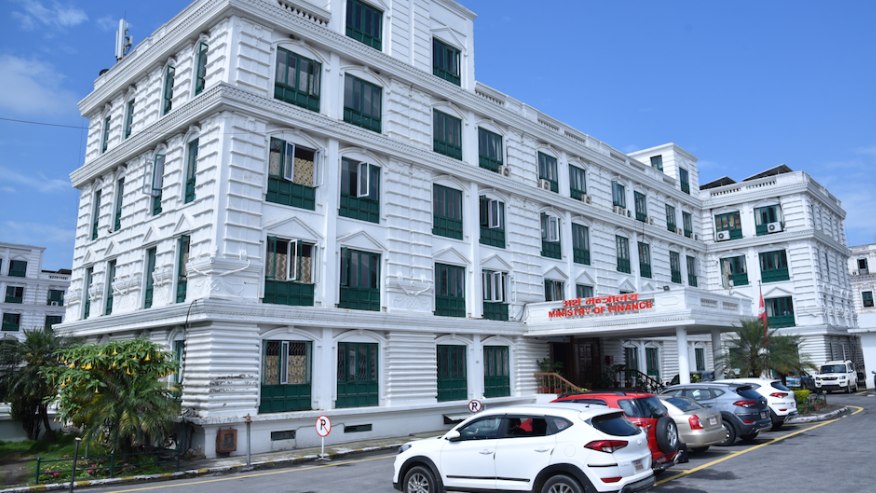
Ministry of Finance. File photo
The fund also draws on fines collected for offenses under the Act, loans or grants from domestic institutions, banks or individuals, loans or grants from foreign governments or international organizations, subject to Ministry of Finance consent, income earned from investing the fund itself, contributions from the Government of Nepal, and any other income the Authority generates.
All of the Authority’s expenses are to be paid from this fund, which must be deposited in a commercial bank licensed by Nepal Rastra Bank. The Authority must also maintain proper income and expenditure accounts, subject to internal audits and a final audit conducted by the Auditor General.
What offenses and penalties does the bill set for activity within airport areas?
The bill lists specific prohibited acts within airport premises as offenses, including unauthorized entry into restricted airport zones, misusing an entry pass, constructing buildings or structures that violate prescribed standards within the airport area, damaging airport perimeter fencing, installing equipment or structures in protected zones around runways in ways that adversely affect flight operations, running unregulated slaughterhouses or dumping waste within three kilometers of an airport, and landing or taking off without the Authority’s permission.
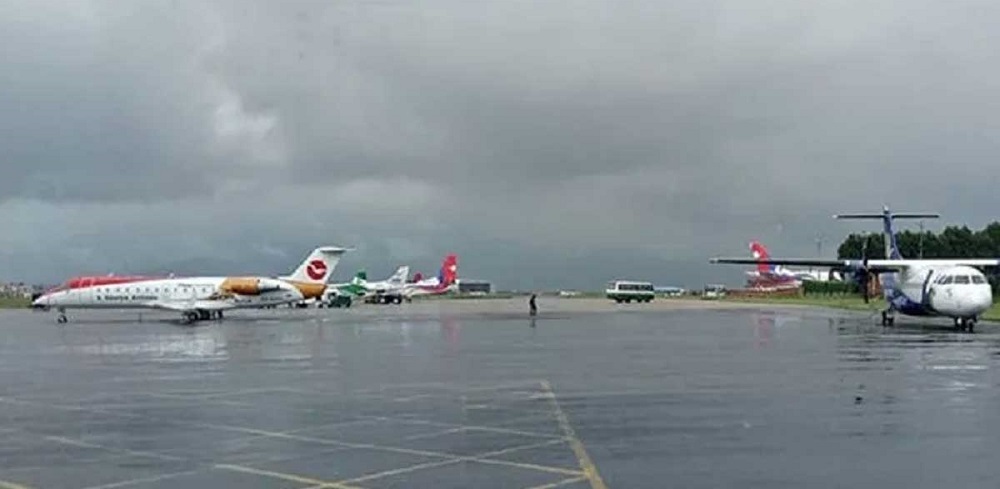
Tribhuvan International Airport. File photo
Penalties for these offenses, imposed by the Managing Director, range from fines of Rs 10,000 to 50,000 for less severe violations up to fines of Rs 200,000 to 500,000 for more serious ones, such as unauthorized structures near runways or actions undermining airport security, with the regulator informed in those more serious cases. Repeat offenders face double the punishment.
Anyone building an unauthorized structure must demolish it at their own expense within a period the Authority sets, or the Authority can demolish it and recover costs from them.
How does the bill handle land needed for building or expanding airports?
When the Authority needs land, buildings, sheds or other structures to construct a new airport, expand an existing one, or upgrade facilities at a current airport, it can formally request the Government of Nepal to arrange acquisition of that property under prevailing law. The bill places the responsibility on the government to secure the needed land or structures and bear the associated costs, then make the property available to the Authority for its use.
This provision effectively gives the Authority a mechanism to pursue infrastructure expansion without needing to independently negotiate land acquisition, since that burden shifts to the government working through existing legal procedures for land acquisition.
1667367423.jpg)
Pokhara International Airport. File photo
The Authority also retains power, working with security agencies and local representatives, to restrict construction or require removal of structures near runways and flight paths that could interfere with aircraft safety, including buildings, towers or trees exceeding height limits it sets in coordination with the Ministry.
What role does the Authority play in airport security and what happens if someone appeals a penalty?
Overall responsibility for airport and airport-area security rests with the Government of Nepal, though the Authority can arrange necessary security personnel for security checks with government approval. Airport operators must adopt security measures coordinated with relevant agencies and following standards set by the aviation regulator, covering protection of aircraft, passengers, crew, visitors, staff and cargo.
Airport heads or designated security officials can issue binding orders to anyone operating within the airport area to maintain secure operations, and passengers, crew and cargo can be required to undergo security screening using equipment the airport operator arranges.
If the Managing Director imposes a penalty on someone under the Act’s offense provisions, that person can appeal to the concerned district court within thirty-five days of receiving notice of the penalty decision. This appeal mechanism mirrors similar provisions in other Nepali regulatory laws, giving affected parties a judicial route to challenge administrative penalties rather than leaving the Managing Director’s decision as final.
How are management committee meetings conducted, and how are decisions reached?
The committee is required to meet at least once a month under ordinary circumstances. The chairperson sets the date, time and location of each meeting, and the member-secretary must ensure all members receive the meeting agenda and notice at least twenty-four hours in advance. A quorum requires more than fifty percent of the committee’s total members to be present.
The Government of Nepal is tasked with determining environmental protection standards around airports, including limits on noise and air pollution generated by flight operations, and with setting the basis for measuring and evaluating such pollution.
The chairperson presides over meetings, and in their absence, a member designated by the Ministry chairs the session instead. Decisions are reached by majority vote among members present, with the presiding officer holding a tie-breaking vote when opinions are evenly split. The member-secretary is responsible for keeping secure records of decisions, certified by whoever chaired that particular meeting.
The committee may also invite outside experts to attend and advise on specific agenda items when needed. Members attending are entitled to meeting allowances based on rates the Ministry of Finance approves, and any other procedural matters are left for the committee itself to determine.
What disqualifies someone from being nominated to the committee and what happens if a member’s position becomes vacant?
Several categories of people are barred from being nominated or continuing as one of the two expert members on the management committee. These include non-Nepali citizens, anyone convicted of corruption, rape, human trafficking, drug-related offenses, money laundering, passport misuse, kidnapping or other crimes involving moral turpitude, individuals blacklisted or in loan default, those physically or mentally unable to continue serving, holders of permanent residency in a foreign country, and people whose family members are directly involved with a service-providing organization or who otherwise have a business relationship or conflict of interest with the Authority.
If an aircraft accident occurs, or if emergency repair work is needed on equipment installed on private property near an airport, an authorized Authority official can enter that property, giving prior notice to the person using it except in emergencies where immediate access is required to prevent harm.
Separately, a nominated member’s seat becomes vacant if they resign in writing, complete their term, become disqualified under these same criteria, miss three consecutive committee meetings without notice, get removed by the government under performance-related provisions, or die.
These provisions are meant to keep the committee’s independent expert seats free from candidates with criminal records, conflicts of interest or an inability to fulfill the role’s responsibilities.
What environmental and wildlife-management obligations does the bill place on the Authority?
The Government of Nepal is tasked with determining environmental protection standards around airports, including limits on noise and air pollution generated by flight operations, and with setting the basis for measuring and evaluating such pollution. Separately, the airport operator carries responsibility for controlling birds, animals and waste within airport premises, and must put in place effective arrangements to manage wildlife risks that could interfere with aircraft operations.

File photo
Residents of surrounding areas are expected to cooperate in supporting this wildlife control effort when needed. The bill also bans anyone from setting up unregulated slaughterhouses or dumping waste within a three-kilometer radius of an airport, and organizations or individuals working within airport premises are barred from generating waste while carrying out their duties there.
These provisions reflect recognized aviation safety concerns, since bird strikes and wildlife incursions onto runways are a well-documented hazard, and waste or slaughterhouse activity near airports can attract the scavenging birds most likely to cause such strikes.
What powers does the Authority have to enter private property near airports and what safety-related building restrictions apply?
Anyone constructing buildings, towers, poles or other structures within the designated airport area or along flight paths must follow height limits and conditions set by the Authority, and structures exceeding those limits are prohibited. Existing structures such as buildings, sheds, walls, trees or other obstacles that exceed permitted heights can be ordered removed, cut down or dismantled, with the Authority coordinating this process with the Government of Nepal under a specific provision addressing such demolition requests.
If an aircraft accident occurs, or if emergency repair work is needed on equipment installed on private property near an airport, an authorized Authority official can enter that property, giving prior notice to the person using it except in emergencies where immediate access is required to prevent harm.
Anyone who enters private property for this purpose must submit a report on the work carried out to the Authority as soon as possible, ensuring some accountability over how this entry power is used in practice.
Does the bill address insurance requirements and joint investment arrangements for the Authority?
The Authority is required to purchase insurance covering third-party liability for damages that could arise from aircraft-related incidents at airports, based on need. This obligation ensures that victims of accidents connected to airport operations have a recognized avenue for compensation rather than relying solely on the Authority’s own funds after an incident.
On oversight, the Ministry is required to assess how well the Act is being implemented within one year after five years have passed since commencement, and again during each following five-year period, submitting its findings to the relevant committees of both houses of the federal parliament.
Separately, the bill allows the Authority, with government approval, to pursue joint investment arrangements with domestic or foreign investors for specific business plans and programs. It can also enter public, private or joint partnership arrangements with domestic or foreign governments and institutions specifically for airport construction, upgrading, operation or management.
This flexibility is intended to let the Authority attract outside capital and expertise for large infrastructure projects, such as new airport construction or major upgrades, without being limited strictly to government funding or its own internally generated fund, while still requiring government sign-off before entering such partnerships.
How will staff retirement benefits work and how will the government track whether this law is achieving its goals?
The bill requires the Authority to implement a contribution-based retirement scheme for employees hired after the law takes effect, following prevailing government rules on such systems, with details on employee contributions and the Authority’s matching contributions to be set separately.
For employees who were already receiving retirement benefits from the former Civil Aviation Authority of Nepal before this law commenced, they will continue receiving those retirement payments through the new Authority after it takes over.
Staff who transition from permanent civil service positions into the new Authority and later retire after completing twenty years of permanent service can choose between retirement benefits or a lump-sum severance payment, whichever suits them.
On oversight, the Ministry is required to assess how well the Act is being implemented within one year after five years have passed since commencement, and again during each following five-year period, submitting its findings to the relevant committees of both houses of the federal parliament.