Kathmandu
Thursday, July 9, 2026





Communities are turning away due to loose practical execution and the high cost of higher education.

KATHMANDU: In the academic year 2019, Shiksha Kshamakanya Secondary School, located in Bayang, Aamchok Rural Municipality-6 of Bhojpur, initiated classes in the technical stream focusing on Crop Science (Agriculture). While there was a quota of 48 students per class in the technical stream, 30 students chose this subject in the first year (Grade 9). Students and parents were attracted to Crop Science, believing it would develop technical knowledge and skills, and ensure they wouldn’t face unemployment after completing their studies.
However, the number of students has been declining in subsequent years. A problem has also emerged where not everyone who signs up to study this subject continues their education.
In the current academic year 2026, only 14 students had registered to study Crop Science in Grade 9 by May 18. Uncertainty looms over whether all of them will continue their studies. Principal Raj Kumar Rai says, “We initially conducted orientation classes. Students have started coming to class, and they are pondering whether they will be able to study it or not.”
Based on his eight years of experience running Crop Science, he identifies three major reasons for the declining attraction toward this subject. First, the lack of subject teachers leads to irregular classes. Second, the inability to provide adequate practical exercises. Third, the high cost of pursuing a Bachelor’s degree in agriculture after passing Grade 12 in the technical stream. Principal Rai shares, “This is a school in a remote place; teachers obtained with great difficulty leave as soon as they find another opportunity. Then, while searching for another teacher, classes are missed for one and a half to two months, the results are not satisfactory, and thus students’ interest is waning.”
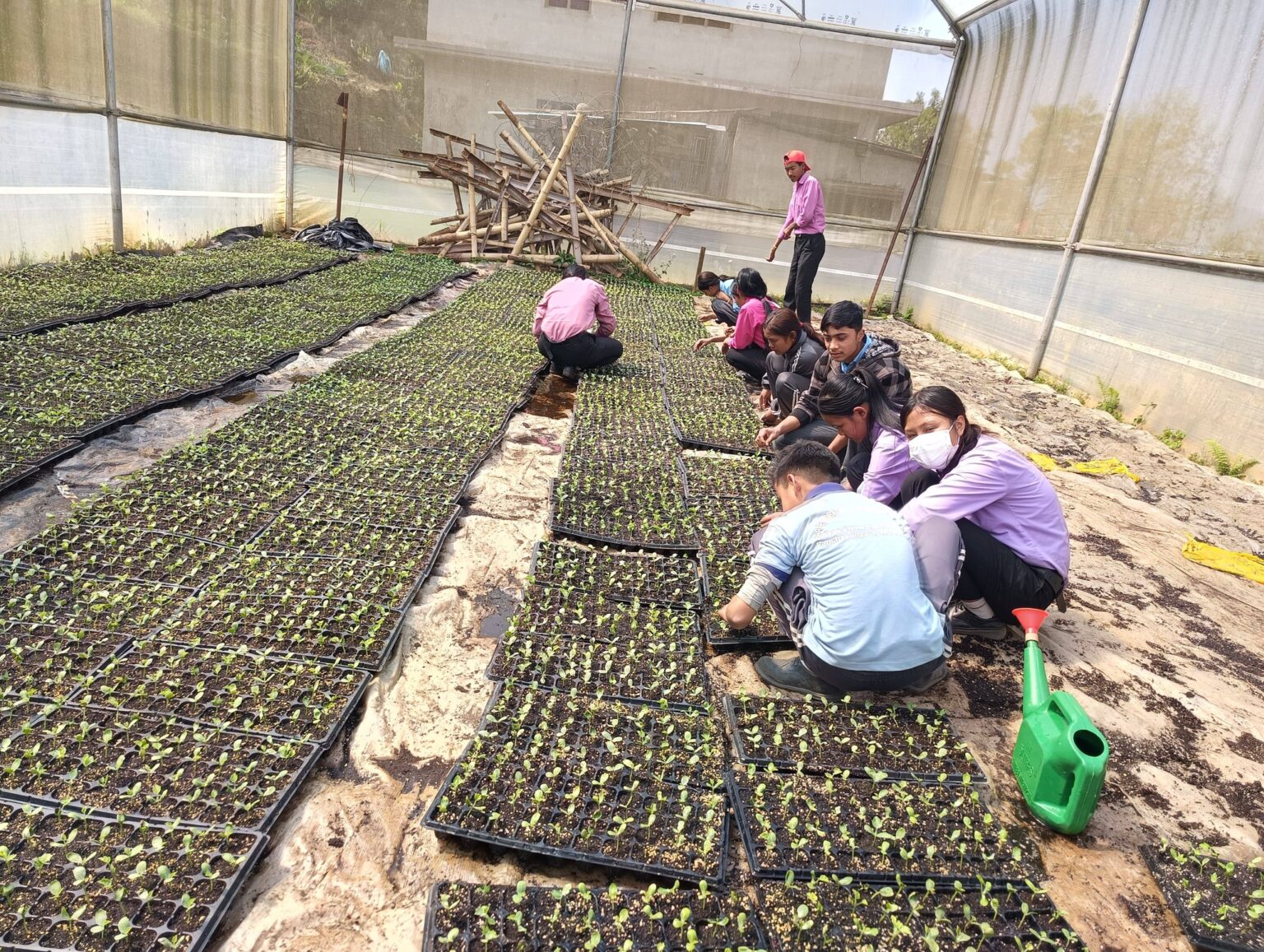
Experimental activities being conducted at Shree Indrayani Secondary School located in Panchakanya Rural Municipality-1, Nuwakot. Photo: Indrayani Secondary School’s Facebook Page
In addition, he states that students and parents are becoming disenchanted with technical education because field study tours incur expenses, and pursuing a Bachelor’s degree in agriculture after Grade 12 requires spending millions of rupees.
To regularly run Crop Science classes from Grade 9 to 12, eight teachers are required. However, Shiksha Kshamakanya Secondary School has only six teachers. “We have looked for two more teachers, but they haven’t been found,” says Principal Rai. Since classes are not regular due to the teacher shortage, students have stopped showing interest in this subject.
To attract students, the school provides school uniforms free of cost to those who enroll in Grade 9 and choose this subject, while the government also provides a subsidy of Rs 3,000 per student. However, even this has not significantly attracted students.
Like Shiksha Kshamakanya Secondary School, community schools across the country offering the technical stream are facing a shortage of both teachers and students. This problem is even more severe in rural areas compared to urban areas.
Lost prestige in 14 years
The government introduced technical and vocational education directly from the school level in the fiscal year 2012/13, aiming to produce a skilled workforce required for the labor market. The core objective of this education, colloquially called the ‘technical stream’ and implemented right from Grade 9, was to identify students’ areas of interest starting from adolescence and provide skill-oriented education.
However, due to the lack of qualified teachers and adequate infrastructure, classroom teaching and practical exercises are loose, leading to weak learning. As a result, neither the expected results are achieved in examinations, nor is quality human resource produced later.
Consequently, the school-level technical education program now appears to be a failure. Prof. Bal Chandra Luitel, Dean of Kathmandu University’s School of Education, says, “When the education itself is weak, there is no question of getting a job. A narrative is being strongly established: why study a skill-based subject if you cannot get a job even after studying it?”
Schools have completely stopped finding students in recent years to sustain the technical education that was implemented with great enthusiasm in the beginning. According to the 62nd Annual Report of the Auditor General, 2025, students studying the technical stream accounted for 10 percent in the fiscal year 2018/19, but dropped to just 2.7 percent by the FY 2023/24.
According to Bhakta Bahadur Godar, Director of the Educational Information Management Section of the Center for Education and Human Resource Development, there were 43,807 students studying the technical stream in Grades 9 to 12 in the academic year 2024. By the academic year 2025, it plummeted to 39,155 students.
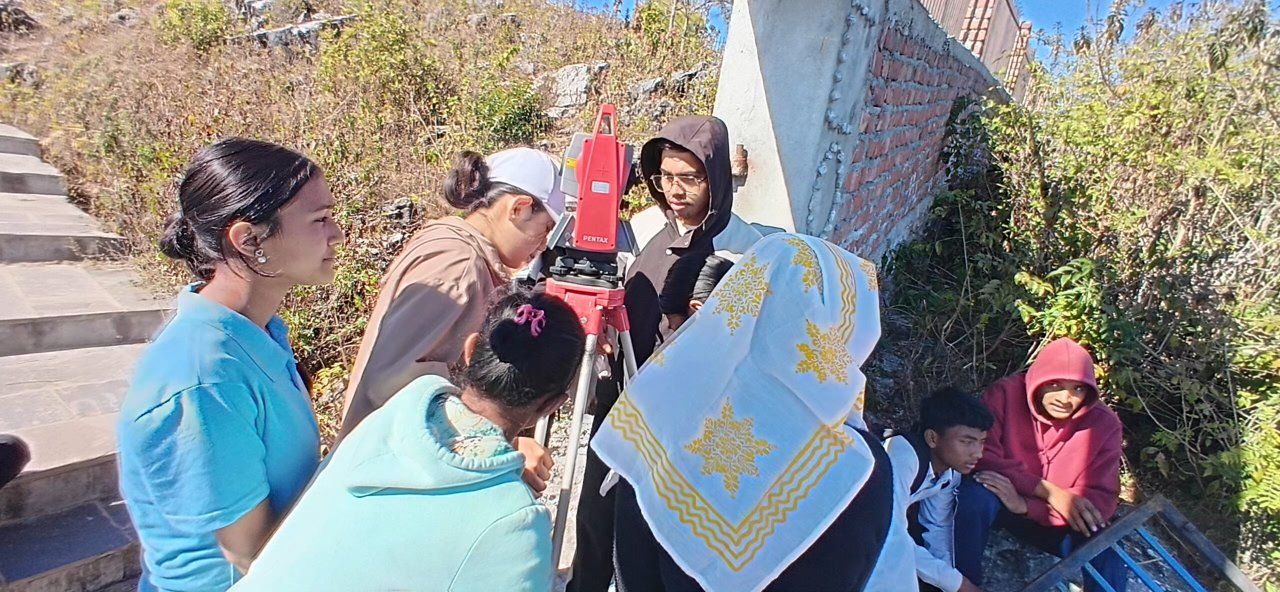
Students of Shree Mahendrodaya Secondary School in Halesi Tuwachung-07, Khotang, performing practical activities. Photo: School’s Facebook Page
Giridhari Sharma Paudel, former Vice-Chairman of the Policy and Planning Commission of Gandaki Province, states that while international practice dictates that technical stream courses should consist of 70 percent practical components, in Nepal, the teaching is almost one hundred percent theoretical. “The situation where students hold educational certificates but lack skills has prevented them from being competitive in the labor market,” he says. “Since this leads to a state of neither employment nor self-employment, students do not seem to want to study it.”
During his tenure at the Gandaki Province Policy and Planning Commission, Paudel had even commissioned a study on the status of technical stream education in the FY 2018/19. “Particularly in villages, because there were no teachers, proper teaching was absent, and the one or two existing teachers would just look at the students and input marks for practical exercises (OJT – On the Job Training),” he says.
A failed program
A study report on the implementation and improvement measures of technical and vocational education, conducted by the then Department of Education in 2017, pointed out that the main challenge behind the failure of technical stream education was the shortage of teachers teaching technical subjects in community schools and the inability to retain them. ‘Problems have also arisen as the teachers found with great difficulty lack subject-focused training and teaching skills,’ the report states.
The government is also aware that technical education, implemented without preparing infrastructure and human resources, is heading toward failure. Shiva Kumar Sapkota, Joint Secretary and Spokesperson of the Ministry of Education and Sports, says, “In a way, this is like a ‘failure program,’ and we now need to discuss what to do about it.”
Nim Prakash Singh Rathore, Director of the Educational Technology and Informal Education Division of the Center for Education and Human Resource Development, stated that since a shortage of students alongside teachers began to occur, they completely stopped giving permission to new schools to operate the technical stream from the academic year 2024. “Local levels might have given it somewhere, but we have completely stopped granting permission,” he says.
The genesis of the technical stream
In Nepal, the Council for Technical Education and Vocational Training (CTEVT), established under the Ministry of Education in 1988, was the sole provider of technical and vocational education. To take technical stream education to schools in every village, the government initiated technical and vocational education at the school level through the then Department of Education.
The government sowed the seeds of technical stream education by issuing the ‘Directive for Operating Technical and Vocational Education at School Level, 2012’ on July 8, 2012. Its concept, however, was formed under the ‘School Sector Reform Program’ (SSRP), implemented from 2009 to 2015 by the Ministry of Education with support from the World Bank, Asian Development Bank (ADB), British Aid, European Commission, Global Partnership for Education, the Danish government’s development agency DANIDA, Australian Aid, Norway, Finland, and UNICEF.
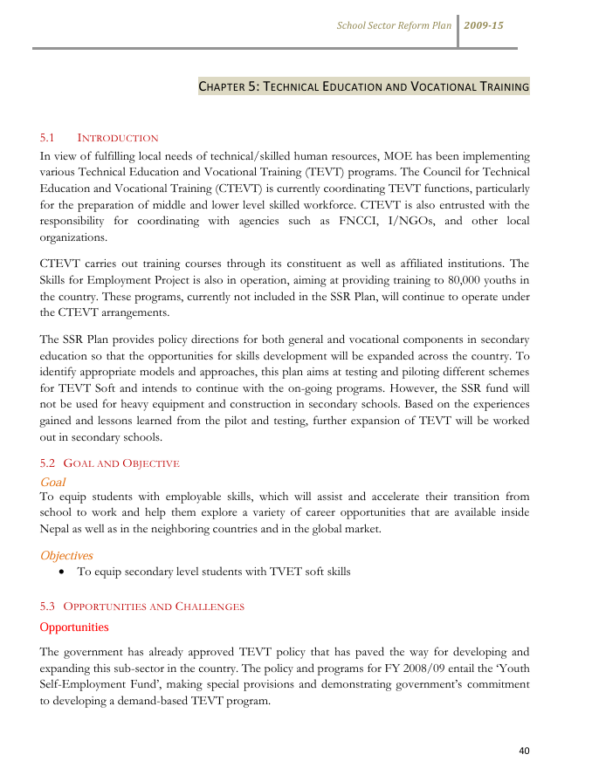
Within the framework of SSRP, the concept developed in 2009 aimed to integrate vocational curricula from Grades 6 to 12 to provide practical and employment-oriented skills to school-level students through training, making them capable for the domestic and foreign labor markets. The concept put forward was to teach life-supporting basic skills to students in Grades 6 to 8 and advanced skills to students in Grades 9 to 12. Initially started by ‘piloting’ in 100 community schools, the directive was brought in 2012 to make this education effective nationwide.
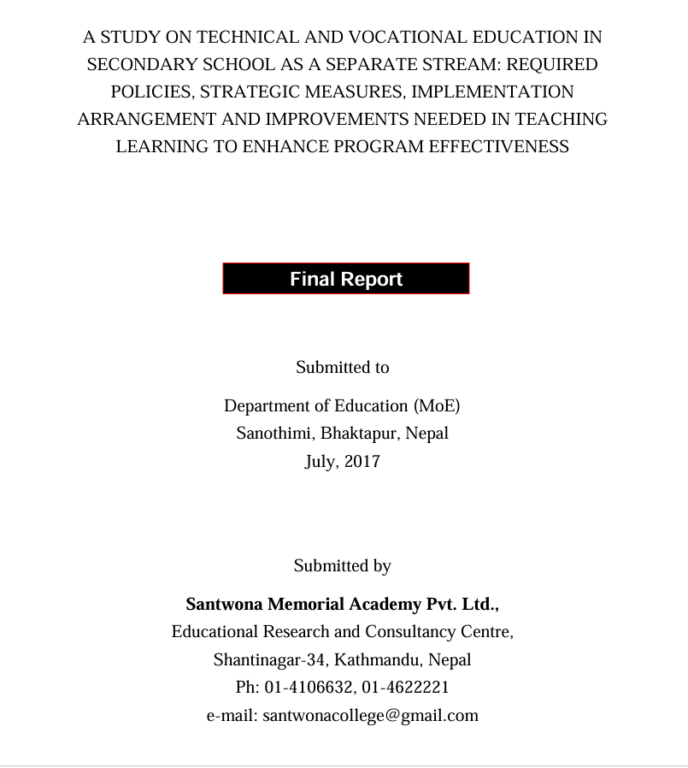
The technical education program at the school level continues in accordance with the directive, which was amended for the first time on June 3, 2014 and for the second time on April 2, 2019. After SSRP, the technical stream education was extended to additional schools under the School Sector Development Plan (SSDP), implemented from 2016 to 2023 with foreign assistance. By the time of the School Education Sector Plan (SESP), which has been in implementation since 2022, the operation of technical stream classes has expanded to 537 community schools at the secondary level across the country, as mentioned in the Flash Report 2024 of the Center for Education and Human Resource Development. Among these, the highest number, 205 schools, are teaching the curriculum of Crop Science, 141 offer Civil Engineering, 109 offer Computer Engineering, 46 offer Animal Science, and 35 offer Electrical Engineering. The curriculum of Bhawani Prasad Sakal Prasad Ram Prasad Janata Secondary School in Kalyanpur, Saptari, has not been disclosed.
Schools’ obsession with grants
Initially started by the Department of Education, this program has been running through local levels since 2019. All schools operating technical education receive a grant ranging from Rs 2.5 to 5 million, depending on the number of students. Similarly, they receive an annual grant of Rs 200,000 per school to upgrade laboratories and pay salaries for up to eight instructors.
In the academic year 2025, nearly Rs 700 million was released for schools teaching the technical stream across the country, given for laboratory purposes and as grants based on student numbers, excluding teacher salaries. Government officials state that because schools insisted on running the technical stream curriculum merely for this grant, it could not become effective.
An official from the Ministry of Education says, “As much as the schools are greedy for the grant, they do not care about quality education; the government also finds relief in being able to give a large chunk of budget to a single entity.”
Out of sheer greed for grants, schools have burdened students by thrusting both general and technical stream curricula into a single class. A study conducted by the then Department of Education in 2017 also pointed out that students found it difficult to study because they had to learn general and technical stream subjects simultaneously. This difficulty is even greater in rural areas. Learning materials are not easily available. Students have to rely entirely on teachers’ notes. For the general stream, the curriculum developed by the Curriculum Development Center is applied, while for the technical stream, the curriculum developed by the Council for Technical Education and Vocational Training is implemented. Separate teachers are required for both.
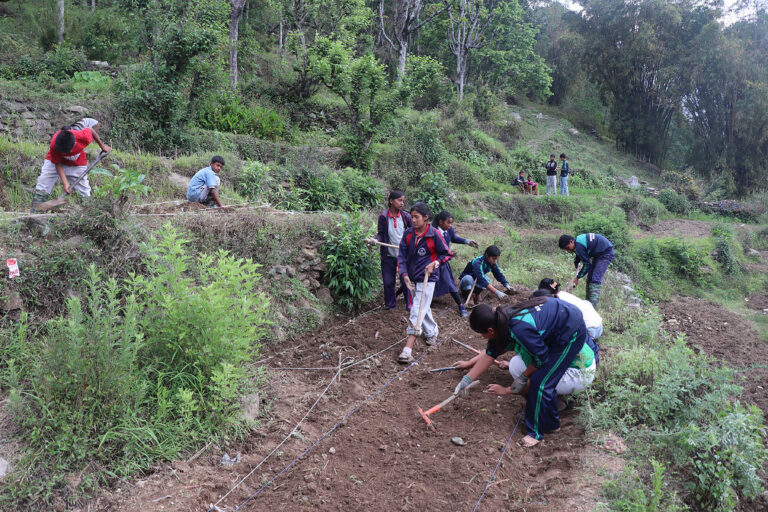
Students of Muktidham Secondary School in Bhagawati, Raghuganga Rural Municipality-2, Myagdi, preparing land for vegetable farming. Photo: Santosh Gautam/RSS
Even 14 years after the implementation of the technical stream, the government has not paid attention to the stability of subject-expert teachers, adding uncertainty to the continuation of the program itself. Nim Prakash Singh Rathore, Director of the Educational Technology and Informal Education Division of the Center for Education and Human Resource Development, says, “Since students have decreased, discussions are ongoing regarding a modality on whether to amend the curriculum and implement it only from Grade 11, but no decision has been reached yet on what to do.” He believes that once a decision is made regarding the modality of the technical stream, the management of teachers, infrastructure, and resource materials will automatically fall into place.
The old ailment
From the very beginning, technical stream education has faced the challenge of a budget crunch for curriculum revision according to labor market demands and the management of necessary physical infrastructure, and similar problems persist today. Education activist Abhishek Ghimire states that the main reason technical stream education at the school level has reached the stage of failure is the government’s inability to provide expert teachers. He says, “Even for the students attracted to the technical stream, rather than teaching them in labs and providing skills, they were confined to whiteboards and merely handed educational certificates, which is why this happened.”
Most schools lack separate buildings and laboratories. The existing laboratories are not adequate for the practical work of Grades 11 and 12. Even if students are attracted, those who have studied the technical stream in rural schools are compelled to move to urban areas to find jobs. Although students who receive technical skill-based education should be able to enter the labor market directly and create employment themselves, opportunities have failed to materialize due to the weak standard of education. The Department of Education’s study had also recommended managing permanent teachers to prevent teacher shortages and revising the curriculum. However, no reform efforts have been made so far.
According to the ‘Practical Exercise Implementation Guideline, 2016,’ students studying under the technical stream are required to complete three months of practical exercise after Grade 10, three months after Grade 11, and six months or one year after Grade 12. However, schools teaching the technical stream across the country have not been able to provide productive practical exercises to students.
Kuber Dhwaj Thapa, who works in the education section of Lisankhu Pakhar Rural Municipality in Sindhupalchok, states that because teachers cannot be found, they have had to focus heavily on theoretical teaching. In this rural municipality, Buddhodaya Secondary School has been operating a Computer Engineering program under the technical stream. However, it is nearly impossible to gather the eight teachers required to run regular classes from Grade 9 to 12. He mentions that they are forced to complete textbook-focused teaching for all classes using just the one teacher they managed to find with great difficulty.
Thapa says, “Even the single teacher found after a thorough search leaves for elsewhere upon finding other opportunities. This school is struggling just to retain teachers and students.” In the academic year 2025, there were only eight students studying the technical stream in Grade 10. In Grades 9 and 11, the number of students was zero.
Educationist Bidya Nath Koirala states that placing technical and vocational education in the same basket and teaching them has hindered the attainment of objectives. “Vocational education means helping students who cannot study higher levels or are weak in studies to learn skills and head toward self-reliance, with the option to continue if they wish to study further later,” he says.
“Here, by putting technical education in the same place, theoretical ambiguity has been created.”
He has argued from the very beginning that this program should not have been implemented at all because it is donor-driven. “Donors give aid to implement educational programs suited to the context of their own countries, but our environment, technology, and economic status do not match that,” he says. “When we suggested not to implement this in our schools, or if done, to implement it in a way that matches our own local context, the government did not listen. Now, ultimately, it failed to be effective.”