Kathmandu
Thursday, July 9, 2026





Despite killing over 41,000 Nepalis annually, air pollution remains absent from the new government’s priority list, raising concerns over citizen health and environmental governance

KATHMANDU: According to the ‘State of Global Air 2025′ report, over 41,000 people in the country die each year due to air pollution. Released by the World Bank on October 22, 2025, the report identifies air pollution as the leading cause of death in the country, highlighting a public health crisis of alarming proportions.
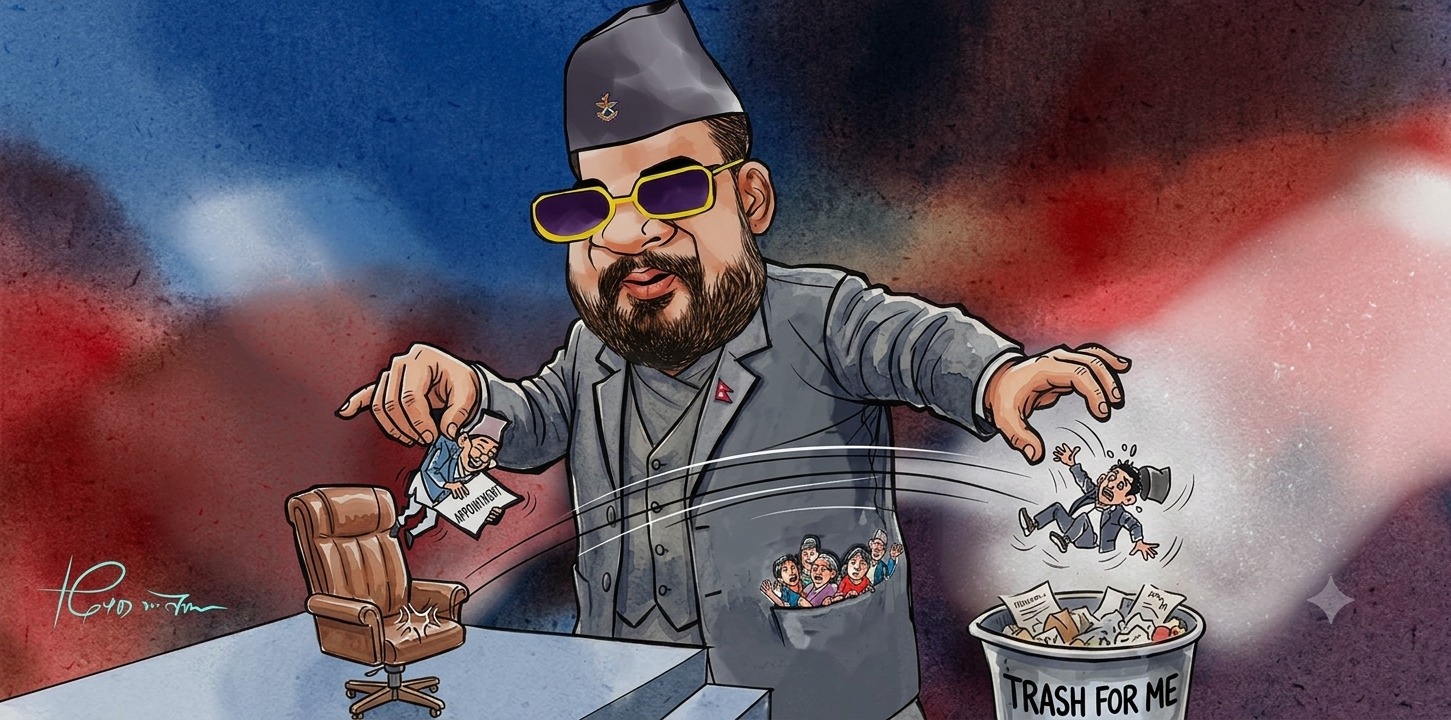
Despite this, the nearly two-thirds majority government led by the Rastriya Swatantra Party (RSP) appears to have overlooked the issue in its immediate governance reforms. In the 100-point agenda approved on March 27 by the Council of Ministers under Prime Minister Balendra Shah (Balen), air pollution does not appear even once.
“Thousands of Nepali citizens are dying every year due to air pollution, but it is shocking that not even a single word has been mentioned about this in the new government’s agenda,” said Senior Advocate Padam Bahadur Shrestha, a long-time advocate against air pollution, illegal mining, and deforestation.
Environmentalist Bhushan Tuladhar adds that it is not just air pollution that has been sidelined; broader issues of citizen-friendly environmental management are also absent. “Environmental issues, which have long been neglected, should have been a top priority for the new government. But that did not seem to be the case,” he said.

A choking blanket of air pollution covers the Kathmandu Valley, highlighting the severe public health crisis facing the capital. Photo courtesy: Nepal Photo Library
The government is preparing to merge the Ministry of Agriculture and Livestock Development with the Ministry of Forests and Environment, arguing that it will reduce expenses by cutting the number of ministries. Both ministries’ responsibilities have been assigned to Gita Chaudhary.
Even when the Ministry of Forests and the Ministry of Environment were separate, critics accused them of prioritizing forestry issues while neglecting wider environmental concerns. “Now that forest, environment, agriculture, and livestock are under a single ministry, it is almost certain that environmental issues will be pushed even further down the list,” said Tuladhar.
This is not to say that pollution control has been entirely ignored by governments. The state has long used pollution as a pretext to collect taxes. Since fiscal year 2008/09, the government has collected Rs 26.863 billion from petroleum consumers under the so-called ‘Pollution Control Fee.’ Yet, much of this money has not been spent on controlling pollution.
The 62nd Annual Report of the Office of the Auditor General, presented to President Ram Chandra Paudel in May 2025, highlighted that funds collected under this fee were not being used as intended.
Meanwhile, the Department of Environment under the Ministry of Forests and Environment has repeatedly highlighted its insufficient budget to tackle air pollution and its related challenges.
“If the government had clearly committed to using these funds for pollution control in its agenda, it would have strengthened citizens’ right to breathe clean air,” said Shrestha. “The new government must address this issue by all means; there is no room for delay or excuses.”
Gyan Raj Subedi, Director General of the Department of Environment, said that the issue of air pollution was raised during consultations with officials drafting the agenda.
“We were invited to the Nepal Administrative Staff College for discussions, and air pollution was brought up. Yet, it did not appear in the final agenda. Perhaps this happened because the government focused only on works that require immediate action in service delivery,” he said.