Kathmandu
Wednesday, July 22, 2026





The state’s failure to honor Gyanmani Nepal, who remained lifelong active in the exploration of Nepali history and provided significant texts examining the naming of the country, is an injustice to his contributions
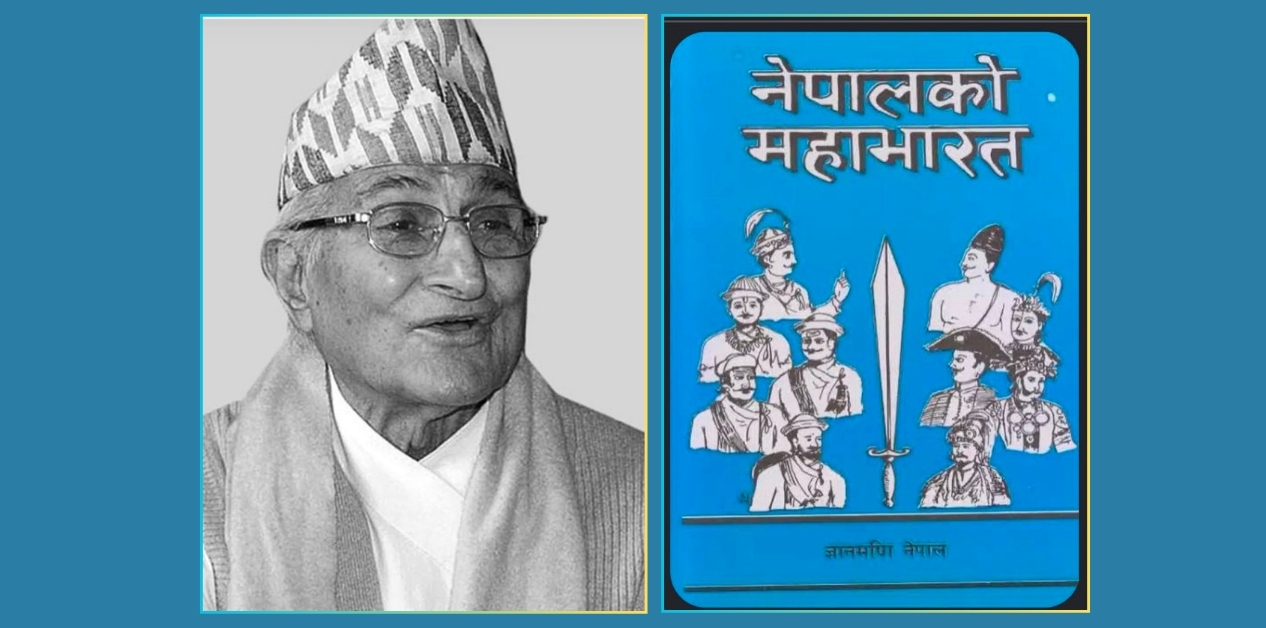
KATHMANDU: Two years have passed since the eminent historian Gyanmani Nepal (May 14, 2024) departed from this mortal world. Having dedicated the most fertile years of his life to researching and writing Nepali history, this historian was truly a gem of knowledge. Leaving behind invaluable treasures for Nepali society—such as Nepal Nirukta and Nepal Nirupanan, which introduced the country to the world based on historical evidence—he bid his farewell.
Even while hospitalized for medical treatment and with most of his bodily organs failing, Gyanmani’s consciousness and memory remained completely intact. Even in the final moments of his life, he continued to display deep anxiety and concern for Nepali history.
Marking the second anniversary of this historian’s passing, a commemorative volume titled Itihaspurush Gyanmani Nepal (The Man of History: Gyanmani Nepal) was recently inaugurated by former President Bidya Devi Bhandari. Given Bhandari’s historical lineage, this coincidence carried great significance.
The vines of history
Becoming the first female president of the Federal Democratic Republic of Nepal established Bhandari’s historical legacy. Similarly, serving two terms as president solidified another historic milestone. Prior to this, she had already set a historical record by becoming the first female defense minister of the country.
However, her historical lineage stretches much further back than that. Let us briefly review it.
King Manimukunda Sen of Palpa had brought a minister to his kingdom from Kumaon. Ganesh Pande, the son of that minister who arrived in Palpa from Kumaon, later went to live in Chhoprak, Gorkha. Pande descendants often mention that when Manimukunda Sen’s kingdom fragmented into the Chaubisi principalities, a disappointed young Ganesh Pande headed east in search of fortune and reached Belbas village in Chhoprak, Gorkha.
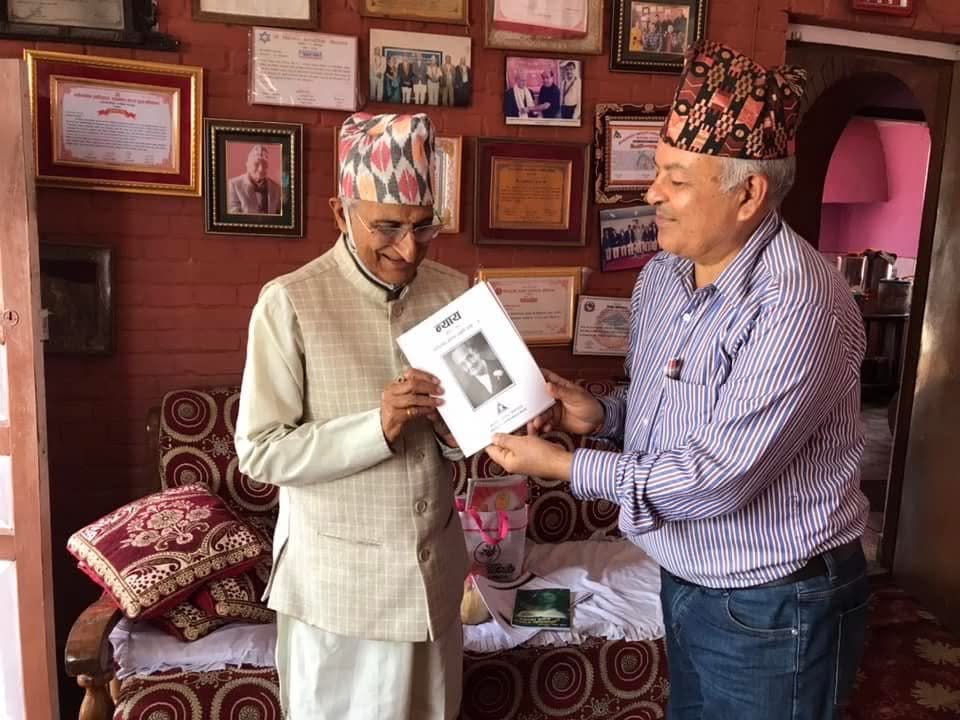
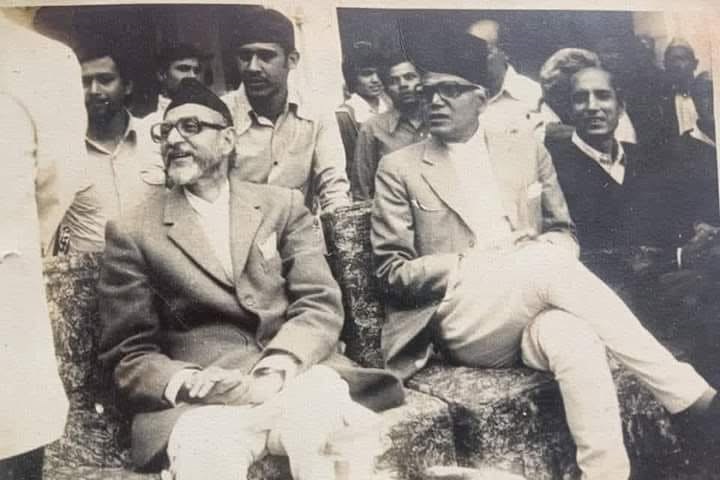
Shesh Raj Shiwakoti, editor of Gyangun publication, presenting a book to Gyanmani Nepal
Historians often describe Ganesh Pande as the military leader who brought Drabya Shah from Lamjung to Gorkha, overthrew the rule of the Khadka Magars, and established the Shah dynasty there. Kaji Kalu Pande—the grandson of Ganesh Pande’s great-grandson Jagatlok Pande—was the preferred and most trusted military commander of King Prithvi Narayan Shah. He is widely discussed in history. When Kalu Pande lost his life in Kirtipur during the war of 1757, Prithvi Narayan Shah expressed that he felt as though he had lost his right hand.
Among Kalu’s sons, the eldest, Bansharaj, fell victim to the wrath of Queen Rajendra Laxmi and Kaji Sworup Singh Karki, and was executed at Bhandarkhal. The youngest son, Damodar Pande, was executed at Bhadrakali under the plot of Swami Maharaj Rana Bahadur Shah and Bhimsen Thapa.
While Bansharaj was the eldest and Damodar was the youngest, Kalu Pande also had a middle son, Sardar Ranashur Pande. During Prithvi Narayan Shah’s unification campaign, he was deployed to the eastern front. His descendants secured employment there and settled in and around Manebhanjyang in Bhojpur. According to the Pande lineage, Ram Bahadur was born to Bhimkumari, the eldest of the two wives of Tilak Bahadur, who represented the seventh generation of Ranashur. Out of Ram Bahadur’s two daughters and three sons, Bidya Devi was born as the eldest child.
From this perspective, the historical lineage of former President Bidya Devi Bhandari (formerly Pande) is quite remarkable.
The presence of such a historical figure at the second memorial day of historian Gyanmani Nepal must be considered a pleasant coincidence. Another coincidence is that both belonged to the Bhojpur district—Gyanmani hailed from Siktel and Bidya Devi from Manebhanjyang.
Gyanmani’s quest for history
When Gyanmani arrived in Kathmandu from Bhojpur to quench his thirst for knowledge, Nepal was shrouded in the darkness of the Rana regime. Although the relatively liberal Padma Shumsher attempted to introduce some reforms, he was heavily besieged by hardliners like Mohan Shumsher.
Gyanmani began his initial education at the Gurukul-style school started by Nayaraj Panta. It was the very school that produced a succession of unparalleled scholars. The contribution of Nayaraj Panta’s disciples to the field of Nepali historical research is of the highest order. Historian Gyanmani Nepal was one of those brilliant disciples.
Having dedicated more than 40 historical works to Nepali society throughout his life, his subject expertise was heavily utilized by Tribhuvan University’s Centre for Nepal and Asian Studies (CNAS) and the then Nepal Royal Academy. Although his physical body has departed, he will continue to shine like a bright constellation in the Nepali sky.
Among his published works, Nepal ko Mahabharat (The Mahabharata of Nepal) is a rare masterpiece. He published this work by meticulously analyzing, from various angles and based on historical evidence, the political tragedies that occurred from the demise of King Prithvi Narayan Shah up to the Kot Massacre—the bloodshed that propelled Jung Bahadur to power. If a country’s politics is sound, everything prospers; if politics deteriorates, everything falls apart. To understand how Nepal’s politics decayed, one must read this book. History is a discipline that must be read to identify past shortcomings, review them in the present, and adopt measures to improve the future. However, because Nepal’s leadership failed to read history and learn lessons from it, the masterpiece Nepal ko Mahabharat, which Gyanmani Nepal published through immense hardship, sweat, and intellect, ended up becoming a pearl cast before swine.
He published this work at a time when the monarchy was still constitutionally alive. In this sense, he presented himself as an exceptionally courageous historian. His other works also possess solid, evidence-backed historical value.
Where is the recognition of his contribution?
After completing his studies under Nayaraj Panta’s Gurukul system, Gyanmani Nepal returned to Bhojpur and immersed himself in teaching by establishing a school. Despite his busy teaching schedule, he remained equally diligent in his historical pursuits. Later, he came to Kathmandu to fly in a wider sky of knowledge. As mentioned earlier, he significantly advanced historical research and writing during his time at CNAS and the Academy.
Given such vast academic endeavors, how much did the nation honor him? Who will answer this question today?
Connecting back to the earlier discussion about former President Bidya Devi and her historical lineage, it would not be an exaggeration to state a few facts here.
Whether spending a decade as president or serving as a minister in the government prior to that, Bidya Devi held immense power. Why did she lack the wisdom to ensure state recognition for historian Gyanmani during that time? While decorating numerous individuals with honors, titles, and medals from Sheetal Niwas, why did she never look for Gyanmani Nepal—a man who made extraordinary contributions to the exploration and writing of history?
It was natural for Gyanmani not to receive any medals during the autocratic Panchayat regime, as he was a democrat. Although democracy with a constitutional monarchy followed later, it is easy to see that he was excluded because the palace retained the authority to distribute national honors. In fact, during the Panchayat era, the royal palace repeatedly obstructed his access while he was studying historical documents at the Ministry of Foreign Affairs.
Why didn’t the royal palace honor him? Because by 1993, he had already published Nepal ko Mahabharat, in which he portrayed Prithvi Narayan Shah’s successors—Pratap Singh Shah, Rana Bahadur Shah, Rajendra Bikram, and Surendra Bikram—along side Bhimsen Thapa, Mathabar Singh Thapa, and Jung Bahadur as antagonists of Nepali politics. Instead, he presented Prithvi Narayan Shah, Prince Bahadur Shah, Kalu Pande, Damodar Pande, and Amar Singh Thapa as the true heroes of Nepal. It was not surprising that a palace occupied by the descendants of Rana Bahadur did not deem him worthy of an honor. However, the failure of the Federal Democratic Republic of Nepal to remember Gyanmani Nepal is an absolute injustice. This is especially true given that Bidya Devi Bhandari sat at the highest office of the nation, being a descendant of Kalu Pande—whom Gyanmani and other historians presented as a heroic figure of Nepal.
Similarly, every year the state confers national-level awards to Nepali talents across various fields, including history. Yet, while his juniors were showered with awards, no one seemed to remember the veteran Gyanmani. Instead, the felicitation volumes published through Gyangun Prakashan, run independently by scholar-worshipper Sheshraj Shivakoti out of his own pocket, became the only medium to comfort the historian’s heart.
We are left only with the regret that we failed to properly honor Gyanmani while he was still alive.