Kathmandu
Monday, June 15, 2026





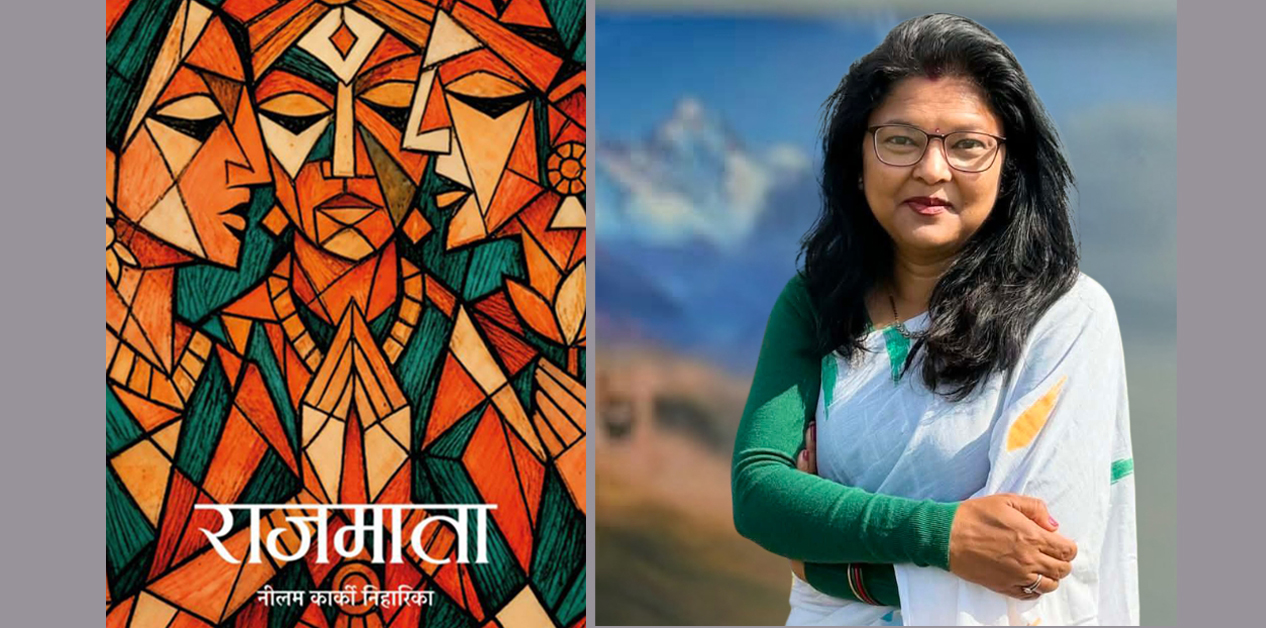
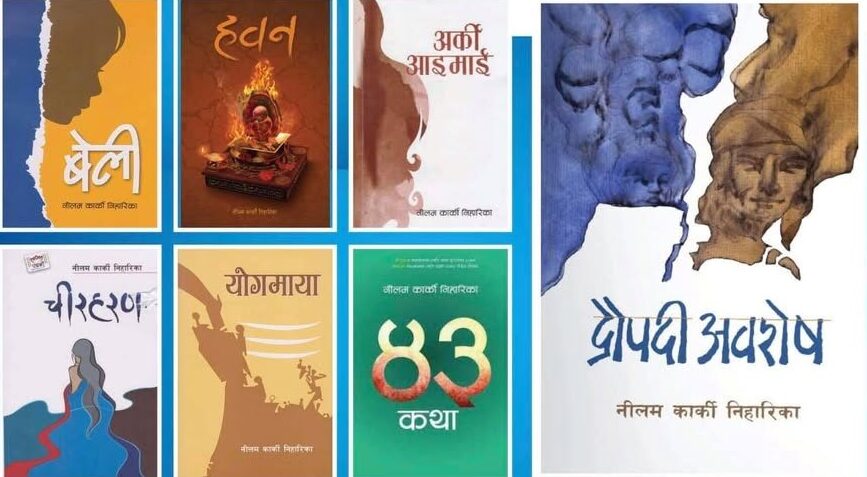
Neelam Karki Niharika is the recipient of the prestigious Madan Praskar for Yogmaya ( 2074 BS), Padmashree Literary Award for Cheerharan (2072 BS), and Ganki Dhuswan-Basundhara Award for Draupadi Awashesh (2078 BS), recognized for her contribution to the advancement of Nepali language, literature, and history. She has just released her new novel Rajamata in the market.
The creator of two poetry collections, three story collections, and seven novels, Niharika has been writing from her home in America to enrich Nepali language and literature. What follows is an edited excerpt of a virtual conversation Nepal News’s Dhruba Satya Pariyar had with Niharika about her new novel, contemporary writing, and the experience of writing.
Your novel Rajamata has just come out. How did the idea of writing it come to you? Or, what is its creative genesis?
It goes back to the day Yogmaya was launched (2074 BS). I felt light, as if a ritual had been completed, but the characters were still there in my mind. Let me put it this way: I had not quite left the world of Yogmaya.
Shortly after returning home after the launch, my mother said: “Daughter, now read and understand and explore, then write another novel about such mothers who contributed to governance.”
It had been a few days since my mother had completely lost her eyesight. Trying to find where I was sitting, she said further: Write Rajamata.
My mother had planted the seed of the novel in me and even come up with the title. On the very day I had completed a major task, the day a significant ritual had been concluded, she had given me another obligation.
My mother always had great curiosity about my writing. She would motivate me with questions from time to time. This time she had given me an entire subject for writing. She knew that my guru Yagyanidhi had suggested I write Yogmaya, and that had been discussed further at the launch that same day. Perhaps thinking that I would write when given a subject, she gave me the topic complete with a title.
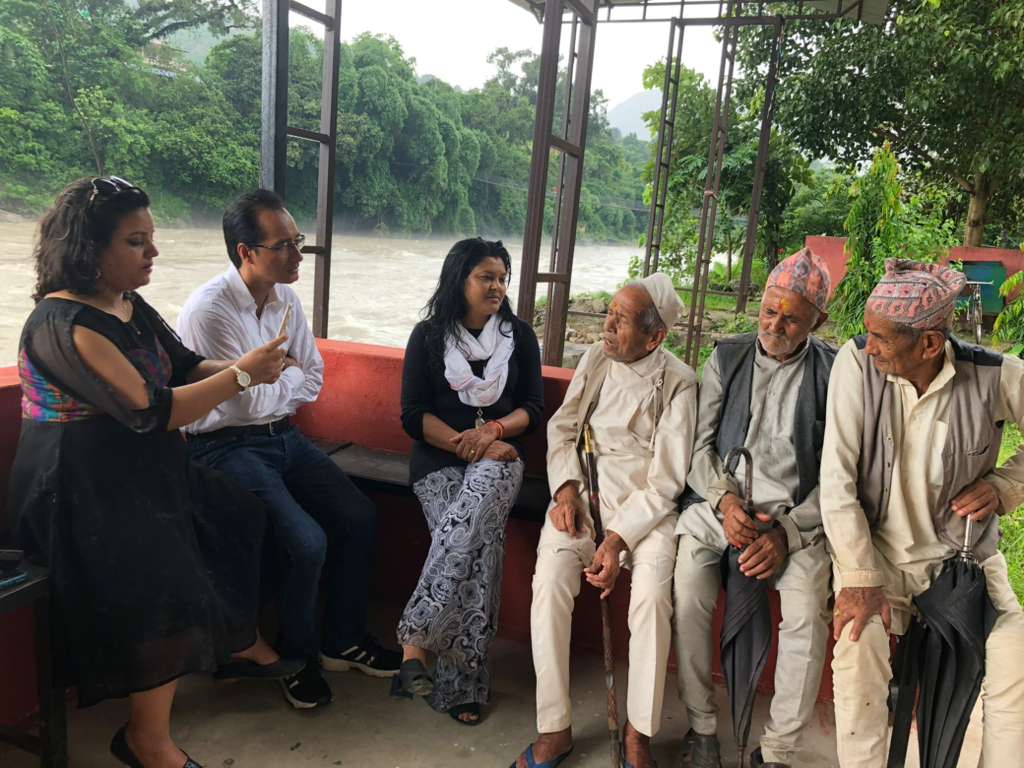
That same evening my mother said something else too: “Now, you must get the novel Cheerharan translated into Hindi.” I committed to carrying both works forward together.
How much research did you have to do to write Rajamata?
The next day I went to Ratna Pustak Bhandar (famous book shop in Kathmandu) to set both works in motion. I talked with Gobinda Shrestha dai about translating Cheerharan. He took on the responsibility of contacting a suitable translator, and I returned carrying some history books.
Before writing Yogmaya, I had gone to the home of historian Gyan Mani Nepal sir. Before writing Rajamata, I telephoned him one morning and shared my plans for the upcoming writing. He suggested some books I should study. I then went to libraries and other bookshops, and met Prof. Dinesh Raj Panta sir, from whose personal library I also obtained books. After gathering as many books as would fit in two suitcases, I returned to America and settled in for study.
As I read, I would get quite confused at times. I would find differing opinions among authors in various books and would speak with knowledgeable persons by telephone. Sometimes I would reflect and choose the path that seemed right to me, and sometimes I would take a middle road.
I had planned to go for fieldwork to various areas of the valley and then to Gorkha, Lamjung, Tanahun, Makwanpur, Sindhuli, and all the way to Nalapani. When I visited Nepal I would find time and go for fieldwork. I also went to Nepal with study as my primary purpose. Each time I would gather materials and return, and sometimes friends would send materials from Nepal. Midway through, the COVID-19 pandemic forced me to set the writing aside for some time. I had plunged into research from 2074 BS (2017/18), and after that phase was complete I started writing continuously from Magh 2080 (Jan/Feb 2024), without allowing anything to distract me.
What is the central struggle of the main character in Rajamata? Measured against the yardstick of the country, time, and circumstances, how far apart are Yogmaya of your Madan Puraskar-winning novel Yogmaya and the queen mothers of Rajamata?
Before writing Yogmaya, I had written Cheeirharan based on the Mahabharata, and then wrote Yogmaya by tracing the history of the people. Yogmaya was born 158 years ago. The Yogmaya novel contains the social and political environment of that time. The story of Rajamata begins 700 years ago. Yogmaya contains the history of the people, Rajamata the history of rulers. Both have different eras and different backgrounds, but within those differences there is similarity in women’s struggles. The causes of pain may differ, but there is no difference in the height of the mountain of pain. I found that society’s way of looking at women was identical in both periods – the poignant rhythms of the sighs from palace and hut were the same, the trust and distrust in women’s capability the same, and the skill women showed in times of crisis and the pivotal role they played the same.
Among all the characters you have brought to life or given a new world in your fiction so far, which is your most beloved and why?
This is a very difficult question. If choosing, Yogmaya is a very dear character to me. Similarly, Taru from Arki Aimai, Pema from Draupadi Awashesh, and Draupadi from Cheerharan are equally dear. Perhaps because I have just finished writing her, Devaldevi of Rajamata feels as if she is right around me. If I must choose just one right now, I choose Devaldevi of Rajamata.
We had read about King Jayasthiti Malla; it was Devaldevi who brought Jayasthiti to Bhaktapur by palanquin in 1411 BS. She arranged Jayasthiti’s marriage to her granddaughter Rajalladevi and taught Jayasthiti statecraft. Jayasthiti came to be known by his own name only after Rajalladevi’s death. Until then, he was known as Rajalladevi’s husband.
At that time the valley practiced dual governance. In such a time Devaldevi had managed power from close to the throne. Yet, we were not taught about this Devaldevi in our lessons; the state did not consider it necessary. A woman had made a significant contribution to her paternal kingdom of Nepal Mandal without formally holding a position, and forgetting this leaves our history incomplete.
What I found during my research for Yogmaya and Rajamata is that there is a tendency to understand or explain men’s contributions by exaggerating them as much as possible; giving credit to what women have done in history and the present is a distant matter- there is even reluctance to speak their names. Whatever the case, Yogmaya’s identity as someone who contributed to society is established to some extent in Nepal. Now, it is equally necessary to read, understand, and reflect on Devaldevi’s contribution too. That is why I choose Devaldevi.
Most male writers are found to present heroines as beautiful in form; they describe and praise women’s physical attributes. In your view, what kind of male character is beautiful?
That man who respects every woman is beautiful.
When writing literature, how much do you consider society and loved ones? Are there any episodes where thinking of society or loved ones while sitting to write meant you could not write openly? In other words, has caring about society and loved ones prevented you from writing any subject you wished to write?
I do consider them, and must. Even wanting to, the pen cannot always be carefree and unbound. For some subjects one has to rely more heavily on metaphor. When developing a story, one must be careful not to wound a community’s culture, and must study that subject deeply and weigh every word in writing. For instance, the novel Draupadi Awashesh had the theme of polyandry, a culture practiced in those times. It was very difficult to weave a story on that subject.
What is the oldest item (other than books) you have kept in your collection? Why have you kept it?
What I have that is old is memory, and that cannot grow old either; I carry it with me and leaf through it page by page from time to time. Another old object is a diary in which I have noted down some points or subjects needed for writing.
There is my father’s tape recorder, about 40 years old, and my brother’s video camera. That tape recorder no longer plays, and that camera no longer captures the present, but I have kept them safely, just like memories.
Why do you write literature? What difference does it make to society if you don’t write?
I write for satisfaction. The feeling that I have fulfilled a responsibility after writing gives me immense satisfaction. If all writers like me were to stop writing, it would certainly make a difference to society. I published my first book in 2051 BS (1994/95) and have been writing since. Perhaps at some point I wrote purely out of the desire to publish, but even if my current writing is still called desire, it is a desire that comes with responsibility and accountability. Can you imagine a society without history, art, and literature? You cannot! These are essential elements for society. And someone must write in this field. We who are devoted to the pen write spontaneously. Creation is the duty of the creator; the creator must fulfill their duty.
Most of your works feature historical and mythological characters. Have you already decided on the characters for your next work?
Right now, I am reading various history books and also noting down episodes and characters. I have not yet decided which character and episode to write about. Perhaps I will arrive at a decision soon.