Kathmandu
Tuesday, June 16, 2026





A recent decision to suspend Parliament and issue ordinances has reignited debate over whether Nepal’s emergency lawmaking powers are being used as constitutional shortcuts
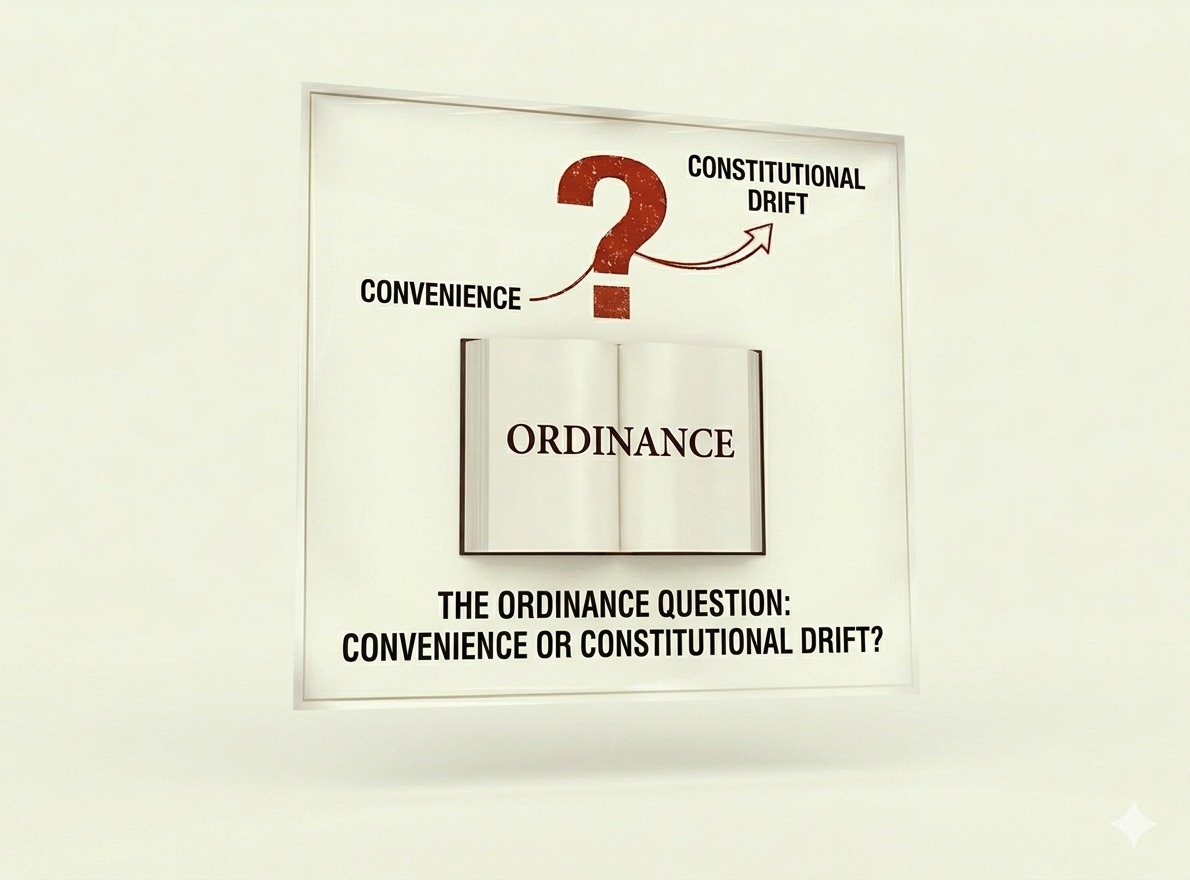
KATHMANDU: There is something deeply telling about a government that calls Parliament into session and then suspends it within 24 hours, citing vague special reasons, only to immediately push through executive ordinances on the very subjects that session was meant to address.
This is precisely what happened in Nepal on April 27, 2026, when the cabinet of Prime Minister Balendra Shah, barely a month into office after a historic election victory, chose to suspend a parliamentary session it had itself recommended and proceed to issue ordinances on the Constitutional Council and cooperatives.
The irony runs deep. Shah and his Rastriya Swatantra Party came to power on the back of one of the most dramatic political upheavals in Nepal’s post-republic history. The September 2025 Gen Z protests, which left more than 75 people dead and saw parliament buildings set ablaze, were fundamentally a cry against the corruption, manipulation, and contempt for accountability that had characterised Nepal’s governing class for decades.
Shah, a 35-year-old former mayor of Kathmandu who had publicly sided with the protesters and turned down the offer to become interim prime minister at the height of the crisis, embodied the promise of a clean break. His party won 182 of 275 seats in the March 2026 elections, the first parliamentary majority any single party had secured in Nepal since 1999. Voters had handed him an extraordinary mandate.
And yet within weeks, his government had done something that constitutional experts described as unprecedented in Nepal’s republican history: calling a parliamentary session for April 30 and then recommending its suspension, creating the legal window necessary under Article 114 of the constitution to issue ordinances.
The very tool that generations of older, discredited politicians had wielded to bypass, undermine, and manipulate Nepal’s legislature was now being reached for by the very government that had promised to do things differently.
To understand why this matters, why it is not simply another political controversy but a window into something structural and deeply rooted, you need to understand Nepal’s long and troubled relationship with the ordinance power.
What the Constitution Actually Says
The ordinance provision sits in Article 114 of Nepal’s 2015 Constitution. It is framed, as such provisions usually are in democratic constitutions, as a narrow exception. When both houses of parliament are not in session and the government concludes that immediate action is necessary, the President can promulgate an ordinance on the recommendation of the Council of Ministers. Once issued, it carries the same legal force as a parliamentary Act.
But it is inherently temporary. Once Parliament reconvenes, the ordinance must be placed before it. From the first day of that session, a 60-day clock begins ticking. Within those 60 days, the government must introduce a replacement bill and get both chambers to pass it, converting the ordinance into permanent law.
If Parliament explicitly rejects it, or if the window simply closes without a vote, the ordinance ceases to have any legal effect. The President can also revoke an ordinance at any time on the government’s recommendation, which has happened several times in Nepal’s history when a new government wanted to undo its predecessor’s work.
If Parliament explicitly rejects it, or if the window simply closes without a vote, the ordinance ceases to have any legal effect.
The constitutional logic is straightforward enough. Legislatures cannot always be in session, and life does not pause for parliamentary recesses. If a genuine emergency arises where the absence of law would cause immediate, serious harm to the public, the executive needs a mechanism to act quickly. The ordinance is that mechanism. The critical constraint is that it must genuinely be urgent, and Parliament must have the final say once it reconvenes.
In practice, Nepal’s political culture has bent this logic so far out of shape that the original purpose has become almost recognizable.
The Historical Pattern
Nepal’s experience with executive lawmaking predates the republic. During the Panchayat era before 1990, legislative authority was concentrated so thoroughly in the monarch that the question barely arose in the parliamentary sense.
The restoration of multiparty democracy in 1990 brought constitutional monarchy and a system where Parliament held legislative primacy in theory, though governments used recesses for executive action fairly regularly. The Interim Constitution of 2007, which guided Nepal through its turbulent transition, had similar provisions, and successive governments used them without the systematic abuses that would come later.
The pattern of deliberate, politically motivated ordinance misuse became pronounced after the 2015 Constitution established the federal democratic republic. Parliamentary research documented that between 2015 and 2020, 49 ordinances were issued but only 17 were converted into permanent law.
The rest either expired when the 60-day window passed without a vote, were revoked by incoming governments, or simply lapsed in the fog of shifting coalitions and parliamentary dysfunction. The constitutional exception had become the default mode of governance for matters governments found too politically sensitive or too inconvenient to push through the legislature in the normal way.
The presidencies of Ram Baran Yadav, who served as Nepal’s first president from 2008 to 2015, and Bidya Devi Bhandari, who served from 2015 to 2023, offer a study in contrasts on how the head of state can either restrain or enable this tendency.
Yadav, operating under the Interim Constitution, is remembered more for his role in protecting constitutional stability than for ordinance controversies. His most significant act was signing the 2015 Constitution into law on September 20, 2015, doing so despite significant Madhesi protests and considerable political pressure from various quarters. Constitutionalists generally credit him with prioritising institutional stability and the completion of the constitutional process over partisan considerations, though he was not without critics.
The presidencies of Ram Baran Yadav, who served as Nepal’s first president from 2008 to 2015, and Bidya Devi Bhandari, who served from 2015 to 2023, offer a study in contrasts on how the head of state can either restrain or enable this tendency.
Bhandari’s legacy is starkly different. Her eight-year tenure became inseparable from her relationship with KP Sharma Oli and his governments, and the accusations of partisan bias that followed that relationship. Constitutional lawyers repeatedly pointed out a visible pattern: ordinances from Oli’s cabinets were signed with unusual speed, sometimes on the same afternoon they were recommended, while measures from governments she appeared to oppose were delayed, returned for reconsideration, or subjected to procedural hurdles.
The citizenship bill case is particularly instructive. When Parliament, under the Deuba government, passed a citizenship bill that had been debated for years and sent it to Bhandari for authentication, she returned it on August 14, 2022 with 15 points of concern, exercising a right the constitution granted her.
Despite this, the House of Representatives re-passed the bill on August 18, 2022, without any changes, followed by approval from the National Assembly, also without amendments. The bill was then resubmitted to the President on September 5, 2022. Under Article 113(4) of the Constitution of Nepal, the President is required to authenticate a bill within 15 days if it is returned and passed again unchanged. However, President Bhandari did not authenticate the bill by the midnight deadline of September 20, 2022, triggering an unprecedented constitutional standoff in Nepal.
Her critics noted the contrast with her handling of Oli’s ordinances, particularly on citizenship related matters, where she had shown no such hesitation. The charge of selective constitutionalism tailored to partisan preference proved difficult to rebut.
Constitutional Council Crisis in December 2020
No episode better illustrates how the ordinance power can be weaponised than the events of December 2020. The Constitutional Council is the six-member body that recommends candidates for Nepal’s most important constitutional positions: the Chief Justice, election commissioners, the head of the Commission for Investigation of Abuse of Authority, National Human Rights Commission members, and others.
These are the guardians of Nepal’s accountability architecture. Who sits in them determines whether anti-corruption investigations are independent or politically managed, whether elections are administered impartially or tilted, whether judicial appointments reflect merit or favour.
The council is chaired by the Prime Minister and includes the Chief Justice, the Speaker, the Deputy Speaker, the National Assembly Chairperson, and the leader of the main opposition. The law at the time required five of the six members to be present for a quorum, and specifically required the presence of the opposition leader, a deliberate design to ensure that appointments to these critical bodies required cross-party consensus rather than simple executive control.
Then Prime Minister KP Sharma Oli had been attempting to convene the council for months, but then Speaker Agni Prasad Sapkota and then opposition leader Sher Bahadur Deuba boycotted the meetings. With the quorum requirement blocking him, Oli’s cabinet issued an ordinance on December 15, 2020, amending the Constitutional Council Act to reduce the quorum to a simple majority of existing members. President Bhandari signed it the same afternoon it was presented to her.
That evening, Oli convened the Constitutional Council with only himself, then Chief Justice Cholendra Shumsher Rana, and then National Assembly Chairperson Ganesh Prasad Timilsina. Three members, constituting a bare majority of the five-member council as it then stood since there was no Deputy Speaker.
Then Prime Minister KP Sharma Oli had been attempting to convene the council for months, but then Speaker Agni Prasad Sapkota and then opposition leader Sher Bahadur Deuba boycotted the meetings.
They recommended 38 people to constitutional bodies. Five days later, on December 20, Oli dissolved the House of Representatives, eliminating the parliamentary mechanism through which the ordinance would have had to be tabled and the appointments subjected to the mandatory parliamentary hearings required under Article 292 of the constitution.
The Supreme Court reinstated the House in February 2021, and Oli presented the ordinance to Parliament. The Nepali Congress obstructed the session in protest. On May 4, 2021, Oli reissued the ordinance and made 20 more appointments to constitutional bodies. On May 22, he dissolved the House again.
The Supreme Court again ordered the House reinstated, this time ordering Deuba’s appointment as prime minister on July 13. Deuba’s government revoked the ordinance on July 18, just hours before the reinstated House convened its first session.
By the time the dust settled, 52 individuals had been appointed to constitutional bodies through a process that bypassed the quorum requirements designed to ensure cross-party consent, bypassed the parliamentary hearings mandated by the constitution for such appointments, and bypassed Parliament itself through strategic dissolutions.
Legal challenges mounted. Fourteen writ petitions were filed. The Supreme Court’s Constitutional Bench eventually delivered a divided verdict in July 2025, validating the appointments by majority on the technical grounds that the ordinances were legal instruments issued when Parliament was not in session and that lapsed executive actions cannot be retroactively invalidated. Dissenting justices argued that constitutional spirit, if not the letter, had been violated.
The middle path proposed by Justice Sapana Pradhan Malla, retrospective parliamentary hearings as a remedy, was offered but not adopted. The appointments largely stood, and the precedent was set.
The Deuba government’s revocation of the Oli ordinance did not, however, automatically restore clear law. The revocation without a replacement act left Nepal in a legal gray zone about what rules actually governed the Constitutional Council.
The original 2010 Act’s provisions were technically back in force, but their interaction with the revoked ordinance and subsequent legal challenges created genuine uncertainty. Multiple attempts to bring a permanent amendment bill failed.
In July 2025, President Ram Chandra Paudel returned a Constitutional Council amendment bill to Parliament citing constitutional concerns, declining to authenticate legislation that had passed both houses. The question that Oli’s December 2020 ordinance had opened remained unsettled six years later.
Deuba Government’s Contradictions
Sher Bahadur Deuba came to power in July 2021 as the court-ordered corrective to Oli’s constitutional overreach. The expectation from civil society and parliamentary reformers was that his government would take the high road and repair the norms that Oli had damaged. What actually happened illustrated a pattern that has repeated itself across Nepal’s party system: the tool looks very different depending on which side of it you are standing.
The timing was nakedly political: it directly benefited Madhav Kumar Nepal and other leaders who were breaking from Oli’s UML to form CPN (Unified Socialist), a new party that would then support Deuba’s coalition.
Within a month of taking office, Deuba’s cabinet issued an ordinance amending the Political Parties Act. The amendment lowered the threshold for splitting a political party from 40 percent of both the central committee and the parliamentary party to 20 percent.
The timing was nakedly political: it directly benefited Madhav Kumar Nepal and other leaders who were breaking from Oli’s UML to form CPN (Unified Socialist), a new party that would then support Deuba’s coalition. The Deuba government used the ordinance power to reshape the party landscape in its favour within weeks of condemning Oli for using the same power in ways it described as unconstitutional.
The 2022 parliamentary research report and subsequent documentation concluded that the cycle had become self-perpetuating. A government issues an ordinance for political convenience. Parliament fails to convert it into permanent law within the 60-day window, either because the coalition shifts, because the opposition obstructs, or because the government simply does not prioritise it. The ordinance lapses. The legal gap it was supposed to fill remains. A future government then issues another ordinance to address the same gap, making the same convenience argument. The Constitutional Council Act, passed around in this way between Oli ordinances, Deuba revocations, and failed replacement bills, represents the most extreme version of this cycle, but it is not the only one.
Even the acid attack and sexual violence legislation, often cited as examples of genuine emergency ordinances, required multiple reissuances before eventually becoming permanent law in 2022. The same law was ordinanced, lapsed, reordinanced, lapsed again, and finally converted into a permanent Act only after years of civil society pressure. The constitutional architecture envisions ordinances as temporary bridges to permanent legislation. Nepal’s political culture has made them into revolving doors.
September 2025 Rupture and Its Implications
Understanding why the Balen Shah government’s ordinance move in April 2026 carries such particular weight requires understanding the context that brought Shah to power. The September 8 and 9, 2025, Gen Z protests were not simply about one government or one set of policies. They were a comprehensive indictment of an entire political culture.
Young Nepalis who had grown up in the republic, who had known no other system, looked at what the 2015 Constitution had produced and found it wanting. They saw rapid cycling through prime ministers, none of whom stayed long enough to implement meaningful change. They saw constitutional bodies packed with loyalists. They saw the CIAA, supposed to fight corruption, staffed through the very politicised appointments process that Oli’s 2020 ordinance had manipulated. They saw a Supreme Court Chief Justice, Cholendra Shumsher Rana, who had participated in the Constitutional Council meetings that made the controversial December 2020 appointments and then faced accusations of conflict of interest when those appointments were challenged in court.
The September 8 and 9, 2025, Gen Z protests were not simply about one government or one set of policies.
The protests turned violent after security forces used live ammunition against demonstrators on September 8. At least 74 to 77 people died, more than 2,000 were injured, and by September 9 parliament buildings, the prime minister’s residence, and party headquarters were in flames. Oli resigned and fled. The army imposed a curfew.
In an extraordinary moment, protest leaders held an online vote on the Discord platform and selected former Chief Justice Sushila Karki as their choice for interim prime minister. President Paudel appointed Karki, dissolved the old parliament on September 12, and set elections for March 5, 2026.
The dissolution had an immediate cascading effect that is directly relevant to the April 2026 ordinance controversy. Without a House, there was no Speaker, no Deputy Speaker, no recognized opposition leader, no parliamentary party structure. The Constitutional Council, which depends on these very positions as members, became completely non-functional. No Chief Justice could be appointed, no election commissioners confirmed, no CIAA heads recommended. The accountability architecture of the state went into institutional suspension.
The elections themselves delivered a verdict that constitutional Nepal had not seen since 1959 in terms of its decisiveness. The RSP, led by Shah wave, won 182 of 275 seats. Shah received close to 70,000 votes in his constituency, the highest individual vote total in Nepali electoral history, and he defeated Oli in Oli’s own home district of Jhapa, where the former prime minister had won every election since 1991 except one.
Several veteran politicians from established parties lost to RSP candidates in constituencies those parties had considered safe for decades. For many voters, particularly younger ones who had been on the streets or had watched from afar, the election was a direct continuation of the September uprising through democratic means.
Shah was sworn in as Prime Minister on March 27, 2026. He has promised governance reform, transparency, and accountability. He has a near two-thirds in parliament. He has the mandate and the numbers to pass legislation through the normal process.
What Happened in April 2026
The sequence of events in April is worth examining closely, because the details matter constitutionally and politically. On April 21, 2026, Shah’s cabinet recommended to President Paudel that Parliament be convened. The President accordingly summoned a session for April 30.
Two days later, on April 23, the government sent another letter recommending the postponement of that session, citing special reasons. The President’s office issued a notice confirming the suspension. Then, on April 27 the Cabinet decided to bring ordinances on the Constitutional Council Act and on cooperatives, and recommended them to the President.
Constitutional experts stated publicly that while this may not be explicitly prohibited by the constitution’s text, there is no precedent in Nepal’s republican history for a government suspending a parliamentary session that it had itself recommended the President call. They argued that calling Parliament and then withdrawing it specifically to clear the path for ordinances is contrary to constitutional morality and undermines the public trust that comes from transparent, formal governance processes.
The criticism from opposition parties came quickly and carried some predictable hypocrisy given their own histories. Nepali Congress spokesperson Devraj Chalise said it was not appropriate to suspend a parliamentary session to bring ordinances. Senior NC leader Arjun Narsingh K.C. called the suspension unprecedented and surprising.
Nepali Communist Party leaders said the government had initiated a wrong practice, noting that with such a clear majority, laws could have been made through Parliament directly. A leader from the NC pointed out that the government, with its near two-thirds majority, had called a parliamentary session for the first time in Nepal’s republican history specifically to bring ordinances and then suspended it without meeting, a practice they described as unprecedented.
The criticism from opposition parties came quickly and carried some predictable hypocrisy given their own histories.
The government’s own MPs offered a more defensive framing, calling it a coordination issue and a technical error regarding the finalisation of dates. The government’s broader argument was that the legal uncertainty around the Constitutional Council’s operating rules was severe enough to require immediate clarification before the newly complete council began making appointments, since any appointment made under unclear legal rules could later be challenged in court and destabilised. The cooperatives ordinance, the second measure, was framed as responding to a genuine regulatory urgency in Nepal’s cooperatives sector, which has been in ongoing crisis.
The irony that constitutional experts and opposition figures alike noted was pointed. The Constitutional Council had finally become complete on April 27, when Nepali Congress elected Bhishma Raj Angdembe as opposition leader, filling the last vacancy in the six-member council. The council could now function. It could make recommendations for the Chief Justice and other positions through the proper process, with all members present, using whatever legal framework was in place.
The claimed urgency of the ordinance was therefore questionable: the problem the ordinance was supposed to solve, a deadlocked council unable to function, had resolved itself through the normal political process just days after the ordinance was recommended.
President Paudel’s Response and What It Tells Us
President Ram Chandra Paudel, who succeeded Bhandari in March 2023, has developed a noticeably different institutional style than his predecessor. Where Bhandari signed Oli’s Constitutional Council ordinance the same afternoon it was presented to her, Paudel’s office responded to the Shah government’s ordinances with the statement that the ordinances are being studied. At the time of writing, he had not yet signed them.
This caution is consistent with Paudel’s broader record. He declined to sign an NC-UML coalition government’s Constitutional Council ordinance in 2024, citing concerns about its content and timing. He returned the Constitutional Council amendment bill to Parliament in July 2025, listing areas he believed needed reconsideration, including the majority-based decision-making provisions.
His critics argued he was blocking legitimate parliamentary decisions. His defenders said he was raising genuine constitutional questions about whether proposed changes to the council’s operating procedures were consistent with the constitution’s spirit.
The comparison with Bhandari’s behaviour reveals something important about the presidency’s role in Nepal’s ordinance culture. When the head of state functions as a rubber stamp for cabinet recommendations, the ordinance becomes a tool with essentially no external check. The President’s signature is constitutionally required, but if it is automatic, the check is nominal. When the President exercises genuine deliberation, as Paudel appears to be doing, the process slows down and forces the government to reckon with whether its reasoning is actually sound. This is closer to how the mechanism is supposed to work, even if it creates political friction.
The Pending Appointments and the Stakes
The immediate practical consequence of the Constitutional Council’s eight-month deadlock is a backlog of critical appointments. The Supreme Court has been operating under Acting Chief Justice Sapana Pradhan Malla since Prakash Man Singh Raut retired on March 31. Courts function under acting leadership for extended periods at a cost to their credibility and institutional authority.
The Judicial Council had already forwarded a roster of six eligible candidates for the Chief Justice position: Malla herself, Kumar Regmi, Hariprasad Phuyal, Manoj Kumar Sharma, Nahakul Subedi, and Til Prasad Shrestha.
Beyond the top judicial appointment, the council needs to fill positions on the CIAA, the National Human Rights Commission, the Women’s Commission, and other bodies. These are not bureaucratic formalities. The CIAA in particular matters enormously in a country where the September 2025 protests were fundamentally about corruption and impunity. Who leads it, and whether they are independent or beholden, determines whether Nepal’s post-protest accountability ambitions have any institutional backing.
This is the real argument for the Shah government’s position: the legal uncertainty around the council’s operating framework is not a technicality but a genuine structural problem. If the council proceeds with appointments under ambiguous legal rules, those appointments can be challenged in court and potentially invalidated, as happened with multiple Oli-era appointments that spent years in legal limbo before the Supreme Court’s divided 2025 verdict.
Beyond the top judicial appointment, the council needs to fill positions on the CIAA, the National Human Rights Commission, the Women’s Commission, and other bodies.
The ordinance, in theory, cuts through that ambiguity and gives the council a clear legal basis to operate. The question is whether the urgency of that clarification actually required bypassing Parliament, or whether a government with 182 seats and a majority that most of its predecessors could only dream of could simply have brought the amendment bill to Parliament and passed it in a week.
What Genuine Reform Would Look Like
The deeper problem the April 2026 controversy exposes is not specific to Balen Shah or the RSP. Every government that has wielded the ordinance power has made some version of the same argument: the situation is urgent, Parliament is unavailable or impractical, we will fix it properly later. The later rarely arrives. The constitutional exception becomes the operative mode of governance for anything politically sensitive.
Genuine reform would need to address several dimensions simultaneously. The first is definitional: what actually constitutes an emergency justifying an ordinance? The constitution uses the phrase “immediate action is necessary” but does not define it. Political convenience is not an emergency.
A legal uncertainty that has existed for five years, as with the Constitutional Council Act, is not a sudden emergency. A parliamentary session that could address the matter in days given the government’s majority is not an unavailability. Courts have been reluctant to second-guess government declarations of urgency, but clearer constitutional language or binding precedent defining what counts would constrain the abuse.
The second dimension is procedural. The 60-day conversion window exists but is routinely ignored. The replacement bill is introduced late, not prioritised, or simply never scheduled for a vote. If the 60 days ran hard against the government, with automatic parliamentary scrutiny built into the session calendar and institutional penalties for failure to convert, the temporary nature of ordinances would be a genuine constraint rather than a theoretical one.
The third dimension is the most fundamental: the practice of calling or dissolving Parliament to create or eliminate the legal window for ordinances must be explicitly barred. The December 2020 Oli dissolutions and the April 2026 Shah suspension represent different ends of the same problem.
The constitution should say clearly that Parliament cannot be convened and then suspended within a short period for the purpose of enabling executive lawmaking, and should provide for judicial review of such manoeuvres on constitutional grounds.
The practice of calling or suspending Parliament to create or eliminate the legal window for ordinances must be explicitly barred
The fourth dimension concerns the President’s role. Paudel’s cautious approach is closer to what constitutional design envisioned than Bhandari’s rubber-stamp signing, but the constitution does not clearly define when a president can decline to sign an ordinance recommended by the cabinet, how long they can take to study it, and what grounds would constitute a legitimate basis for refusal.
Without clarity, the presidency’s ordinance role oscillates between automatic endorsement and unpredictable veto depending on the individual occupant of Sheetal Niwas and their relationship with the sitting government.
The fifth and in some ways most important dimension is political culture. Constitutional reform can change the rules, but rules only work when the political class accepts their legitimacy. Nepal’s ordinance culture is ultimately an expression of a deeper pattern: executive impatience with the slow, contested, compromise-demanding processes of parliamentary democracy.
Coalition management is hard. Getting an amendment through committee, both chambers, and potential opposition obstruction takes time and negotiation. An ordinance can be issued in an afternoon. Until the political class genuinely internalizes that parliamentary process is not an obstacle to be navigated but the substance of democratic governance itself, the rules will continue to be gamed.
The Balen Shah Test
The latest controversy is, in one sense, early days for a government that has barely had time to find its footing. Shah came to power after a period of extraordinary upheaval, inherited a constitutional council that had been non-functional for several months, and is trying to make appointments and establish governance frameworks while simultaneously managing a cabinet reshuffle, an economy stressed by regional disruptions, and the enormous weight of public expectations that his election created.
But the political honeymoon in Nepal’s parliamentary system is short, and precedents set early tend to calcify. If Shah’s government establishes in its first month that it will use the ordinance power even when it has a legislative majority capable of passing laws through Parliament, that precedent will be harder to walk back later.
The argument that the situation was technically urgent and legally complicated will be made again for the next contested piece of legislation. The argument that Parliament would be slow or unpredictable will sound more and more like the arguments made by every government that treated the legislature as an obstacle.
The Gen Z did not protest for a government that was somewhat less corrupt and somewhat more careful about constitutional propriety than its predecessors. They protested for a genuine break from the practices that had made Nepal’s political class contemptible in their eyes. The ordinance move, even if it proves to have some legal justification, sends a message that is difficult to read as anything other than business as usual dressed in new packaging.
The argument that Parliament would be slow or unpredictable will sound more and more like the arguments made by every government that treated the legislature as an obstacle
What Shah does next matters enormously. He could bring the Constitutional Council amendment as a regular bill to Parliament the moment it convenes, passing it through properly, and ensure that ordinances during his tenure are genuinely exceptional rather than convenient. He could establish institutional rules within his own cabinet about what circumstances justify recommending an ordinance to the President. He could commit publicly to the 60-day conversion window as a real deadline rather than a formality. He could, in short, use the overwhelming mandate his party received to actually build the governance culture that mandate promised, rather than defaulting to the same tools that made his predecessors so thoroughly distrusted.
Nepal’s constitutional bodies have operated in legal limbo for five years over a question that should have been settled by a proper parliamentary act within months of the original 2020 dispute. Every government that touched the issue chose expedient workarounds over the harder work of building legislative consensus. The Balen Shah government has the majority to end that cycle in a single parliamentary session. Whether it will is the most consequential question of its young tenure.
The Emergency That Never Ends
Nepal’s ordinance culture represents one of the cleaner examples of how formal democratic institutions can be systematically hollowed out not through their elimination but through their routine circumvention. The constitution is not violated in any obvious textual sense. The president signs, the gazette publishes, the law takes effect. But the legislative branch, which is supposed to be the primary lawmaking authority, is progressively sidelined. The 60-day window that was supposed to make parliamentary endorsement of ordinances the normal outcome has become a procedural fiction. And the result is exactly what constitutional scholars predicted: an accumulation of legal uncertainty, contested appointments, rival versions of the law operating simultaneously, and a political class that treats legislative process as optional when they have executive power.
The Gen Z generation that burned parliament buildings in September 2025 was expressing a very specific frustration: not just that their government was corrupt, but that the institutions designed to constrain corruption had themselves been captured and corrupted. The Constitutional Council was supposed to appoint independent accountability officials. It had been packed with loyalists through an emergency ordinance signed in an afternoon. The judiciary was supposed to adjudicate disputes impartially. Its chief justice had a direct conflict of interest in the cases before him because he had participated in the appointments being challenged. The legislature was supposed to make laws with cross-party deliberation. It had been dissolved twice when it was politically inconvenient.
Balen Shah’s government cannot afford to be remembered as the change that looked different from the outside and acted the same on the inside.
Nepal’s post-Gen Z movement is genuinely fragile: the old parties are discredited but not destroyed, the new government’s credibility rests almost entirely on its willingness to govern differently, and the constitutional institutions that need rebuilding can only be rebuilt if someone actually builds them rather than bypassing them when building them is inconvenient.
The ordinance on the Constitutional Council may resolve a specific legal ambiguity. It will not resolve the larger question hanging over Nepal’s political system: whether any government is actually willing to work through Parliament when Parliament is there, functioning, and capable of being worked through.
That question is what the latest controversy has put squarely on Balen Shah’s desk, and his answer to it will shape Nepal’s democratic trajectory far more than any individual appointment or piece of legislation ever could.