Kathmandu
Tuesday, July 21, 2026





Democratic rhetoric, undemocratic alliances

KATHMANDU: Following the Gen Z protests, a strong public sentiment to displace old parties and figures emerged and forced its way to the surface in Nepali politics. The foundation of this shift was a wave of populism. It was upon this very wave, initiated by the rise of Balendra Shah (Balen) as the Mayor of Kathmandu Metropolitan City, that the Rastriya Swatantra Party (RSP) was formed. Once Balen and the RSP’s ‘Bell’ symbol interconnected, it assumed the form of a full-fledged youth movement, which ultimately swept the RSP into parliament with an overwhelming mandate.
Now, the question arises—can this new wave steer the country in the right direction? The answer can only be found by deeply analyzing the policies, styles, and actions of these new forces that have emerged in Nepali politics.
The obsession with popularity and ideological ambiguity
On the eve of the election, the RSP desperately needed “celebrity” faces, at the center of which stood Balen Shah. A crowd of individuals possessing popularity and public appeal, but lacking adequate political maturity, became visible within the RSP. Aside from the popularity gained through rap music and the sheer willpower to clean up the mess created by the old parties through corruption, Balen himself possessed no prior experience in state governance or administration.
Leading a metropolitan city and leading a country are structurally entirely different matters. Governing a state requires a profound understanding of ideology, principles, democratic values, and institutional systems; transient desires and willpower alone are simply not enough.
Contradictions are equally evident in the RSP’s ideological foundation. Their internal working style resembles the ‘Politburo’ of an old communist party. Meanwhile, the influence of the US Republican Party’s ‘neoliberalism’ and former President Ronald Reagan is visible in their policies and programs. They claim they are not practitioners of ‘crony capitalism’, yet just like the old parties, they have elevated industrialists to policy-making levels via the proportional representation quota. This has exposed the glaring gap between their words and their actions.
Lack of internal democracy and coordination
When engaging in discourse, the RSP advocates for an American model of democracy and internal primary elections, yet its own internal democracy appears remarkably weak. The commands and dictatorial decrees of a handful of men seem decisive within the party. Emerging as a popular force based on the concept of ‘primaries’ for internal democracy, alongside the willpower to clean up the filth of anomalies and corruption left by old parties, is a positive attribute. However, when such a force aligns itself with narrow platforms like ‘MRR’—which is associated with hyper-masculinity, religious fanaticism, and the bypassing of legal procedures—it stops leading toward a democratic and egalitarian society. Instead, it advances toward a ‘populist authoritarianism’ that challenges established rules and human dignity.
The fact that the leadership met with the Army Chief during the youth movement and showcased proximity to military power raises serious questions about whether these new actors are treaded on a path that weakens democratic values and processes.
The eclipsing of experienced youth leaders like Ranju Darshana, Pukar Bam, and Toshima Karki, combined with the selection of leadership based on personal discretion, serves as proof that the party’s internal system has not matured. This immaturity is reflected in government operations as well. There appears to be a severe lack of minimal coordination among ministries; the statement of one minister openly contradicts another. Although attempts are made to show uniformity at the administrative level, various policy decisions and public statements signal internal friction and a lack of functional coordination among the ruling coalition partners.
Weak prioritization in the name of good governance
State governance and good governance translate to concrete plans and programs where consultations with stakeholders and victims are mandatory. However, under the pretext of urban development and disaster management, the current government hastily deployed bulldozers to displace landless settlers without following any legal procedures or arranging alternative housing—an act that cannot be justified as just from any angle. No factual investigation was conducted, nor were citizens given time to compose themselves.
Disregarding laws and democratic rules in this manner is utterly unacceptable. A government that tramples upon the constitutional rights and human dignity of its people just to make its job easier has no right to claim it stands for a just and free society.
Similarly, contradictions are glaringly obvious in their economic policies. Customs duties are being stringently collected from ordinary citizens bringing in goods worth over Rs 100 from border areas for their daily sustenance. Initiated without strengthening domestic industries or the foundations of self-reliance, this immature step has brought inflation rather than relief to poor consumers, while pushing the market into the control of a few select big businessmen.
While public education, healthcare, and health insurance schemes are falling apart, the government has failed to collect taxes from large corporate houses or those engaging in policy-level corruption to avert the financial crisis. Instead, it appears eager to grope around in the pockets of the poor.
The latest political wave and the RSP, which is leading the government, exhibit severe ideological deviation and a repetition of past blunders. If they merely change their rhetoric while repeating old mistakes, the country cannot take a leap forward.
The RSP brands itself as a centrist force in its policies. They claim they will transform our country’s economy to mirror wealthy European nations (specifically Nordic countries like Sweden or Norway), where an open market coexists with state-provided welfare benefits for citizens.
Not long ago, RSP leaders claimed they did not follow the path of neoliberalism or communism, nor did they favor crony capitalism that nurtures only big businesses. Yet, a massive gulf is visible between their words and deeds. If one deeply studies the decisions they have made so far, the bills they have presented in parliament, and their economic plans, their speeches to the public and their actual behavior move in entirely opposite directions.
Despite assurances of ensuring citizen welfare and social justice, their practical policies prioritize market forces and the profits of private companies. This completely contradicts the essence of the Nordic model they claim to emulate.
The risk of ultra-nationalism and undemocratic forces
Loving one’s country and taking pride in nationality is positive. However, when patriotism turns toward ultra-nationalism and religious fanaticism, it takes an intolerant form. The ‘Hindutva’ agenda in neighboring India or the steps taken by Netanyahu in Israel serve as examples of this. Ultra-nationalism and religion are weapons that can easily incite a crowd. If such a wave enters Nepal, a communally sensitive country like ours will not be able to withstand it.
The RSP’s growing proximity to undemocratic elements is another cause for concern. Out of pure anger toward the old political parties, royalist forces have been silently or directly supporting the actions of Balen and the RSP. The fact that the leadership met with the Army Chief during the youth movement and showcased proximity to military power raises serious questions about whether these new actors are treaded on a path that weakens democratic values and processes.
Meanwhile, rumors are circulating that Prime Minister Balendra Shah will not address the nation even on the occasion of Republic Day. If such historical contexts are governance-wise neglected, it demands a serious debate from the perspective of political theory, constitutional decorum, and democratic institutionalization.
According to modern democratic theory, the legitimacy of a government rests upon a constitutional contract. Republic Day is not just a festival or a mere formality; it is an emotional and legal declaration that the sovereignty of the state has been transferred from a lineage or an autocratic institution and is now vested in the common citizens.
Governing a state requires a profound understanding of ideology, principles, democratic values, and institutional systems; transient desires and willpower alone are simply not enough.
The Prime Minister’s position is an executive institution established precisely upon this republican and constitutional foundation. If we recall the social contract theory of political theorists, demonstrating allegiance to the state’s core political philosophy and foundation falls within the primary responsibility of the executive head. The silence of the executive chief on a historic occasion like Republic Day raises questions about institutional loyalty toward the core constitutional spirit and the established system of the state.
In this manner, the style currently observed in politics—which fosters groups of blind followers while allowing an authoritarian character to dominate under the guise of discipline or ‘action’—ultimately risks pushing the country toward fascism.
When studied comprehensively, the latest political wave and the RSP, which is leading the government, exhibit severe ideological deviation and a repetition of past blunders. If they merely change their rhetoric while repeating old mistakes, the country cannot take a leap forward.
Furthermore, at a time when we must run alongside the modern world, getting entangled in backward, archaic thoughts, religion, ultra-nationalism, or the monarchy debate will be an even greater misfortune for the country.
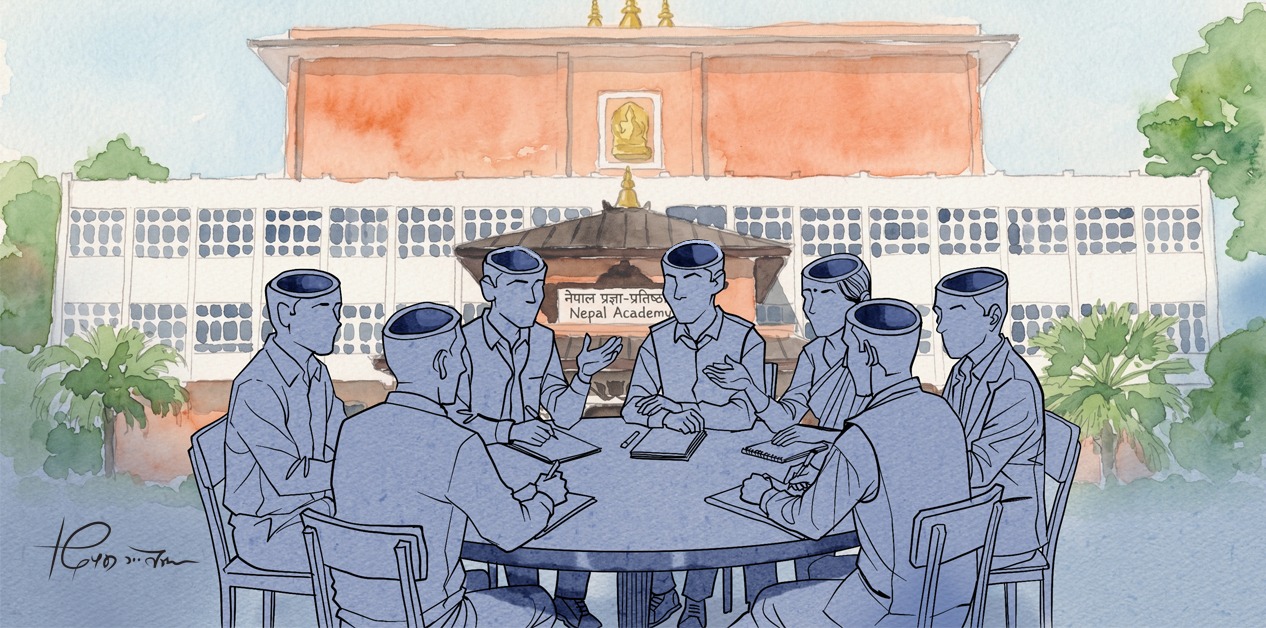
(Based on a conversation between political scientist Pyakurel and Lokendra Bishwakarma)