Kathmandu
Tuesday, July 21, 2026





If communist parties in Nepal want to attract the new generation and preserve their existence, they must not merely swell the crowd in their membership; they must return to the purity of ideology and conduct.
KATHMANDU: Following the results of last year’s parliamentary elections, political analyst Arun Subedi stated in an interview that “the political sterilization of communists in Nepal has occurred.” While one may not completely agree with his argument, it has opened the door for further discussion and discourse regarding the Nepali communist movement. And this is indeed necessary.
Let us discuss the membership of communist parties itself. Will Nepalis take up communist party membership now or not? To ponder the depth of this issue, I have initiated a discussion from its history. Across the world, and specifically in Nepal during the mid-20th century (from the 1950s to the 1990s), people were highly attracted to taking up membership in communist parties. The primary reasons behind this were the social, economic, and political conditions of that era. Communism was an ideology that envisioned a society free of exploitation and showcased a dream of radical transformation. The 1848 ‘Communist Manifesto’ explained to the world a detailed breakdown of why people are poor, along with the causes and solutions.
Looking at history, many world-famous and influential individuals have held communist party membership. There are also several famous individuals who sought membership or whose thoughts were closely aligned with the communist movement. The references to some famous individuals in world history who wished to join or were associated with communist parties are noteworthy.
The scientist Albert Einstein openly held socialist views. In 1949, he even penned an essay titled “Why Socialism?” Although he was not an official member of the communist party, American intelligence agencies kept him under surveillance for years due to his leftist leanings and sympathy toward the Soviet Union, suspecting him of being a ‘communist agent’ or being connected to the party.
Actor and director Charlie Chaplin’s film Modern Times strongly protested capitalism and industrial exploitation. Although he did not take up membership in the American Communist Party, he was very close to communist ideology and party workers. Because of this, during the Cold War, he was accused of being a communist in America, and he ultimately had to leave the United States.
On the other hand, painter Pablo Picasso took up membership in the French Communist Party in 1944. Upon joining, he stated, “My joining the Communist Party is the most logical step of my life.” Following that, he remained an active member and supporter of the party throughout his life.
George Orwell, the author of famous books like Animal Farm and 1984, was initially deeply attracted to socialism and the communist movement. During the Spanish Civil War, he traveled to Spain to fight against fascism alongside the communists. However, after witnessing Joseph Stalin’s methods in the Soviet Union, he later became a staunch anti-communist.
The Nobel Prize-winning American author Ernest Hemingway was also deeply connected with communist and leftist fronts during the Spanish Civil War. According to FBI files, he had even come into contact with Soviet intelligence agencies and was assigned a code name. However, he did not become an active political worker.
South African leader Nelson Mandela was initially very close to the South African Communist Party (SACP). According to historical documents, during the early phases of the anti-apartheid movement (in the 1950s and 1960s), he even took up membership in the Central Committee of the Communist Party. However, he later established his identity as the leader of the African National Congress (ANC).
There was a period in history (from the 1930s to the 1960s) when intellectuals, artists, writers, and scientists across the world seemed eager to acquire communist party membership or connect with its ideology in their search for equality and justice. This was because, in the past, communist party membership was not just a piece of paper from a political party or a mere party affiliation; it was a matter of life philosophy, lifestyle, and unwavering dedication. Communist ideology was implemented in one’s actual life. Today, however, times have changed.
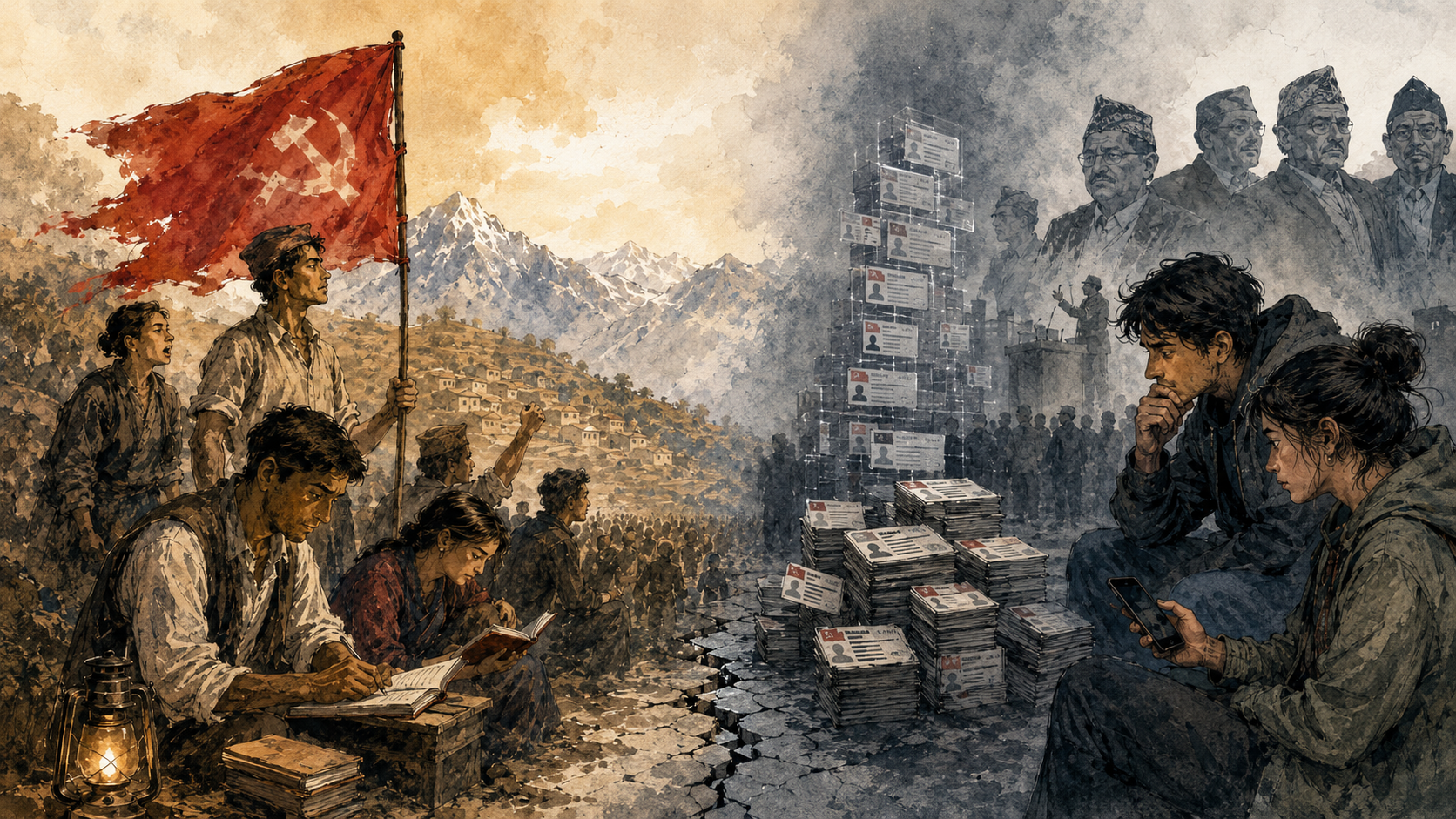
There was an era when receiving communist party membership in Nepal was equivalent to receiving a certificate of being the most ideal, self-sacrificing, and transformative citizen in society. In the past, regardless of an individual’s background, it was believed that once they took shelter under the communist party flag, a radical change in their thinking and a class transformation must occur. Membership was not merely a weapon to increase electoral arithmetic; it was a pledge of loyalty toward the proletariat and a revolutionary way of life.
At that time, obtaining party membership was a Herculean task. There was a system where specific criteria had to be met, ideological tests had to be passed, and the party minutely scrutinized an individual’s daily conduct, social circles, and lifestyle. The doors of the communist party remained shut to those carrying feudal and bourgeois mindsets, those with nouveau riche tendencies, or those consumed by personal greed. Even after gaining membership, if someone failed to mold their lifestyle in accordance with communist conduct, their membership would be revoked—countless such examples are preserved in Nepal’s communist history. The party operated as a school where every member was trained to become an agent of social transformation.
Here lies a vast space for ideological debate. On one hand, despite placing such strict boundaries of discipline and testing around party membership, deviations gradually began creeping into practice. Because of this gap between theory and practice, the parties narrowed down in some situations, and their popular base began declining.
On the other hand, parties like the CPN (UML) adopted a comparatively flexible policy regarding membership distribution. While adopting a strategy to turn the party into a cadre-based people’s party through a network of mass organizations, a massive crowd of cadres and members gathered there. Along with that crowd, however, a massive flood of non-communist conduct and bourgeois tendencies also entered the party.
The topic for debate here is: Does ideological strictness make an organization small? Conversely, even if policy leniency builds a massive organization, does it carry the risk of losing the ideology and movement to the point where the very essence of being a communist vanishes? Today’s Nepali communist politics is wavering along this very path. Although Nepali communist parties talked about everything from the democratization of parties to internal democracy, they showed little interest in practicing democratic exercises. They took no steps toward reforming the party through internal democracy. Instead, the leadership seemed intent on penalizing those who attempted to debate reform or hold differing views within the party.
On what basis should party membership be granted now?
The pressing question currently facing the Nepali communist movement is: Based on what ideals, morality, practices, and foundations should the new generation take up communist party membership?
In the past, the struggle against feudalism and the dream of equality and equity inspired youth to become communists. Driven by a hunger for a change in conditions and the political system, young people were prepared to endure painful, underground lives for long periods. But today’s generation, living in the era of technology, demands immediate results and good governance. When the new generation witnesses the luxurious lifestyles, brokering tendencies, and corruption of leaders who call themselves communists, extreme aversion toward communists breeds within them.
The upcoming generation is not going to take up membership simply because someone says, “I am a communist.” What kind of answers will come forth when they ask the communist parties and their leaders the following questions: “How does this membership teach me to fight the climate change crisis? How will it eradicate economic inequality and unemployment in the country? Does this party genuinely represent women, the marginalized, and the youth, or does it merely protect the interests of elderly and established leaders?”
If communist parties fail to transform themselves according to the requirements and expectations of the new era—including the digital economy, social justice, transparent lifestyles, and good governance—the attraction of communist membership among the younger generation will completely disappear. No one will take up membership just to hang onto positional hierarchies within the party or to attend ritualistic meetings.
The future of supporters
Due to the ideological degradation and opportunistic character of old parties, including the communists, past staunch supporters and well-wishers find themselves deeply confused and dissatisfied today. Many supporters are silent now, or they have started looking toward new political alternatives. But will they change their political path forever?
There is a saying in politics that concluding that a single election closes or opens doors forever is hasty and incomplete. History is full of ups and downs. Facing defeat in an election or a decline in popular mandate does not mean the end of the communist movement itself. At the grassroots level, the inclination and desire for leftist thinking, social justice, and equality have not vanished. It is possible that well-wishers have merely distanced themselves from the party, not from the communist ideology itself.
If communist parties realize their mistakes, self-reflect, launch purification campaigns, and rectify their conduct, those well-wishers might return. However, if the parties continue running merely on the mathematics of power and old habits, this silence of the well-wishers will turn into a permanent rebellion, and they will change permanently.
Communist party membership used to be a way of life yesterday; today, it has turned into nothing more than a ‘database’ to win elections. If communist parties in Nepal want to preserve their existence, they must not focus on increasing crowds but must return to the purity of ideology and conduct. To attract the new generation, yesterday’s “story” is not enough; today’s “delivery” and tomorrow’s “clear roadmap” are essential.
There is no ultimate truth in politics; the door to reform is always open. The only condition is that the leadership must possess the courage and honesty to step through that door.