Kathmandu
Friday, June 19, 2026





When governance increasingly runs through ordinances sent to the President and stamped back into law, a satirical question emerges: is Parliament any different from wedding guests who have no clear role
KATHMANDU: Since childhood, I have not received a satisfactory answer to a question my grandmother once asked: “The groom has come to take the bride, but why have the wedding guests come?” Later, in books and articles on Nepali folk literature, I encountered the earlier part of this verse, along with similar segments, under titles such as ‘Wedding Q&A’ or the ‘Madyouli game,’ a tradition of singing folk verses during weddings, often performed by women or the bride’s friends.
This is a folk poem in a question-and-answer style, sung between the groom’s side and the bride’s side during weddings in Nepali society. There is a tradition of reciting such poetry by those who are not directly involved in the rituals or the management of the ceremony. Much like the Dohori songs popular today, these exchanges serve as a medium to tease one another, test wit and eloquence, and provide entertainment. One part of this poem goes like this:
Bride’s side:
“Kata paryo Mal-Madhesh, kata paryo Chin?
Dulaha aayo dulahi lina, janti aaye kina?”
Translation: Where lies Mal-Madhesh, and where lies China?
The groom has come to take the bride, but why have the wedding guests come?
Groom’s side:
“Dakhin paryo Mal-Madhesh, uttar paryo Chin,
Dulaha aayo dulahi lina, janti bhater khana.”
Translation: Mal-Madhesh lies to the south and China to the north.
The groom has come to take the bride, and the wedding guests have come to partake in the feast.
Because these poems belong to an oral tradition and demand quick, improvised responses, variation is inevitable. So if some insist that the verses I have cited are “not like this, but like that,” it should come as no surprise. Still, the opening lines I shared are heard in almost every version. What continues to trouble me, even now, is that persistent question: “Why have the wedding guests come?” I still do not understand why they come or go. Nor am I convinced they are there merely to eat. They must serve some purpose, yet I cannot say what it is. And so, I remain unmoved in my conclusion that the wedding guests, in essence, have no real function. If that is the case, why did they come at all?
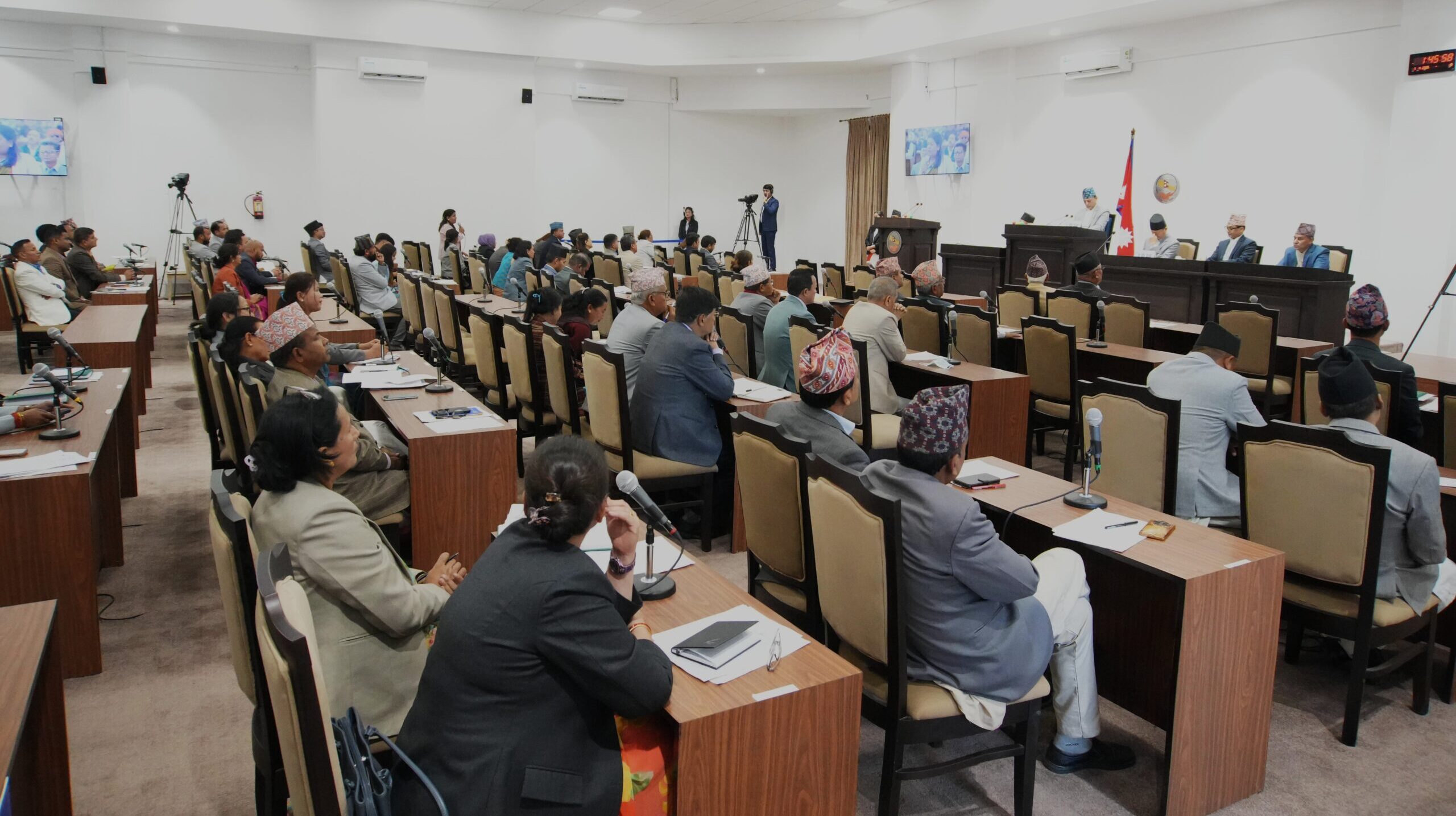
On top of this, another question emerges. Nepal recently held parliamentary elections, in which one party secured nearly a two-thirds majority. In between, there were quiet maneuvers and political adjustments. The President was prompted to convene a session of Parliament and, with some ingenuity, did so. But before the session could properly proceed, a message arrived to halt it, and, once again, the President obliged. The result was chaos. Members of Parliament suddenly found themselves without work. A group of them even staged a sit-in at the CDO office. The precedence set by the previous Parliament no longer applied, and the new one had yet to establish its own.
Fortunately, while previous upheavals may have swept aside governments and legislatures, the presidency was preserved and now proves useful.
In truth, even members of the ruling party seem distanced from power. When one must rely on social media just to catch a glimpse of the Prime Minister or the Home Minister, the only remaining option may be to approach the highest accessible representative of the central government, a government that hardly seems “federal” in practice. Some MPs turned up to intimidate a headmaster, repeating habits ingrained since childhood. Others appeared beneath the leaking tents of displaced squatters, as if quietly acknowledging that their standing within Parliament and the party is not much different. From a near two-thirds majority, the emergence of even a few such self-aware figures is, in itself, noteworthy.
Meanwhile, after halting Parliament, the government began dispatching ordinances to the president’s office in rapid succession, as if firing a .303 rifle (SMLE, Mark III). A couple were sent, then a pause, followed by several more. Within days, seven or eight ordinances had reached the president. Fortunately, while previous upheavals may have swept aside governments and legislatures, the presidency was preserved and now proves useful.
There is also talk of amending the Constitution, and it seems the government has already formed a task force to prepare a common consultation document. Public debate has split into two camps over whether to retain or scrap the provinces. Those who created them were never properly asked why they were necessary, while those calling for their removal argue that they are too costly. As for me, I had chosen to remain silent, thinking that rather than getting entangled in provincial debates, those in power should focus on larger questions. But the flood of ordinances has forced a new thought into my mind:
“Kata parchha Mal-Madhesh, kata parchha Chin?
Mantri chahiyo shasan garna, sansad chahiyo kina?”
Translation: Where is Mal-Madhesh and where is China?
A minister is needed to govern, but why is a member of Parliament needed?
Seen this way, the roles of those wedding guests and today’s Members of Parliament begin to look strikingly similar. The former appear to have no real function, and neither, it seems, do the latter. With roughly 15 ministers in place, along with a president to head the state, the country appears to run just the same. When laws are needed, ordinances are dispatched in quick succession to the president and returned just as swiftly with approval. What, then, is the purpose of Parliament?
This is no longer merely a question of whether provinces should be retained or scrapped. Why not do away with Parliament itself? It would save money, and little would be lost. Otherwise, a clear answer is due: why is a member of Parliament needed?