Kathmandu
Tuesday, July 21, 2026





Devendra Raj Pandey was selfless and fearless, he was independent. That independence was his greatest strength. He remained an independent intellectual throughout his life.
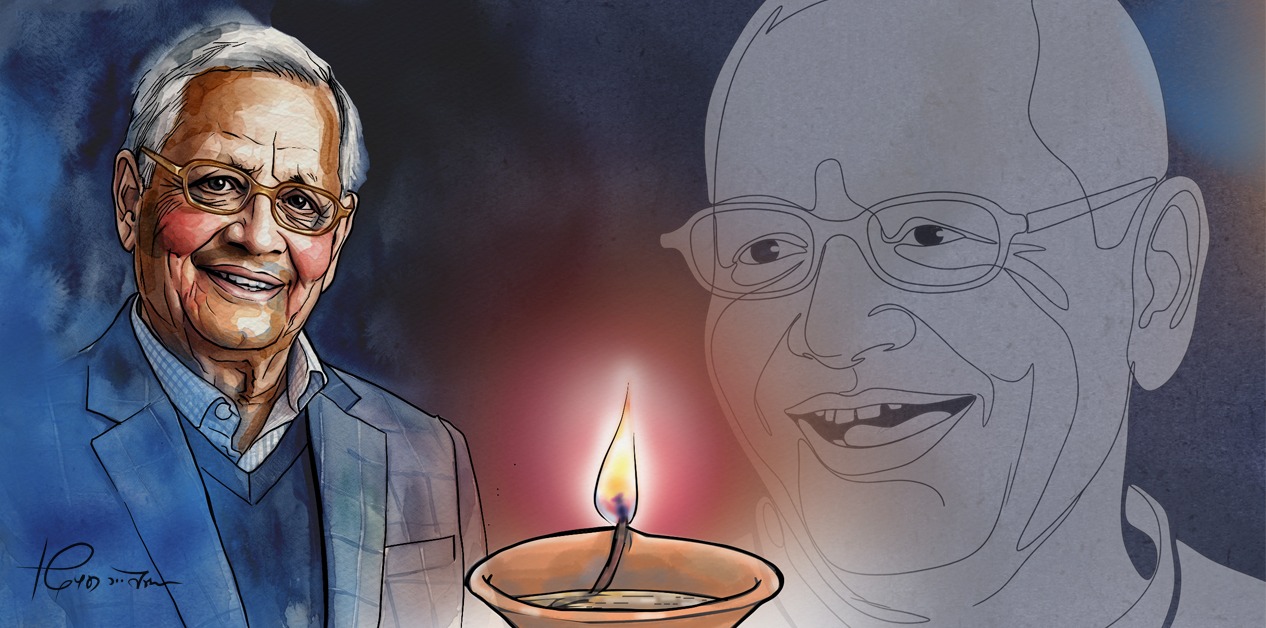
KATHMANDU: On January 14, 2024, I spoke about the “Concept of Self-Reliance and the Contribution of Dr. Devendra Raj Pandey.” At that time, Dr. Pandey was sitting right in front of me, listening. Sadly, his physical body is no longer with us. However, the memories he left behind remain fresh. His contributions and guidance are exemplary.
Since I was born in Bishalnagar, he was my neighbor. His youngest brother, Kalyan Raj Pandey, was my friend. We went to different schools, but we used to play cricket together.
Although I would catch glimpses of Dr. Pandey, we rarely spoke. The maternal home of his wife, Padma, and my residence were across the street from each other. Even before their marriage, we would see each other around, though we did not know each other or converse. However, we knew each other’s entire families.
My subsequent acquaintance was with Dr. Pandey’s elder brother, Narendra Raj Pandey. After returning from India with an MA, my first jobs were at Radio Nepal and The Rising Nepal. I had returned after studying for a master’s degree in sociology in India. Since I could not immediately find work in my own field, I landed an opportunity at Radio Nepal based on my decent knowledge of the English language. Although I felt uncomfortable speaking English, I could write it. I had to prepare written material for a five-minute current affairs program broadcast after the news. Narendra Raj held the entire responsibility for Radio Nepal’s English program. I worked with him for about a year and a half. That was a period of great learning for me.
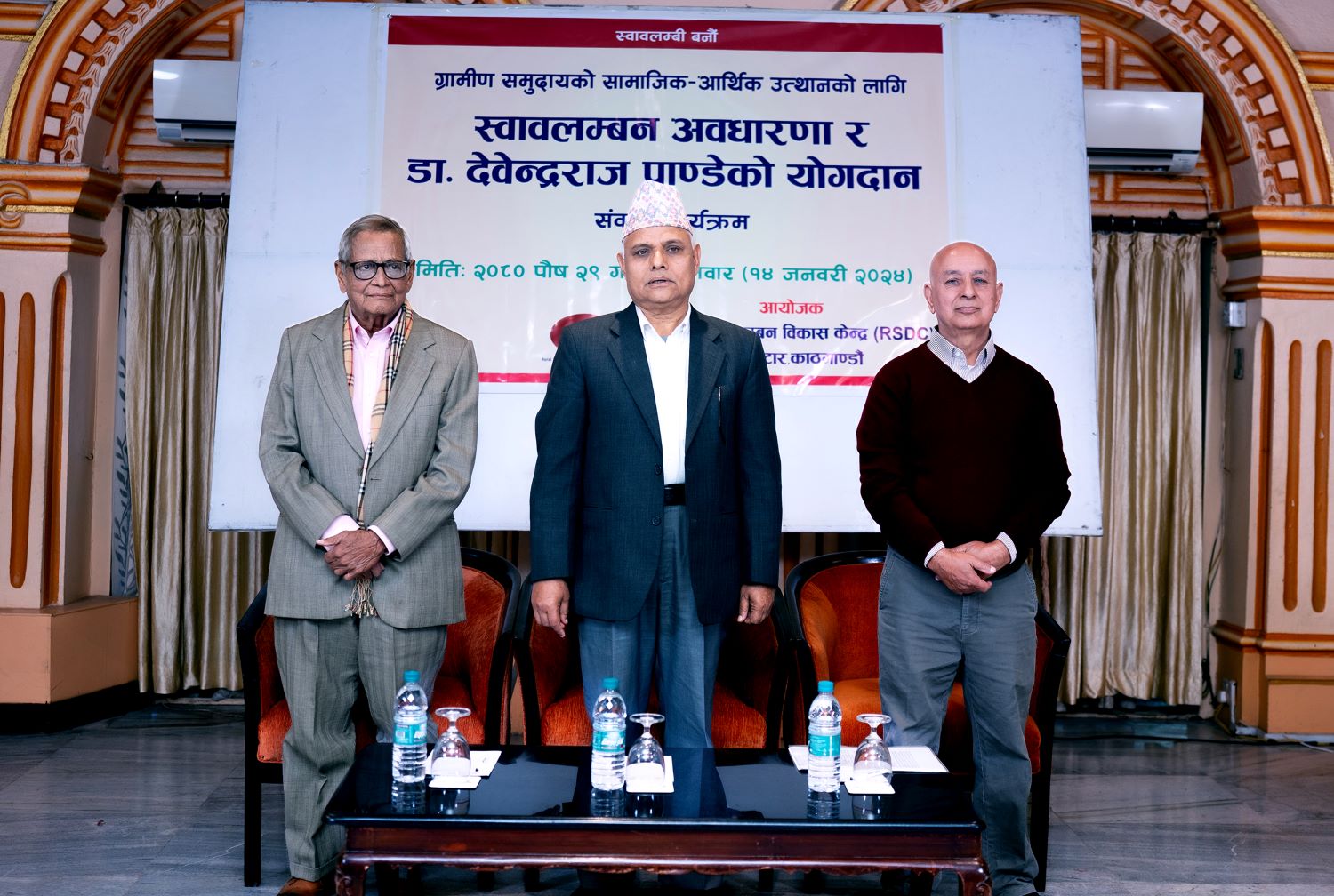
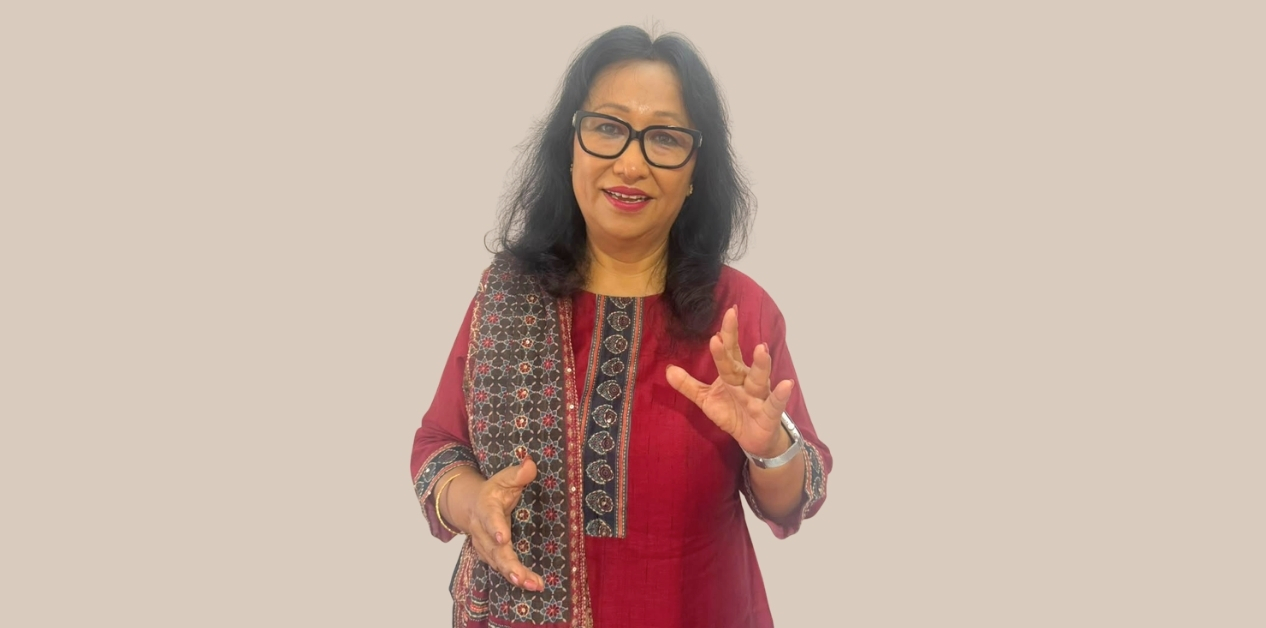
Devendra Raj Pandey, Rajendra Dahal, and Chaitanya Mishra
One thing I learned from him that I have not forgotten to this day. I had to collect and keep “clippings” on various topics such as development, tourism, culture, and festivals. At that time, he told me, “You do not have to memorize everything. It is enough to know where the facts are.”
His words that one must keep their mind empty to think of new things proved useful throughout my life. Even now, I do not remember numbers or dates. I learned from him that it is sufficient to know where the required source can be found when needed.
After resigning from government service, Dr. Devendra Raj Pandey became associated with IDS (later IIDS—Institute for Integrated Development Studies). That institution was started by Kula Shekhar Sharma, Bhesh Bahadur Thapa, and Prakash Chandra Lohani. One day, Dr. Pandey called me for a meeting and requested me to write a working paper on foreign aid. It turned out that five or six people like me had been asked to write working papers for a seminar organized by the institution.
Initially, I hesitated a bit. At that time, the topic assigned to me felt far removed from sociology. But I could not say no; I took it as an opportunity. That was where he and I got acquainted. After that, around 1987/88, I became involved in other works of IIDS.
A few years later, in 1998, Dr. Pandey called me again, saying we should co-author Nepal’s first Human Development Report. Prepared over a year and a half with the help of some colleagues, that report received an extremely positive response. The report viewed development not merely from the perspective of economic growth, but from the standpoint of human life, education, health, opportunity, and social justice.
He was clear about the interdependent relationship between freedom, democracy, and development. The Nepal Development Report, on which we collaborated, was based on the concept that “development and freedom rest on the empowerment and expansion of the capacity of every citizen and citizen group.” We followed the concept of Amartya Sen regarding the interdependent relationship between freedom and development, as well as the ideas of thinkers who shared similar views. That started a new chapter in the development debate in Nepal.
We did not do many projects together after that, but we kept meeting, and our relationship continued. Even though we were neighbors, our relationship was highly professional rather than personal. Nevertheless, he has visited my current home in Chabahil, Mitrapark, and I have been to his house. We know each other’s wives, children, and everyone.
His wife, Padma, had opened a school in Gyaneshwar—International School. My daughter attended pre-school there. I would often meet her when going to pick up my daughter. Even though the families knew each other, the relationship between Dr. Pandey and me was not at a personal level. We rarely discussed our private lives. When we met, we talked about the country, development, research, policy, politics, society, and the world. This is why I call our relationship deeply respectful and professional.
Thought and life
One of Dr. Pandey’s identities was also that of an economist. However, he earned his PhD not in modern-day “economics” but in “development economics.” Development economics is not just the study of the economy; it connects politics, society, culture, the state, history, and international relations. Therefore, he did not view economics, politics, and society as separate disciplines. The scope of his thinking was vast.
He believed that economics, politics, and society cannot be understood in isolation from one another. While subjects are separated in universities, they are all intertwined in life and society; hence, his thinking was that to understand society, everything must be looked at collectively.
During the time Dr. Pandey went to study in the United States, the Civil Rights Movement against segregation and inequality was taking place under the leadership of Martin Luther King Jr. Until that time, America was mostly presented as a unified society without major issues. Much attention was focused on what binds a society together.
After the 1960s, the divisions, inequalities, and struggles within American society began to manifest clearly. The Vietnam War also had a major impact on this. Witnessing the violence in the war, many people were outraged. People took to the streets and protested. Movements against racial discrimination, gender discrimination, and poverty were rising.
The impact of these movements was felt from the streets to the universities. Dr. Pandey was influenced by these events. Seeing people in America take to the streets for their rights, and witnessing events of war and injustice, broadened his perspective even further.
While going to observe the Civil Rights Movement, he was even detained by the police for a day. At that time, it must have crossed his mind that if a powerful country like America has marginalized people, then a country like Nepal faces far more problems.
My own experience says something similar. After returning from India, I felt that although I had read books, I had yet to understand the world. Therefore, by the time I was preparing to go to America, I had already made up my mind that going to America was not just to read books, but to read the world. Even though I was studying sociology, I was clear that I needed to understand society, understand America, and understand the world.
Hence, I viewed the five years of my doctoral studies as an opportunity to understand the world. I feel that a similar thing must have happened in Dr. Pandey’s case.
Some special qualities
Dr. Pandey possessed several special qualities that serve as an inspiration to me.
He was a man of serious dedication and commitment to his work. Once he made a decision to do a piece of work, it had to be done without any compromise. He believed that every task should be executed excellently. Slipshod, average work simply did not pass.
He worked extremely fast. A detailed report on the Integrated Rural Development Program implemented in Dolakha had to be prepared. To finish the work within the stipulated deadline, he drafted the approximately 70-to-80-page report in just two nights. That is an extraordinary capability. His commitment was visible not only in his thoughts but also in his discipline toward time.
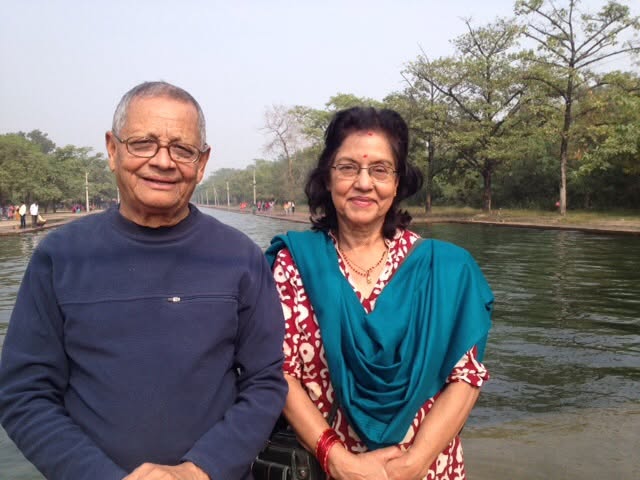
Devendra Raj Pandey with his wife Padma Pandey. Photo: From Devendra Raj Pandey’s Facebook page.
He was a man of deeply serious dedication. He felt a connection not just to Nepal, but to the entire world.
I tell my students: if you can blend life and theory, that becomes meaningful learning. Otherwise, it is mere pedantry. One must connect the sky and the earth.
Dr. Pandey was a person who successfully put this into practice. He could bridge the sky and the earth. He could clearly explain how the life of a Dalit or a marginalized person in Jhadewa village of Palpa, where he worked, was connected to the global economy. This was his intellectual hallmark.
He looked through a single lens at everything, ranging from the question of how a person in a village in Palpa can live a good life and how improvements can be made in education, health, and income, to the structure of international development cooperation.
He did not just look at Nepal. He held the perspective of learning from the world and teaching the world about Nepal. He used to say, “Foreign aid did not even give us the opportunity to learn from our own mistakes.”
The process of development must move forward with one’s own society learning from its own experiences. Making mistakes, learning from them, and making improvements again is the foundation of development. His understanding was that when all decisions are directed from the outside, learning itself gets blocked.
I remember a seminar. A large program on foreign aid was organized. Generally, much time is spent on such programs for the chief guest, inauguration, seating arrangements, long welcome speeches, and formalities. We follow many traditions without even thinking. He, however, was a person who could break such unnecessary traditions.
Independent citizen
His honesty, integrity, and outspoken nature are public knowledge. When speaking with donor agencies, the government, or any powerful entity, he could say what he felt was right without any hesitation or sugarcoating. He did not possess the nature to alter his views just to please someone. This very nature led him to resign from his government position as well.
The main reason for such fearlessness was his integrity. Because for him, morality was greater than any position. The greatest thing I learned from him was not just research or writing skills, but intellectual honesty. He never used his influence for personal gain. In Nepal, relatives or friends generally expect assistance from influential figures. But he never engaged in such practices.
He even defined the concept of “integrity” in his book The Idea of Integrity and the Universe of Corruption and Anti-Corruption.
Dr. Pandey proved his honesty, integrity, and morality by serving in the Nepal chapter of Transparency International, as well as on the board of its main headquarters in Berlin, Germany. He was an influential intellectual figure in South Asia. He was also active in intellectual networks. He played a significant role in regional organizations working on human rights, democracy, and public policy in South Asia. Accompanying him, I have traveled to countries including Sri Lanka, India, and Pakistan. When going to observe the elections in Pakistan, I received an opportunity to learn many things.
One feels that his life and the title of his book, Ek Jyan, Dui Juni, match perfectly. Many people are satisfied with a secure life. After attaining a good government job, prestige, and facilities, they stop there. But he always chose the path of challenge and honesty.
When I remember him, I recall his fearlessness more than his positions. His academic background, his writings, his tenure as a secretary, or his PhD are important. However, the courage to change his life according to his values is a far greater thing.
Dr. Pandey’s greatest qualities were honesty and fearlessness. I do not possess that level of fearlessness. During protests, he would walk right in the middle of the street holding a flag. I, on the other hand, would watch from the sidewalk. He was ready to go to prison; I was afraid. I do not have that quality of his.
I think this confidence came to him due to two reasons. First, he had seen the world. He presented his views based on the experience, study, and research of many countries.
He was dedicated to studies. Even when visiting America, except for spending time with his daughter or grandchildren, his core time was spent in the university library. Work like studying, writing, discussions, or public debates kept him continuously active.
Second, he had firsthand experience ranging from remote villages in Nepal to the ministries. Therefore, he did not consider the advice given by any foreign expert to be the ultimate truth.
His dedication to the society and the country was extremely deep. Development for him was not just a professional subject; it was a moral responsibility. That is why he was always found among the people and on the streets. His activism did not stem from a position, but from intellectual curiosity and a sense of public responsibility.
Because he was selfless and fearless, he was independent. That independence was his greatest strength. He remained an independent intellectual throughout his life. He never became a permanent spokesperson for any political party, government, or institution. He supported or criticized depending on the need and the situation.
In every speech and piece of writing, he consistently emphasized the principle of being an “independent citizen.” I feel that he motivated himself and others to become independent citizens. The ideas of a person who battles the surging tide of history become refined. As he aged, he became increasingly refined.
He viewed himself as a citizen. Because of his activism and courage in teaching Nepalis the meaning of transitioning from subjects to citizens, many regarded him as a leader of the civil movement.
In the current altered political context, citizens are again feeling a sense of dread. Dr. Pandey remained worried about this until his final days. If this crisis escalates, we will once again desperately need independent, principled, and fearless intellectual citizens like him.
(Based on a conversation with Professor Mishra by Prabhakar Gautam.)