Kathmandu
Monday, June 15, 2026





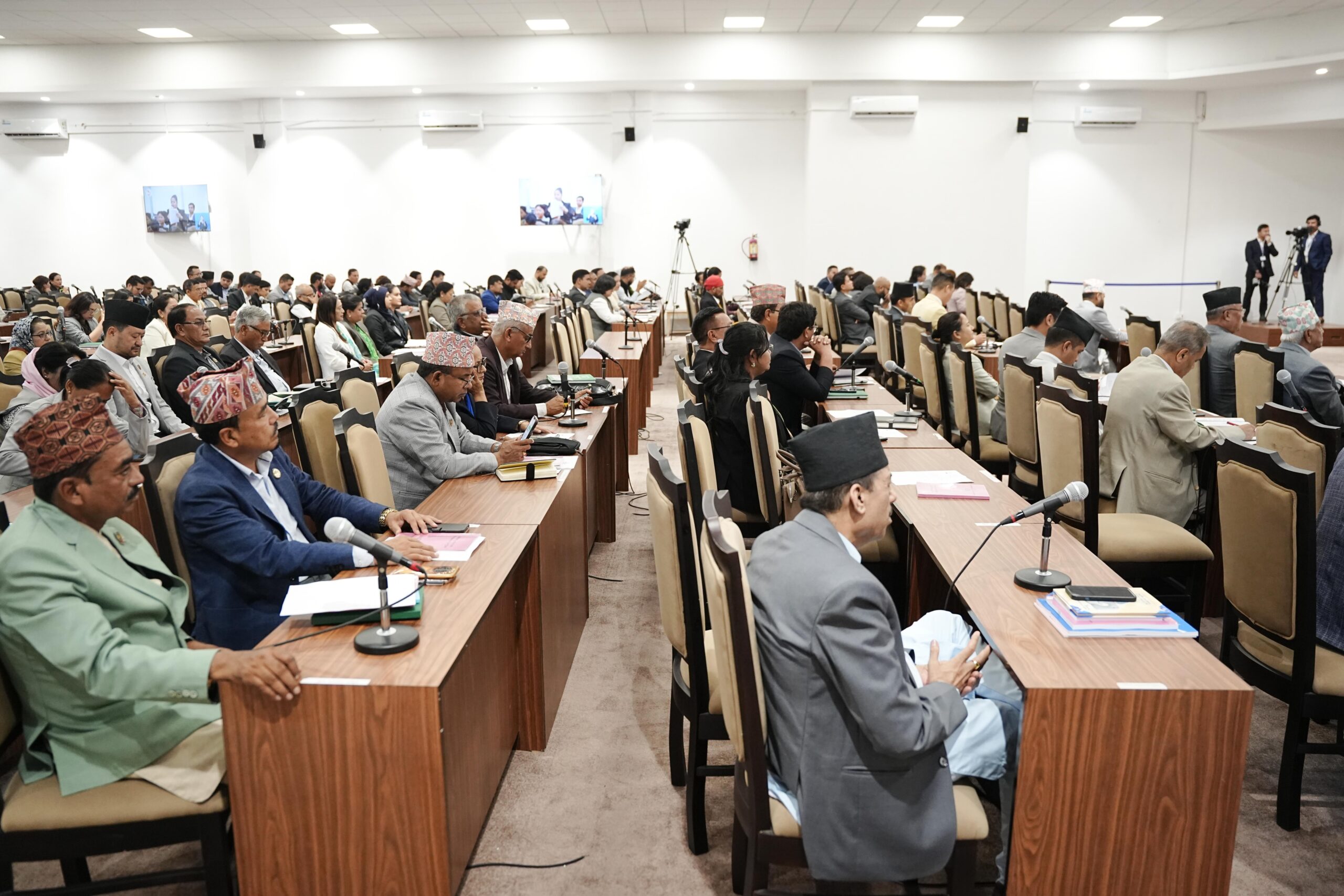
KATHMANDU: The recent electoral defeat of the Nepali Congress President Gagan Thapa, the declared frontrunner for the prime ministership, has thrown the Nepali Congress into introspection over its parliamentary leadership. Of the 18 direct seats contested, 14 were won by candidates aligned with Thapa. In contrast, only four candidates loyal to former party president Sher Bahadur Deuba, Dr. Shekhar Koirala, and vice-president Purna Bahadur Khadka secured victories.
Overall, Congress will enter the House of Representatives with 38 MPs-18 from direct elections and 20 through proportional representation. Despite finishing second, the party holds no decisive sway in forming the next government. The Rastriya Swatantra Party (RSP) has narrowly missed a two-thirds majority by just two seats, leaving Congress in a defensive posture than ever in electoral history of Nepal. Though the party retains the position of the main opposition, its scale is notably diminished compared to RSP’s sweeping mandate.
With nearly all senior leaders defeated, the race for parliamentary party leader is less contentious, though internal consensus remains tricky. Many in the party favor selecting a leader by unanimity rather than internal election, given the breadth of losses.
Who won where?
Within the Thapa faction, 14 out of 18 candidates emerged victorious: Firdosh Alam (Rautahat–2), Abhishek Pratap Shah (Kapilvastu–3), Khadka Bahadur Budha (Jajarkot), Sandeep Rana (Palpa–1), Basna Thapa (Dailekh–1), Mohan Acharya (Rasuwa–1), Santos Subba (Tehrathum–1), Bharat Swar (Achham–1), Prakash Singh Karki (Solukhumbu–1), Narendra Kerung (Panchthar–1), Jankaraj Giri (Bajura–1), Nishkal Rai (Ilam–1), and Khadga Shahi (Mugu–1). Yogesh Gauchan from Mustang aligns with Shekhar Koirala’s camp, though his ticket was secured post-special general convention, reflecting an institutional balancing act. Despite being Koirala-aligned, Gauchan is reported to side with Thapa’s bloc.
Among the Deuba, Koirala, and Khadka camp, only Bishnu Khadka (Surkhet), Tek Bahadur Gurung (Manang), Jayapati Rokaya (Humla), and Bharat Bahadur Khadka (Doti) won. Rokaya, from Humla, straddles the factional divide and is reportedly considered above factional politics.
Proportional representation and factional balance
While Thapa’s dominance is evident in direct elections, the proportional list reflects former establishment influence. Former president Deuba had set the proportional list to secure his sway prior to the special general convention. Of the 20 proportional seats Congress is to secure, 13-15 are expected to hail from the Deuba-Koirala faction. Combining proportional and direct wins, the parliamentary bloc could comprise 14 MPs aligned with the establishment and six others from outside. Final allocations, however, remain unsettled, and a very few seats could introduce competition in the parliamentary leadership contest.
The proportional list also mandates gender representation, with Congress expected to appoint 15 female MPs. Among proportional MPs, senior leaders Bishma Raj Andembe and Arjun Singh KC possess parliamentary experience, positioning KC as a strong contender for parliamentary leadership. Meanwhile, debates continue over whether a younger leader might be appropriate, balancing experience with political dynamism.
Some within the party advocate consensus-based selection over elections, fearing factional rivalry. Even if Thapa had won, unanimous leadership selection would have been difficult. Given the party’s weakened state, experience and internal consensus are key. Electoral setbacks have diminished its scale, yet the party remains the primary opposition force. Factional loyalties persist, but internal consensus appears increasingly necessary to maintain cohesion. Whether leadership emerges through negotiation or election, Congress’s ability to unify and present a credible parliamentary bloc will determine its relevance in Nepal’s reshaped political landscape.
Congress’ historic fall: from two-thirds majority to its weakest showing in history
Nepal’s political landscape has undergone a seismic shift. The March 5 House of Representatives elections delivered unexpected defeats to senior leaders and long-established parties, most notably the Nepali Congress (NC), which has long stood as the pillar of democratic politics in the country. Constituencies that had been the stronghold of the Congress for decades now witnessed their political equations overturned, signaling the end of an era.
Since its formation in 1947 through the unification of the Nepali National Congress and the Nepal Democratic Congress, NC has been the torchbearer of multiparty democracy. It dominated the first general election of 1959, winning more than two-thirds of the seats—74 out of 109, or 67.89%. The party was instrumental in shaping the democratic discourse, fighting against the Panchayat system and re-establishing multiparty democracy in 1990. Over the decades, it has oscillated between first and second positions in elections, reflecting the ebb and flow of Nepalese political tides. In terms of vote share, NC consistently secured a commanding presence: 37.23% in 1959, 39.50% in 1991, 34.47% in 1994, 37.17% in 1999, and 32.74% in 2017. Only in 2008 and 2013, during the first and second Constituent Assembly elections, did it slip to second position with 22.79% and 25.55% respectively.
Yet in the 2026 elections, NC suffered a crushing blow. The party secured a mere 10.91% in direct elections and 16.5% in proportional representation, winning only 18 of 165 seats in the House of Representatives. The contrast with past victories is stark: in 1999, it had 111 seats; in 2017, 23; and in 2022, it had still managed 55 (33.33%). NC’s decline is all the more striking given its historical dominance over national politics, having contested every democratic election, fielded candidates in nearly all constituencies, and maintained the iconic Tree symbol that has represented its identity for decades.
NC’s defeat reflects broader political dynamics. The party’s historical rival, the CPN-UML, topped the proportional representation tally in 2022 with 2,720,639 votes, edging out the Congress’ 2,585,090. Nepalese voters, increasingly drawn to newer parties and reformist agendas, have turned away from the once-indomitable party, signaling a generational shift in political loyalty. This electoral upheaval, marked by the fall of senior leaders and the erosion of traditional vote banks, underscores the fragility of long-standing political dominance and heralds a new chapter in Nepal’s democratic experiment.
Nepal’s electoral history, meticulously recorded across seven general elections and two Constituent Assembly elections, shows NC as both the oldest and most resilient party. It has shaped national discourse, governed the country, and weathered coups and systemic upheavals. Yet the 2026 elections may be remembered as the moment when even the most enduring political bastions were forced to reckon with the winds of change.
![Victims of Karnali Development Bank protest at Maitighar seeking refund of savings [Photo Feature]](https://english.nepalnews.com/wp-content/uploads/2026/06/Karnali-Dev-Bank-Pidit_NPL-2.jpeg)