Kathmandu
Tuesday, July 21, 2026





Balen Shah’s blistering line from his 2019 track Balidan, “all leaders are thieves, looting the country and eating it up”) wasn’t mere rhyme; it was a gut-punch verdict delivered in raw Nepali flow, straight from the rooftops of Kathmandu to the ears of a disillusioned youth. Those words, profane and piercing, stripped the varnish off Nepal’s political facade, naming the theft that had become routine.
Yet the man who spat them isn’t defined by the mic alone. Balendra Shah – Balen to millions – was never just a rapper venting underground fury. He holds a Bachelor’s in Civil Engineering from Himalayan WhiteHouse International College, a Master’s (M.Tech) in Structural Engineering from Visvesvaraya Technological University in Karnataka, India and is pursuing a PhD at Kathmandu University, researching the conservation of Newa heritage structures to boost tourism and economy. An engineer by training, a scholar by pursuit, he brought structural precision to his verses – and now, to the nation’s fractured foundations.
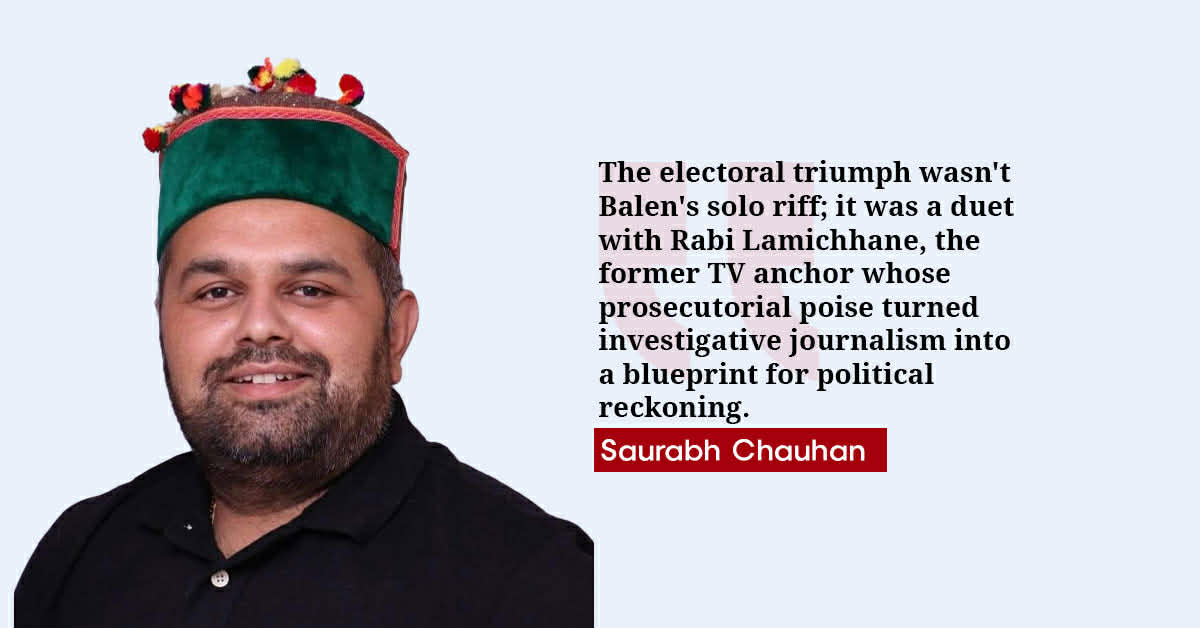
But this triumph wasn’t Balen’s solo riff; it was a duet with Rabi Lamichhane, the former TV anchor whose prosecutorial poise turned investigative journalism into a blueprint for political reckoning. Lamichhane, with his unblinking stare-downs on The Rabi Lamichhane Show, didn’t just expose scandals – he built a bridge of trust, grilling ministers on live air about misallocated funds and ghost schools, earning the moniker “Nepal’s watchdog” among viewers who tuned in not for entertainment, but for accountability.
His approach – methodical, evidence-driven and relentlessly transparent – complemented Balen’s street-smart fire, turning RSP from a viral sensation into a viable vanguard. Where Balen rallied the restless with raw emotion, Lamichhane mapped the rot with data-dripping exposés, like his 2023 series on remittance rackets that siphoned billions from migrant pockets. Together, they weren’t just anti-establishment; they were architects of an alternative – one part passion, one part precision – that convinced a skeptical nation this wasn’t another flash in the pan.
The 2026 elections delivered not a gentle shift but a seismic rupture, a testament to how Lamichhane’s forensic lens amplified Balen’s blueprint into a national blueprint. RSP, under their tandem leadership, stormed to a brute super majority – 182 seats in the 275-member federal parliament.
Margins weren’t polite nods; they were landslides – nearly 50,000 votes crushing K.P. Sharma Oli in Jhapa-5, 39,838 burying rivals in Chitwan-2 (Lamichhane’s own turf, where his local roots and anti-corruption crusades turned whispers into waves), 10,000+ gaps in Terai strongholds. This wasn’t endorsement of polished policy; it was exhaustion weaponized at the ballot box. Gen Z, fresh from 2025’s street fury that toppled the old regime, didn’t vote for dreams – they voted to punish betrayal.
Fourteen governments in eighteen years, a carousel of coalitions that spun Nepal into stasis: 35% youth as NEETs, remittances (25% of GDP) from Indian borders and Gulf deserts the only lifeline, informal jobs penalizing workers 29%, human capital utilization scraping 13-26% across provinces.
The old guards – UML’s machine politicians, Nepali Congress’s dynasty heirs, Maoists turned deal-makers – weren’t merely defeated; they were deposed. They promised protection but guarded only their privileges, leaving floods to orphan fields, stunting to chain generations and corruption to hollow the state.
Their wipeout whispers a hard truth: guardianship isn’t lineage or longevity; it’s results. RSP now inherits the throne they torched – and the warning etched in every oversized margin: deliver, or dissolve. Lamichhane’s contribution shines here too; his pre-election audits of provincial pork, broadcast to millions, primed the pump, showing voters not just what was wrong, but how to right it – a narrative of reform rooted in revelation, not rhetoric.
This mandate stretches far beyond Kathmandu’s smog-choked lanes; it’s a national indictment, province by province, where RSP’s victories map the precise pains each region endures and the precise cures they demand from these young leaders, with Lamichhane’s detail-oriented drive ensuring Balen’s vision doesn’t dissolve into vagueness.
In Koshi Province, the eastern gateway of mist-veiled hills and monsoon-ravaged rivers, RSP swept the plains of Jhapa, Morang and Sunsari. The 2024 floods that drowned 20 lives and harvests aren’t distant memory – they’re open wounds, with 20% poverty and foundational reading at 40% proficiency.
Voters here expect Balen’s engineering eye to design flood-resilient infrastructure, not repeat empty pledges; to channel youth into agro-processing jobs that halt the NEET exodus; to push education survival rates beyond Grade 5’s 88.9% cliff. Health’s anemia shadow over women and children calls for iron-rich outreach, not photo-op clinics – and Lamichhane’s knack for exposing aid leaks could safeguard those funds, turning suspicion into sustained support.
Madhes Province, the fertile yet forsaken Terai heartland, delivered RSP 30 seats including Sarlahi-4 (Amaresh Singh’s 10,857-vote rout of Nepali Congress President Gagan Thapa)
Poverty at 25%, child stunting at 29% (Nepal’s highest), women’s anemia at 52%, institutional deliveries at 67% – these aren’t statistics; they’re daily indictments of a system that treats the plains as periphery.
Madhes demands equitable devolution: flood embankments that hold, health posts that stock life-saving drugs, vocational training to turn 52% youth NEET into skilled workers. Gender literacy gaps (55% for females) beg for targeted scholarships, subtly strengthening the open-border ties with India that funnel essential petroleum and migrant earnings without compromising dignity. This province feeds the nation; it expects to be fed back, with Lamichhane’s investigative edge auditing cross-border aid flows to ensure they reach roots, not just rhetoric.
Bagmati Province, Nepal’s throbbing urban core from Kathmandu Valley to Chitwan’s plains, became RSP’s unbreakable bastion: clean sweep of Kathmandu Valley’s 15 seats, all three in Chitwan.
Ranju Neupane’s 15,455-vote surge in Kathmandu-1, Shishir Khanal’s 27,719 in Kathmandu-6 – these reflect a valley paradox: 75% college access yet 60% kids failing basic reads, air thick with pollution while elites seek care abroad.
Lamichhane’s Chitwan triumph taps post-COVID despair, informal jobs’ earnings penalty, traffic devouring time – his local exposés on factory graft here were the spark that lit the fuse. Bagmati, boasting 58% HCI, insists RSP dismantle private-school monopolies, hike education spending toward UNESCO’s 6%, green infrastructure with hydropower exports that benefit neighbors like India through steady trade (USD 8.7 billion lifeline). NCDs claiming 70% deaths demand community wellness, not elite hospitals, where Lamichhane’s transparency toolkit could expose and excise the waste.
Gandaki Province’s misty Annapurna slopes yielded 15 out of 18 seats for RSP.Tourism’s seasonal ghosts, landslides swallowing lives, 20% stunting amid postcard views, 69% Grade 10 failures – voters seek eco-jobs blending heritage and skills, midwife networks to cut neonatal deaths, vitamin A coverage sustained at 94%.
Lumbini Province, Buddha’s serene birthplace (26 seats), gave RSP 21 seats out of 26. 20% poverty, MMR 207/100,000, 32% girl dropouts for early marriage – expectations include artisan economies honoring culture, clinics catching complications, schools breaking caste barriers. Soft synergies with India’s Buddhist trails could ethically boost pilgrim flows, audited by Lamichhane’s watchful eye to prevent pilferage.
Karnali’s remote wilds (12 seats) saw RSP take only 1. 36% stunting, 31.5% food insecurity, under-5 mortality 46/1,000 – isolation eats 30% of budgets in transit. This frontier craves aviation links, technical schools beyond 6.2%, agro-innovations rooting families.
Sudurpashchim’s far-west (16 seats) mirrored with 10 seats for RSP including the cleaqn sweeps in Kailai and Kanchanpur amid 38% stunting, 34% poverty, 49/1,000 infant deaths.
Gender literacy lags; voters demand stocked clinics, jobs that end migration mills – Lamichhane’s provincial probes could map these margins, ensuring remote voices aren’t remote from reform.
These provincial cries – anguish in every crevice – reveal Nepal’s deeper malaise: HCI 46-58%, public spending 2-4% on health/education, 81% informal toil. The brute majority is balm and blade: RSP must navigate federal fractures with equity lenses, lest provinces fracture further, blending Balen’s structural savvy with Lamichhane’s scrutiny.
The gauntlet ahead for Balen (36) and Lamichhane (nearing 50) is unforgiving. Toppling titans is torch-easy; statecraft is the slow burn. Gen Z’s digital vigilance – the force that birthed RSP – must evolve into constructive oversight, not chaos.
Provincial parity demands ring-fenced funds: Koshi’s embankments, Madhesh’s clinics, Karnali’s roads. Economic Everest: 6.5 million jobs by 2050 via hydropower (1,346 GWh exported), skills mirroring India’s IT ascent, remittances reinvested. Health’s NCD siege, education’s dropout plague (32%), gender chasms (25% female participation) require universal insurance, cash transfers, creches. Corruption? E-procurement ironclad, whistleblowers shielded – Lamichhane’s forte, turning his show into statute. Disasters? Resilient networks, early warnings drawing on neighbors’ expertise.
Balen, the PhD scholar-engineer whose verses once veiled pain in precision, now faces unrhymed ledgers: stunted children in Sudurpashchim, flooded farmers in Koshi, NEET dreamers in Bagmati.
Balen’s Balidan question – how to become a country? – shifts from accusation to assignment. With Rabi’s prosecutorial gaze, they must guard grace, not greed.
Nepal, resilient as its rhododendrons, deserves this pivot: sovereign, stitched by integrity, thriving in partnership. Fail and the jewel dims; succeed and the engineer’s blueprint becomes the nation’s enduring frame.