Kathmandu
Tuesday, July 21, 2026





Wrongful convictions by lower courts leave innocents behind bars for years, with justice arriving too late, and compensation even later
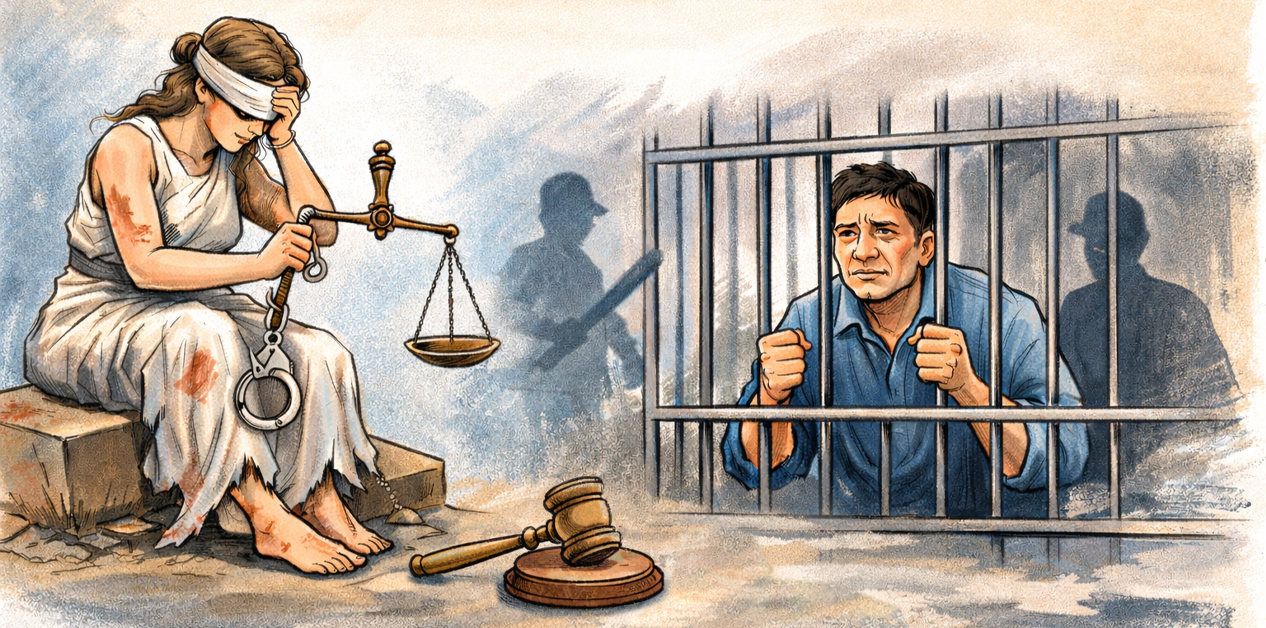
KATHMANDU: Ram Kumar Karki (52) of Kirtipur was sent to prison on 19 October 2011 after Kathmandu District Court sentenced him to seven years on a charge of attempted murder. Arrested on 13 January 2010, Karki served the seven-year sentence at Central Prison Jagannath Dewal and walked out on 13 January 2017. One year after his release, a Supreme Court verdict on 10 January 2018 proved him innocent. The Supreme Court had ruled that since Karki had been imprisoned unjustly, a law should be made to provide him compensation. After the verdict, he was free from prison, but he says he has still not experienced justice, because no law on compensation for those wrongly imprisoned has been enacted. Even after leaving prison, his days are spent making rounds of the Judgment Execution Directorate, the Home Ministry, and other agencies pleading for a law to be made.
Many innocent people like Karki have been forced to spend time in prison unjustly when cases take long to be decided because of protracted court processes. But with no compensation law enacted, they are enduring injustice upon injustice. In cases where the court itself specified an amount, compensation has been paid, albeit belatedly. One of those who received such compensation is Padam Maya Gurung (58) of Dhankuta. Imprisoned in a culpable homicide case, she had to spend five and a half years more in prison than the court had determined.
Twelve years after her release from prison, she filed a writ petition at the Supreme Court on 6 January 2015 with the help of advocate Niranjan Upreti, demanding compensation for excess imprisonment. A joint bench of then-Chief Justice Gopal Parajuli and Kedar Prasad Chalise issued a directive order on 25 February 2018 ruling that Padam Maya, who had been held in prison unlawfully, should be paid compensation at the rate of three hundred rupees per day. Under the court’s verdict, she was to receive Rs 603,600 for five and a half years. But she had to wait eight years for it. She received the amount only on 24 November 2025.
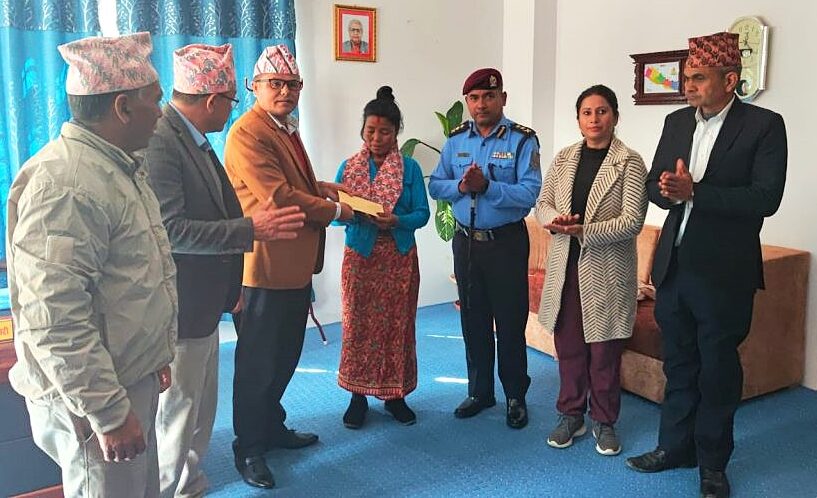
Padam Maya receiving the compensation as determined by the Supreme Court. Photo: Social media
The ordeal of obtaining compensation is only part of the story; the background of how she ended up serving excess time is equally distressing. Dhankuta District Court had sentenced her to life imprisonment with forfeiture of all property on 21 February 1992. The Appellate Court in Biratnagar reduced the sentence to 10 years. A Supreme Court verdict on 19 May 1994 reduced her prison term by a further five years. But neither was the Supreme Court verdict implemented nor was she informed. Having arrived at Tehrathum Prison Branch on 17 December 1991 along with her minor daughter, she was released on 24 June 2002. Under Dhankuta District Court’s verdict, Padam Maya should have been released from prison on 16 December 1996. She was kept in prison for five and a half years more and then released on the basis that the letter from Dhankuta District Court instructing her release had only reached Tehrathum Prison Branch on 24 June 2002 – six years after she should have been freed.
In Ram Kumar’s case, the charge itself was proven false after he had already served a long prison sentence. A joint bench of Supreme Court justices Ishwar Prasad Khatiwada and Prakash Man Singh Raut overturned the district and high court verdicts and acquitted him, finding no facts or evidence. The Supreme Court’s verdict in his case states: “It does not seem appropriate to find someone guilty based on suspicion and assumption from accusations made by a complainant acting out of personal enmity. It is not right to hold someone guilty on mere suspicion in a way that curtails their fundamental freedom.” He then filed a writ at the Supreme Court demanding compensation for having been forced to serve prison time without cause.
The Supreme Court’s verdict notes that Raju Khatri, out of family enmity, fabricated a false incident and filed charges of kidnapping, hostage-taking, and attempted murder against Ram Kumar. The Supreme Court’s verdict states: “The fact of an attempted murder incident having occurred was not found proven from the case file evidence.” Yet the bench of then-Kathmandu District Court judge Bishnu Prasad Koirala had sentenced him to seven years’ imprisonment, saying the attempted murder was confirmed by the case file and evidence. Similarly, on 8 January 2013, the bench of then-Appellate Court judges Kul Ratna Bhurtel and Yagya Prasad Basyal had upheld the district court’s verdict. On 19 January 2011, the District Administration Office Kathmandu had also found him guilty in a weapons case and sentenced him to four years’ imprisonment and a fine of Rs 60,000. But when the case reached the Supreme Court, all charges were proven false.
Seven years of wrongful imprisonment cost him his years, caused him physical and mental suffering, and brought him loss and damage. Ram Kumar had been imprisoned at 36 and was already 43 by the time he got out. Having also lost the time he could have spent working abroad and earning, he demanded Rs 50 million in compensation calculated against the gold price of that time. The Supreme Court too ruled in his favor and opened the path to providing time-appropriate compensation through legislation. On the recommendation of the Home Minister, Ram Kumar received five lakh rupees as financial assistance in Poush 2081(mid-December 2010 to mid-January 2011) but says he has not received the compensation as determined by the court verdict.
Although the number of those serving prison sentences due to legal oversight and negligence appears large, neither official data nor detailed studies on this exist. Judgment Execution Directorate director Govinda Prasad Ghimire also acknowledges that there is no consolidated data on those “victimized by the law” itself.
To study this matter, the Human Rights and Public Concerns Committee under the Nepal Bar Association formed a study task force on 1 February 2026 under the coordination of advocate Tara Kumar Shrestha, with Dev Kumar Moktan and Apsara Dhakal as members. The Bar conducts such studies when a petition is filed. The task force studied the incident and verdicts from district to Supreme Court level, and submitted a study report to the Bar recommending that persons acquitted at the final decision in cases of false accusations and wrongful prosecution should receive appropriate compensation from the state. The report also requests the Bar to recommend the government to quickly enact a law for appropriate compensation. The report states that the Bar should play a coordinating role with other stakeholder organizations to create a compensation law and should advocate for its enactment and implementation. The task force concluded that since the victims’ family and financial situations have deteriorated due to the state itself, it is necessary for the state to make appropriate decisions and take necessary action for the victims’ livelihood and income generation.
Task force coordinator Shrestha says the criminal justice system’s practice of arresting first and investigating later causes innocent people to get caught up. “There are many examples of innocent people getting trapped in criminal cases,” he says. “Based on discussions in various Bar committees and looking at cases where the Supreme Court acquitted at final verdict, it can be estimated that five to ten percent have had to spend time in prison unjustly.”
He concludes that this problem has been created by the practice of arresting immediately upon complaint, even though Nepal Police is capable of conducting proper investigation. On this basis, he recommends, “Not every case requires immediate arrest. Arrest should only be made after investigation and after looking at the accused’s involvement.” He points to the need to amend the Criminal Procedure Code for this. His argument is that the state should not be able to violate anyone’s personal freedom by filing baseless cases. He says, “The economic, social, and psychological damage suffered by a person wrongly arrested cannot be fully compensated. Therefore, no one should be imprisoned unjustly at all. A clear legal provision for immediate compensation when wrongful imprisonment is found must be made in law.”
Although the number of those serving prison sentences due to legal oversight and negligence appears large, neither official data nor detailed studies on this exist. Judgment Execution Directorate director Govinda Prasad Ghimire also acknowledges there is no consolidated data on those “victimized by the law itself.” “They are sent to remand during hearings and released when acquitted. There is no organized data on how many there are,” he says. “Similarly, we also do not have consolidated data on those forced to stay in prison longer than their stipulated time.”
The legal situation on compensation
Nepal’s criminal justice system has a Crime Victim Protection Act and a Victim Relief Fund to provide compensation to crime victims, with provisions for appropriate compensation along with justice. But there is no separate law to provide appropriate compensation to persons who suffered wrongful prosecution and imprisonment because of the state system itself. Therefore, in cases of those “victimized by the law,” the Supreme Court has from time to time issued directive orders to provide compensation to victims and to create related legislation. Only when such a law is enacted will victims be able to receive compensation immediately upon release from prison.
Director Ghimire says directive orders issued by the Supreme Court on such matters are sent to the relevant ministry for implementation. He says the Supreme Court’s directive order in Ram Kumar’s case was also sent to the Home Ministry at that time.
Another similarly sensitive precedent exists – a Supreme Court verdict dated 5 September 2018 in a rape case involving police constable Madan Narayan Shrestha. It states that since the rape charge could not be sustained and the court acquitted him, having been suspended and dismissed, “the right to automatic reinstatement to the position after acquittal remains.” The verdict also holds that the state must compensate the petitioner for having been imprisoned unjustly due to the negligence of state bodies despite being innocent.
Existing law states that no person shall be liable for punishment for any act that is not punishable. The fundamental rights provisions in the Constitution state: “No person shall be given a punishment greater than that prescribed by law at the time of committing the offense,” and “An accused person shall not be considered guilty until their guilt is proven.”
The fundamental rights guaranteed by the constitution are also a strong basis in this regard. Article 16, sub-clause 1 provides that “every person shall have the right to live with dignity.” Article 17 states that “no person shall be deprived of personal liberty except in accordance with law.” Sub-clause 2 of the same article gives citizens the right to freedom of thought and expression.
On the constitutional rights of arrested persons, Article 20 states: “No person shall be kept in custody without being informed of the reasons for arrest. From the time of arrest, the arrested person shall have the right to consult a legal professional of their choice and to be defended by a legal professional.” The same article requires that the arrested person be produced before the adjudicating authority within 24 hours of arrest excluding travel time, and that the arrested person shall not be kept in custody except by order of such authority.
Existing law states that no person shall be liable for punishment for any act that is not punishable. The fundamental rights provisions state: “No person shall be given a punishment greater than that prescribed by law at the time of committing the offense,” and “An accused person shall not be considered guilty until their guilt is proven.”
Article 22 of the constitution, under the right against torture, provides that “no person who is arrested or kept in custody shall be subjected to physical or mental torture or inhumane or degrading treatment. Such acts shall be punishable by law and the victim shall have the right to compensation as provided by law.”
A bill is being drafted
According to Nepal Law Commission secretary Indira Dahal, work has already begun on a bill to provide compensation to victims who suffered unjust punishment. But she says the draft is still at an early stage and will take time to complete due to limited human resources at the commission. She says, “The Home Ministry had sent it for study. We are still studying some aspects. The bill is being drafted so that justice can be obtained in a simple and accessible way.”
According to Dahal, the bill is being drafted so that persons wrongly imprisoned can receive compensation from their own district. The bill will include a provision for the compensation amount to be assessed and paid by a body including the Chief District Officer, the chief of the District Treasury Controller Office, and a representative of the district court.