Kathmandu
Tuesday, July 21, 2026





Illegal debt cycles are pushing rural Nepal to the edge, leaving families homeless and trapped in a desperate struggle between life and death
KATHMANDU: Among the illegal activities categorized under the ‘black economy,’ the practice of lending and borrowing money at exorbitant interest rates through informal, person-to-person arrangements is known as ‘usury,’ more commonly referred to as ‘loan sharking.’
The government classifies the offense as ‘usurious lending,’ a term used to describe predatory lending practices. Such transactions are typically conducted through verbal agreements or by using checks, promissory notes, land, houses, gold, silver, or vehicles as collateral. In cases where borrowers lack collateral, transactions are often carried out solely through the exchange of checks.
In such situations, the exchange of either a check with a written amount or a blank check is common. When writing an amount on the check, the interest is added beforehand. If a moneylender provides Rs 100,000, they demand a check for Rs 200,000, and larger transactions often take place using blank checks.
At the time of providing the loan, loan sharks typically say, “I have given you money based on trust; what is your objection to giving me a blank check? Give me the check, take the money.” The borrower also feels that the point is valid. Since they lack access to the formal financial system, are not trusted for loans, and face numerous procedural hassles, they end up at the doors of local moneylenders and landlords. Some seek loans to escape emergencies, while others go to moneylenders for starting or expanding businesses, the stock market, children’s education, or foreign employment.

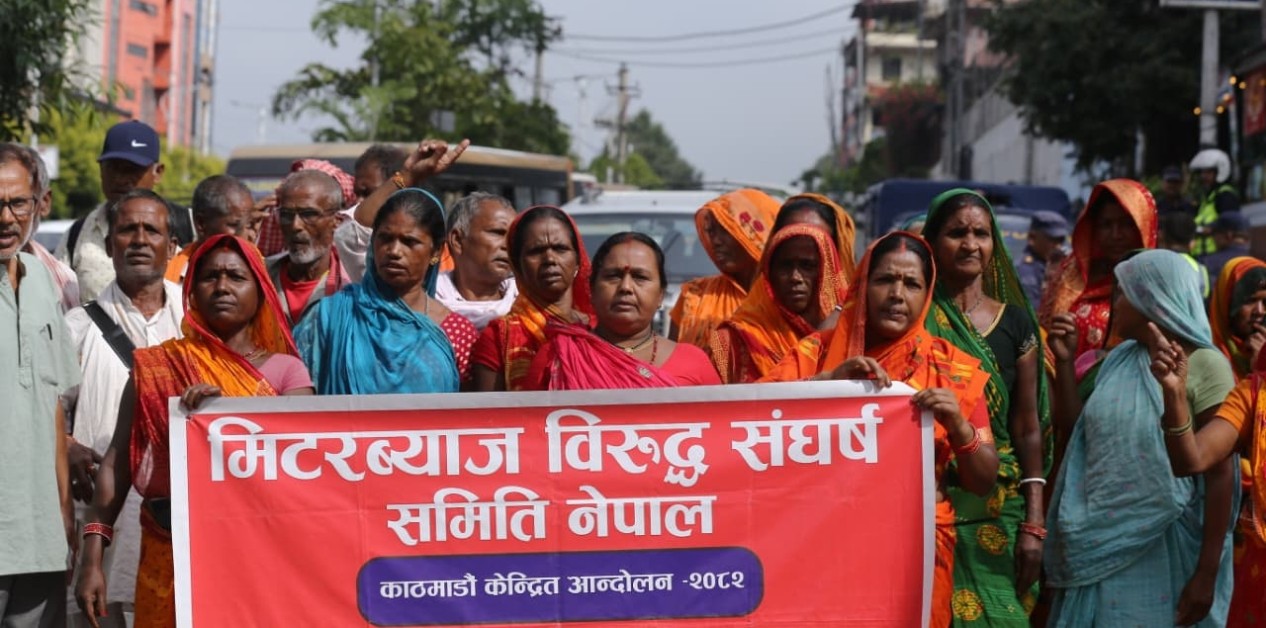
Victims from the Madhesh region’s usurious lending protest in Kathmandu demanding justice against predatory moneylenders. File photo
The borrower knows pretty well that what the consequences of giving a check will be if the money cannot be returned. For this reason, the possibility of dishonesty after taking the loan is minimal. However, if things do not go as planned after taking the loan and no basis for repayment is formed, the problem starts from that very point. Excessive interest continues to accumulate, and the borrower falls into the vicious cycle of the loan shark.
Once the problem begins, borrowers pay interest with great difficulty out of fear of their checks bouncing. Some pay off interest to one moneylender by taking a loan from another at an even higher interest rate than before. Due to this vicious cycle, the borrower’s economic foundation crumbles while continuously paying interest. To repay the loan, one must either sell their house and land or face imprisonment.
In the context of checks and blank checks, the interest rate is often higher than 5 percent per month. Although the lenders remain quiet for some time, they eventually begin to apply pressure. They give warnings ranging from threats of imprisonment to hiring people to issue threats of physical assault. Due to such fear and terror, borrowers become ready to pay interest on interest or even higher rates. The interest is increased from 5 percent to 8 percent or 10 percent per month. This interest amounts to 98 percent to 120 percent annually. For collateral involving gold, silver, houses, or land, the monthly interest is found to be 3 percent to 4 percent. For motorcycles and vehicles, it is 5 percent to 10 percent.
Surprisingly, almost every loan shark seems to have collusion with the police. One person invests the money, and the police recover it. With this arrangement, the moneylender fills in the desired amount, bounces the check, and immediately has the borrower arrested and imprisoned. After imprisonment, they recover their money either through physical assault or from the borrower’s movable and immovable property.
An elder close to me had reportedly taken Rs 800,000 at one time and Rs 400,000 another time, totaling Rs 1.2 million. The reason for taking the money was to reduce a bank loan to then increase the loan limit. After the money was paid, the bank stated that the loan could not be increased, citing various reasons. After the elder paid back Rs 400,000 of the principal to the moneylender, Rs 800,000 remained. The lender said he would return both checks after the Rs 800,000 was paid. However, the elder could not pay the money on time, and the lender bounced the check for the full Rs 1.2 million and proceeded with legal action.
The court did not listen to the victim. It upheld the amount of Rs 1.2 million and decided in favor of the loan shark. The court did not even care about the evidence of interest being paid at a rate of 36 percent on the Rs 800,000 for several months.
1688785770.jpg)
A sit-in demonstration by loan-sharking victims in Kathmandu
In another incident, a young man reportedly took Rs 350,000 by pledging some 27.29 grams of gold with a moneylender and an additional Rs 150,000 by giving a blank check. The purpose of taking the Rs 150,000 was to manufacture goods for a customer. However, the customer did not provide the money within the month as promised. The problem started immediately. The young man has already paid Rs 600,000 in cash so far. Gold worth more than Rs 600,000 is still with the loan shark. Despite taking a loan of Rs 500,000, the moneylender calculates the total at Rs 1.2 million, including Rs 700,000 in interest, and refuses to return either the check or the gold. Instead, he is threatening to break the young man’s limbs and bounce the check. Only God knows how much more money he will extort from that young man! The moneylender has been recovering money under the protection of a superintendent of Nepal Police, claiming to know him.
These are just representative incidents. There are many victims trapped in the snare of loan sharking across the entire country. Moneylenders initially provide money by coaxing and taking blank checks and later continue to recover it by scaring and threatening. For this, they employ petty goons. Some even reportedly hire people to find potential borrowers. Through them, the work of finding people and investing is being carried out. It is also found that goons take loans from lenders at low interest rates and lend them out at high interest rates.
Some borrowers have died by suicide after being unable to repay debts tied to loan sharking, while others have lost their homes, families, and personal freedom. Despite the growing impact of such practices, effective state intervention has largely remained absent.
Critics argue that the judiciary often focuses solely on checks and the amounts written on them, without examining whether the underlying transactions are legitimate or exploitative. If the judiciary were to examine the reality behind such transactions, perhaps the victims, too, might finally receive justice?
Loan sharking continues to expand, reaching even rural communities, while the government appears largely indifferent to its spread. Perhaps the government should now pay serious attention to introducing stronger laws and measures to curb such predatory lending practices.
(Rasaili is a social activist and researcher.)