Kathmandu
Saturday, July 18, 2026





I was trying to capture the scenes observed during the journey—a little in the camera, and a lot more on the retina inside my eyes.
“This country is a drug.”
I suddenly remember this poem written by Raju Jhallu Prasad. The poem says—there are so many places, subjects, characters, and settings within the country to look at, understand, get lost in, and rest at, that no one has the luxury of staying crippled in one place. Therefore, he urges his friends to grab their bags and leave immediately. It felt as if Raju was teasing me: how long can you stay squeezed inside this valley, brother? Cramming a few belongings into a backpack, I too stepped out of my nest. In the course of development work, I had traveled to nearly 64 districts, but after that, for almost a decade, repetitions occurred in those same old places; not a single new district was added. I felt disappointed with myself. What stopped me from reaching new places?
Born in Chitwan, I live in Kathmandu and frequently travel back and forth to Pokhara. However, I hadn’t even set foot in the neighboring Gorkha district. When going to Pokhara, stopping at Aanbu Khaireni to buy oranges and miscellaneous knick-knacks meant touching Gorkha’s soil. But that doesn’t count as reaching 65 districts. To me, reaching a district means it is mandatory to reach its headquarters. And if one can observe some of the surrounding local life, it is even better.
With this thought, I dashed toward Gorkha last Sunday. Aiming for the headquarters, the microbus we boarded turned off the Prithvi Highway to the left from Aanbu Khaireni. I had already tucked Jose Saramago’s novel Blindness, which I was reading in the vehicle until moments ago, inside my bag. I no longer wanted to remain confined to the pages of a book. It felt as if Nida Fazli whispered into my ear: Dhoop mein niklo, ghatayon mein naha kar dekho / Zindagi kya hai, kitabon ko hata kar dekho (Go out into the sunshine, bathe in the clouds and see / Put the books away and see what life is). A geography I had not crossed lay before me. I was curious to observe the surrounding landscape.
Shanta Shrestha, who boarded from Aanbu Khaireni, was next to me. She was going to the headquarters for a three-day teacher training. As it was almost 10 o’clock, she looked a bit anxious, in a hurry to arrive. “I am a Nepali teacher, but I have to teach all subjects to the little kids,” was her admission. Some local information was obtained through the conversation. Pointing to the right side, she introduced: “That over there is the Gorakhkali Rubber Industry.”
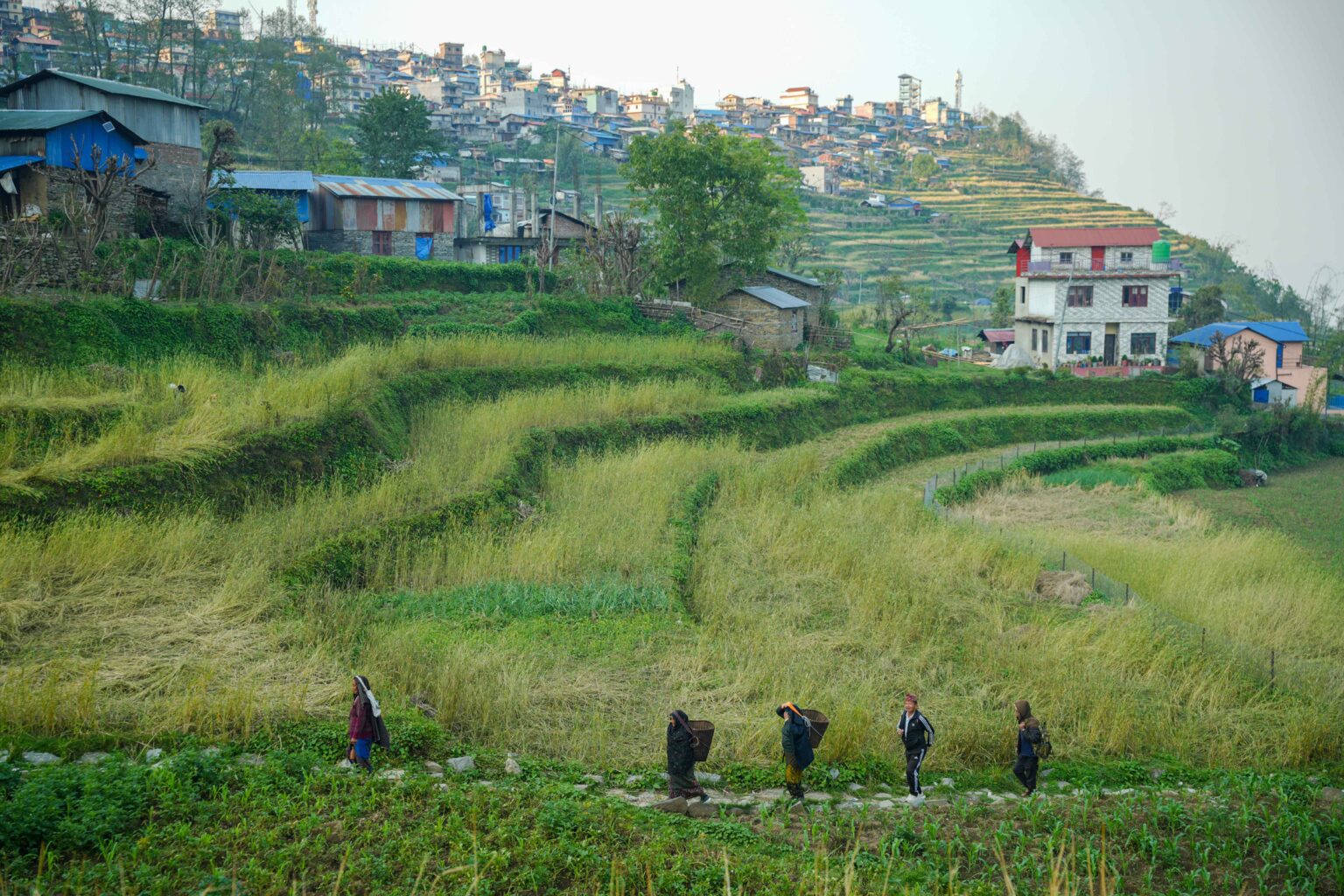
Barpak. Photo: Nepal Photo Library
The vehicle kept rushing along. It reached 12 Kilo and stopped for a while. The driver brother got off, went to a nearby tap, washed his face and hands, cupped his hands to drink water, gulping it down. Then he lit a Shikhar cigarette and began to inhale with great pleasure. The cigarette smoke reminded me of the storyteller Manto. It was puffs of cigarettes like this that used to prepare various embryos of stories in Manto’s mind. Behind us, buses were parked in a row; they were vehicles going to Barpak. Upon seeing the destination “Barpak” on the front of a bus, my plan suddenly changed. I thought—I will visit the headquarters, which is 12 km above, on my way back. Then, grabbing my bag, I boarded the bus going to Barpak.
Next to me was Bal Bahadur Ghale. He was returning after receiving medical treatment in Chitwan. Just like from many districts of Gandaki and Dhaulagiri, a significant number of people from Gorkha have migrated to Chitwan. Gorkhalis are found in every new settlement over there. Many neighborhoods around Chitwan have been named after the local villages and places of the Gorkhalis. Even those who have not migrated, like Uncle Bir Bahadur, are connected to Chitwan; due to education, health, trade, or other contexts. On another side, a passenger sitting there was telling someone over the phone—”My daughter finished Plus Two, I am traveling to Chitwan to get her enrolled in Bachelors.”
Although it was an unpaved road, it wasn’t very difficult. Most houses were seen with flower fences. Ribbon flowers, bellflowers, and various seasonal flowers were blooming in places. These were the mediums that reduced the monotony of the journey. Nearby, the Daraudi River was visible, flowing silently. Due to the intense afternoon heat, it felt as if smoke was rising from the ground.
Pointing at the Daroudi, Uncle Bir Bahadur spoke—”Earlier, down below, the river was clear; it must have rained up in the high hills. The water started becoming turbid.” On the opposite side, dense pine forests were visible. In the fields on both sides of the river, thriving maize could be seen, having already grown corn silk and tassels. Sighing, Uncle added—”If this was down in the lowlands where there is plenty of land and wealth, two crops of rice would have been planted. Up in our high hills, we only plant millet and buckwheat; rice doesn’t grow like it does here. Hailstorms and rain also ruined our maize.”
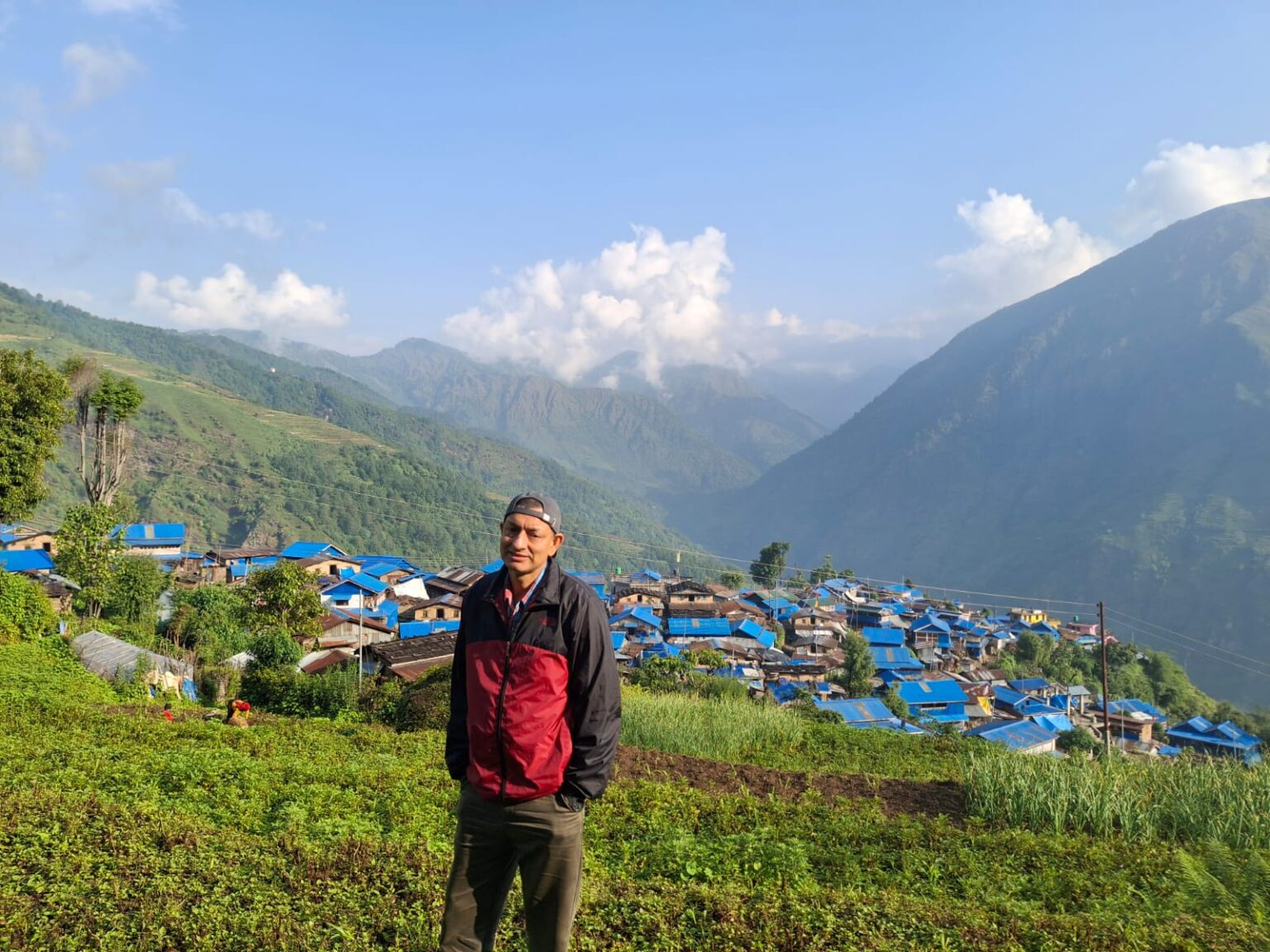
Author Khaniya.
“Are there sheep sheds in the village now?” To my question, his answer was—”They used to be in various places. I had my own until the year before last. The sheep reached 500. Later, my wife also passed away. The kids went abroad. I couldn’t manage alone.” Digging into the past, he spoke again, “Previously, it took five days to bring salt to the village. Now the road has been built, many things have become easier.” How much he understands politics could not be known in a brief meeting. However, he was not optimistic about the new regime. His accusation was, “They seem to pocket all of the citizens’ money. Let’s see how long they survive.”
Uncle Bir Bahadur got off three stations before reaching Barpak. Since most passengers had already gotten off, the bus had become empty; there were only three of us when we reached the Barpak bus park. “Alright, now the money you gave has run out. This is the end. Please get off,” the conductor’s assistant announced jokingly.
A while ago, someone was saying to someone on the phone—”I am preparing to go to Poland, the visa will probably come through by July-August.” I became lost in thought about whether his desire would be fulfilled or not by the two lakh rupees he submitted. Among the issues the RSP used as a ladder to ascend to power was one—returning those who went for foreign employment and engaging them in respectable income-generating activities here. Does the general youth not have such expectations toward the new government either? Why are their steps unable to stay grounded here? The wave of going to the Gulf is the same even today. Alongside it, Europe has become a new destination. The investment of those going to Poland, Portugal, Romania, Cyprus, and Malta exceeds Rs 400 000. Yet, young people who want to go there to build their future are still found in significant numbers.
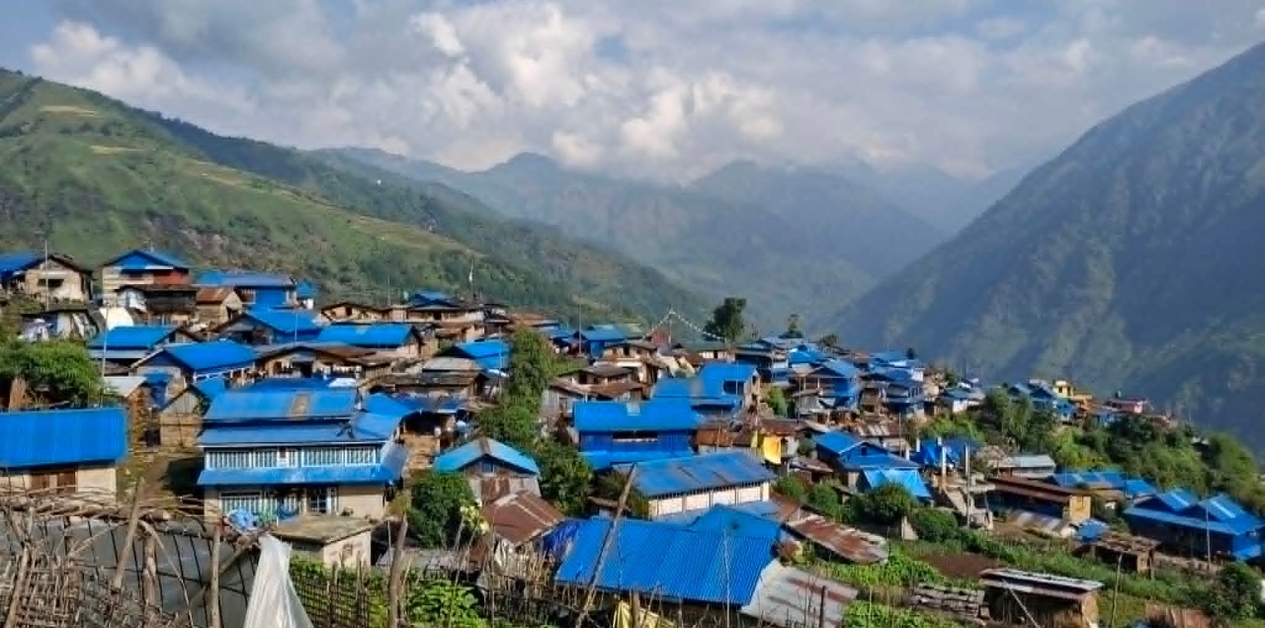
From the bus park, I went straight to a hotel; Hem Suk Gurung was at the counter. I ordered chowmein and drank tea. After satisfying my stomach, I was about to head out with the intention of observing Barpak. A woman who had gotten off the bus with me also entered the same hotel. “Didn’t we come together?” She nodded her head up and down in agreement. Now, I set out to observe the surroundings of Barpak. A little further up was the Khumche Gumba. Inside the monastery, I met Lama Damber Bahadur Ghale. After stepping inside for a general observation, I reached the upper floor. Most of Barpak’s view could be captured from there. New houses with blue corrugated zinc sheets were standing here. There are also some concrete houses with brick-colored roofs. Two statuses of life were conspicuously visible in the same settlement.
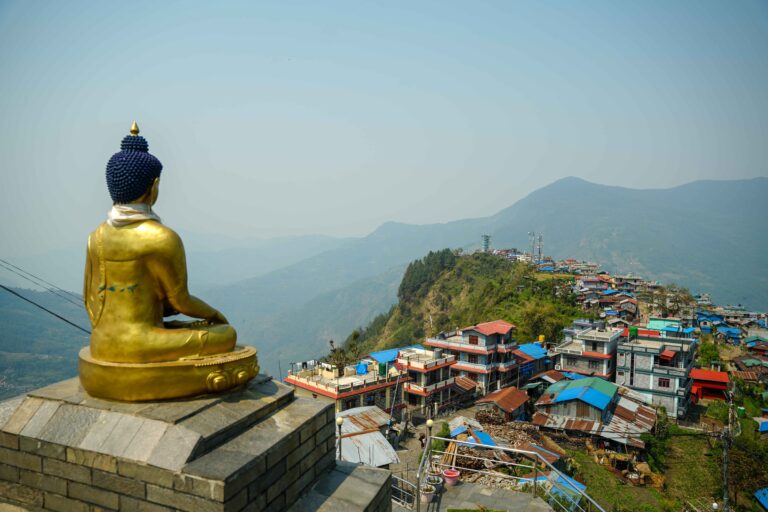
Photo: Nepal Photo Library
You all know the destruction of the earthquake a decade ago. Since Barpak was the epicenter itself, the old houses here were all reduced to mud. Since I hadn’t come here before the earthquake, I didn’t see the old settlements myself, but in the photos in the archives, the design of the settlement and the location of the houses looked attractive. Today’s houses and settlements have not been able to become that organized. There is no artistry either.
On a public resting platform above the Barpak bus park, I saw a crowd of elderly people resting. I also joined the crowd. Some were puffing cigarettes, some were giggling showing their toothless mouths, while others were sitting downcast. One or two were just coming, leaning on bamboo walking sticks. Most turned out to be ex-servicemen; among them, those retired from the Indian military service were in the majority, while some were also ex-British soldiers. They regularly come to that same platform in the afternoon after having tea and snacks. “It’s a way to pass the time, nothing else can be done,” one elderly man was saying. I thought for a moment, this old age is certainly tedious. The wives of some had already passed away. But for those who have wives at home, how are they passing the time? Taking care of grandchildren, helping with housework, or sitting on the porch coughing detachedly?
The construction of view towers became a distorted narrative among us over the past decade. Mostly without any artistry, in a clumsy manner. Just a waste of money. In Barpak too, a view tower has been built to see the new settlement and the surrounding view. However, when looking from a slight height, the clustered settlements below are easily visible; in this sense, the view tower feels irrelevant here too. There is a memorial building and archive information center a little below the monastery, where the records of those killed in the 2015 earthquake are kept. While walking around, I met local teacher Bal Bahadur BK on the road. The Gurungs are in the majority in Barpak, which is why non-Gurungs here also speak comfortably in the Gurung language itself; Sir Bal Bahadur was conversing in that exact manner with the villagers he met on the road. Barpak turned out to be the village of Gorkha VC Gaje Ghale. As I was walking around with Sir Bal Bahadur, I met the woman who had gotten off the bus with me earlier again. Saying “Namaskar Sir,” she began to talk with Sir Bal Bahadur. “Barpak became disfigured after the earthquake. The destruction had occurred anyway, but in the name of reconstruction, government/non-government people snatched away all the locality and originality of this place,” they were saying simultaneously.
Not only Barpak, but Laprak, another settlement above, was also devastated by the earthquake. This was known to me, so why the discussion only about Barpak? I asked. Sir Bir Bahadur spoke—”Before the earthquake, there was no such discussion about this place. Later, a swarm of people began to gather here. Coming this far, taking photos, and leaving. Why would they take the trouble to climb higher?” Sir’s statement pricked me. A terminology took up residence in my mind—Disaster Tourism. I remembered the jumbo teams that go to observe the trail of destruction; I recalled the line of people taking selfies with those who survived the disaster. Then I remembered an essay I had taught myself—”Ground Zero.” In it, the context of the queue of locals and foreigners after the attack on the Twin Towers of Manhattan, USA, is included. On the tin sheets hung along the main road from Barpak to Laprak, it was written—Epicenter Adventure Trail. In this format, the Gorilla Trail around Rukum-Rolpa and the Mundhum Trail around Majh Kirat are already in practice.
My mind did not agree to register my name on the list of those who return after reaching only Barpak. Sir Bir Bahadur’s point applied to me too. “How far is Laprak?” I asked. The woman who was with me said—”It is a one/one-and-a-half-hour ride by vehicle. The bus for Kathmandu will arrive in a moment. If you are going, let’s walk, I am also going that way.” Parting ways with the teacher, we headed straight toward the bus park waiting for the vehicle. Enjoying the rural scenery, I was riding. “My name is Vishnu Kumari Gurung. Returned from Kathmandu yesterday evening. Our village is even lower than Laprak. The village’s name is called Gumda.” Extending the introduction, the fellow passenger explained the details. I also gave a brief introduction of myself.
Before reaching Laprak, a beautiful village appeared. Identical houses were built there. After the devastating earthquake collapsed all houses in Laprak, some model settlements had been built. This was one of those settlements. Every house had concrete roofs of brown-and-white colors. It turned out to be a settlement built under the leadership and assistance of former NRN President Shesh Ghale. It was equally attractive too. The sad thing is, very few people live in this settlement built at such a huge expense. “Due to farming and daily chores, the residents of the Laprak market over there were not interested in coming and living permanently in this settlement,” Raj Gurung, a local politician met in the vehicle, unveiled a curtain of mystery. A little before reaching Laprak, a park was seen. Written on the top was—Iman Climber Park. In a moment, we reached the final destination of the vehicle—Laprak. The settlement was ordinary, with a few makeshift hotels.
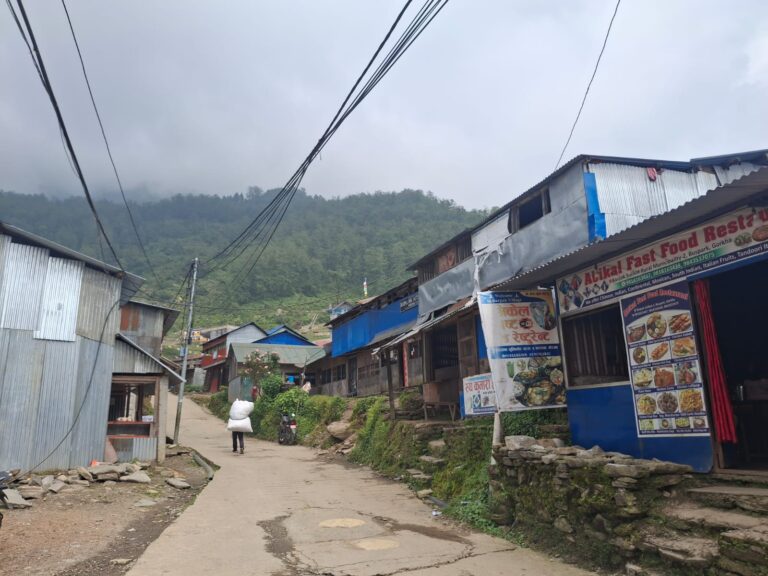
Photo: Nepal Photo Library
Netra Kumal, the vehicle’s assistant brother, had gotten off the vehicle and was drinking coffee at a nearby tea shop. “Alright Sir, take a rest for a moment; Shopkeeper, give Sir a coffee too.” In his speech, there was a hint of a command, not a request. While drinking coffee, a few more locals joined. Bishnu ji also joined in. They were planning to go down to Gumda even if it meant traveling through the night.
They were urging me, “Let’s go, Sir, over to our village. Homestay is available there. Stay and sleep in a clean place. Fresh village vegetables and food can be eaten. Over here, the taste of the city has already entered. They only take a lot of money, there is no facility at all, it’s terrible.” It felt as if the local boys were trying to intimidate me. At evening time, another destination? I felt like going, but there was also a dilemma.
Like Pathao and InDrive in the city, motorcycle rider services turned out to be in practice here too. However, probably due to the drizzling rainy weather, many had already returned home. Vishnu ji called riders she knew; everyone was engrossed in eating and drinking, and their gathering looked like it would last all night. “Now there is no option but to walk,” their conclusion emerged. I was still undecided. The boys were lifting their feet to leave. Right then, one brother added—”In the village, there is even singing and dancing to welcome guests. The Gumda Ekata Women’s Group organizes the program. This sister herself is the chair of the group.” Now, I also decided to go with them.
Bishnu ji took the lead. With me were two brothers, Tak Bahadur and Ashish. Matching their pace with force, I also strode along. Drizzling rain had been there from before. Now it began to pour heavily. We all opened our respective umbrellas and moved forward. An uphill-downhill path, nighttime. We stopped for a moment to rest at one place. It had become pitch dark. My eyes turned toward the sky. There were a few clouds, but they hadn’t been able to block the presence of the moon. The stars were also struggling in the sky to claim their existence. The crescent moon had awakened a distinct enchantment in the mind at that moment. This splendor of nature is rarely observed. Again, I remembered an essay by Henry David Thoreau—”Night and Moonlight.” Thoreau’s description in this essay is immensely alluring. In the light of the moon, he exposes many unperceived aspects of the night. Toward the humans who shut themselves inside houses at night, he says in a feeling of pity—You are losing a uniquely charming form of nature, you early sleepers. My concentration was stolen by the song of the two brothers who came along. From time to time, they relieved their boredom by singing songs; this time, Vishnu ji was also mixing her melody with them.
The heavy rain had filled the potholes of the road and made it flat; the faint light of the moon didn’t offer much support. Turning on the torches of our respective mobiles, we were making forward progress. Frequently, we would plunge into potholes, sometimes a slippery path, sometimes squelchy mud, and somewhere piles of cattle dung. The brothers stopped dead at one place; they were waiting for me. Vishnu ji also stopped. She herself said—”There is a short route from here, it goes a bit downhill. It’s a jungle path, but there’s no need to fear. We will arrive quickly, let’s go from here.” I had no option but to follow them. At one place, my left foot got tangled in vines; Ashish rescued me. No sooner had I stopped to rest for a moment than leeches had already captured the inside of my shoes. Annoyed by the itching. With an empty stomach and a tired body, we kept moving forward. The umbrella had not been able to protect us from the slanting rain; in a state where half the body was drenched, the day’s resting stop was finally reached with great difficulty.
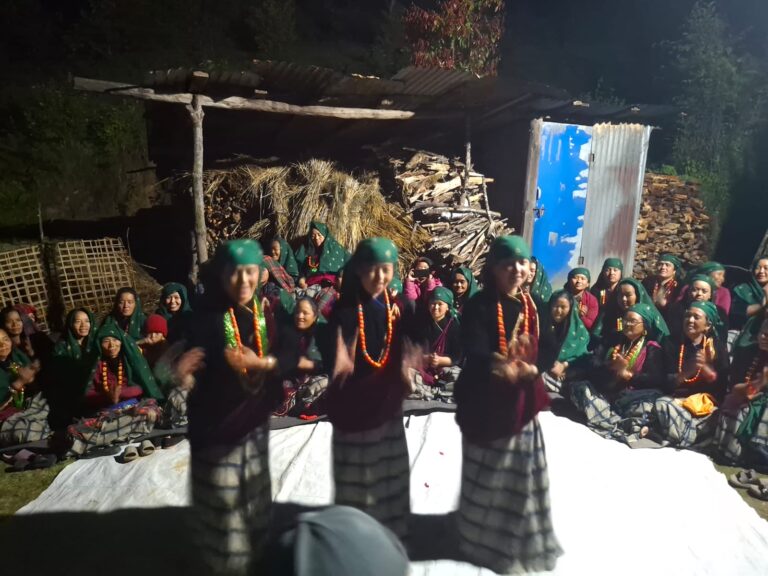
Photo: Nepal Photo Library
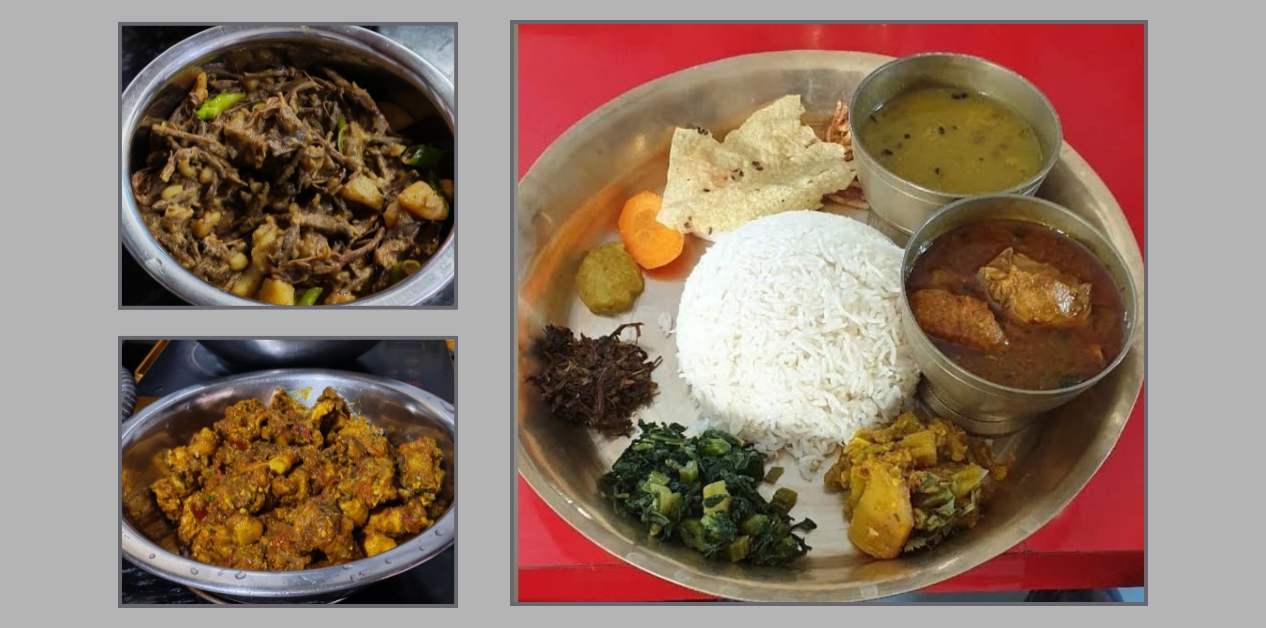
Since information had already reached beforehand, the house to stay in had already been decided. Taspani Gurung was the head of the household. Her husband is in the Gulf, and Thaku also went to Arab following his father the year before last. The younger son and Kansi (youngest daughter) are studying. One is at the headquarters and the other is in Samakhusi, Kathmandu. When Taspani was saying this, it felt as if she was carrying a heavy burden. A face wrinkled before its age, a hunched back, and cracked heels were saying a lot without speaking. Every line of Shyamal’s essay “Rittho Gaon” (The Empty Village) felt as if it was drawn from Taspani’s life. Local fiddlehead fern (niguro), lightly fried round beans (matyangre), potato curry, and rice seasoned with perilla seed (silam) pickle were in the food. The sharp taste of the food remained lingering on the tongue.
Inadvertently, it came out of my mouth—jibher madhye legei thaklo. Vishnu ji spoke—”What did you say?” I said—”The food was delicious, the taste is still hanging on the tongue.” “What language is this?” “Bengali”—my answer. “We don’t understand.” “I don’t understand what you all speak either, do I?” For the past hour, the villagers gathered there had all been conversing in the Gurung language itself; I was silent, seeking some meaning from their gestures.
“Now we must go, the rain has stopped too, the singing and dancing team has already gathered.” Kanchi Gurung, the treasurer of the women’s group, warmed everyone up. Matresses were spread outside in the courtyard. Everyone from school-aged girls to mother-grandmother ages had gathered together at once. In attire like Ghalek, Chaubandi Cholo, Lungi, etc., local Gurung identity was reflected. Glass beads (pote), tilhari, etc., were adorned around the necks of the married women. Some young girls dressed tidily in necklaces were seen adorned in lehengas. Songs were played selectively from mobiles; the loudspeaker amplified the sound and woke up the hill village. More villagers joined, and the cultural dance began here. Single, duet, trio, performing up to multiple dancers presented their respective dances. Later, everyone participated in the group dance. Started from popular songs and Dohori, this musical ritual truly became cultural when songs in the Gurung language echoed there. Conducted by Kanchi Gurung, the said ritual featured the captivating dances of Kalasi, Nilam, Vijay, Soni, etc. The local women’s group accumulates some finances from such singing and dancing and other social works. It is engrossed in building its own building; other programs are also in the plan in partnership. They are in search of helping hands and hearts. Along with that, they are in expectation of correct guidance.
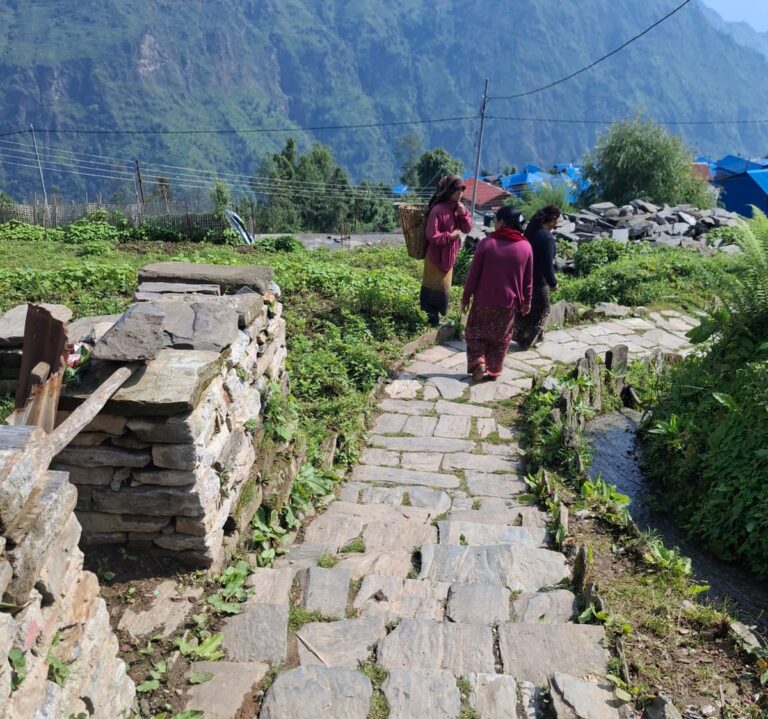
The next morning, the sun had already risen. Mountains stacked high above were visible. The settlements were bustling. Vishnu Gurung and Kanchi Gurung were ready to show me around Gumda village. There was a school on the upper side, and a wide space below was named—Thamra Wag Park. However, the park is yet to be built. At this very location, the Potato Festival is organized every year in the first week of August-September under the leadership of the same women’s group. There is a practice at that time to sell the potatoes grown by themselves and also make various dishes of potatoes to collect cash. There is stone paving throughout the village, which has worked as stairs to go from one place to another. During Dashain-Tihar and the Nepali New Year, the local residents repair and maintain these structures of their respective neighborhoods. After a short circuit of the village, having cooked and eaten food at the house of that same Taspani Gurung, I headed uphill, sitting behind rider brother Tak Bahadur’s Pulsar bike. The scenes missed while going to Gumda, I was trying to capture upon returning—a little in the camera, a lot more on the retina inside my eyes.
Bhupal Rai wrote in poetry itself, “Brother, poetry is in the village.” I say—vibrant life is in the village, but unwritten. Writer friends! Let’s not stay stuck too much in this city.