Kathmandu
Tuesday, June 16, 2026





Reading experience of the book ‘Mother Mary Comes to Me’ which correctly explains Arundhati Roy
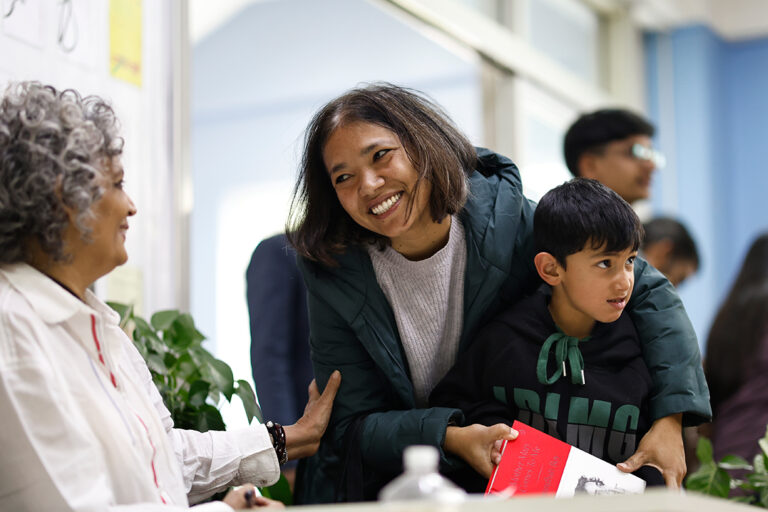
I met Arundhati Roy at an unexpected time. After the People’s War started in 1996, my parents went underground. The following year, my maternal aunt (elder) brought me to Gorakhpur to meet my mother. That same year, Roy was the talk of the town after winning the prestigious Booker Prize. In some context, my mother said—The God of Small Things, which won the Booker, is a book written by my classmate.
My mother used to call her classmate Roy “Suzy,” which is why I also knew her as Suzy Auntie. At that time, I was 11 years old and studying in class 8. In the process of going underground with my parents, I also received the responsibility of delivering letters to Roy’s house. Therefore, whether I read her book first or the process of giving letters happened first, I cannot remember. I would go quietly, hand over the letter, and return. Once, however, I was disappointed when I had to return after leaving the letter right at the door.
There was a kind of aura in Roy’s personality. I looked up to her as an ideal. After meeting her, I found out that she was an extremely humble and loving person. She was not only a fiction writer but also an activist. I used to read her interviews without missing any. However, after Nepal itself began to become the field of work during the course of the People’s War, I did not get many opportunities to meet her.
I met Roy again later at another unexpected moment. I had gone to Delhi for my MPhil studies. My friend Usha Titikshu had invited me to a meeting related to the sanitation workers’ movement. Coincidentally, Arundhati Roy was also present there. She was expressing solidarity from the audience gallery. That created an even deeper respect for her in my heart.
I also knew some friends with extremely radical views who looked at Arundhati as an elite individual who enjoys her fame and status and overshadows others. However, I saw her other side there. I was truly impressed by her when I saw her making a conscious effort not to overshadow others, but rather to be present simply as a fellow traveler of the activists.
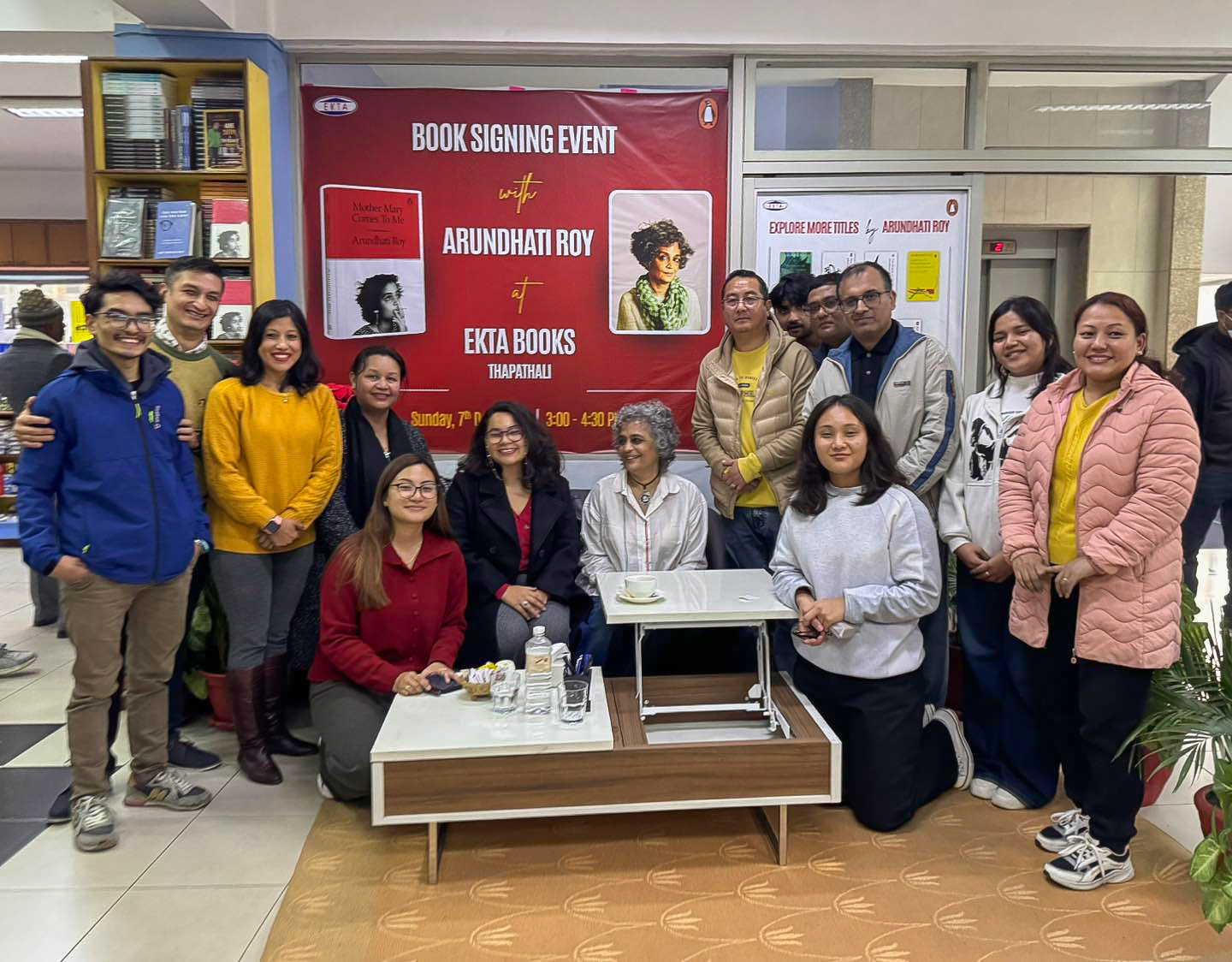
She had participated in a program held in Nepal, but many did not know about it. She did not want to appear in the media or become public on social media, etc., whereas we were interested in meeting her. In such a situation, some of us got the opportunity to meet her in a quiet and private setting. I admit, this opportunity was received by us women who had access due to privilege and accumulated social capital. There, we discussed feminist thought, ideas, movements, and the work we were doing. We also spoke about our situation, global shared experiences, and the times we are living in. She was aware of the difficult times we are living in and was interested in understanding how we are understanding and facing them. That was a useful session.
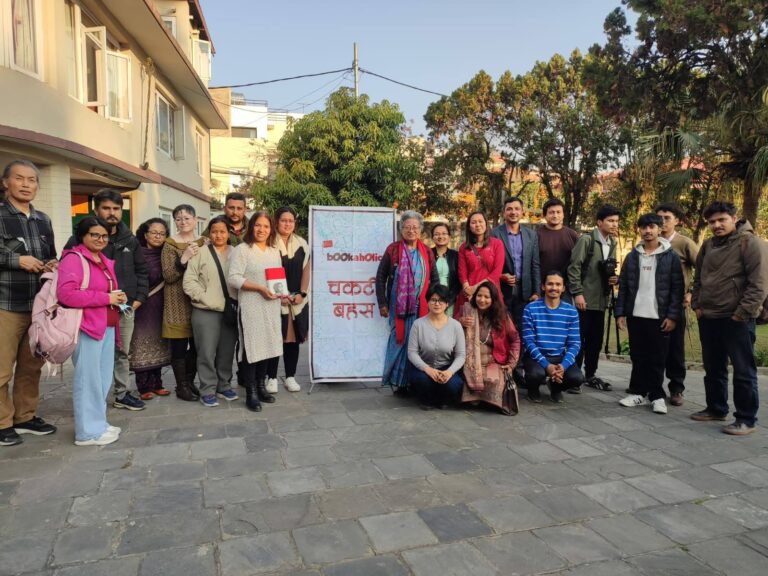
The latest meeting with her, however, took place right in Kathmandu at a book signing event organized in Kathmandu for her new book Mother Mary Comes to Me. I wanted to introduce my son to her and wanted to get a signed book from a beloved author present in my own city.
That was a time about one month after the Gen Z protest took place. I was in continuous interaction with some promising female and queer activists of the Gen Z protest. We used to talk about thoughtfully thinking, understanding, and expressing the mandates of the movement. However, the way the media should have given them space, that was not happening. Instead, they were defamed and their presence in relevant meetings was ignored. Arundhati was a source of inspiration for them. They wanted to discuss with the author who inspired them. After providing information about the Gen Z activists and the activism they were showing, she agreed to meet. I got the opportunity to facilitate that discussion.
That was an extremely emotional session; almost all of our eyes were filled with tears. In the situation after the Gen Z protest, we had not been able to express our psychological state. That meeting with Roy felt as if—the Gen Z activists were meeting their own Mother Mary. The participants showered her with questions just like to a politician. Even though they held high expectations from Roy, she accepted her limitations very humbly. She said that she was fundamentally a writer who holds empathy for others and becomes their voice. She said, “I do not know much about the developments in Nepal. But speaking from intuitive feeling, you all are in the right direction.” Her voice was full of encouragement and empathy. After that, we engaged in the discussion of Mother Mary Comes to Me.
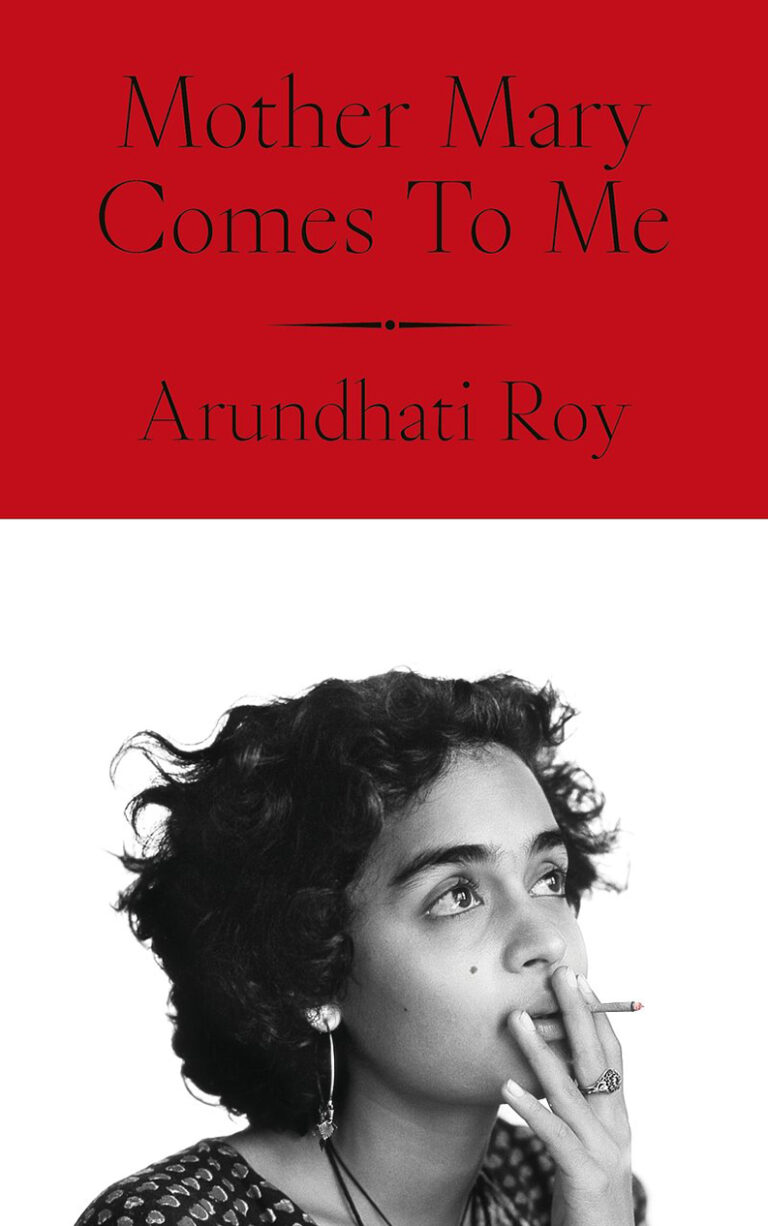
As a person experiencing motherhood, reading this book of hers felt like an experience where one’s mind and brain became active. This was important even from the perspective of the experience of the “sandwich generation” who has to take care of an aging mother and become a mother to a growing child. Reading about the relationship of a powerful personality like Arundhati with her mother made me emotional in many places. It compelled me to think, question myself, and reconsider my relationship with my mother, the way I am raising my child, and the meaning of being a mother.
Just in the morning, I had a minor fight with my son. The bread that I had prepared by taking out time and with love, he suddenly threw away in anger. I also snapped, and then he started crying. After that, I realized that because there was another person in the room, he felt uncomfortable and was crying.
I recalled an episode from the book where the personal boundary was very blurry in the shared space that became both a school and a home especially for Arundhati and her brother Lalith Kumar Christopher (LKC) during childhood. She is my mother, but she is primarily a teacher and she makes it clear that she wanted to remain more of a teacher than a mother. Therefore, they address her as “Mrs. Roy.” During childhood, Arundhati keeps longing for a separate private space between mother and daughter. I understood how important privacy and private moments with a parent are in situations where one does not want to share what is happening between oneself and one’s parents with others. After that, I requested that friend to step out of the room so that I could speak with my son privately.
Therefore, books can be transformative as well. They influence how you live your life, and I think—this aspect of Roy’s writing is beautiful. She dedicates herself completely, but is also full of empathy.
Classifying writers into selfish writers and generous writers, she has said—selfish writers are narrow and want the reader to follow their work only in a certain framework. Generous writers leave what they have written to the readers themselves to understand, take forward, and make even more refined.
Being a generous person, her writing is also very generous. For me, even thinking of bringing the experience of life with one’s mother into a book is a very difficult task. I think, one reason she was able to do this work is only because the book came out after her mother’s death. I do not think that any daughter can write about their mother in this way while she is still alive. This is a very painful and love-filled experience.
The Roy I am seeing looks like a magnificent personality from the outside, wearing good clothes, speaking good English, possessing social capital, and living in an area where wealthy people live like Chanakyapuri in Delhi where I met her. However, the book shows that her childhood was full of painful struggles. This book is not just about the relationship between her mother and daughter. Ultimately, it is also about what kind of a writer she became later. How the relationship with the mother played a role in every life experience; love, sex, education, her father, the men who came into her life, the profession she chose—all these experiences of life have shaped what kind of a writer she became and what she wrote about.
She has also shown how her mother connects to all of this. Later on, during the course of her writing, there are commentaries about the rise of Hindutva politics in India and its direction. There is also her question about who big dams and overall development are for. There is a description of her upbringing in Kerala’s own socio-economic and political environment. And it appears that the ground of looking at class, caste, and women influenced her upbringing. Alongside, she also has her own independent views.
Arundhati’s thesis turns out to be interesting too. Not just drawing traditional pictures and maps, she appears to have looked by theoreticianizing about who holds rights in urban areas, the urban and non-urban, those considered citizens of the city and those thought of as non-citizens in the city. At the age of 20-21, the traditional way of teaching in college felt meaningless and tedious to her. She is opposite to the traditional stream and turned toward creating original things. In that, I felt that her critical consciousness was pro-people. I think, this connects with her way of not wanting to flow with all these currents. Who gets the rights of urban life and who doesn’t? She analyzed the dimensions of the urban and non-urban, and the urbanite and the non-citizen. She likes to become different from the mainstream. This remained maintained in her life till much later. In this process, she has earned enemies as well. However, there are good people around her. She attaches great value to friendship, due to which she could tolerate life and succeeded in surviving. If she had not been liberated from the bondage of her mother, she would not have been able to be the writer and person we know now.
As a daughter, I know how difficult it is to break the attachment with a mother and move away physically. The courage she showed is not easy. Emotionally, of course, there is always a longing there, which is found in her book as well.
There is a contradiction there too. On one hand, there is also something like a complaint about parents not being around. On the other hand, she does not like to go to her friends’ houses because she does not want to meet those mommy-daddy type of people. She is living in a very contradictory and complex world. This is what life is, and she has clearly put the contradiction of love and hate toward her mother in the book.
As a daughter, I know that we all have such a relationship with our mother. It is beautiful too and painful at the same time. Therefore, in the most beautiful phrase of this book that most people talk about, she has called her mother the storm and shelter (storm and shelter). What I gained through the book is that, perhaps more than a mother in the form of a shelter that Arundhati wanted or could claim, she was a storm. However, looking at the time and circumstances her mother was living in, I can empathize with her mother in many ways too.
Of course, in Arundhati’s family, she also looked at the abuse and violence happening through her mother and primarily the often-absent but later returned-to-her-life father. Later, she also took care of her alcoholic father. Despite whatever things were there that shouldn’t have been experienced from the mother, she knows that her mother is not just a mother. I remember, even when she came here for the book signing program, she had written for a person ahead of me in the name of a child—Your mother is not just your mother. Arundhati is very firm on this matter. Who says this to a small child? But saying this is very important. I must keep saying this to myself too, because I also tend to underestimate my mother. Sometimes I take her only as a family person. But she is not just my mother. She is also a politician, writer, activist, and artist. And she likes to sing.
Our mothers have many forms which we sometimes underestimate, ignore, and look down upon. She is very objective and generous toward her mother, especially on matters related to the Travancore Christian Succession Act. That Act turns out to have come right in the year 1986, the very year I was born. For a single mother, gaining equal rights for women in ancestral property through the Succession Act in a community that is very proud of its identity like the Syrian Christian community, and a conservative community despite being in Kerala, was a big deal. Going to the High Court and fighting a case was an extremely important task for a woman and for the entirety of Indian women. Arundhati too had underestimated that struggle initially. It is mentioned in the book that only after someone told Arundhati that her mother’s fight was for young women and women as a whole did she understand how important it is. That too Arundhati finds out from someone else. Therefore, realizing how we behave in matters of motherhood and gender is also important knowledge for me.
I teach theories related to gender and motherhood, yet in life we are living in the very system which we are even criticizing. While criticizing this patriarchal neoliberal structure, we are also a part of it. Sometimes we do not even know how we become a part of it. Sometimes we are criticizing such a structure in its totality, but we cannot completely detach ourselves from it because we are also a part of that very system. We live in this contradiction. In the process of understanding this and understanding a lot, we live within it. However, even in such a situation, how not to surrender is my continuous struggle. Even as a politician, this is a very difficult fight. For Arundhati Roy too, this is a continuous struggle. She is also a part of it. In this context, she has sometimes spoken about the void that comes from helplessness.
Such moments keep coming throughout her life. Especially during the Sikh riots, during the regime of Indira Gandhi, the rise of Hindutva, and she has spoken about the helplessness she experienced during Lal Krishna Advani’s Rath Yatra for the demolition of the Babri Masjid. She has also spoken about the dilemma of whether or not to make decisions about her life. However, she also talks about overturning that and her returning, and talks about coming back after completely becoming a proper human being. She sees that moment too. She is an insecure human being just like all of us.
We are not always courageous, and it turns out we do not always have such chances, opportunities, and time. The way we now consider Arundhati courageous and as holding the guts to criticize the current Hindutva regime with such passion, the situation turns out not to have been the same always. That is fine too. We too turn out to be in a state of gathering strength at some time. She also makes a resolve to return again as a fully developed mature person. She does the same in life too, and starts life from a new direction, takes flight.
She had said in her remarks too—”It is not that I do not feel afraid. I feel afraid. I also feel lonely. So many threats and attacks happen continuously that it feels like I should also form my own gang.”
She doesn’t particularly like to go onto the stages of grand programs, but the main reason for making an effort to go there and participate turns out to be that the feeling that people are needed arises in her too. We realize that after all, she too is a human. It is understood from her life that even to become a powerful human being, one reaches there in life only by passing through all such weaknesses and stages of struggle.
I want to discuss here some excerpts that I found beautiful while reading this book. This is about Arundhati, her brother, and mother. It is about how the sister and brother are taking their mother’s death. This is taken from the section titled “I am on the side of the unvanquished, unconquered moon.”
When we were children, my brother and I never spoke to each other about Mrs. Roy (Mother). We used to address her simply as she. She never liked things related to each other because she thought we were conspiring against her. She made every possible effort to keep us separate. Now, only after she passed away do we meet each other freely, exchange things openly, and laugh. When she died, my brother did not pretend to be sad. Even when she was in the coffin. For me, however, it was different. I came unprepared.
If I had been able to understand myself well, perhaps I would have understood even more about the world and certainly about my country, where many people respect their oppressors and look grateful when they get to be oppressed and follow others’ directions on what to wear, what to eat, and how to think.
In all these things, there is something mysterious about the human condition. But, perhaps it is better not to understand some things, it is better to leave them mysterious. I am on the side of unclimbed mountains and unconquered moons. I am worried by endless theories and explanations. I think I have started giving priority to descriptions. Anyway, all this is just to say that when Mrs. Roy was in the glass coffin, I was devastated, but my brother was cheerful and was welcoming those who came to pay tributes. People looked at him considering it strange. I did not look that way. He did not care. I like that thing about him.
He never made an excuse that what happened to us did not happen. It was almost like that in order to shed light on her students and give them everything, we had to look at the dark side of the mother. Today, I am grateful for that gift of darkness. I learned to keep it close, to understand it, and to keep looking at it until its secrets unfolded. This became the path to freedom.
In this, there is a very honest and quite deep description of how Arundhati took the pain of losing her mother. What does it mean to say I have embraced darkness as a gift? How could someone consider darkness as a gift? This is the most painful thing that has remained with me. It compels me to think.
How was she able to move toward freedom by turning those shadows of darkness into positivity in her life? This is something I also need to learn, because we are living in difficult times in our homes, neighborhoods, and surroundings. Especially, due to the Gen Z protest, sometimes it feels like we are passing through a collective trauma. But as politicians, we have to move forward quickly in life as if nothing happened. But the reality is that in our country, in the neighborhood, and in our home, something radical changed. A lot of darkness is still left. But we are looking for that silver lining. What I received from Arundhati Roy’s writing is to look for a ray of hope and spread it through one’s writing and speeches. I will always remain grateful for being able to be her reader and for getting to know her personally.
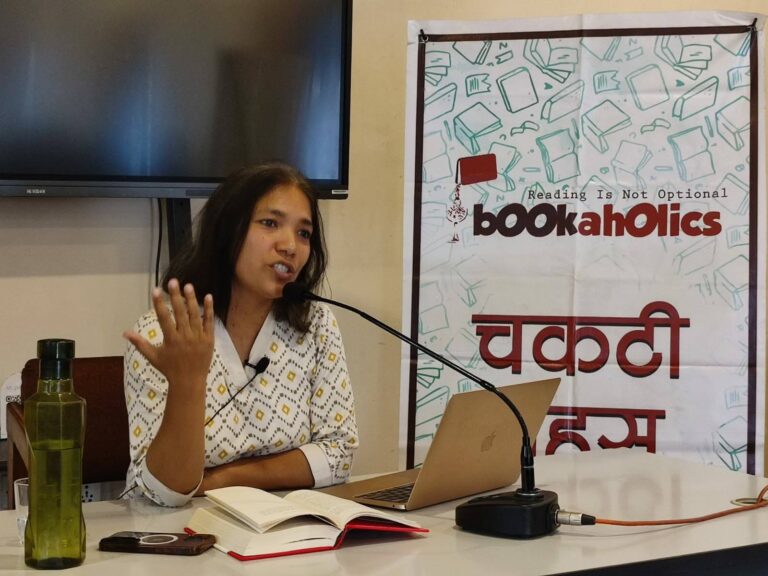
(An edited excerpt of the views expressed by Bhattarai on 20 February 2026 during Bookaholics’ 106th Chakati Debate regarding Roy and her book.)