Kathmandu
Monday, June 15, 2026





As a member of the Local Government Reform Commission 2024, I am pleased to observe that The Bangladesh Nationalist Party (BNP) has formally eliminated the partisan election system in local government bodies following its resounding victory in the 13th legislative elections. In April 2026, I was travelling to various union parishads in Bangladesh for research, and everyone was appreciating the BNP government’s great move in abolishing party-line local government elections, which was one of the major reform proposals of the Local Government Reform Commission 2024. Elections for city corporations and other local governments are now held on a nonpartisan basis, eliminating the necessity of using political party emblems. It was clear from previous elections that staging local government elections along party lines led to extensive nomination bargaining, increased electoral violence, and discouraged respected local individuals from running for office.
Local government (LG) is a conducive setting for democracy because, historically and since the dawn of civilisation, it permits the most disadvantaged people to ask questions, seek accountability, and participate in the governance process. In third world countries, it is a necessary precondition for sustainable development. Local institutions also function as schools for democracy because they develop leaders, who are crucial to the success of a democracy. LG is a crucial part of the central government of Bangladesh. However, a number of enduring problems have impeded the units’ capacity to grow into long-lasting institutions that offer the community democratic education.
From its inception, Bangladesh has fought to become a modern, democratic nation. However, a lot of political ups and downs, the establishment of a one-party government, military rules, and the competition of political parties for power have jeopardised the nation’s democratic path. Rather than the Constitution, Bangladesh’s political problems are a result of its political culture. It has also made it more difficult to democratise Bangladesh’s local government structure. The Cabinet’s decision to organise partisan local elections on October 12, 2015, marked a fundamental shift in Bangladesh’s political structure.
Since local government elections have been conducted on a nonpartisan basis since Bangladesh’s independence, many impartial and well-liked locals have had the chance to win. But in many instances, these individuals did not come forward this time. Furthermore, it is quite unfortunate that the nomination process has been corrupted. Honest and committed politicians are also vying for favours from powerful people. Thus, there is intense debate on the logic of the party-based approach of local government elections. For this reason, a number of political parties and election specialists have long advocated for the elimination of party emblems from local government surveys. The Local Government Reform Commission and the Electoral System Reform Commission both suggested doing away with party symbols. In response to their suggestions, the interim administration repealed the clause in July of last year through an ordinance.
At the request of the Local Government Reform Commission 2024, the Bangladesh Bureau of Statistics (BBS) conducted a household survey in January 2025 across rural and urban areas of all 64 districts of Bangladesh. The survey aimed to gather public opinion on various aspects of local government reform from 46,080 people from different professions and men and women in 64 districts through scientifically successful sampling. At the household level, nearly three-quarters (71.1%) of respondents do not support local government elections held with political party symbols. Only 24.8% support holding local government elections with political party symbols.
In my opinion, credible, fair, participative, and peaceful local government elections are greatly influenced by the government’s total neutrality, political parties’ responsible behaviour, the EC’s firm stance, and the integrity of poll workers. Even while strict procedures will be put in place to avoid violence, we need political parties to show a genuine commitment to maintaining peace. Enough law enforcement must be implemented, and if any anomalies or malpractice were discovered, the EC would not hesitate to utilise its authority to immediately suspend voting places. It is encouraging that the Election Commission plans to raise the security deposit amounts for all tiers, with the exception of the Upazila elections, and is doing away with the necessity that independent candidates obtain signatures from 1% of voters.
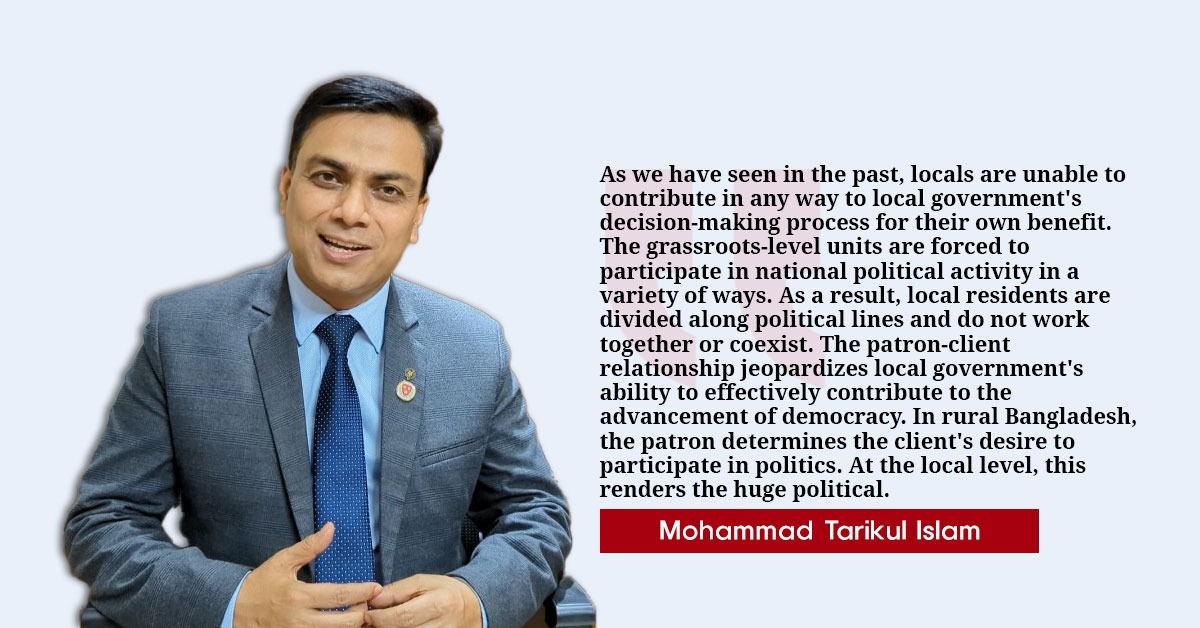
As we have seen in the past, locals are unable to contribute in any way to local government’s decision-making process for their own benefit. The grassroots-level units are forced to participate in national political activity in a variety of ways. As a result, local residents are divided along political lines and do not work together or coexist. The patron-client relationship jeopardizes local government’s ability to effectively contribute to the advancement of democracy. In rural Bangladesh, the patron determines the client’s desire to participate in politics. At the local level, this renders the huge political.
For LG to function effectively as a democratic body in the proper sense, there must be a strong political will. The “bottom-up” method to development, which actively incorporates people in the formulation and execution of local government choices, is urgently needed to make development really meaningful, empowering, and sustainable. This compels democracy to become as decentralised as possible. For the democratisation of Bangladesh’s local government entities to be effective, there must be a strong political will.
(Dr Mohammad Tarikul Islam is a Professor in the Department of Government and Politics at Jahangirnagar University as well as a Postdoctoral Fellow and Visiting Professor at Oxford, Cambridge, LSE, and Harvard. Professor Islam was the member of the Local Government Reform Commission 2024.)