Kathmandu
Sunday, June 21, 2026





Opened in Laxminiya, Dhanusha, this cooperative is linking remittances with entrepreneurship while breaking the cycle of unemployment.
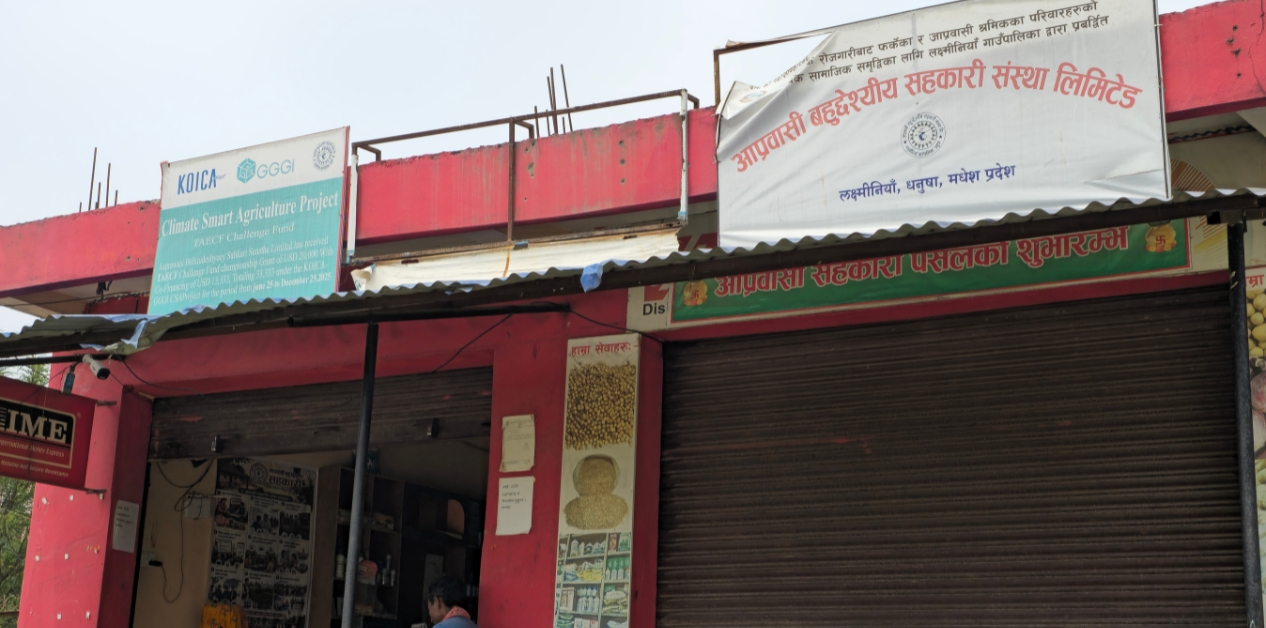
JANAKPURDHAM: When Umesh Sahani from Laxminiya Rural Municipality-2, Sohni Tol in Dhanusha went to Qatar for the first time, he took a loan of about Rs 400,000 from a local moneylender. The interest rate was a staggering 36 percent. Earning about Rs 40,000 a month from manual labor, he ended up paying Rs 700,000 in principal and interest over four years.
Sahani, who spent about 10 years working in various countries including Qatar and Malaysia, developed a serious health problem while abroad. Following this, the fear of financial crisis grew within his family. However, his wife, Sabitridevi Sahani, looked for a new path while staying at home. Upon learning that a cooperative had opened in the village to connect migrant workers and their families with savings, loans, and entrepreneurship, she joined it.
Sabitri took a loan of Rs 30,000 from the cooperative to set up a grocery shop and a sewing machine. Currently, the income from this business covers household expenses, the children’s education, and her husband’s medical care. Of her two children, her daughter is studying in grade 5 and her son in grade 3. She shares that she deposits Rs 600 daily into the cooperative as savings and loan installments.
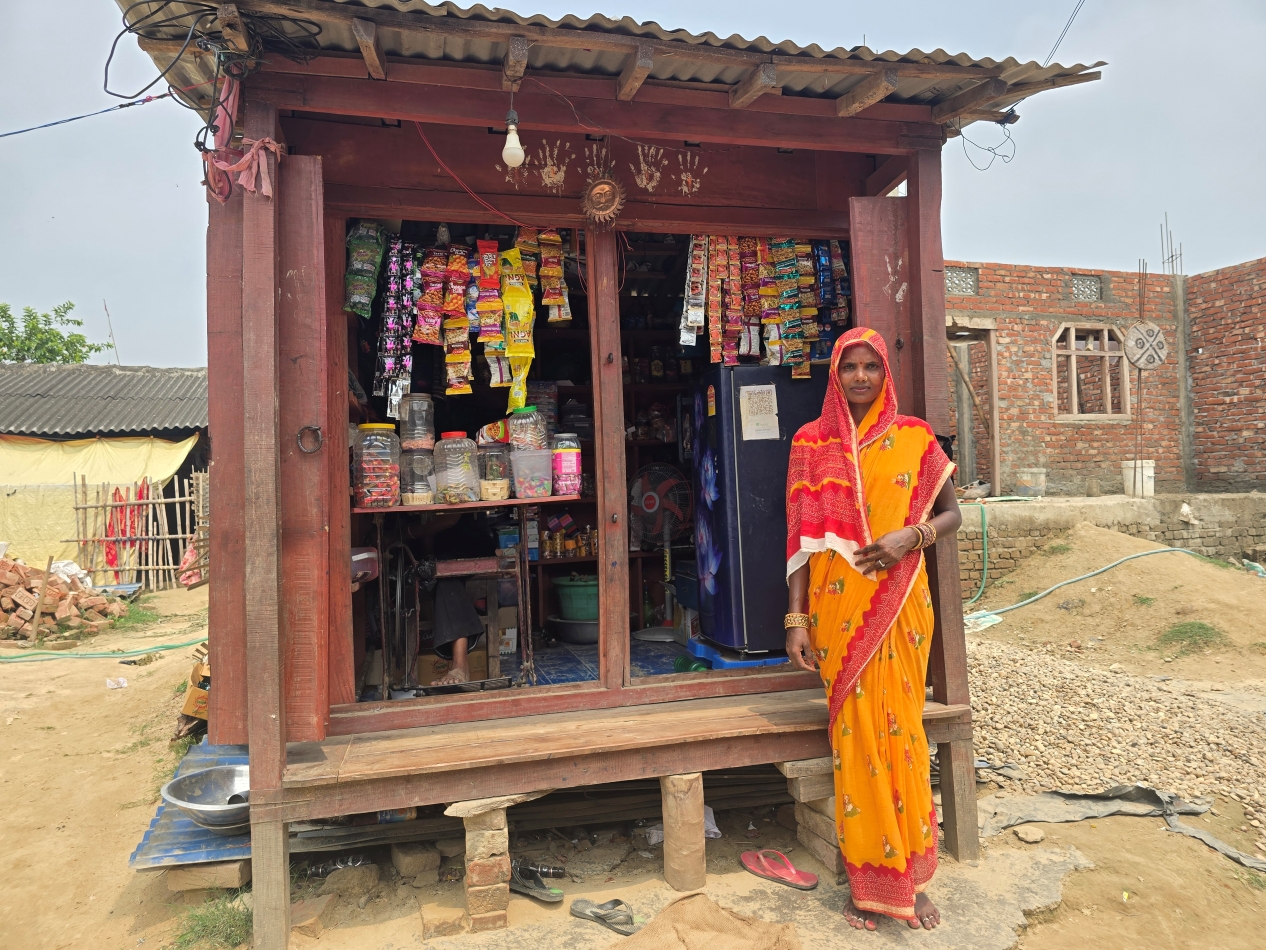
Sabitridevi Sahani, who runs a grocery store with a loan from the cooperative.
“Previously, we didn’t understand the high interest rates of moneylenders. We only realized it after paying them off,” Sabitri says. “Now, taking a loan from the cooperative has become easy. I also plan to expand the business.”
The Migrant Multi-Purpose Cooperative Society Limited, established in Laxminiya for families dependent on foreign employment, has attempted to bring savings, loans, skills, financial literacy, agricultural supplies, and safe migration information together under one roof. This initiative was undertaken by locals to resolve problems related to exorbitant interest rates, predatory loan-sharking, unsafe foreign employment, and the reintegration of returning migrant workers.
Returning from abroad to start a business in the village
Upendra Sah, also from Laxminiya-2, Sohni, spent about nine years in Qatar and Malaysia. In Malaysia, he worked in a factory, and in Qatar, he worked as a plumber. His wife, Savitri Sah, began depositing a portion of the money he sent from abroad into the cooperative. After Upendra returned, he took a loan of Rs 100,000 from the cooperative, bought an old mill, and started a business grinding wheat, rice, and spices right in the village.
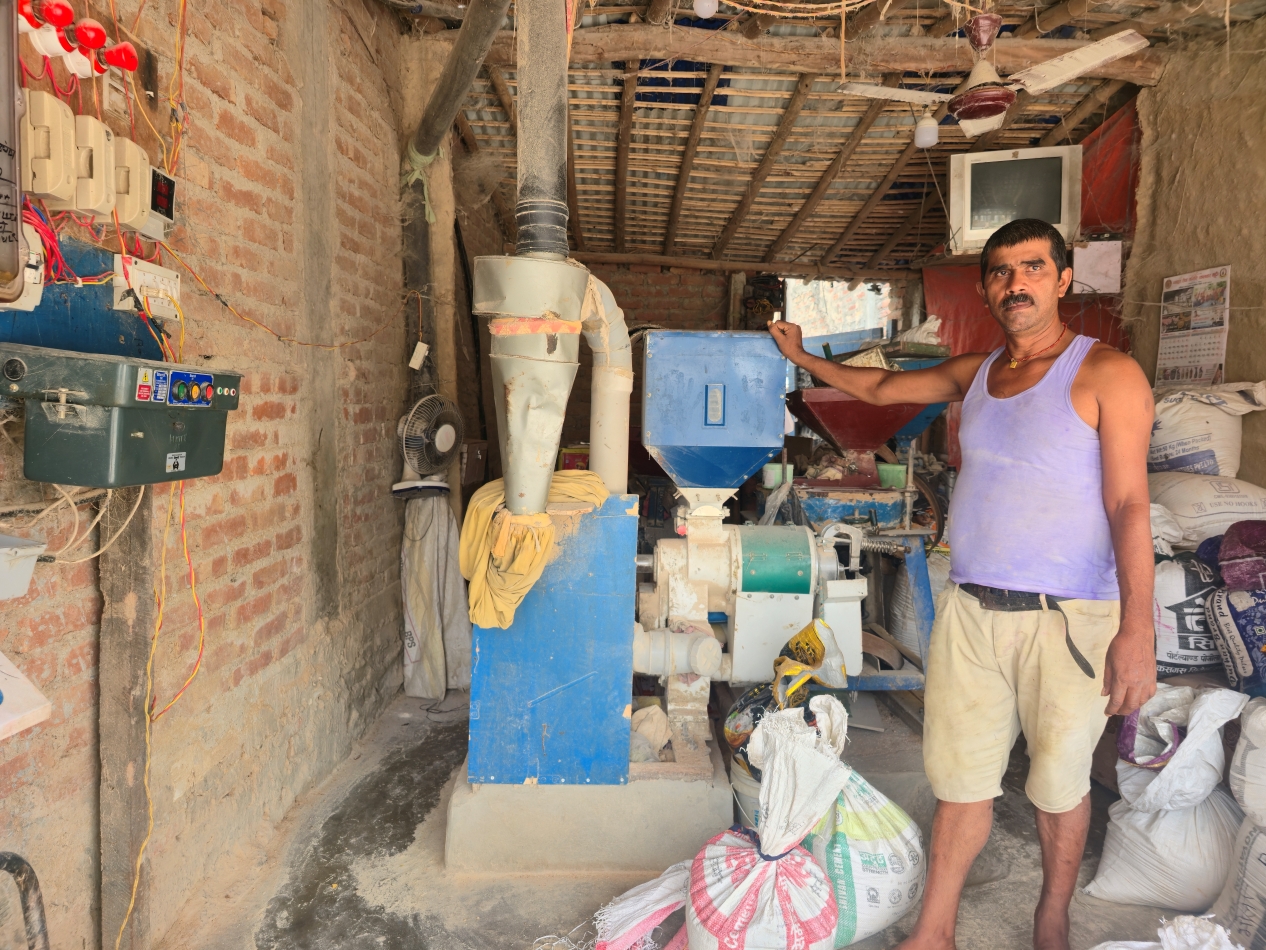
Upendra Sah, operating a mill after securing a loan from the cooperative.
Later, he upgraded the old mill with new machinery. Currently, along with the mill, he also runs a grocery and hardware supply store. His wife and son support him in managing the business.
“It is much better to sweat in your own village than to suffer in a foreign land,” Sah says. “Instead of working under the scorching heat of Qatar, it has been wonderful to take a small loan and work in my own village.”
According to Sah, if the government made subsidized loans and other support available for those who want to return from abroad and start enterprises in their own villages, it would encourage many to work within the country.
The cooperative exclusively accepts migrant workers, returnees, and their families as members. Family members save money, take loans when necessary, invest in business or farming, and receive vital information regarding the migration process through the cooperative.
The chairman of this cooperative, Dukharan Yadav, is a returnee migrant worker himself. He returned to the village after working as a junior electrician in the UAE for about 10 years. Despite passing the written examination for the Nepal Electricity Authority twice, he went abroad after failing the interviews. He shares a bitter experience where, upon reaching the airport for a job that was advertised as free, an agent insisted that he would not be allowed to fly unless he paid Rs 60,000.
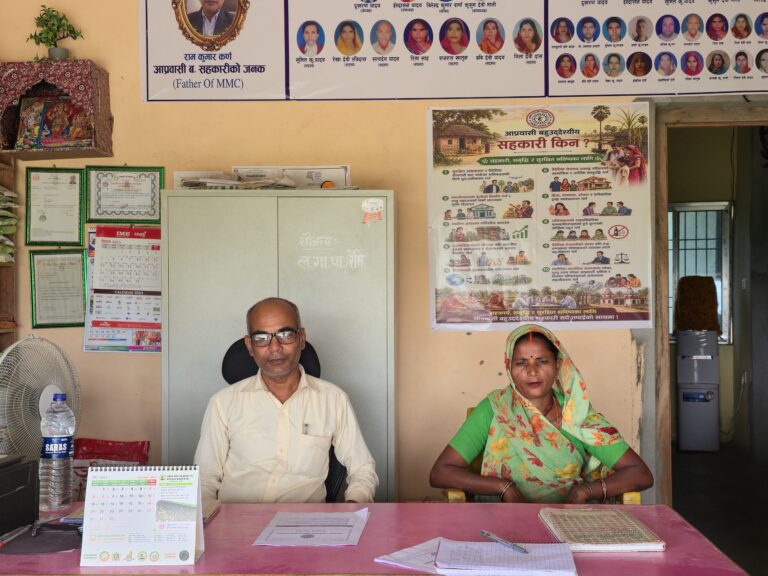
The Chairman and Treasurer at the cooperative office.
Yadav shares that this very experience inspired him to do something in the village after returning from abroad. He says, “To ensure other Nepalis are not cheated the way I was, we started raising awareness and focusing on savings after my return.”
The cooperative was established on October 9, 2018, by forming an 11-member committee in the presence of 101 people. The cooperative aims to promote safe migration for those heading abroad, facilitate the sustainable reintegration of returning workers, organize migrant families, and channel remittances into productive sectors.
Currently, the cooperative has 736 share members. Among them, 69 are male returnees (those back from foreign employment) and 667 are female members of migrant families. The cooperative has 86 groups, with a maximum of nine members per group. The total number of shares stands at 14,320, with a share capital of Rs 1,432,000. The cooperative’s savings have reached Rs 8,139,800, and loan disbursement has reached Rs 6,668,627.
Self-employment through savings, loans, and skills
According to the cooperative’s audit report for the fiscal year 2024/25, the cooperative recorded an annual turnover of Rs 2,852,000 in fertilizer and pesticide sales, Rs 284,540 in agricultural seeds, Rs 336,000 in animal feed, Rs 224,000 in grocery items, Rs 16,200,000 in remittance services and Rs 115,000 through eSewa and mobile banking services.
As highlighted in the audit report, the cooperative has provided financial literacy and business knowledge training to 250 individuals. Additionally, 156 individuals received skill-based training, and loans were disbursed to 25 individuals. The cooperative claims that 25 returnee migrant workers have successfully started self-employment ventures.
Among them 7 run grocery stores, 4 run clothing shops, 2 run fruit stalls, 3 are engaged in livestock rearing, 4 are doing fish farming, 3 operate e-rickshaws and 2 are involved in vegetable production.
Families of these returnees have also ventured into business as 6 have started vegetable trading, 4 have opened snack and tea shops, 3 have started Lahathi (lac lacquer bangles) and glass bangle shops and 23 have taken up fish trading.
The cooperative offers a 6 percent interest rate to savers and disburses loans at a 12 percent interest rate. Chairman Yadav claims that because the members belong to families connected to foreign employment, there are zero bad loans.
Rekhadevi Das, the cooperative’s treasurer, shares that her husband, Rambinod Ram, has been working abroad for about 17 years. Following her husband’s departure, the responsibility of farming, childcare, and managing the household’s finances fell on her shoulders. While two of her daughters are already married, she still bears the responsibility of raising and educating three remaining children.
Rekha has leased about two bighas of land for farming and also rears buffaloes and goats.
“Previously, even for minor expenses, we had to knock on the doors of local landlords and moneylenders,” she said. “We had to pay exorbitant interest rates. Now, I am able to save money, and I also take out loans when needed. Life has become much easier since the cooperative was established.”
According to Rekha, the cooperative makes it easy for migrant families to farm by providing tractors, seeds, fertilizers, and pesticides at subsidized rates. She added that at a time when agriculture is facing a crisis because young people are moving abroad, this kind of support has helped families keep their farms running.
Emphasis on safe foreign employment
However, the cooperative’s scope is not limited to providing business loans. According to Yadav, advocating for safe foreign employment is a top priority for the cooperative. He noted that people often get swindled, arrive abroad without any skills, find themselves in hazardous jobs, and leave no necessary paperwork at home, leaving their families unable to assist when troubles arise.
“If individuals are informed beforehand about the destination country, its rules, laws, language, culture, and weather, the problems minimize,” Yadav explains. “We also advise them to leave a copy of their labor permit, visa, employment contract, and insurance documents at home.”
According to him, whenever cooperative members learn that someone in the village is planning to go abroad, they reach out to them to explain the parameters of safe foreign employment. They also hold meetings every three to four months to discuss the risks and necessary precautions associated with foreign employment.
In the Terai-Madhesh region, borrowing money from local landlords at high interest rates for foreign employment remains a prevalent practice. The issue of predatory loan-sharking has burdened many families with inescapable debt. In this environment, the cooperative appears to be successfully reducing dependency on local moneylenders by offering savings, subsidized loans, and enterprise options to migrant workers and returnee families.
Suryanath Mishra, a local resident of the same village and former Ambassador to Qatar, states that the cooperative serves as an exemplary model proving that success comes from local collective initiatives rather than searching for solutions outside. “The solution is not somewhere outside; it lies in our own collective efforts,” Mishra says. “If this type of initiative is replicated elsewhere, many people can benefit.”
Bhogendra Mishra, Chairman of Laxminiya Rural Municipality, remarked that the cooperative has brought immense ease in terms of safe migration, self-employment, agricultural inputs, and financial support for the families of young people going abroad. According to him, scaling this practice to other regions could help returning workers become self-reliant.
Mishra adds, “In a context where hard-earned money from abroad is routinely drained by daily household expenses or spent entirely on clearing lenders’ debts—only for the cycle of unemployment to repeat upon return—the cooperative’s effort to link foreign earnings with village-based entrepreneurship is highly commendable.”