Kathmandu
Saturday, July 11, 2026





Moving beyond simple fiction, Keshab Dahal’s latest book Itha delivers a weighty critique of the male mindset and a powerful celebration of women’s autonomy
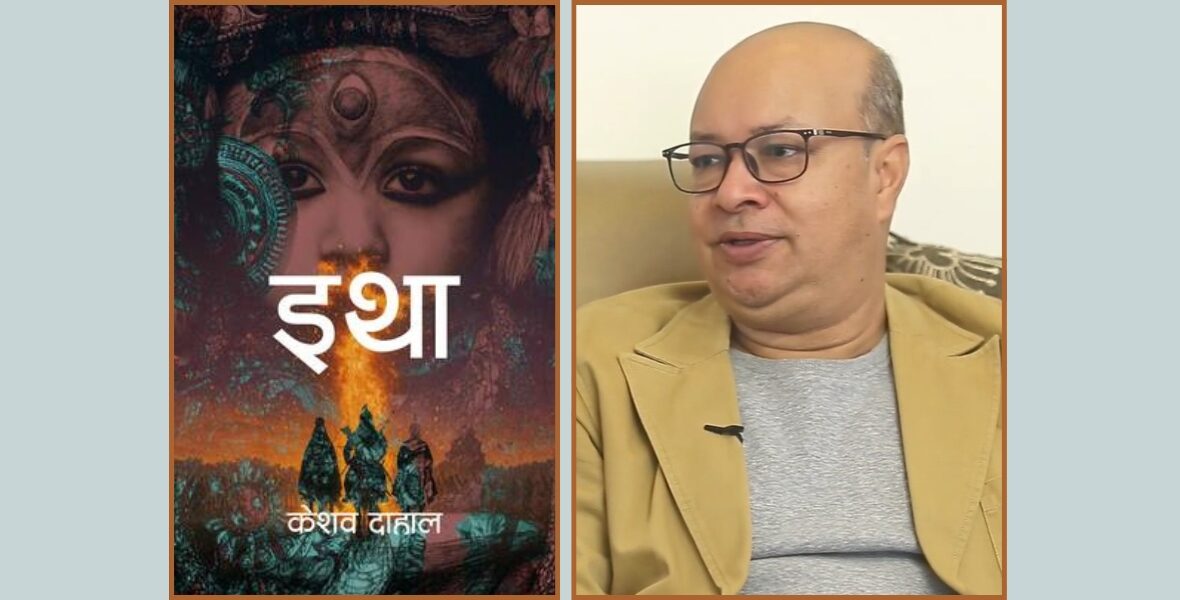
KATHMANDU: Having read Keshav Dahal’s debut novel Mokshabhumi, a grand narrative centered on slave liberation, anticipation for his second piece of fiction, Itha, has been building ever since its pre-publication stage. Dahal has once again anchored his narrative in a historical landscape. For a writer widely recognized for publishing thought-provoking analytical commentaries across print newspapers and digital screens, Dahal’s deliberate choice of historical fiction as a vehicle for literary imagination is as intriguing as the novel itself.
Although the background of Dahal’s newest novelistic work Itha is history, it is not a ‘sequel’ to his previous work Mokshabhumi. With different historical periods and an entirely separate subject matter, Dahal stands before the readers’ court this time.
The meaning of ‘Itha‘ is not found in the Nepali dictionary. Some words do not have fixed meanings, and they remain outside the dictionary. Some speculate that Itha could be the name of a specific person. The benefit of the doubt can be given to such a speculation. Because, if Itha is a name, it belongs not to a person but to the work, meaning the novel. Itha is a word formed from the combination (fusion) of history and fiction, explaining which the novelist says, “Itha is the Ithalaya, meaning the reflected world of story and history, where there is not even a slight distinction between the worldly and otherworldly realms. ‘Itha’ is a mixture of history, story, fantasy, and doctrine or ideology.” In this way, novelist Dahal appears creative right from the name of the work.
Itha is a history that is like a story and a story that is like history. As soon as the novel begins in a scenic city named Amaravati, it starts flowing like a river between story and history, a fine invisible line whose play leaves readers confused about whether Itha is a story or history.
The centrality of Itha is women’s liberation. A woman’s self-existence and independence are its pivot. The novelist has synchronized two different plots of the Malla period of Nepal Mandal and the Shakyamuni Gautam Buddha period, woven around two female characters, Basudha and Nayantara. From Basudha’s Malla period, the author takes the reader to wander in the Buddha period through a ‘time machine.’
Whether it is the path of self-immolation or the renunciation path of a nun, both female characters fight the battle for self-existence. They cross numerous misogynistic barriers named tradition.
When the former Kumari Basudha is rejected by her lover Prince Shubhakamadev due to a body defect because of having a mole on her breast, she reaches a decision to take revenge on that ‘lover.’ And she wants to fulfill that revenge through self-immolation on the day of Indra Jatra. Self-immolation is not cowardice for Basudha but a retaliation. It is a rebellion against the insult to a lover’s existence in the name of love. The plot of Kumari Basudha’s retaliation is the beginning of the story of Itha, which the author has synchronized with the plots of retaliation of another female character, Nayantara, against her ‘impotent’ but war-manic husband Pramati and her husband of compromise, ‘Dasti.’
Whether it is Basudha who reaches the decision of self-immolation, or Nayantara, who dons the white robe from being a queen due to a voluntary divorce from King Pramati, both are powerful female characters. Whether it is the path of self-immolation or the renunciation path of a nun, both female characters fight the battle for self-existence. They cross numerous misogynistic barriers named tradition.
Itha has thoroughly dissected the male mindset that considers a woman merely an object of pleasure. Nayantara’s consideration of women’s self-existence as paramount even amidst the dilemma of becoming the queen of Baishali King Pramati if she wins the theatrical competition and having to become the city bride of the Amrapali circle of dancers if by any chance she loses makes it clear that the centrality of Itha is women’s liberation. Nayantara’s determination that ““Even if I become a city bride, I will not become an object of pleasure. I will become a self-respecting woman”” is the clarion call of women’s self-existence. Those women do not see any connection with the morality and integrity of love, marriage, and sex, and they fight an untiring battle for self-existence.
The thin line between story and history has already been discussed, an outstanding aspect of Itha is the philosophy within it. It is scripture and philosophical critique. In the novel, two separate chapters are set aside for the critique of religion and philosophy. Since it is a Shakyamuni Buddha period setting, the dialogue among the Tathagata Buddha, Nayantara, and Dhanyavati in Sarnath and, similarly, the debates on religion and philosophy in the grand sacrifice organized by Prince Supushpa in Manjupattan are the most profound, or rather the heaviest sections of the novel.
The question-and-answer sessions featuring Tathagata Buddha, Mahamuni Mahavir, the scholarly woman Gargi, the scholar Ashtavakra, and Acharya Shukadev, among others invited to the grand sacrifice, reflect timeless inquiries. In today’s language, these function as the ‘Frequently Asked Questions’ (FAQ) of religion and philosophy that have persisted since primordial times.
During the event, the organizers of the sacrifice and the common people present vented their deepest curiosities upon these sages, asking questions such as:
“What is the mystery of birth?”
“Is death terrifying?”
“What is the existence of the soul?”
“What is the path to salvation?”
“What is consciousness?”
It is no small audacity of the author to provide these innocent yet profound questions of the common people from the very mouths of the Buddha or Mahabir. Knowing very well that the plot would not be affected even if these and such questions and chapters were not included, the author’s including such profound topics can be considered the ideology of the novel. The author probably critiqued religious philosophy in the sweet syrup of fiction to increase the ‘weight’ of the book. However, the reader can read or set aside these questions and contexts according to their interests. Doing this will not affect the flow of the story at all.
The novel remains under the complete grip of the author. He does not appear carried away anywhere and does not fail to give poetic justice to his characters.
The strongest aspect of Itha is its linguistic grace. As graceful as novelist Dahal’s language is, the description and imagination are even more captivating. The setting of the story is so picturesque that as the pages are turned, the reader reaches to wander in a dreamlike world. The joy of reading a novel can be fully experienced in Itha.
It can be felt that the story has been enjoyable not only for the reader but also for the author himself. While extending Nayantara’s plot in the ‘Ithansh’ chapter, the author happens to remember Basudha. Again, he creates a mix-up with the name of Supushpa’s school, Taxila, for Nayantara, who had bid farewell from Sarnath. It is hoped that the author will correct these errors in future editions.
Despite saying this much, the novel remains under the complete grip of the author. He does not appear carried away anywhere and does not fail to give poetic justice to his characters. He punishes bad and arrogant rulers, while he gives justice to good characters. Through this very wand of poetic justice, he brings a ‘twist’ into the story and reverses Basudha’s decision of self-immolation.
While providing the pure pleasure of fiction, the deeper ideological focus on women’s self-existence elevates Itha into a weighty, profound work that goes far beyond a simple, delightful read.