Kathmandu
Tuesday, July 14, 2026





When judicial appointments and Constitutional Bench formation are seen as politically influenced, the courts risk losing the independence that underpins constitutional democracy.
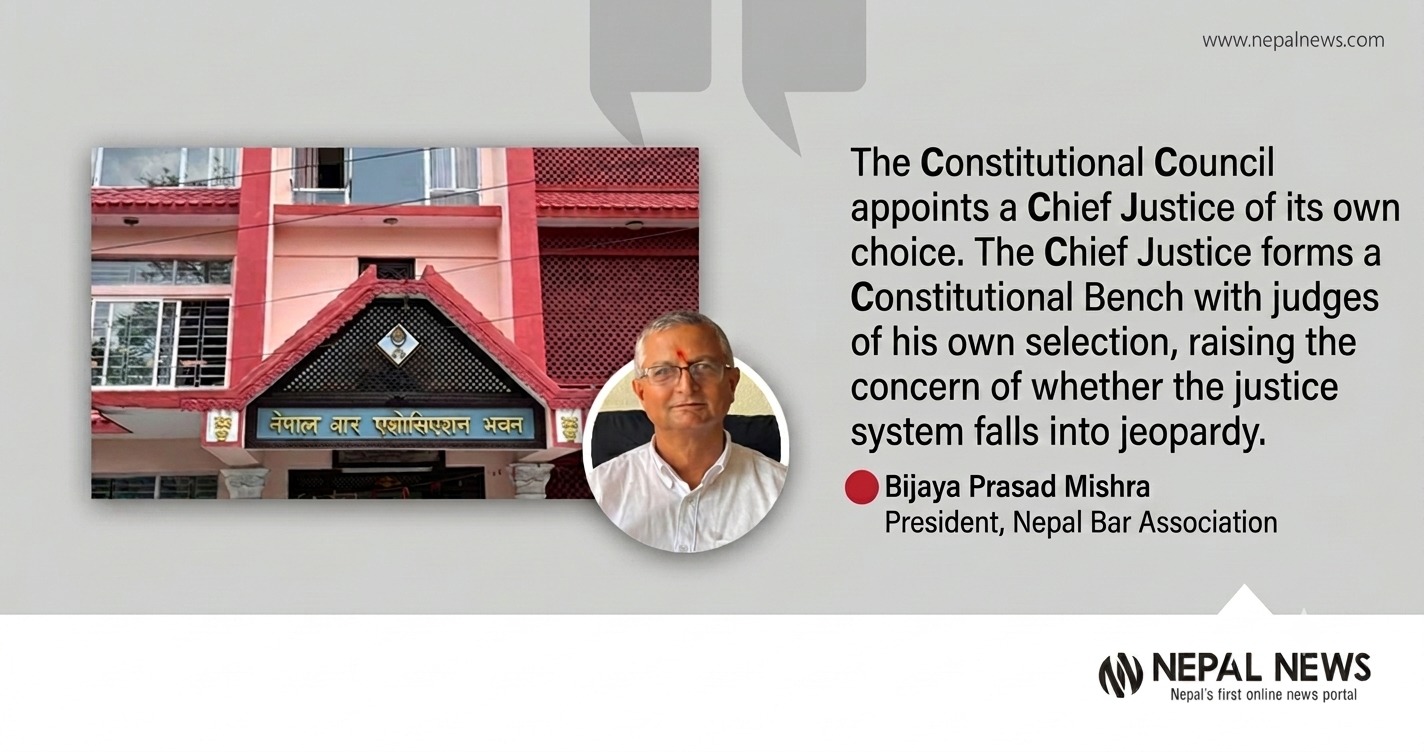
The Nepal Bar Association is considered an integral part of the judiciary. As the umbrella organization of legal practitioners across the country, the Nepal Bar has historically launched various agitations demanding judicial reforms. In this context, Bhasha Sharma of Nepal News spoke with Senior Advocate Bijaya Prasad Mishra, the Central President of the Nepal Bar Association, covering topics such as the state of the judiciary following recent political changes, the relationship between the Bar and the Bench after the Constitutional Council appointed the fourth-ranked judge as Chief Justice, the growing backlog of cases, delays in appointing judges, and accusations leveled against the Bar.
What kinds of programs is the Nepal Bar Association currently running?
Various committees of the Nepal Bar—including those dedicated to consumer law, mediation, human rights, and constitutional matters—are highly active in their respective fields. They are conducting research, studies, and seminars. The Bar Association is also preparing for its annual general meeting and amendment of its statute. Draft work is underway to amend the statute to align it with the federal structure. Furthermore, since a national conference must be held within a year, the framework for that is currently being prepared.
We are also executing other routine tasks and closely monitoring the daily activities of the judiciary. Our work consistently focuses on ensuring constitutionalism, an independent judiciary, the rule of law, and the swift administration of justice.
The Bar is considered an arm linked directly to the judiciary. How is the relationship between the Bar and the Bench at present?
We place immense focus on ensuring that the relationship between the Bar and the Bench does not deteriorate. We hope it will not. We have been raising all our concerns transparently during meetings. However, the system of seniority has been gradually dismantled here, and the fourth-ranked judge has been appointed as the Chief Justice. The Honorable Chief Justice has also started forming the Constitutional Bench at his own discretion.
We are deeply concerned by the prospect that the justice system could fall into jeopardy when the Constitutional Council appoints a Chief Justice of its own preference, and that Chief Justice subsequently forms a Constitutional Bench by picking judges of his own choice. On the other hand, the Speaker of the House has repeatedly expressed the view that the judiciary must coordinate with other state organs and work in the same rhythm, which has also forced us to reflect seriously on this matter. If a harmonious relationship is maintained between the Bench and the Bar, executing all programs becomes easy, and that is what works best for us. However, the current circumstances and certain incidents make us feel that signs are emerging that the days ahead will not be so easy.
What exactly did the Speaker say?
The Speaker expressed his views in a manner suggesting that the executive, the legislature, and the judiciary must share the same rhythm, the same voice, the same policy, and the same programs.
Does this mean we should understand that discussions regarding the judiciary are taking place within the legislature as well?
It is the judiciary’s role to examine whether the laws enacted by the legislature conform to the Constitution. The executive always looks forward to the next election and tries to act according to its own whims. In such a scenario, the rights and interests of the citizens can be trampled upon or suppressed, the public can be weakened, and the executive might arbitrarily detain its critics. It might also attempt to stifle the media by cutting off advertisements. It could even fragment the court system by setting up benches in various places to weaken organized institutional strength. It is the duty of the judiciary to stand firmly against such machinations and protect the Constitution. The judiciary cannot move forward functioning merely as an extension of the executive or a branch of the legislature.
It is being said that judicial reforms have commenced since the government with a new mandate took charge. What is your take on this?
A mere change of faces does not reform the judiciary; it degrades it further. Beyond the Constitution, laws, and regulations, there are also various unwritten traditions and systems that are practiced smoothly and powerfully within the judiciary. While the budget for judicial reform ought to be sufficient, it has actually been slashed. The judiciary has been unable to acquire necessary physical resources. It is forced to operate under such limitations. In these circumstances, we view the ongoing actions as an assault on the unity and established practices of the judiciary. On the other hand, we have received reports from many quarters that, in the name of reform, the judiciary is shifting its focus heavily toward increasing the number of settled cases. However, the court’s work should not be disposal-oriented or statistic-driven; it must be justice-oriented.
Furthermore, at a time when negativity is prevalent everywhere, a pilot program to live-stream court proceedings has been introduced. Rather than seeking public validation for its every verdict, the judiciary’s decisions must be consistent with the Constitution, the law, and pure conscience. A judge should never act to gain publicity or social sympathy. They must exercise judicial conscience. Allowing certain matters within the judiciary to run according to their own established systems is far better for the institution. Live-streaming is appropriate for cases involving the dissolution of parliament, or matters where politics and law intersect—essentially, cases of massive public interest. When a case is live-streamed based on media trials, it can lead to a situation where the facts in the case file point one way, while social expectations pull the other way. A judge cannot give in to social desires. Live-streaming should not be conducted in a way that defames a judge who is simply exercising their independent conscience. Moreover, policy guidelines and regulation are vital here. Broadcasts cannot be conducted in a way that obliterates the distinction between a courtroom hearing and a YouTube video designed for entertainment.
On the flip side, there are assertions that ‘populism’ has come to dominate the judiciary. The judiciary is not a place to become a celebrity; it is a sanctuary for dedication and penance. It is a place to deliver justice to those who have been wronged. The strength, patience, and environment required by the judiciary must be provided by other state organs, civil society, and particularly by lawyers. We have always contributed to fostering an environment that gives the judiciary the necessary courage. However, other state organs are actively trying to strip away its beauty, oppress it, and establish the narrative that the judiciary is a subordinate body under their control. The general perception now is that the judiciary is failing to exhibit the level of fearlessness required in the current context.
You mentioned case disposal. There are over 27,000 pending cases in the Supreme Court. It is also alleged that the backlog piles up because legal practitioners take unnecessarily long during arguments and frequently seek postponements. What do you say?
The disposal of a case is ultimately done by the judge. The lawyer’s job is to argue the case. The Bench is responsible for regulating the arguments presented by the lawyer. During that process, the Bench needs to show active leadership by intervening when a point is fully clarified and directing the lawyer to move on to new arguments.
At times, postponing a case becomes absolutely necessary. If unexpected and uncontrollable circumstances arise, it simply must be done. However, the practice of legal practitioners requesting adjournments has decreased significantly compared to the past. Regulations now dictate that old cases cannot be postponed, hearings on writs where interim orders have been issued cannot be deferred, a lawyer cannot request a postponement in one bench after arguing in another, and postponements are permitted only in the event of illness.
Parties who attempt to deduce the outcome of a case using jurimetrics and conclude that a delay serves them best are the ones who try to secure postponements. Social environments and media trials also dictate whether a case gets heard, gets blocked, or gets postponed.
Earlier, you mentioned that the Chief Justice has started forming the Constitutional Bench at his own discretion, and it appears the order of seniority among judges was bypassed. What are the risks of this?
The established system does not grant the Chief Justice the authority to bypass seniority when forming the Constitutional Bench. Controversies regarding the formation of the Constitutional Bench have occurred in the past as well. We have a precedent where an order was issued regarding the adherence to seniority in the bench formed to hear the case on the dissolution of the House of Representatives. That order was passed by Justices Deepak Kumar Karki and Anand Mohan Bhattarai, with Justices Bam Kumar Shrestha and Tej Bahadur KC expressing dissenting opinions. Seniority was established as the primary baseline for sitting on the Constitutional Bench. If seniority is disregarded and the Chief Justice proceeds by handpicking judges, the entire system breaks down. Once the system is disrupted, the judiciary ceases to be an institution that checks the actions of the executive; instead, it turns into an entity that has lost its power, capacity, and resolve. That is unacceptable to us. We have registered our dissent regarding this, and we will continue to do so.
Have there been changes among legal practitioners as well following the shift in the popular mandate after the elections?
Legal practitioners want the country’s system to be run by keeping both national and international legal principles at the forefront. They look forward to seeing the poor receive justice, the rule of law established, and prosperity prevail in the country. However, there are no grounds to state that the current signs are promising. Populism is not the solution to everything.
When you say the signs are not promising, what exactly are you referring to?
Creation is always better than breaking or ruining a system. Destruction is easy, but building is difficult. Focus must be placed on the process of building. Positive and welfare-centric programs must be introduced to bring happiness to every citizen and provide employment opportunities. Our firm belief is that old laws must be reformed to adopt international principles and laws that benefit everyone.
Three positions for judges remain vacant in the Supreme Court, yet there are delays in appointments. What is the Bar’s stance on this?
Judicial appointments must be made on time. Judges should not be appointed based on political alignment or on the basis of who has benefited or will benefit a political leader. Scholarly, fearless, and experienced individuals who view the judiciary as a sanctuary of dedication must enter the system. We firmly believe that the Constitution and the country’s system can only be protected by the hands of such qualified individuals. Judges must not be appointed out of a desire to secure long-term personal safety for politicians. The Judicial Council, which holds the structural power of the judiciary, must be allowed to exercise its independent conscience in this matter.
If judges are appointed through the parliamentary hearing process based solely on the whims and interests of the ruling majority party, it severely harms the system. Judges appointed in such a manner remain indebted to the individuals and political tendencies that selected them. Our clear perspective is that a judge must be loyal only to the Constitution, the law, and conscientious justice.
What could be the reasons behind the failure to appoint judges on time?
One reason is that the Judicial Council is incomplete. Second, there is a lack of initiative for necessary discussions within the Judicial Council. Third, the parliamentary hearing system is excessively cumbersome. Because of this, a scenario has emerged where some form of consultation with political powers becomes seemingly inevitable, even if unwanted. Despite political forces pledging honesty and claiming they will bring in the best people, history shows that they ultimately resort to political horse-trading. The signs we are receiving right now are not very positive either. Therefore, we must focus on improving the institutional tendency rather than just focusing on individuals. We need a system where one can argue before a bench freely, happily, and with total faith in the judicial process.
There is also criticism and commentary suggesting that the Bar exerts pressure to appoint its own preferred individuals during judge selections. How do you respond?
The Bar does not exert such pressure. The Bar merely insists on bringing good, honest individuals into the judiciary. We have stated that we should have the opportunity to review the names of potential candidates at certain levels. When our opinion is sought, we highlight the positive and negative aspects and advise them to select the finest individuals based on those factors. Members of the Judicial Council may leave at any time due to age or other factors, but the judges they appoint will remain in the judiciary for a long time. If a problem arises because of a poor appointment, the lawyer faces only momentary distress, but the wound of the victim never heals. For instance, in a lawsuit between a merchant and a poor citizen, if a lawyer correctly presents the poor citizen’s case but the judge unjustly rules in favor of the wealthy party, it pains the lawyer. Injustice becomes institutionalized. This is why we demand good judges; we are not seeking a share of the political pie. Our stance is that honorable, upright professionals from both the career cadre and the Bar should be selected without any compromise.
The Bar Association, as an independent professional organization of legal practitioners, often faces criticism for operating under the shadow of political parties. Has such partisan closeness actually manifested?
We have not felt that way. In the past, people used to label it the ‘Government Bar,’ but they no longer do so. While lawyers within the Bar do hold personal political beliefs, we have consistently endeavored to work independently of those beliefs and ideologies. Leaving our political leanings aside, we have worked independently, we are doing so now, and we will continue to do so in the future.
What needs to be done to reform the courts?
Honesty is imperative in the courts. It is absolutely vital to establish proper methods and systems. It is equally necessary to bring in honest, qualified judges. Procedures must be simplified. The working hours of the courts must be extended. Certain services provided by the courts—such as registering disputes, certifying powers of attorney, and extending remand periods—should be operated after 4:00 PM into the evening. This would reduce overcrowding in the courts.
Similarly, for government-led appeals where defense lawyers do not need to argue and only government attorneys present cases, progress can be accelerated by extending bench hours or keeping courts open on Sundays. A system is also required where writ petitions are heard by forming a bench after 1:00 PM on the very day they are registered. Judges must abandon the mindset of avoiding complex cases out of fear of public criticism; they must approach every case with equal vigor, enthusiasm, courage, and integrity.
Another crucial point is that the medieval practice where the Chief Justice personally assigned cases has been replaced by the lottery system. The process of determining the daily cause list must now transition from the lottery system toward automation through technology. Until we transition to automation, the lottery system must be continued. Verdicts must be delivered swiftly and competently, and once a decision is reached, the full text must be written without delay. The judiciary also requires additional manpower. If any institution is capable of protecting the nation’s system, it is the judiciary alone—and it has historically done so. The report prepared by the committee coordinated by Hari Krishna Karki for judicial reform must be fully implemented. Most importantly, the trend where the rich win cases and the poor lose them must end. The judiciary must not become a venue for displaying political muscle. In Nepal, the judiciary has been made even more powerful than the Supreme Courts of the UK and Japan. This power must be exercised with profound wisdom.
The government has formed a task force to prepare a shared consultation paper on constitutional amendment. Has the Bar been asked for its inputs regarding these amendments?
After receiving a letter from the task force requesting the Bar to send legal practitioners for consultation, we dispatched a few lawyers. Following that, the official stance of the Bar was requested. We have gathered recommendations by consulting with our local units. We have forwarded the roadmap on constitutional amendment, which was finalized during the Bar’s previous national conference, to the task force. Once they prepare the concept paper, we will offer our detailed feedback on it. We have made it clear that any activity that weakens constitutionalism will be completely unacceptable to us.
It is reported that political parties involved in the constitutional amendment task force recently walked out over suspicions of a complete constitutional rewriting. Despite this, rumors suggest that the consultation paper to be submitted to the government is in its final stages. What is the status?
The underlying reality remains obscured. A matter as profound as a constitutional amendment requires the consensus of all political parties. It also demands the approval of the National Assembly and, if required, the Provincial Assemblies. A constitutional amendment is not like amending a statute or an ordinary Act. It is a document born out of the sacrifices of the Nepali people, aimed at steering the nation from instability toward stability. Therefore, a mere consultation paper cannot achieve anything unless it is handled with sensitivity and encompasses all parties. Transforming a consultation paper into an actual constitutional amendment requires extensive groundwork. Primarily, political will is indispensable for this. Following that, everyone must be brought on board to move forward hand in hand. However, looking at the preparation and framework of this constitutional amendment paper, it does not feel as though many factions are ready to take ownership of it.
The government is currently amending several laws and regulations, including the National Criminal Procedure Code and the National Civil Code. Is this a necessity? Are you involved in this process?
Yes, we are actively engaged across various forums. We have provided recommendations where they were sought, and we are monitoring developments where they were not. If a law is found to be enacted unconstitutionally, our members will challenge it. We will strongly contest it. The venue to contest such actions is the court—specifically, the Constitutional Bench. If the Constitutional Bench itself is formed in an arbitrary manner, it causes massive damage to the system. The individuals and tendencies involved in such actions will be condemned by history. We wish to ensure that a mindset of “let history condemn us, regardless of what happens to the system” does not take root within the judiciary.
Lately, there has been a rise in the number of detentions made by the government. Does this appear compliant with the law?
Investigators are supposed to conduct an inquiry first and make an arrest only after guilt is reasonably established. Arresting someone first, creating a media spectacle, and rendering the individual socially ruined before even completing the investigation is entirely wrong from a human rights perspective. This is not practiced anywhere else in the world. The Constitution itself guarantees that a person must be presumed innocent until proven guilty. The state’s intent and practice of initiating an investigation only after defaming a person and inflicting a mental punishment equivalent to a death sentence in the media and public eye is improper. This government was chosen by the people for a five-year term. It must act with the foresight of what would happen if, after five years, a different mandate emerges and the new ruling power treats its opposition in the exact same manner. We have always opposed, and will continue to oppose, actions that go against established legal procedures and human rights.
The Commission for the Investigation of Abuse of Authority (CIAA) appears to follow a practice of arresting individuals prior to completing its investigation. Do you perceive any malice or prejudice in this ‘arrest-first’ approach?
Every organ of the state must be capable of exercising its constitutional wisdom, independence, and autonomy. The CIAA is a constitutional body formed to check the actions of the government—specifically, to investigate whether public officials have abused their authority. This body cannot, and must not, operate according to the whims of the government or a specific minister. Initiating an investigation only after arresting, defaming, and socially punishing an individual turns a person’s life into a living hell. The question of who is corrupt and who is upright must be resolved through an impartial judicial inquiry. The government must not engage in arbitrary detentions simply to please a few individuals or to feed a crowd that thrives on negativity. Votes obtained through widespread negativity may not yield long-term stability.
Since you are also a professor, let us ask this question: The government has capped the enrollment quota at the Law Campus at 600 students, even though four to five thousand applicants were interested. Doesn’t this amount to depriving citizens of education?
Education must be accessible to everyone. Law is a specialized technical education; it was not historically treated as general education. Currently, due to quota expansions and similar factors, there is a perception that it is being dragged toward general education. Once education is attained, another problem emerges regarding where this manpower will be absorbed. The employment provided by the state is extremely limited. The Public Service Commission opens vacancies for only a limited number of seats. A few find employment in the private sector and local levels. The remainder naturally head into the legal profession. In the legal profession, the number of lawsuits is limited. It operates within its traditional framework.
To evaluate what the state’s actual requirement is and how legal education is being administered, the Nepal Bar Council has formed a special expert team including former Justice Pawan Kumar Ojha, Prof. Dr. Bharat Bahadur Karki, Amar Prasad Panta, and Professor Purna Man Shakya to conduct a comprehensive study. We want the National Planning Commission to clarify this issue. When there is a massive number of legal practitioners and limited work, figuring out how to provide employment to the generated manpower is a monumental challenge. The state has failed to pay any attention to this.
It is not mandatory to become a practicing lawyer after studying law. A person can also study to understand the law and expand their horizon of knowledge. They shouldn’t be barred from studying altogether, right?
It is certainly not mandatory to become a practicing lawyer after completing law studies. However, those who do become or wish to become legal practitioners must meet the criteria set by the Bar Council to register with the Bar. The state has allocated a quota of 3,800 seats for legal education to universities. Open universities and provincial universities appear to be opening admissions for everyone.
How many complaints are typically filed against legal practitioners at the Bar Council?
Complaints do get filed. There is a Disciplinary Committee within the Bar Council. The committee convenes under the chairmanship of the Attorney General. It resolves disputes after hearing arguments from both sides.
Complaints reaching the Council are often rumored to face delays in resolution. Why does this happen?
Complaints against legal practitioners should never be held up. Whatever the outcome is going to be, a resolution must be provided swiftly. If a legal practitioner is dissatisfied with the punishment meted out by the Bar’s committee, an appeal can be made to the Supreme Court. Decisions on filed complaints must be made in a timely manner. Failing that, it can cause distress and severe mental strain to the legal practitioner. We have explicitly stated that such situations must be avoided.
Are all legal practitioners operating within the bounds of the code of conduct?
They must operate within the code of conduct. We have made it clear that those who operate outside its boundaries will inevitably fall into a ditch.