Kathmandu
Monday, June 15, 2026





From the disbelief that greeted Sharada Shrestha when she became Nepal’s first female judge in 1967 to courts in Makwanpur now run entirely by women, the country’s judiciary reflects a dramatic shift in both representation and attitudes
KATHMANDU: When Sharada Shrestha became a judge in 1967, many people did not believe it, and some were astonished. In a Nepali society six decades ago that had only seen men in the seat of justice, it was natural to find it strange when the first woman became a judge. She had entered the justice sector through the Land Reform Special Court.
At a program organized in Lalitpur on 11 March 2024, two years ago, she recounted the early days of her judicial career, saying that when a freshly graduated young woman came as a judge, many did not believe it. Seeing a female judge, people simply did not trust that she could deliver verdicts. She recalled how a hearing related to a case connected to a Rana family was held up. “She’s a little girl like a doll, how will she settle a case, they said. That day I did not even feel like settling the other cases scheduled either,” she had shared.
Former judge Shrestha passed away on 1 March 2025 at the age of 84.
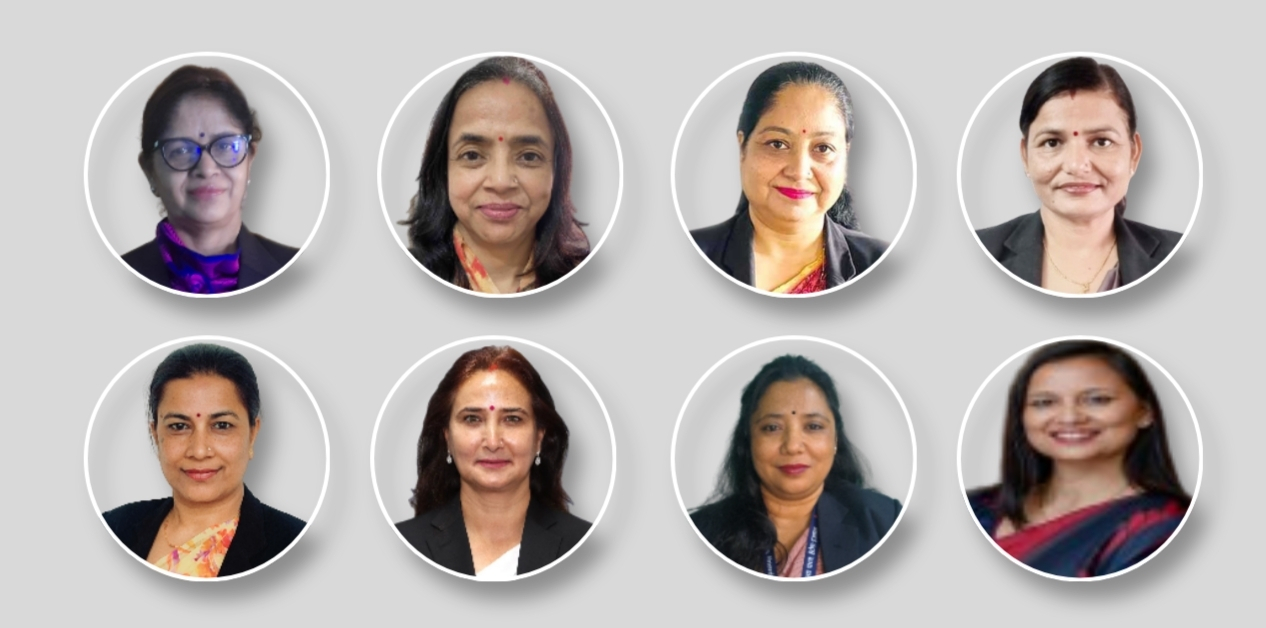
Between then and now, not only have society and attitudes changed, so has the picture of the justice sector. Not only has the number of women in the judiciary increased, there are now courts where all judges are women. One such court run entirely by female judges is the High Court Patan, Hetauda Bench, where all six judges including the presiding one are women. Not only that, the registrar is also a woman.
Not only at the Hetauda Bench, the Makwanpur District Court also has only female judges. And it is not just judges, the court clerk and revenue officer are also women.
The Hetauda Bench has six judges under the leadership of Yamuna Bhattarai. The other judges are Babita Upreti, Neelam Paudel, Kiran Kumari Gupta, Mamata Khanal, and Sharmila Thapa Bisht. Sapana Adhikari serves as registrar. Deputy Registrar Badri Prasad Lamichhane says that women have been able to deliver sound justice and that service recipients are broadly satisfied with the court’s work. “In rulings on fundamental legal matters, the law simply prevails as it should. But in sensitive matters, female judges show even greater sensitivity in their performance. Particularly in cases involving children, rape, and issues related to women, judicial discretion is found to be even more refined,” he says.
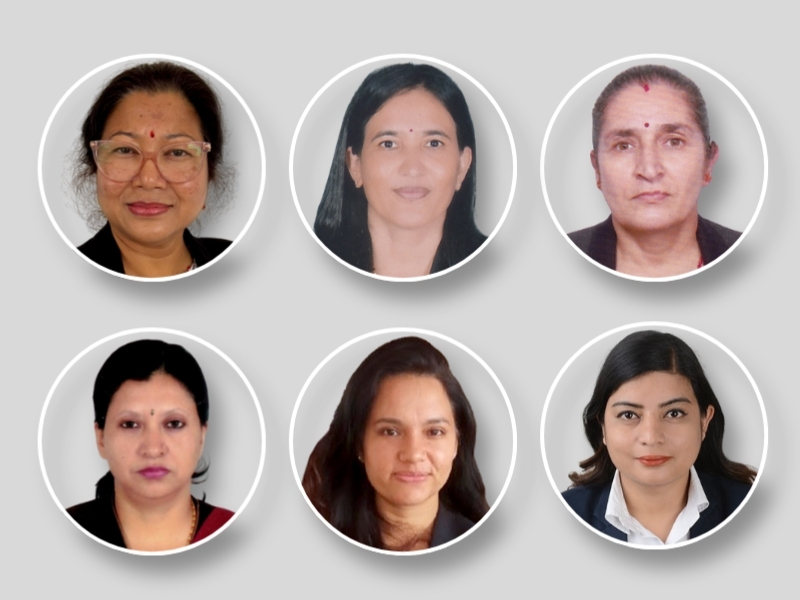
District judges (from top left): Geeta Shrestha, Shakuntala Karki, Nirmala Sharma Subedi, and Purnima Koirala; along with court clerk Roshi Bhandari and revenue officer Babita Basnet.
Not only at the Hetauda Bench, Makwanpur District Court also has only female judges, and not just judges, the court clerk and revenue officer are also women. The judges there are Geeta Shrestha, Shakuntala Karki, Nirmala Sharma Subedi, and Purnima Koirala. The court clerk is Roshi Bhandari and the revenue officer is Babita Basnet.
The head of the Office of the High Government Attorney in Hetauda is also a woman – Pooja Khatri. The Office of the High Government Attorney is the body that prosecutes cases in court on behalf of the government.
Viewed this way, women clearly dominate the judicial sector of Makwanpur district. Baburam Dahal, deputy registrar and head of the Research and Planning Division of the Supreme Court, says the performance of courts run by women has been very good. “The biggest measure of work in the judiciary is case disposal. Courts run by women show no shortage in case disposal. There have been no significant complaints from service recipients or legal professionals,” he says.
Women’s leadership is sometimes viewed with suspicion. It is assumed that because women carry double and triple responsibilities, including household work and community roles, they cannot perform effectively or be relied upon in professional duties. But in the judiciary, women have clearly been shouldering their responsibilities well.
It has been two years since women took over leadership of the High Court Patan, Hetauda Bench. According to Supreme Court data, 41 percent of cases were disposed of at the Hetauda Bench in the seven months of the current fiscal year 2025/26 (mid-July 2025 to mid-January 2026). In the same period last year, 58 percent of cases had been disposed of. The reason fewer cases were settled this year compared to last is the arson and vandalism carried out at courts during last September’s Gen Z movement. Case files were also burned in the arson at the Hetauda Bench. When the Supreme Court’s IT room was set on fire and destroyed, servers across the country went down, bringing work to a halt in 23 courts nationwide including the Hetauda Bench for two months. Deputy Registrar Dahal says that overall, the Hetauda Bench’s case disposal rate remains good. “The High Court Butwal, Tulsipur Bench, which has a similar caseload, disposed of only 24 percent of cases. The High Court Biratnagar, Ilam Bench, which has a comparable workload, disposed of 42 percent,” he says.
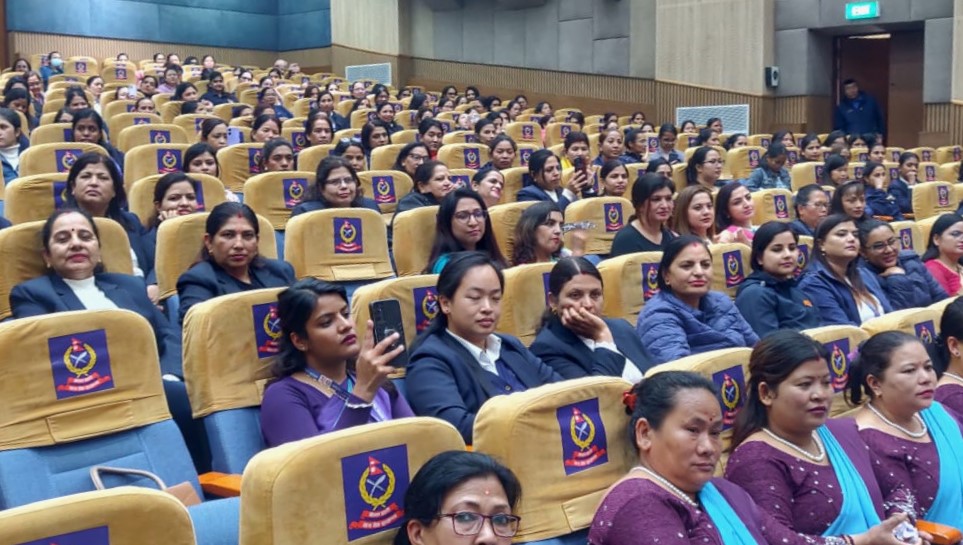
A program held on 10 March 2o26 to mark International Women’s Day and International Women Judges Day. Photo: Bhasha Sharma.
According to Dahal, there are no cases older than two years pending at the Hetauda Bench under women’s leadership. There is only one case that has crossed one and a half years. “The team spirit there is strong and work is proceeding in line with the judiciary’s goals. Had the arson during the movement not occurred, even more cases could have been settled,” he says.
As of mid-January 2026, the nationwide court case disposal rate stands at 49 percent. According to Supreme Court Deputy Registrar Dahal, the Hetauda Bench’s disposal rate is above its target, demonstrating that the court under women’s leadership is ahead in settling cases.
The Makwanpur District Court also suffered damage during the Gen Z movement. Despite this, 39 percent of cases have already been disposed of by mid-January 2026 of the current fiscal year. In the same period last year, 49 percent cases had been disposed of. According to Deputy Registrar Dahal, the average case disposal rate across all district courts is 33 percent.
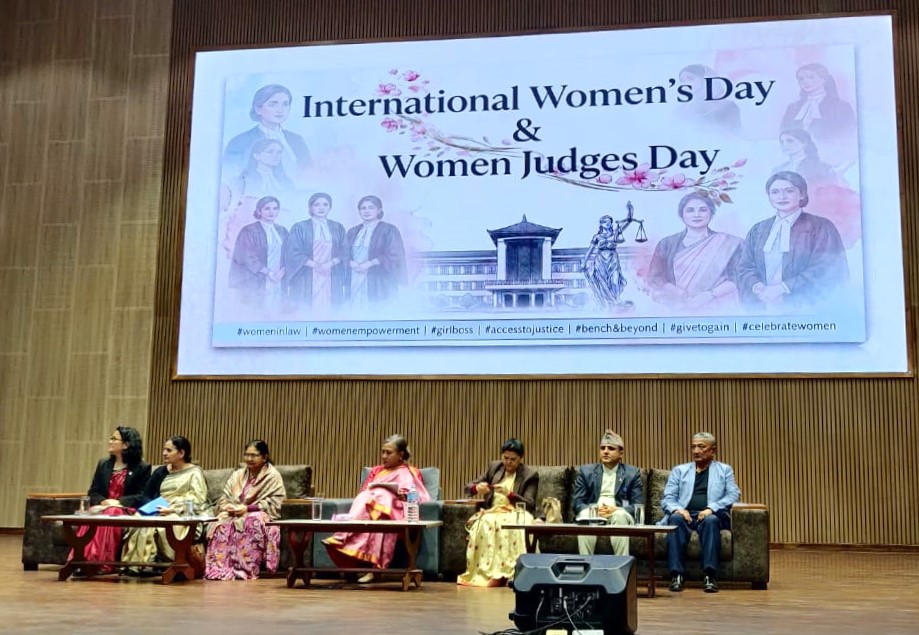
A program held on 10 March to celebrate International Women’s Day and International Women Judges Day. Photo: Bhasha Sharma.
First Justice and Chief Justice at the Supreme Court
After democracy was established in 1951, the Chief Court Act 1952 was promulgated. After receiving royal assent on 8 May 1952, it was published in the gazette on 22 December of the same year, formally constituting the Chief Court. Hari Prasad Pradhan was appointed as the first Chief Justice. The Supreme Court was subsequently established with the enactment of the Supreme Court Act 1956.
The first female justice of the Supreme Court is Sushila Singh “Shilu.” Sushila Karki has already served as the first female Chief Justice. The opportunity for a woman to become Chief Justice came after 25 male Chief Justices and 60 years after the establishment of the Supreme Court. Karki was the 26th Chief Justice.
So far, a total of 73 justices (excluding Chief Justices) have retired from the Supreme Court, of whom five are women – Sushila Singh, Sharada Shrestha, Gauri Dhakal, Mira Khadka, and Sushmalata Mathema. Compared on the basis of gender, women’s presence in the judiciary remains limited.
56 female judges across the country
According to data from the Judicial Council, there are 461 judges across various courts in the country, of whom 405 are male and 56 are female.
According to Judicial Council spokesperson Ram Prasad Bhattarai, there are 19 justices at the Supreme Court, five chief judges at high courts, 151 judges at high courts, and 286 judges at district courts. Among them, there are 3 women at the Supreme Court, 24 at the high courts, and 29 at district courts, totaling 56 female judges. This is 13.8 percent of the total number of judges.
Supreme Court Justice Sapana Pradhan Malla says that in the past, the idea of women becoming judges in Nepal was simply not imagined. She points to the fact that no dress code was defined for women and that judges were customarily addressed as “Shreeman” (sir) as illustrations of this. Speaking at a ceremony organized in Kathmandu on March 10 for International Women Judges Day, she said: “The dress code only envisioned daura-suruwal for men. There was a group called Judges’ Wives.”
The president of that group used to be the wife of the sitting Chief Justice. When Sushila Karki became Chief Justice, the group’s procedures had to be changed entirely and its name was changed to “Nyayaadhish Parivar Samaj” (Judges’ Family Society). “Because women were not imagined as judges, the procedures themselves had to be changed,” said judge Malla. “Despite the uncomfortable journey, we have reached a point where 13.8 percent of judges are women, 32 percent in the judicial service, 37 percent in law, and 28 percent among government attorneys.”
She noted that women have now reached every organ of the state by breaking through structural barriers, and that an environment must be created to sustain this over the long term. Chief Justice Prakashman Singh Raut is set to retire on 1 April 2026 due to age limits. On the basis of seniority, Justice Malla is in line to become Nepal’s second female Chief Justice. The Judicial Council meeting has already recommended her to the Constitutional Council for appointment as the next Chief Justice.