Kathmandu
Sunday, July 26, 2026





Despite growing numbers of universities and increasing state investment, educational outcomes remain dismal
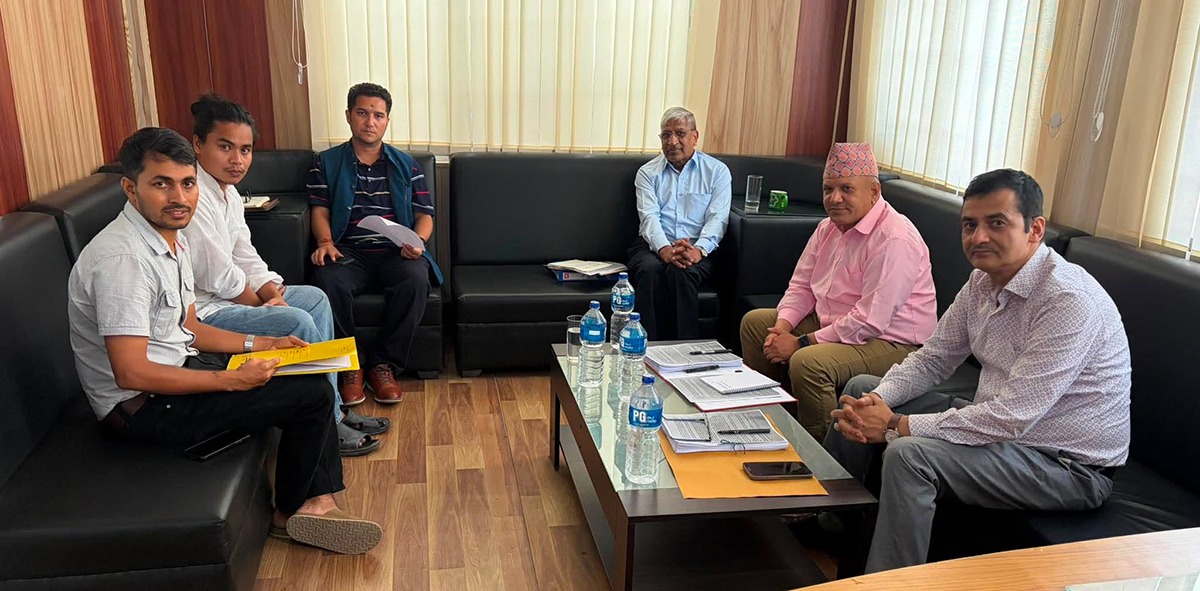
KATHMANDU: Education activists including former Education Minister and House of Representatives member Mahabir Pun have met Minister for Education, Science and Technology, Sasmit Pokharel, and presented a blueprint for reforming the education system. Pun told Nepal News that on April 15, 2026, he handed over to the current minister files prepared during his tenure as education minister, along with a three-year strategy for education system reform.
Pun says, “The files cover the need to protect higher education, school education, and the Council for Technical Education and Vocational Training (CTEVT) from politicization, to improve quality, and to emphasize practical over theoretical learning.”
Education activist Abhishek Ghimire, who accompanied Pun to the ministry, informs Nepal News that Minister Pokharel was requested to continue the policy reforms that remained incomplete during Pun’s tenure, including the unified higher education bill, establishment of an innovation fund, and the 10th amendment to the Education Regulations 2002. He says, “The education minister has given due consideration to the issues we raised. He has expressed commitment to continuing the unfinished work.”
Ghimire told Nepal News that the three-year strategic recommendations cover topics including operating residential schools, school consolidation and teacher post alignment, research-based education, improving outcomes in public education, teacher participation in curriculum development, and procedures for operating and managing private schools.

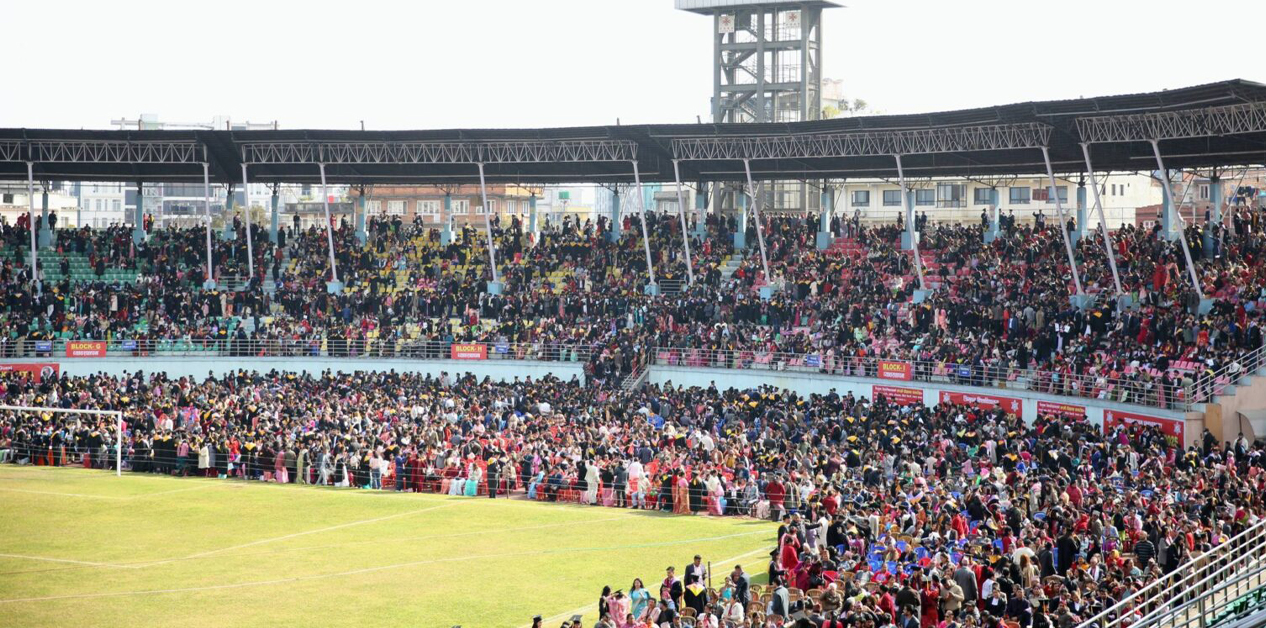
A photo taken on April 15, 2026, after a team led by Member of the House of Representatives and former Education Minister Mahabir Pun submitted a three-year education reform strategy to Education Minister Sasmit Pokharel. Photo source: Abhishek Ghimire
After becoming education minister on 22 September 2025, Pun had put forward an agenda to eliminate politicization in higher education, school education, and CTEVT. During his tenure, groundwork had begun for amending the law to remove the provision making the Prime Minister the chancellor of universities. “The Prime Minister doesn’t even know how many universities he is chancellor of; the Prime Minister only knows that he gets to choose the vice-chancellor,” then education minister Pun had said, “Because of politicization, the aim was to remove this system and establish a practice of electing a clean chancellor.”
Then Prime Minister Sushila Karki had also spoken at Tribhuvan University’s annual general meeting on 26 November 2025, saying that making a party representative chancellor leads to unnecessary politicization and such a provision must be ended. In line with this, Pun formed an expert committee and brought a new bill. The bill had proposed bringing fundamental changes to the structure of universities.
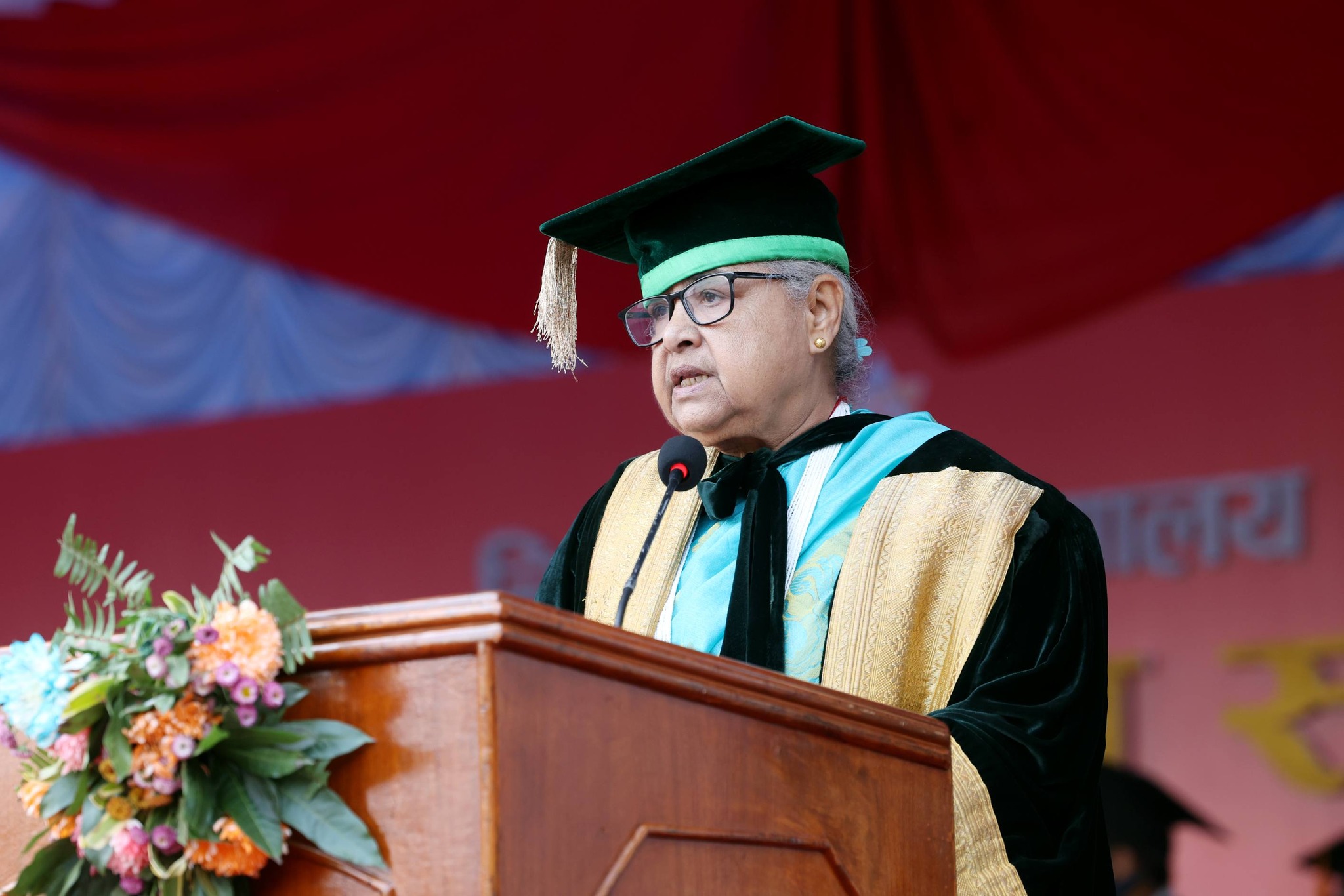
Former Prime Minister Sushila Karki addressing the 51st convocation ceremony of Tribhuvan University, held on December 25, 2025, at Dasharath Stadium in Kathmandu. Photo: Keshav Thapa
For this, the provisions covered removing the arrangement of the Prime Minister being chancellor of universities, establishing meritocracy, bringing an academic person to the chancellorship, removing student organizations, and forming an independent service commission for appointing professors and teachers. After discussions with vice-chancellors, rectors, registrars, and deans of 14 universities, Minister Pun had put forward two options for removing the provision of the Prime Minister being chancellor. First, to remove it immediately through an ordinance, or second, to remove it by presenting it as a bill in the National Assembly and making it law.
However, before the proposed provisions could be realized, Pun resigned from his position. He tells Nepal News, “There was non-cooperation from ministry staff. The tenure was also short, and seeing that the reform goals would not be achieved, I resigned to contest the election.” To participate in the March 5 House of Representatives election announced after the Gen Z movement, Pun had travelled to his home district Myagdi and registered as an independent candidate on 20 January 2026.
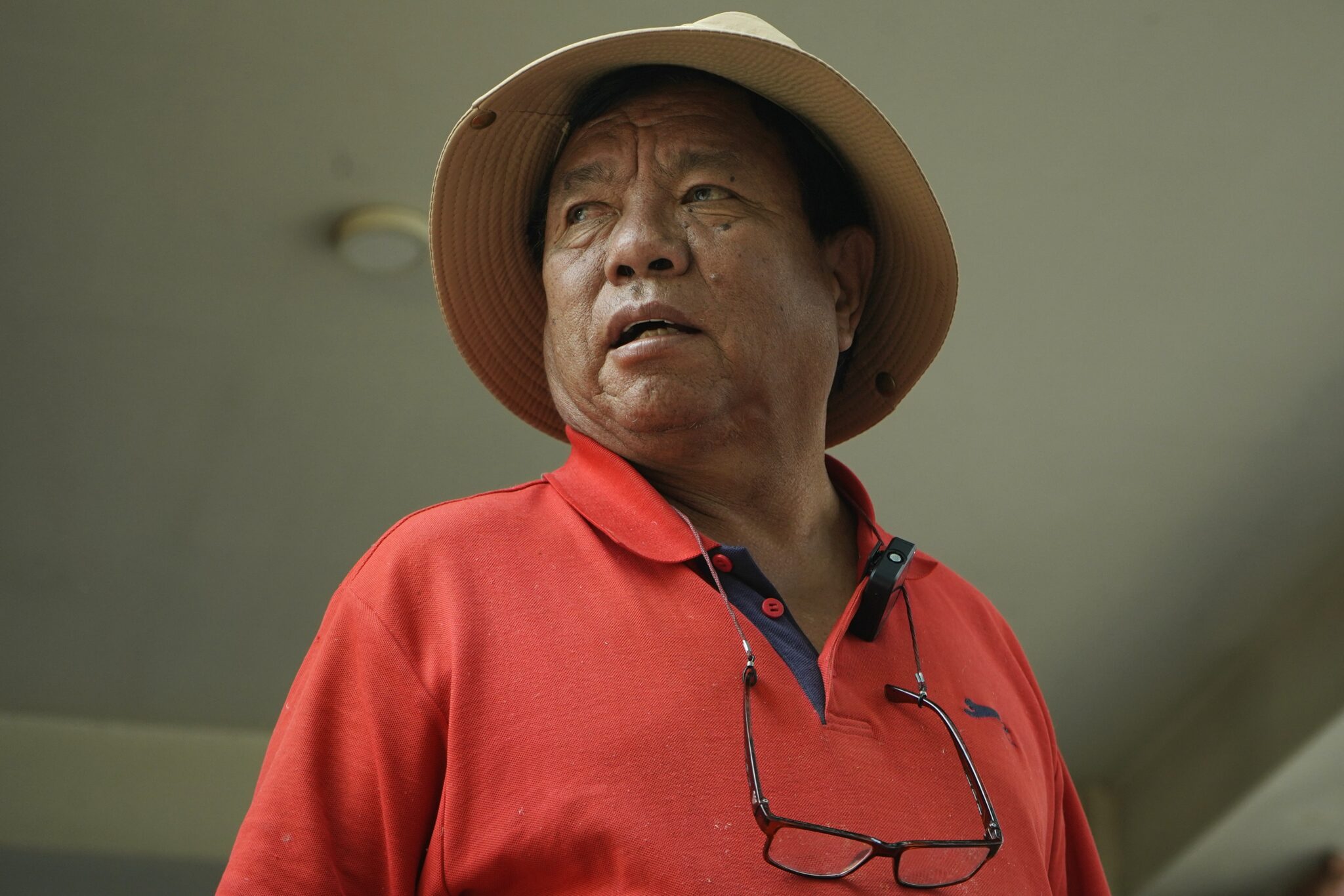
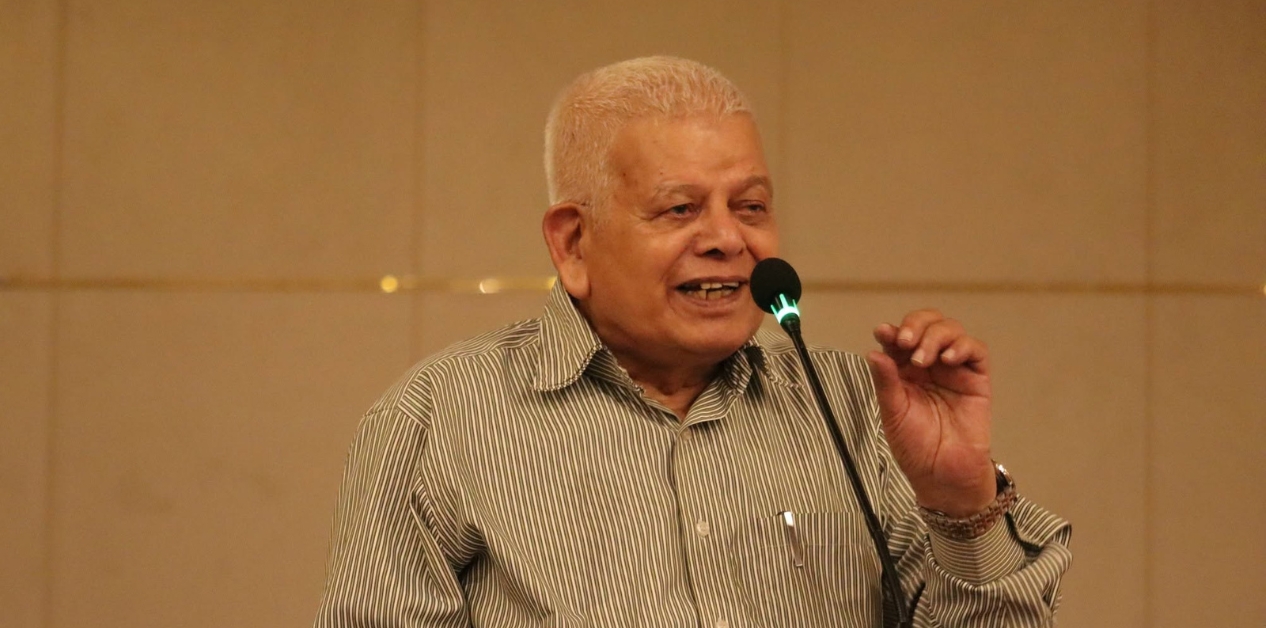
Mahabir Pun. Photo: Bikram Rai/Nepal News
Pun had been appointed education minister in the interim citizen government formed on 12 September 2025 under the leadership of former Chief Justice Sushila Karki after the then government fell following the movement of young people on September 8 and 9 demanding good governance. Under-secretary and spokesperson for the Ministry of Education’s Planning and Monitoring Division, Shiva Kumar Sapkota, claims the lawmaking process did not advance because the short tenure meant work could not be done.
Since being elected a member of the House of Representatives, Pun has been ‘lobbying’ to fulfil the dreams for education system and quality reform he had set during his tenure. He says, “To improve universities, politicization must be removed first. Only after leaders improve will staff, institutional systems, and educational quality improve.”
He holds the view that the provision making the Prime Minister the chancellor of universities has turned universities into arenas of political influence, and this provision must be removed. When the Prime Minister is made chancellor, party-affiliated organizations put unnecessary pressure on vice-chancellors to get things done. His argument is that such self-serving pressures have obstructed the pace of knowledge creation and skilled human resource production at universities.
Higher education on a downward slide
At the time the Rana regime ended in Nepal (1951), the literacy rate was below two percent. There were only Tri-Chandra College and 11 secondary schools. After Tribhuvan University was established in 1959, new colleges began receiving affiliation and providing higher education. The institutions providing higher education that expanded in this way have now reached 29. According to the National Census 2021, the nationwide literacy rate is 76.2 percent. Only 6.8 percent of the total literate population has achieved education above bachelor’s level.
Low enrolment rates at universities, declining pass rates, failure to produce the human resources needed by the labor market, and youth of higher education age emigrating abroad have raised questions about educational quality from all sides. Educationist Binay Kumar Kushiyait says, “Every year the size of government investment in the higher education sector keeps growing. But the returns are not proportionate. The greatest disorder is in higher education.” He says the quality, accessibility, and credibility of higher education is weakening.
A study by the University Grants Commission has also shown that the quality of higher education in Nepal has been declining year after year. The five-year strategic plan (2024 to 2029) published by the Grants Commission on its website on 4 September 2025 states: ‘Universities have not paid attention to producing skilled manpower that matches the needs of the labor market.’
According to the study, although universities claim to have reformed curricula, there is no alignment between master’s level education and the needs of the labor market. This has increased the rate of educated unemployment. With employment not guaranteed even after achieving higher education, the younger generation is being forced to emigrate to countries like Malaysia, the UAE, and South Korea as construction and agricultural workers.
One evidence of declining higher education quality is that most of those competing for teaching positions cannot even achieve the minimum marks needed to be eligible for a job in their subject area. In the secondary level Teacher Teaching Permit (License) examination conducted by the Teacher Service Commission on 26 October 2024, only 33.67 percent of examinees passed. From all seven provinces, 37,804 people participated in that exam, of whom only 12,729 passed, raising questions about the very quality of the human resources produced by higher education.
To be eligible to participate in the secondary level teaching permit exam, one must have graduated from the Faculty of Education or, having graduated from another faculty, must have completed at least a 10-month training in education. “This signals that the quality of higher education has weakened and shows the need for immediate restructuring in this area,” the study states. Director of the Monitoring and Evaluation Division, Kedar Prasad Acharya, informs Nepal News that the University Grants Commission has implemented a strategic plan for higher education reform for the period 2025 to 2029.
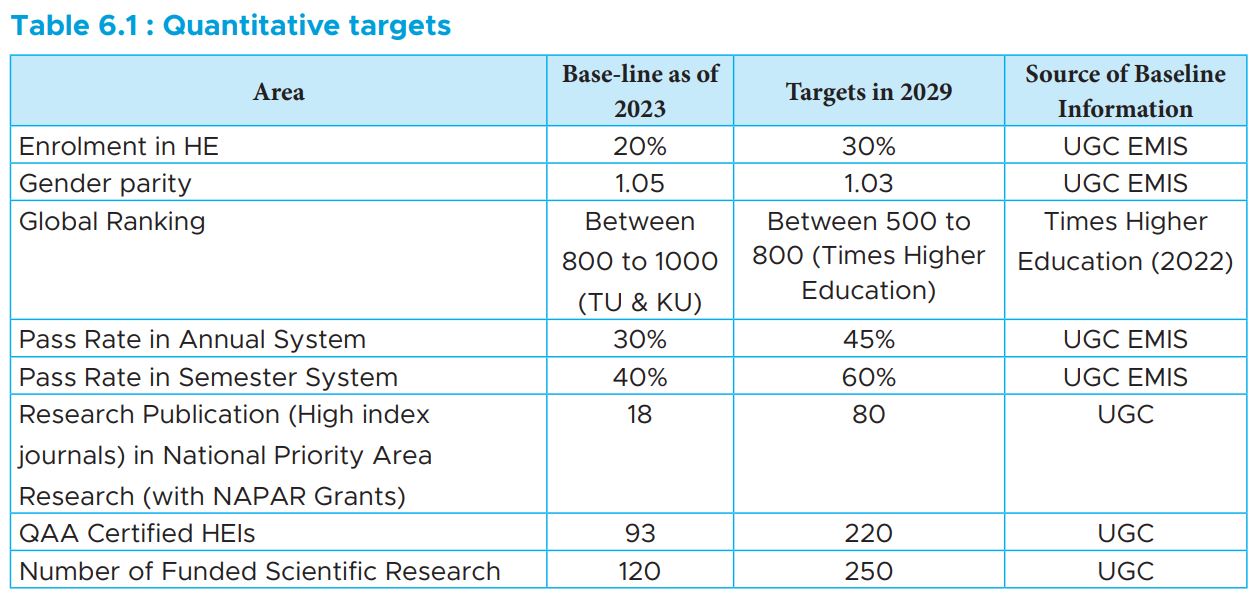
Although the information on the website states 2024 to 2029, he has clarified that the plan period is 2025 to 2029. According to him, it has been one year since the strategic plan began to be implemented. Since education ministers change whenever governments change, the expected reforms have not been achieved in one year. The strategic plan sets targets of reaching a 30 percent higher education enrolment rate by 2029, improving the global ranking of TU and KU from the current range of 800 to 1,000 to the range of 500 to 800, raising the annual pass rate from 30 percent to 45 percent, and raising the semester pass rate from 40 percent to 60 percent.
The conclusion has also been drawn that educational quality at the higher level has declined because school education (grades 1 to 12), considered the foundation of higher education, is itself at a weak level. Very little budget is allocated for the development of physical and ICT infrastructure needed for quality improvement. Of the total budget the government releases to local levels for the education sector, 92 percent is spent on regular obligations such as teacher and staff salaries, scholarships, midday meals, and sanitary pads. “Only the remaining eight percent of the budget is what gets spent on schools’ physical infrastructure and ICT infrastructure,” spokesperson Sapkota says.
Declining pass rates
Another indicator showing the weakness of higher education quality is students’ low pass rates. According to the University Grants Commission’s strategic plan, the average pass rate being below 30 percent in faculties such as humanities, management, education, and law – and being limited to just 50 to 60 percent even in technical subjects like science, engineering, medicine, forestry, and agriculture – signals serious weaknesses in teaching methods, curriculum, and assessment systems.
Similarly, according to the University Grants Commission’s Higher Education Management Information System report, in fiscal year 2080/81 BS (2023/24), the oldest and most senior university in the country has the weakest pass rate. Tribhuvan University and Nepal Sanskrit University have the lowest pass rates at 30.1 and 30 percent respectively.
Far-Western University’s pass rate is 40.1 percent, Mid-Western University’s 44.7 percent, Pokhara University’s 45 percent, Agriculture and Forestry University’s 66 percent, and Lumbini Buddhist’s 68 percent. However, Kathmandu University students’ pass rate is better than other universities at 90 percent. But this percentage has declined from 2068/69 BS (2011/12), when Kathmandu University’s pass rate was 96 percent.
Both Tribhuvan University and Kathmandu University have implemented the semester system. However, Kathmandu University’s results are three times better than TU’s. Prof Luintel says, “The continuous learning assessment method is what has produced better pass rates for students.” At KU, students get the opportunity to identify and improve their weaknesses through the continuous assessment method which involves them in presentations and project work. Similarly, student attendance in class (including online classes) has been strictly enforced; those without 80 percent attendance cannot sit the annual examinations.
Among health science academies, Patan Academy of Health Sciences and Karnali Academy of Health Sciences achieved 100 percent pass rates. The pass rate of National Academy of Medical Sciences students is 95 percent, and BP Koirala Institute of Health Sciences has a pass rate of 92.44 percent.
Delays in results
At Tribhuvan University, which has the largest number of students, delays in publishing results have been affecting students’ academic sessions and their ability to participate in employment opportunities. Although a meeting of TU’s Executive Council on 14 October 2023 decided to publish results within one hundred days of examinations being completed, this has not been implemented. Publishing results for bachelor’s level examinations conducted in Chaitra 2079 (mid-March to mid-April 2023), Baisakh (mid-April to mid-May), Shrawan (mid-July to mid-August), and Bhadau (mid-August to mid-September) 2080 BS (2023) took between 204 and 400 days. The 62nd Annual Report 2082 BS of the Auditor General has recommended that results be published on time since delays in TU’s result publication affect students’ academic sessions and opportunities to participate in employment.
New universities face a drought of students
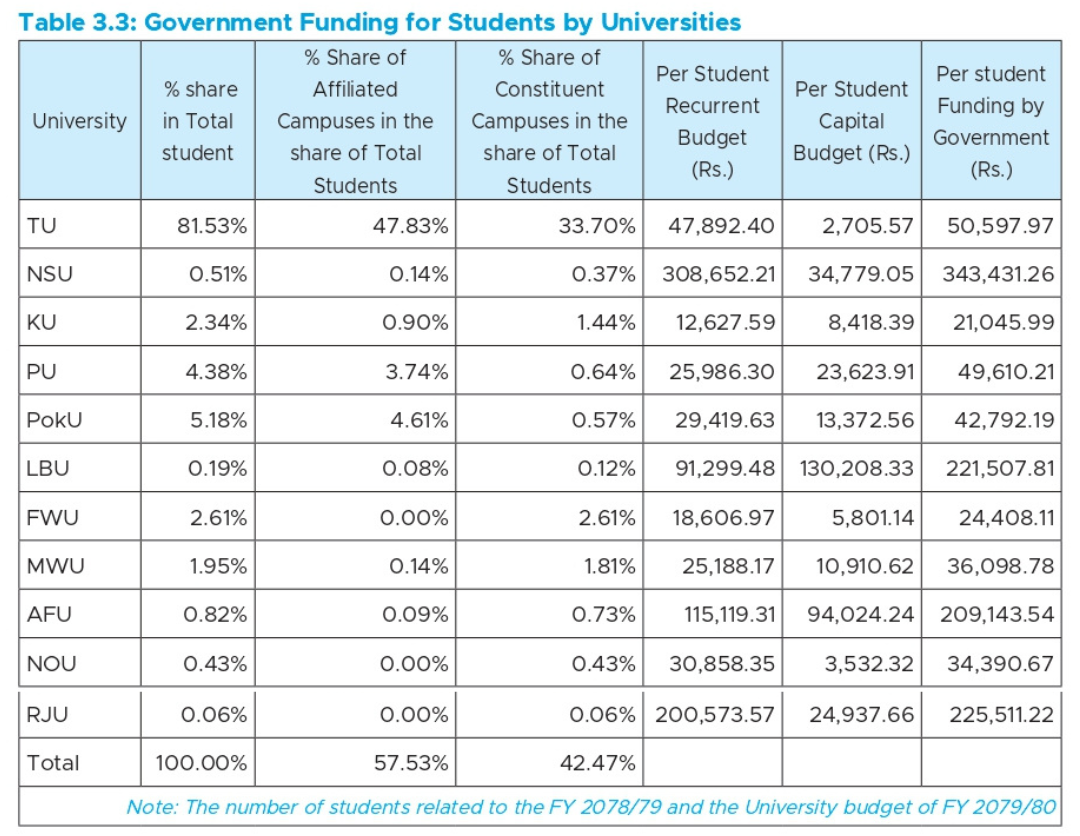
The number of universities and the government budget allocated to them keeps growing, but the number of students studying has not grown proportionately. Additionally, quality has been declining further. Prof Bal Chandra Luintel, Dean of the School of Education at Kathmandu University, analyses that the very process of opening universities in Nepal has been wrong. “TU targets students across the country and Kathmandu University targets students in the valley,” he says, “Whatever universities were built beyond these — they became places where vice-chancellors, registrars, and rectors are appointed first and only then is a search for students conducted. There are universities with fewer than 60 students.” He says universities need to undergo ‘remapping’ and ‘rezoning’.
According to Krishna Hari Prajapati, assistant director of the Scholarship, Information, Communication, and Technology Branch at the University Grants Commission, there are 29 institutions providing higher education in Nepal. Of these, 15 are national-level and 6 are provincial-level universities. There are also 6 national-level and 2 provincial-level health academies.
According to the Ministry of Education, 56 institutions have received permission to run higher education programs affiliated with foreign educational institutions. Universities from the United States, United Kingdom, Switzerland, Malaysia, Thailand, and India have given affiliation to run higher education programs in cities like Kathmandu, Pokhara, Biratnagar, and Chitwan.
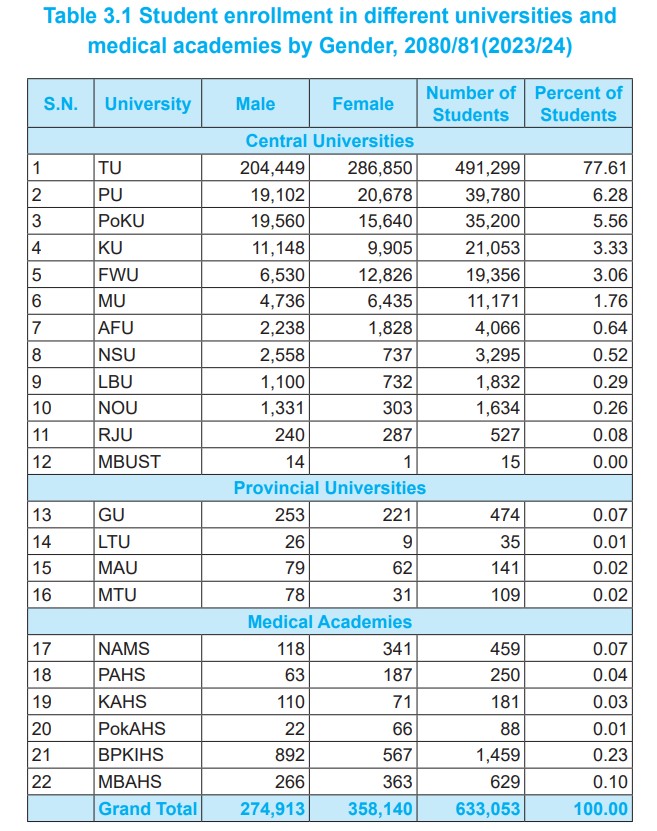
Enrolment rates in some departments of older universities have declined, while newly opened universities have failed to attract students. In academic session 2080/81 BS (2023/24), only 15 students were enrolled at Madan Bhandari University of Science and Technology, established in 2022. That university, which was said to offer master’s and doctoral studies in Organic Agriculture, Forest Biomaterials Science and Engineering, Sustainable and Resilience Infrastructure, Digital Technology: AI, and Digital Technology: Data Science, currently has only 62 students enrolled and 18 professors working.
According to the report for 2080/81 BS (2023/24) published by the University Grants Commission, 10 universities and health science academies have fewer than 500 students.
The University Grants Commission had also discussed the situation of more universities being opened but failing to attract students on 5 July 2023. Newly opened universities in particular are finding it difficult to get students. Addressing that situation in the discussion attended by vice-chancellors, then Education Minister Ashok Rai had said that universities should only be opened when there is capacity to operate and manage them. “Leadership must be able to upgrade their own institution,” he had said.
80 percent still beyond reach of higher education
The low rate of higher education participation has also become another educational concern. The Higher Education Management Information System report for 2080/81 BS prepared by the University Grants Commission notes that approximately 80 percent of youth of higher education age still remain beyond the reach of universities.
In academic session 2080/81 BS (23023/24), a total of 633,053 students were enrolled in higher education nationwide, comprising 274,913 male and 358,140 female students. This does not include the 28,073 students enrolled in institutions operating under foreign university affiliations. Of the 3,000,698 people aged 18 to 22 nationwide (1,544,855 male and 1,455,843 female), only 21.09 percent (633,053 people) are seen to be enrolled in higher education.
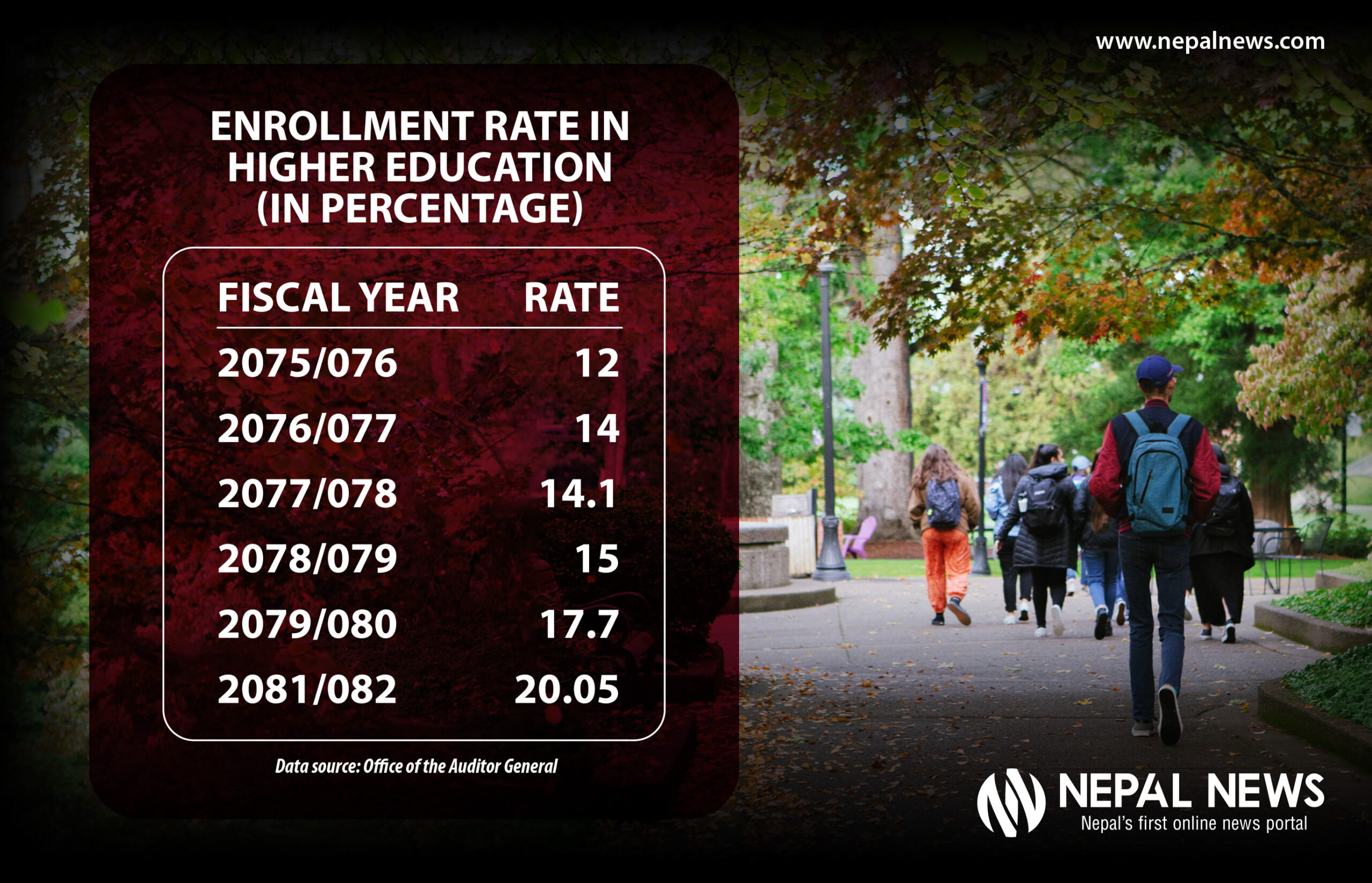
The 62nd Annual Report 2082 of the Auditor General, however, shows the higher education enrolment rate in 2080/81 BS at only 20.05 percent. In Nepal, 18 years of age is considered the average age for bachelor’s enrolment and 22 years for master’s enrolment.
Emigration abroad
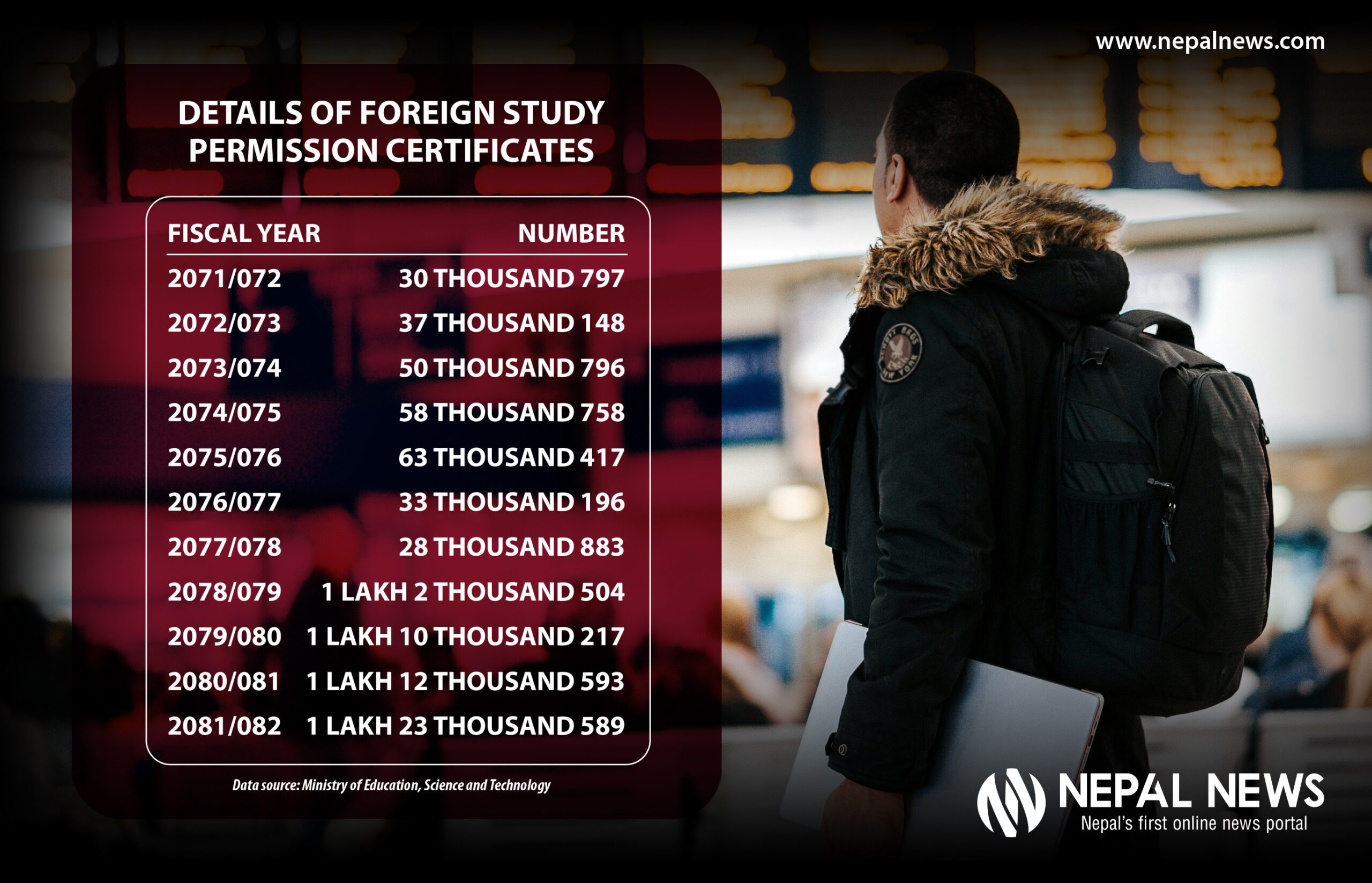
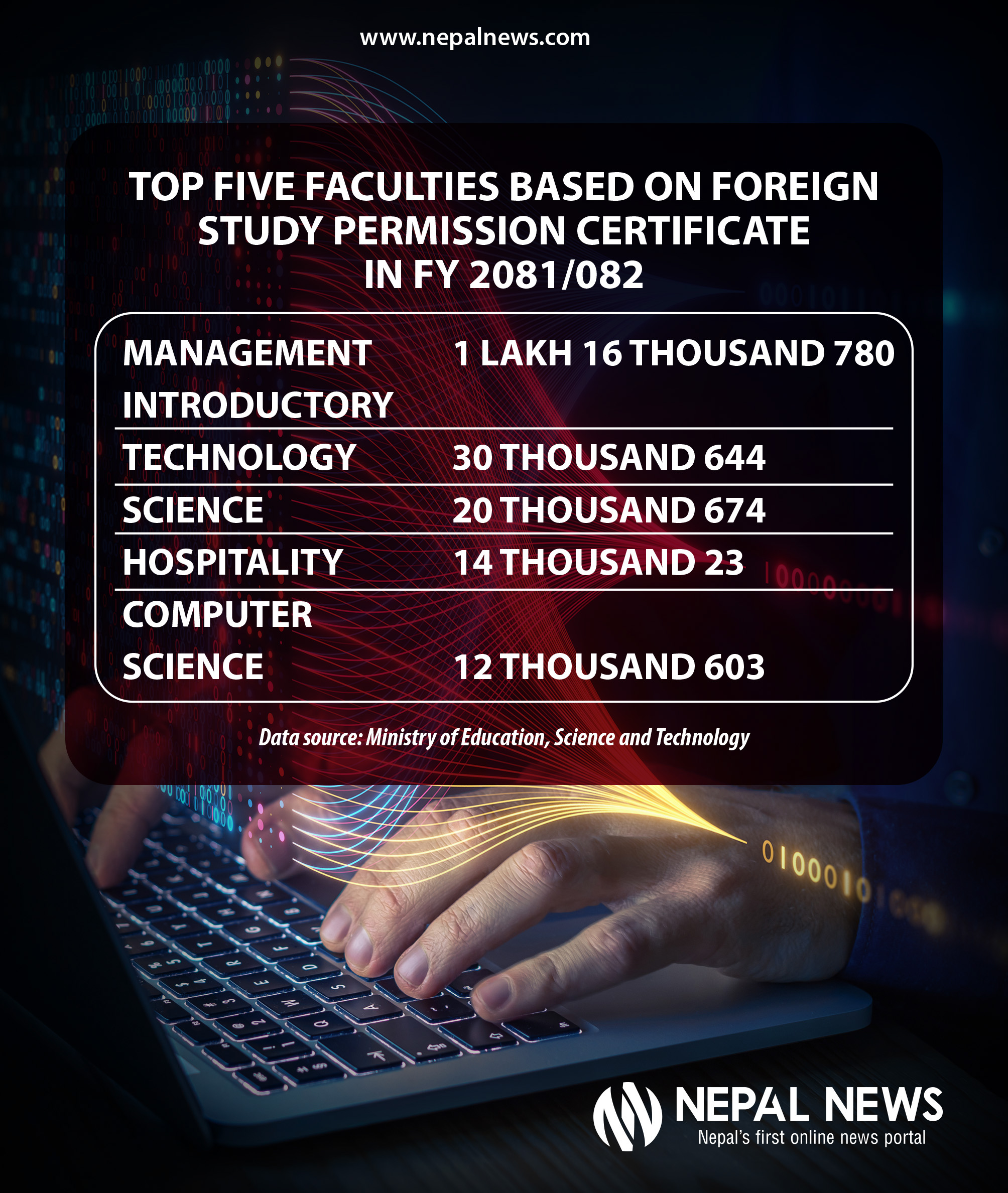
Bachelor’s and master’s level education has not been able to ensure employment. This is why the trend of youth going abroad keeps growing. Statistics show they are going abroad more for the purpose of entering the labor market than for studies. According to the Ministry of Education, more than 100,000 students have been obtaining No Objection Certificates (NOC) for foreign study every year since fiscal year 2078/79 BS (2021/22). Under-secretary of the Ministry of Education’s Higher Education Division, Birendra Jung Thapa, says that in 2081/82 BS (2024/25) alone, 123,589 people obtained NOCs for 84 countries.
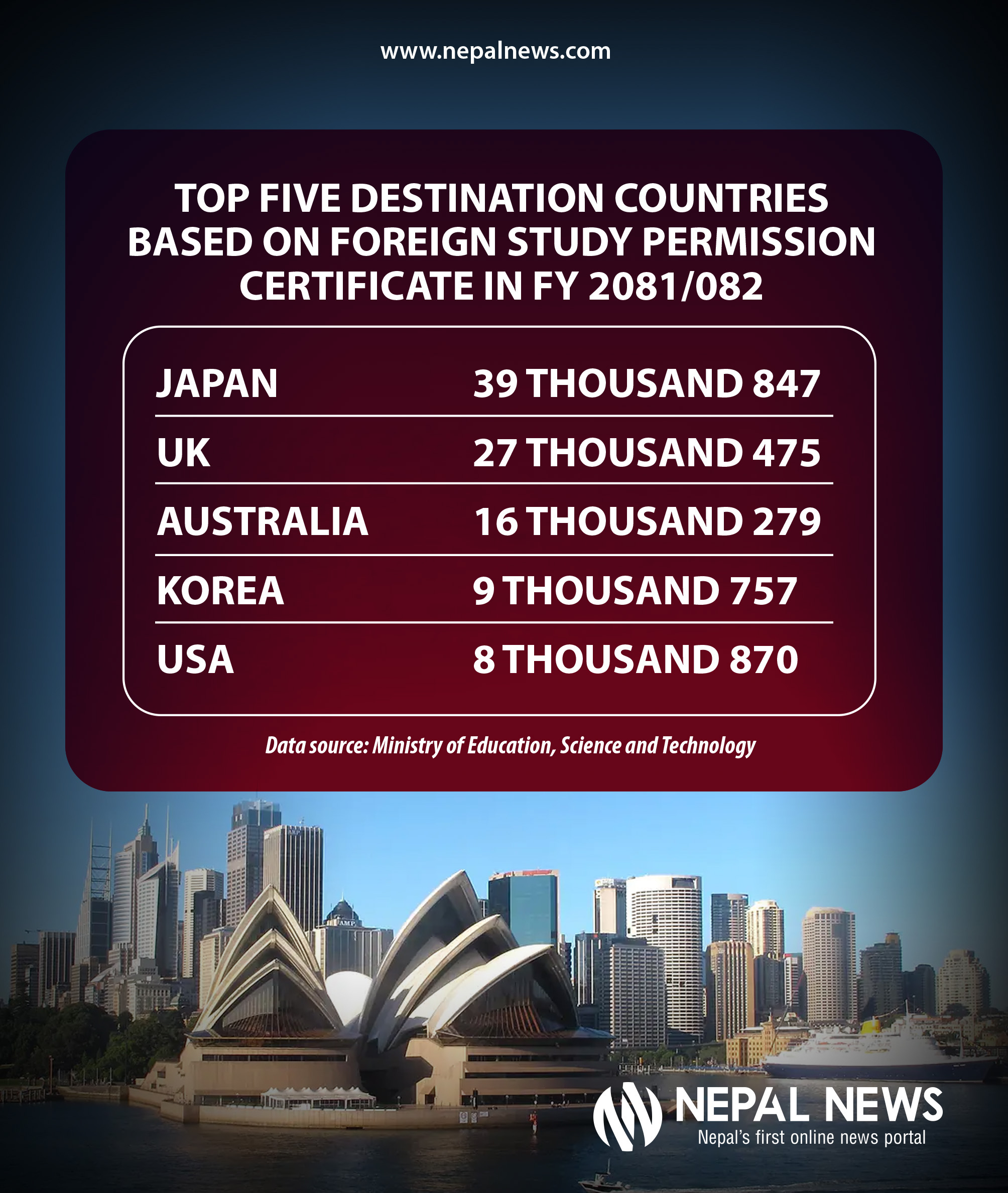
The fact that more than 400 students obtain NOCs daily shows that the younger generation’s trust in the country’s education system is weak. “Not all who take NOCs go abroad, but it is a population standing ready to leave the country with one foot raised. This is a signal of distrust in the education system,” says Prof Bal Chandra Luintel, Dean of the School of Education at Kathmandu University.
Under-secretary and spokesperson Shiva Kumar Sapkota of the Ministry of Education’s Planning and Monitoring Division, however, is not ready to accept this. He says, “They are not going abroad because they couldn’t get enrolled here or couldn’t find classrooms to study in; it is that another level has failed to meet their needs.” He says studies are underway on the topic of ‘needs at another level’.
High investment, low returns
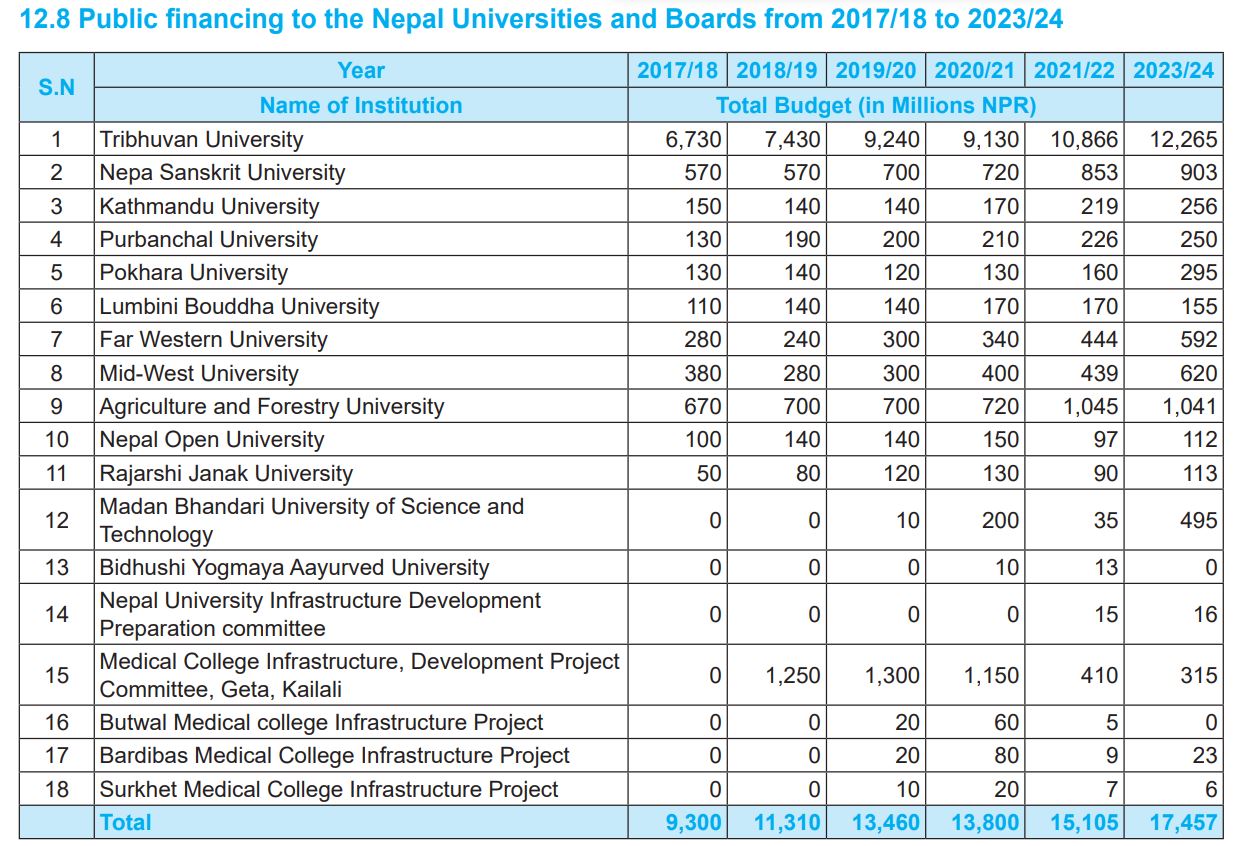
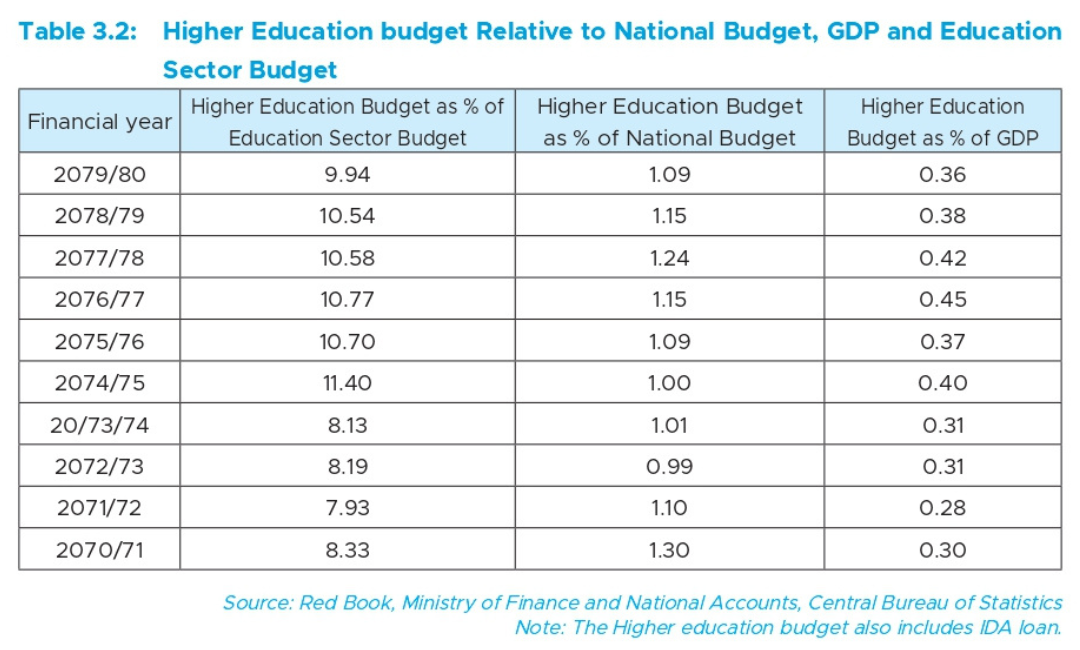
Government investment in universities and infrastructure committees keeps rising. While Rs 9.3 billion was allocated as budget in fiscal year 2074/75 BS (2017/18), it has reached Rs 17. 457 billion in 2080/81 BS (2023/24). According to the University Grants Commission, this budget has been allocated to 18 universities and infrastructure committees including Tribhuvan University, Nepal Sanskrit University, Kathmandu University, Purbanchal University, Pokhara University, and Lumbini Buddhist University.
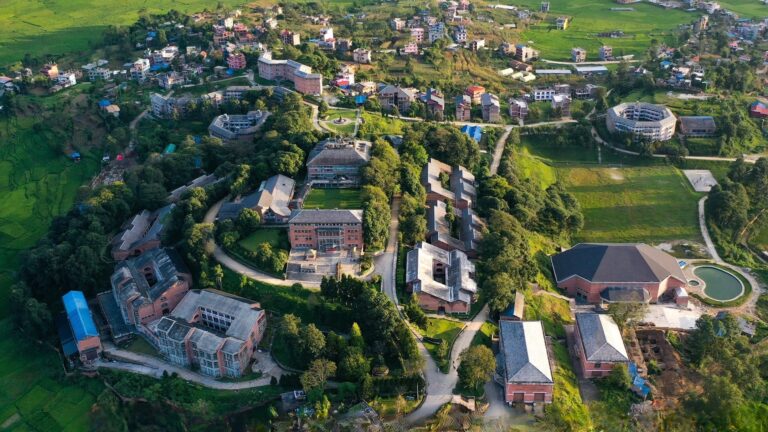
Kathmandu University. Photo source: University’s website.
These include Far-Western University, Mid-Western University, Agriculture and Forestry University, Nepal Open University, Rajarshi Janak University, Madan Bhandari University of Science and Technology, and Vidushi Yogmaya Himalayan Ayurveda University.
Also included in these infrastructure projects are the Nepal University Infrastructure Development Committee, the Physical Infrastructure Development Project Committee for the medical college at Geta in Kailali, Butwal Medical College Physical Infrastructure Plan, Bardibas Medical College Physical Infrastructure Project, and Surkhet Medical College.

Purbanchal University. Photo: Pankaj Kumar Yadav.
Among these, the one receiving the most budget is Tribhuvan University, whose budget allocation has been growing year after year. While Rs 6.73 billion was set aside in fiscal year 2074/75 BS (2017/18), Rs 12.265 billion was allocated in 2080/81 BS (2023/24). This is 6.21 percent of the Rs 197.29 billion allocated to the Ministry of Education, Science and Technology in fiscal year 2080/81 BS. Yet TU’s own average pass rate is around 30 percent.
According to the Auditor General’s 62nd Annual Report 2082 BS, in fiscal year 2080/81 BS, grants of over Rs 19.625 billion were distributed to 12 universities, four infrastructure development committees, and 496 community campuses. For medical colleges, budget is also allocated from the Ministry of Health and Population. The fact that quality has not improved despite increasing budgets shows there are problems in management and prioritization.
Caught in the grip of party interests
Universities face the problem of not making timely curriculum revisions. Teaching-learning methods and assessment systems are traditional and weak. Experts say that party interference, lack of adequate academic and physical infrastructure, and the absence of reliable quality measurement, accreditation, and advisory mechanisms are also causing Nepal’s higher education to decline further and further.
Prof Kedar Bhakta Mathema recalls that a study conducted by the Asian Development Bank (ADB) nearly 12 years ago had recommended that to improve higher education, it must first be freed from party interference. Prof Mathema, who became vice-chancellor of Tribhuvan University, had to resign with one year remaining in his term, due precisely to party interference.
Under the Tribhuvan University Act 1992, the vice-chancellor’s term is four years. According to Mathema, who was appointed TU vice-chancellor on 11 August 1991when then Nepali Congress General Secretary Girija Prasad Koirala was Prime Minister, he had been working to solve TU’s problems that had been festering for years. He had told Deshsanchar.com on 15 August 2023 that after taking over TU, he had tried to bring some degree of transparency to the recruitment, appointment, and promotion process of teachers and staff to prevent party interference and had adopted cost efficiency by cutting unnecessary staff.
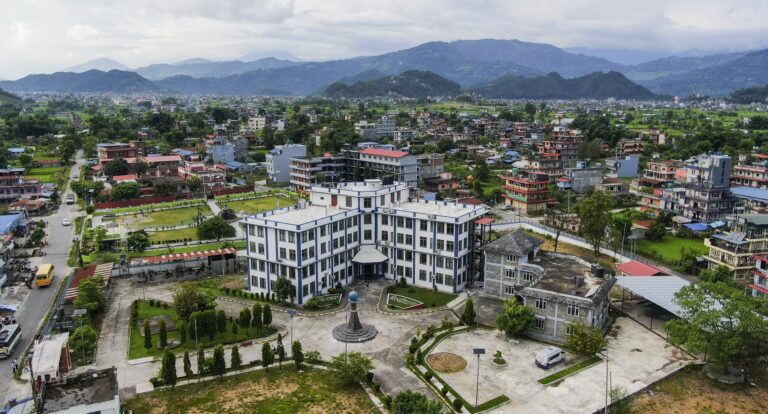
Pokhara University. Photo: University’s Facebook page.
Then UML chairperson Manmohan Adhikari, who became Prime Minister on 30 November 1994, forced Vice-Chancellor Mathema to resign from his post on 26 January 1995 under party pressure. Speaking to Deshsanchar, Mathema said: “When the Prime Minister said I must take charge of Tribhuvan University while I was in a World Bank job, I jumped at it. I went with the intention of fixing education, but I could not complete the work. I had to leave in just three years.”
When Nepal News sought further clarification on this, he said he had to resign after pressure came to appoint UML-affiliated persons at TU. “Even though I was appointed under a Nepali Congress-led government, I had said from the beginning that I would not make TU a playground for party interests. Later, when the UML government came, pressure came to recruit party people, so I left,” he says. Mathema says that power-sharing at universities increased after the People’s Movement.
The path to reform
Mathema’s suggestion is to study the current state of higher education and then begin reforms. “There is a situation where some universities have many students and some have very few. This must be corrected and brought into balance,” he says. He also emphasizes that universities and colleges/campuses running higher education must be given autonomous authority and freed from party interference. “A university or college should not always run on the budget of the Grants Commission; it should earn and manage itself through study and research. For this, autonomous authority must be given,” he says. His argument is that if the declining reputation of TU’s leadership, teaching-learning, and human resource production is preserved, higher education will improve to a great extent.
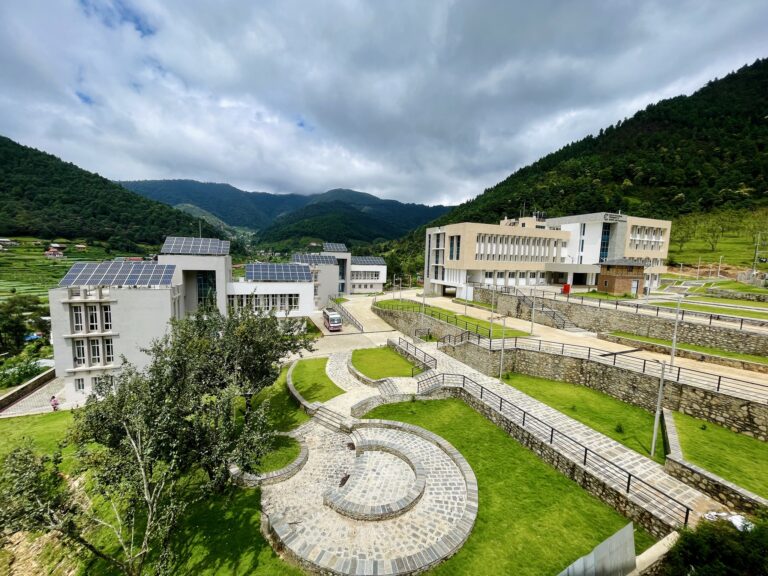
Madan Bhandari University of Science and Technology. Photo source: University’s website.
Prof. Bal Chandra Luintel, Dean of the School of Education at Kathmandu University, claims that higher education will improve if universities publish their routines on time, conduct examinations, and release results. He says, “Capable young people must be prepared for higher education leadership; meritocracy must be given space to produce knowledge at universities.” Since many discussions have already been held on higher education reform, his suggestion is that the government led by Balendra Shah must focus on implementation.
Educationist Kushiyait holds the view that TU must be reformed for higher education to improve. “If TU improves, higher education will improve greatly,” he says, “It cannot happen with the current structure and leadership; it must be restructured and moved forward.” His suggestions are that TU’s teachers, administration, and leadership must be made accountable, the student enrolment process must be improved, the quality of teaching faculty must be evaluated, and student absenteeism must be reduced.
The hundred-point governance reform agenda approved by the Balen-led government at its first Council of Ministers meeting on March 27, 2026, also includes points on education sector reform. These cover plans such as removing structures of political party-affiliated student organizations from school/university premises, abolishing party-affiliated trade unions of teachers and professors, having universities create procedures so that citizenship is not required to study up to bachelor’s level, and publishing bachelor’s and master’s examination results according to the academic calendar.
Spokesperson Sapkota says the Ministry of Education has prioritized the plans included in the governance reform agenda for now. “Until the policy and program for fiscal year 2083/84 BS (2026/27) arrives, these are the plans,” he says, “We will move forward according to the policy the government sets on higher education reform.”