Kathmandu
Sunday, July 5, 2026





Mandatory retirement at 65 undercuts constitutional intent
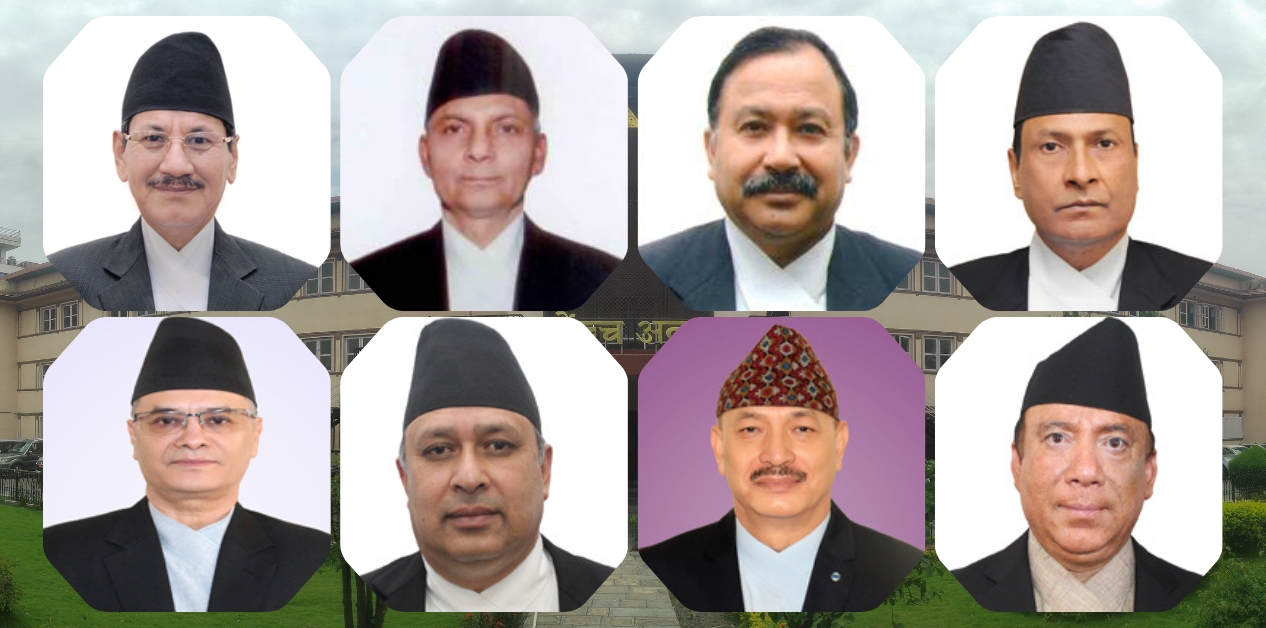
KATHMANDU: Prakash Man Singh Raut, who assumed office as Chief Justice on October 6, 2024, is set to retire on April 1 this year after reaching the constitutional age limit.
The Constitution provides for a six-year term for the chief justice, but it also sets a mandatory retirement age of 65. As a result, no chief justice since 1990/91 has been able to complete the full term.
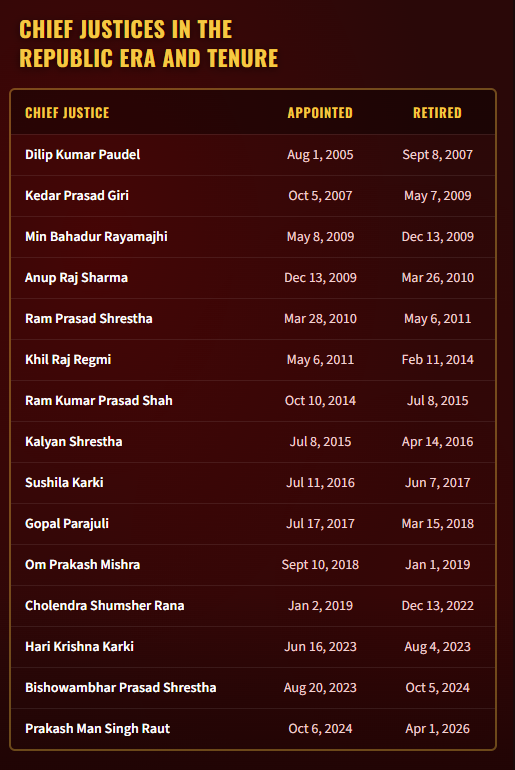
Since 2005/06, at least 16 individuals have led the judiciary, with an average tenure of just over a year. The seniority system, based on the date of appointment to the Supreme Court, has also meant that several capable judges retire before ever reaching the top position due to age restrictions.
Article 129 of the Constitution outlines the qualifications and appointment process for the chief justice, requiring at least three years of service as a Supreme Court justice. While it guarantees a six-year tenure, Article 131 enforces the 65-year age limit, effectively shortening most terms in practice.
According to the 2021 census, Nepal’s average life expectancy stands at 71.3 years, up from 66.6 years in 2011. In this context, former Supreme Court Justice Ananda Mohan Bhattarai argues that the retirement age should be reconsidered.
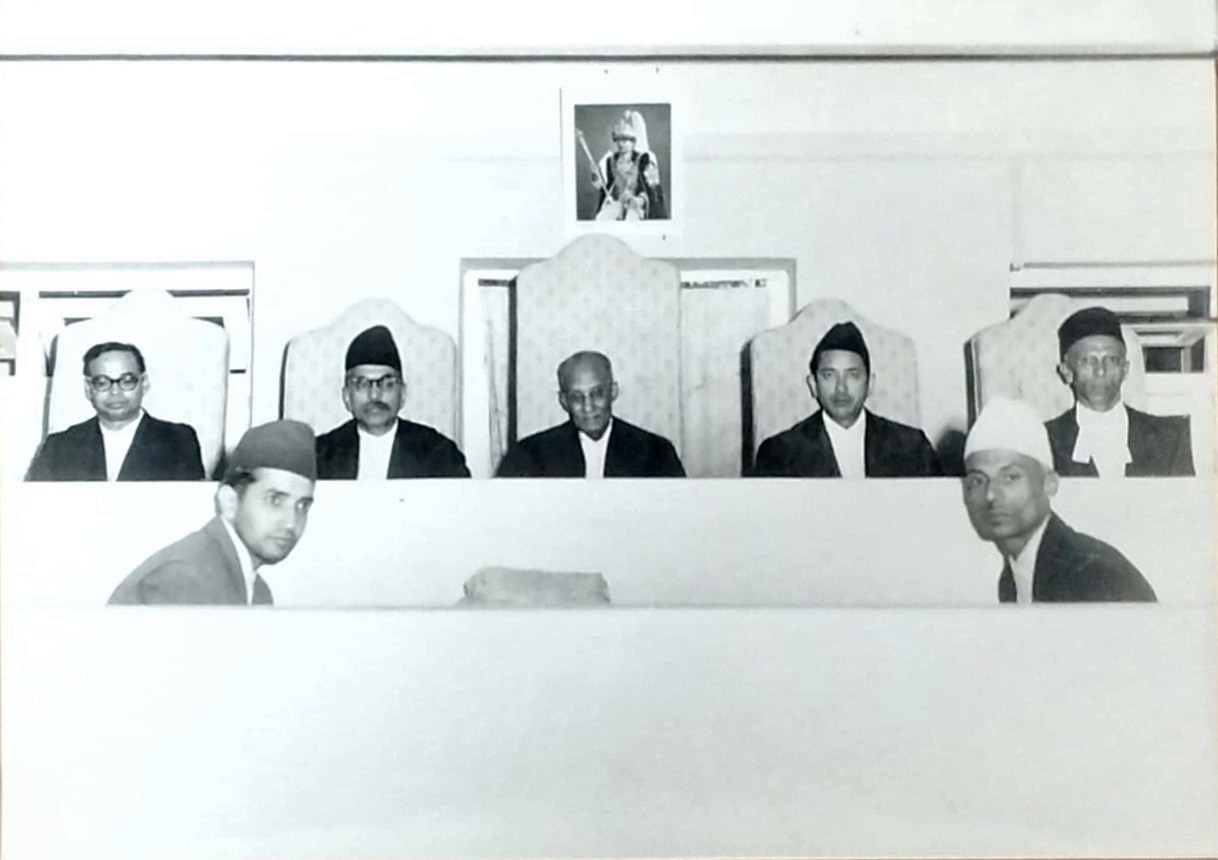
The first full bench of the Pradhan Nyayalaya. Photo courtesy: Supreme Court
“Courts require experienced individuals, and allowing them to serve longer can strengthen institutional stability,” Bhattarai says. “With time, judicial integrity and independence continue to deepen.”
Bijay Prasad Mishra, president of the Nepal Bar Association, says that average life expectancy and the tenure of judges were not taken into account while drafting the constitution.
“The more cases a judge decides, the more refined they become. Therefore, it is appropriate to increase the age limit that was arranged a long time ago,” Mishra says. He also recalls that during the conference of judges held in 2014 during the tenure of Chief Justice Ram Kumar Prasad Shah, a demand was made to increase the retirement age of Supreme Court justices to 67 years.
Judges retired from the Supreme Court are barred from appointment to other government posts, except for the Human Rights Commission. Clause 2 of Article 132 of the Constitution states, “A person who has been the Chief Justice or a judge of the Supreme Court shall not be eligible for appointment to any government post, except as otherwise provided in this Constitution.”
Along with the Supreme Court, the term of office for heads and officials of other constitutional bodies of the state is also set at six years and the age limit at 65 years. Among them, no age limit is specified in the case of the Human Rights Commission.
It appears that there has not always been a single arrangement regarding the term and age limit of judges in Nepal.
Panchayat era: Average five years
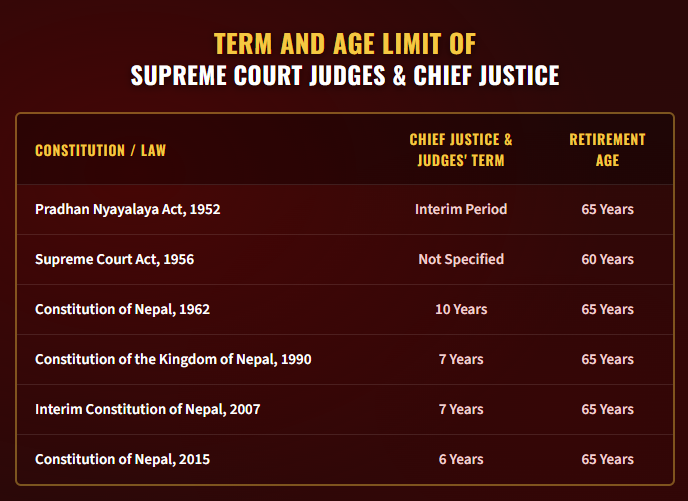
In Article 32 of the ‘Interim Government of Nepal Act, 1951,’ formed after the establishment of democracy in 1951, a provision for a Pradhan Nyayalaya (Apex Court) was made, and a year later, the Pradhan Nyayalaya Act, 1952, was issued. After the Pradhan Nyayalaya was formed following its publication in the Nepal Gazette on December 22, 1952, Hari Prasad Pradhan was appointed as the first chief justice. Section 6 of the Act stated, “In the Pradhan Nyayalaya, there shall be one chief justice and not more than four other judges unless the number is increased by His Majesty the King along with the Cabinet. ” The term for judges was said to be ‘for the interim period. ‘ Pradhan led the judiciary for five years, from July 22, 1951, to May 20, 1956.
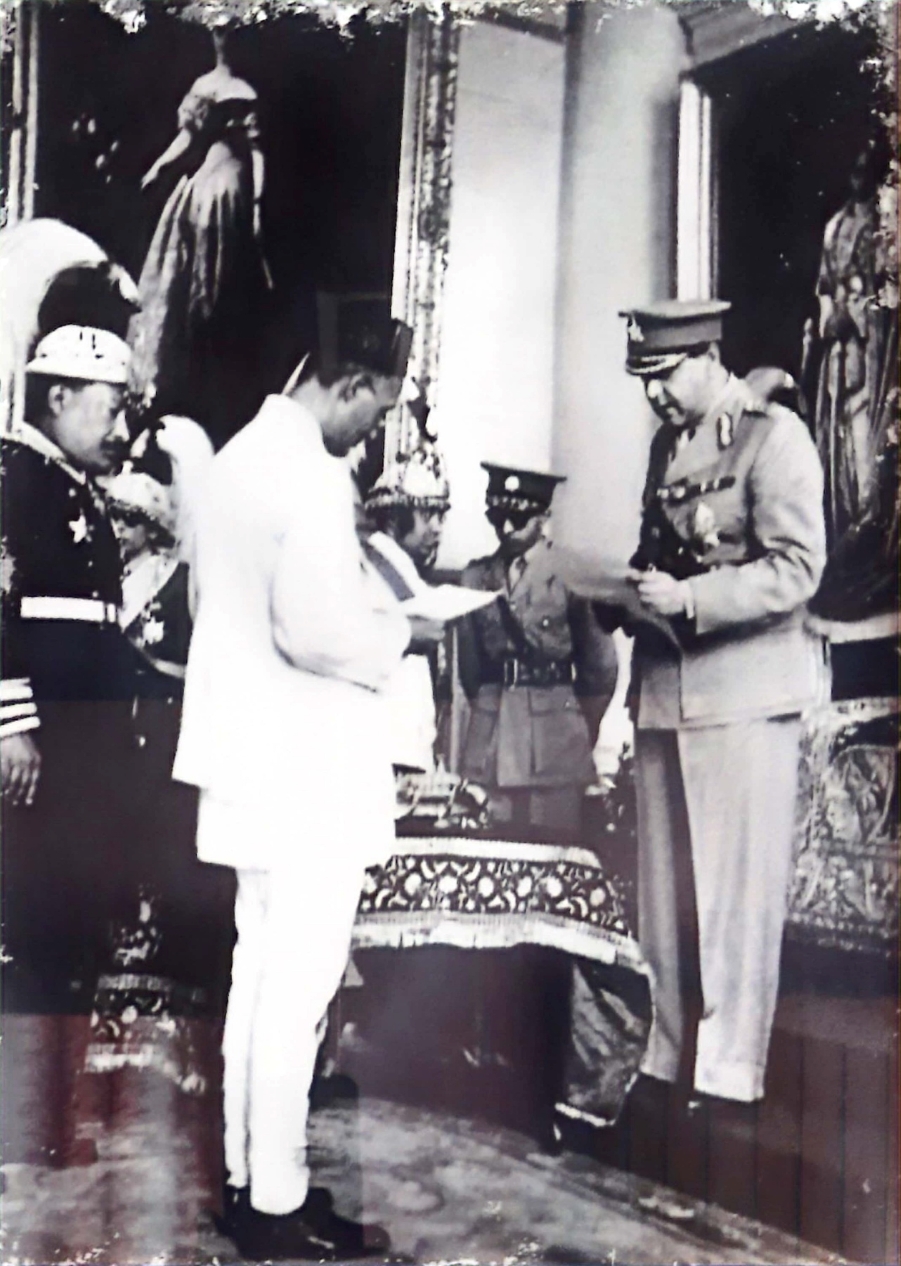
Chief Justice Hari Prasad Pradhan taking the oath of office from the then King Tribhuvan. Photo courtesy: Supreme Court
In 1956, the Supreme Court Act was issued, and the Supreme Court was established. That Act also provided for one Chief Justice and four judges. However, this time the age limit for judges was set at 60 years. Following that, Aniruddha Prasad Singh became chief justice. Appointed on May 21, 1956, he remained in office until June 29, 1959.
From December 14, 1961, to December 15, 1963, Hari Prasad Pradhan was made Chief Justice again. After that, the ‘Constitution of Nepal, 1962’ was issued, in which Article 68 made provisions regarding the Supreme Court. In the Constitution, which stated there would be a Chief Justice and up to six other judges unless a higher number were specified by law, the term of office for the Chief Justice and judges was set at 10 years.
After that, Bhagawati Prasad Singh, who became Chief Justice, held office from April 9, 1964, to July 10, 1970, while the fifth Chief Justice, Ratna Bahadur Bista, was Chief Justice for six years from July 26, 1970, to August 6, 1976. The sixth Chief Justice, Nayan Bahadur Khatri, however, remained in office for nine years and four months. Serving as the head of the judiciary from August 8, 1976, to December 10, 1985, this tenure of Khatri is the longest to date. The seventh Chief Justice, Dhanendra Bahadur Singh, was at the Supreme Court from December 11, 1985, to August 7, 1991.
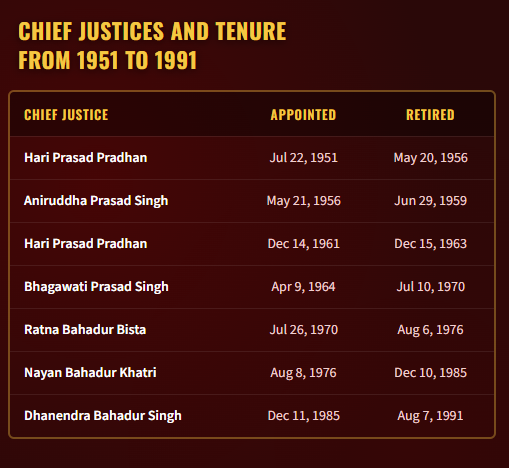
In the 38 years from June 1951 to 1989, a total of seven individuals became chief justice. Among them, only the first chief justice, Hari Prasad Pradhan, was repeated. During this period, it appears that one chief justice worked for an average of five years.
Multi-party era: Average three years
Article 87 of the ‘Constitution of the Kingdom of Nepal, 1990,’ issued after the restoration of the multi-party system in the country, determined a seven-year term and a 65-year age limit for judges.
The eighth Chief Justice after the issuance of the Constitution was Biswa Nath Upadhyaya. He worked for four years, from August 7, 1991, to September 25, 1995. The ninth Chief Justice, Surendra Prasad Singh, appointed on September 26, 1995, worked for 17 months and retired on February 14, 1997.
The 10th Chief Justice, Trilok Pratap Rana, was able to work for only seven months due to the age limit. Appointed on February 14, 1997, he retired on September 17, 1997 (Ashwin 1, 2054). The next chief justice, Om Bhakta Shrestha, also remained in leadership for only six months. Appointed on September 17, 1997, he exited on April 12, 1998 (Chaitra 29). The 12th Chief Justice, Mohan Prasad Sharma, received his appointment on April 11, 1998, and worked until December 16, 1999. Keshav Prasad Upadhyaya, who became chief justice after that, served from December 16, 1999, to December 5, 2002. He was able to work three years more than the previous chief justices. Following Keshav Prasad Upadhyaya, Kedar Nath Upadhyaya headed the court for more than a year. He worked from December 6, 2002, to January 21, 2004.
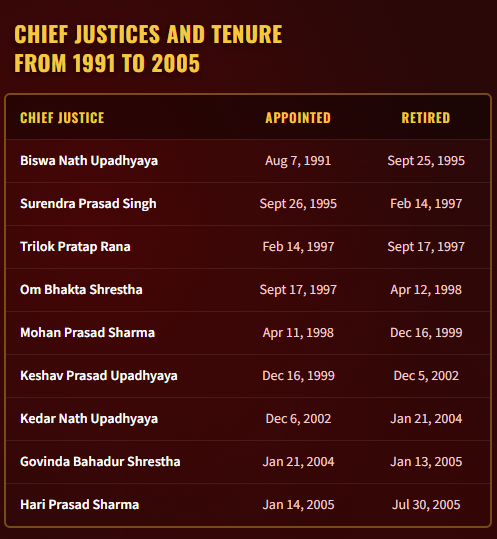
The 15th Chief Justice, Govinda Bahadur Shrestha, was able to work for about a year. Appointed on January 21, 2004, he retired on January 13, 2005. The 16th Chief Justice, Hari Prasad Sharma, led the judiciary for six months from January 14, 2005, to July 30, 2005.
Republican era: Average one and a half years
The ‘Interim Constitution of Nepal, 2007’ also continued this arrangement. In the 20-year period from 2005 to 2025, at least 16 individuals have already headed the judiciary.
Before the current Chief Justice Raut, Bishowambhar Prasad Shrestha was the Chief Justice. Appointed as the 31st Chief Justice of the Supreme Court on August 20, 2023, he retired about a year later, on October 5, 2024.
The shortest tenure in the Supreme Court to date was that of Hari Krishna Karki. He was able to remain in the role of chief justice for only about one and a half months, from June 16 to August 4, 2023.
Before that, Cholendra Shumsher Rana served as the 29th Chief Justice from January 2, 2019, to December 13, 2022. He sat at the head of the judiciary for a relatively long time, about four years. However, the final verdict on the impeachment motion registered against him in Parliament is still pending.
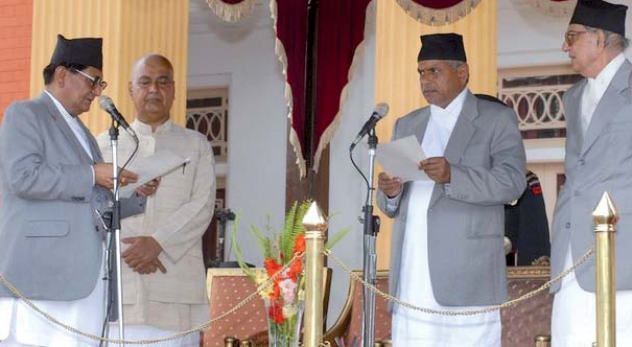
President Ram Baran Yadav taking the oath of office and secrecy from the then Chief Justice Kedar Prasad Giri
Before Rana, Om Prakash Mishra became Chief Justice, although he was not in the role. After the Parliamentary Hearing Committee of the Federal Parliament rejected the most senior judge and acting Chief Justice Deepak Kumar Karki, he received the opportunity to lead the judiciary for about four months from September 10, 2018, to January 1, 2019.
Gopal Parajuli, who preceded him, is also among the controversial chief justices. Handling the court for seven months from July 17, 2017, to March 15, 2018, he was caught in a citizenship dispute. He resigned after writ petitions were registered in the Supreme Court due to different dates of birth.
From July 11, 2016, to June 7, 2017, the first female Chief Justice, Sushila Karki, took leadership. During her 11-month leadership, Karki also had to face the trouble of an impeachment. However, the impeachment charges were later withdrawn.
The same Karki became the country’s first female prime minister after the Gen Z protest of September 8 and 9, 2025. A writ petition has even been registered in the Supreme Court against her becoming Prime Minister, contrary to the constitutional provision that a Chief Justice of the Supreme Court cannot hold a government post, which is under consideration.
Before Karki, Kalyan Shrestha became the 25th Chief Justice from July 8, 2015, to April 14, 2016. He remained in the supreme post of the judiciary for more than a year. Before him, Ram Kumar Prasad Shah was chief justice from October 10, 2014, to July 8, 2015. He was in the post for nine months.
From May 6, 2011 to February 11, 2014, Khil Raj Regmi was at the head of the judiciary for 22 months. He ended up becoming the chairman of the Council of Ministers while his term was still remaining. A case was filed against him in the Supreme Court as well. Supreme Court Chief Justice Kalyan Shrestha and Sushila Karki had given the opinion that he was made chairman of the Council of Ministers contrary to the spirit of the Interim Constitution. Nevertheless, the opinion was divided in the five-member bench. The writ was dismissed, stating that by the time of the court’s verdict, the election had been held and had received legitimacy.
From March 28, 2010, to May 6, 2011, Ram Prasad Shrestha became the 21st Chief Justice. He was in leadership for two years. In 2009, at least three individuals became chief justice. Anup Raj Sharma became the 20th from December 13, 2009, to March 26, 2010, and Min Bahadur Rayamajhi became the 19th Chief Justice from May 8, 2009, to December 13, 2009. Kedar Prasad Giri had headed the court from October 5, 2007, to May 7, 2009. Before that, Dilip Kumar Paudel became the 17th Chief Justice from August 1, 2005, to September 8, 2007.
Practice in other countries
There are different arrangements in various countries regarding the term and age limit of Supreme Court judges. Nepal’s legal structure and process are similar to neighboring country India’s. In India, too, the age limit for judges is set at 65 years. In Sri Lanka and Pakistan, 65 years is also considered the retirement period.
In Bangladesh, the age limit is 67 years. In Bhutan, however, the term of the chief justice is set at five years. In Australia, the age limit for judges is 70 years.
In America, once one enters as a judge, one can work for life. Chief Justice John Marshall worked for the longest time from 1801 to 1835. In the UK, an age limit of up to 75 years is set.
Former Chief Justice Min Bahadur Rayamajhi has expressed reservations about ongoing discussions on extending the tenure and age limit of the chief justice. He argues that the current system, in which the position is determined by seniority, remains appropriate.
“If the tenure of judges and the Chief Justice were extended, it could create complications. Appointing authorities may begin selecting candidates based on how long they can remain in office,” Rayamajhi says.
Rayamajhi maintains that judicial independence must remain paramount. “Regardless of tenure, judges should be allowed to work independently. The judiciary must always remain free from influence,” Rayamajhi further added.