Kathmandu
Sunday, July 19, 2026





A review of Nepal’s elections since 1959, tracing the rise of parties and the path of parliament
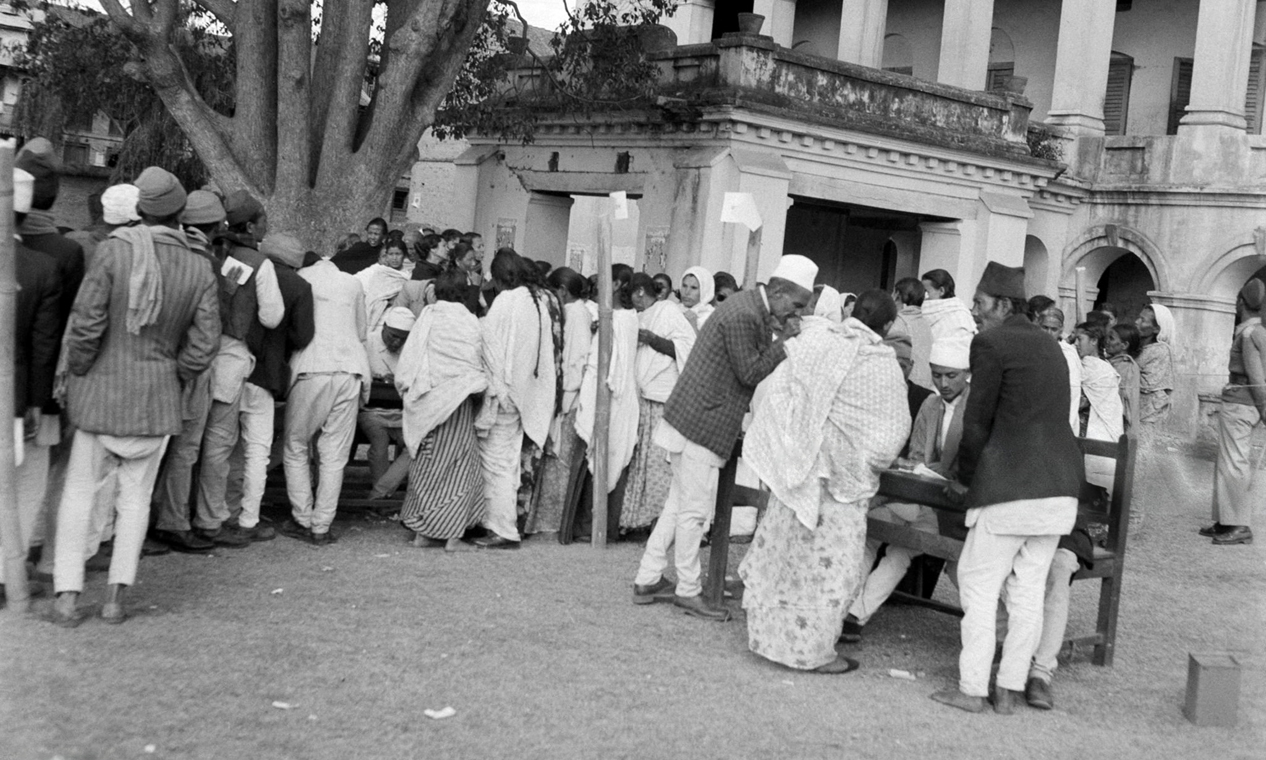
KATHMANDU: Following the dissolution of the House of Representatives due to the Gen Z protests on September 8 and 9, 2025, voting is underway on Thursday to elect new members of parliament. This marks the ninth general election held under the democratic system since 1959. However, except on two occasions, no parliament in the country has been able to complete its full term.
The seven previous general elections are discussed here.
A look back at the first general election:
After the end of the Rana oligarchic regime in 1951, the country held its first general election in 1959. Conducted on the basis of universal adult franchise for the first time, voting began on February 18, 1959, and took 45 days to complete. The counting process took another 30 days, with the final results announced on May 11, 1959.
A total of 786 candidates, including 268 independents, contested the election from nine political parties and independent groups. Out of 4,246,448 registered voters, about 47 percent, or 1,981,381 people, cast their ballots.
The Nepali Congress secured a two-thirds majority, winning 74 seats in the 109-member House of Representatives. The Nepal Rashtriya Gorkha Parishad, backed by the Ranas, won 19 seats, while the Samyukta Prajatantra Party secured five seats. The Communist Party of Nepal won four seats, the Nepal Praja Parishad won three, and four independents were elected.
Despite his party finishing second, Ranadhir Subba, chairman of the Rashtriya Gorkha Parishad, lost the election in Dhankuta. Among major party leaders, only Bishweshwar Prasad Koirala (B.P. Koirala) won his seat. The sole female candidate, Dwarika Devi Thakurani, was elected from Dadeldhura and later became a minister.
In terms of popular vote, the Nepali Congress received 666,898 votes, the Gorkha Parishad secured 305,118, and the Communist Party of Nepal obtained 129,142 votes. At that time, only parties receiving more than 100,000 votes were recognized as national parties, and each party was required to field candidates in at least 22 constituencies.
Following the election, B.P. Koirala, president of the Nepali Congress, became the first popularly elected prime minister. However, on December 15, 1960, King Mahendra dismissed the government, banned political parties, and introduced the partyless Panchayat system. The system remained in place for nearly three decades until it was overthrown by the People’s Movement of 1990.
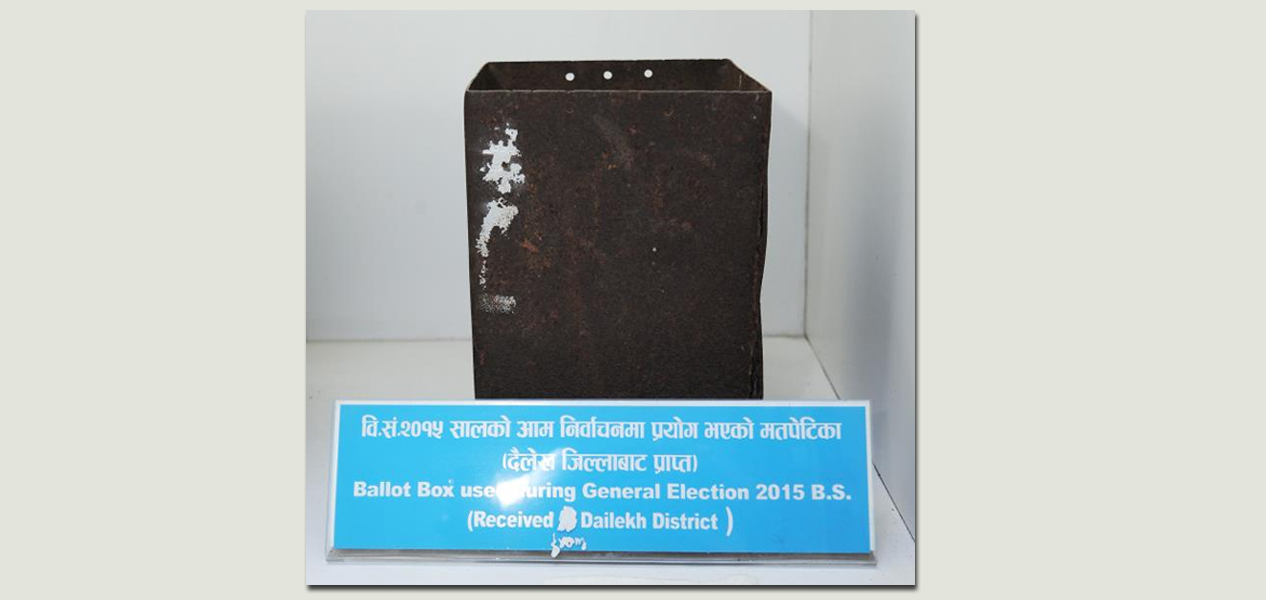
A ballot box from the first parliamentary election in 1959. Photo courtesy: Election Commission
General election of 1991
Following the 1990 People’s Movement led jointly by the Nepali Congress and the United Left Front, the Panchayat system was overthrown, and an interim government introduced the Constitution of the Kingdom of Nepal on November 9, 1990. Under this constitution, a general election was held on May 12, 1991, to form the House of Representatives, marking the first democratic parliamentary election in 33 years.
A total of 11,191,777 voters were registered, and 65.15 percent of them, or 7,292,084 people, cast their ballots. The election featured 1,345 candidates, including 219 independents.
The Nepali Congress secured a clear majority, winning 110 seats in the 205-member House of Representatives. The Communist Party of Nepal (Unified Marxist-Leninist) won 69 seats and became the main opposition. Samyukta Janamorcha secured nine seats, Nepal Sadbhawana Party six, Rashtriya Prajatantra Party (Chand) three, and Nepal Majdoor Kisan Party and CPN (Democratic) two each, while Rashtriya Prajatantra Party (Thapa) won one seat. Three independent candidates were also elected.
Out of 6,969,061 valid votes cast nationwide, the Nepali Congress received 2,742,452 votes, equivalent to 37.75 percent. The CPN (UML) obtained 2,040,102 votes, or 27.98 percent.
Despite the party’s victory, Nepali Congress acting president and interim Prime Minister Krishna Prasad Bhattarai lost the Kathmandu 1 constituency to CPN (UML) General Secretary Madan Bhandari. Bhattarai’s defeat came even though he had been widely credited for steering the political transition and overseeing the promulgation of the new constitution. After the election, Nepali Congress General Secretary Girija Prasad Koirala became prime minister.
Following the death of Madan Bhandari in a vehicle accident at Dasdhunga in Chitwan on May 16, 1993, a by-election was held in Kathmandu-1 on February 7, 1994. In that contest, Bhattarai was again defeated, this time by Bhandari’s wife, Bidya Devi Bhandari.
Bhattarai’s earlier defeat had already triggered accusations of internal betrayal within the Nepali Congress, deepening factional tensions inside the party and parliament. The conflict escalated on July 10, 1994, when the House of Representatives was scheduled to pass a vote of thanks to King Birendra for presenting the government’s policies and programs for the fiscal year 1994/95. At least 36 lawmakers aligned with the Bhattarai faction remained absent in protest, causing the motion to fail.
Later that same day, Prime Minister Girija Prasad Koirala dissolved the parliament and announced midterm elections for November 15, 1994. As a result, the first parliament formed after the restoration of the multi-party system was unable to complete its term despite the ruling party holding a majority.
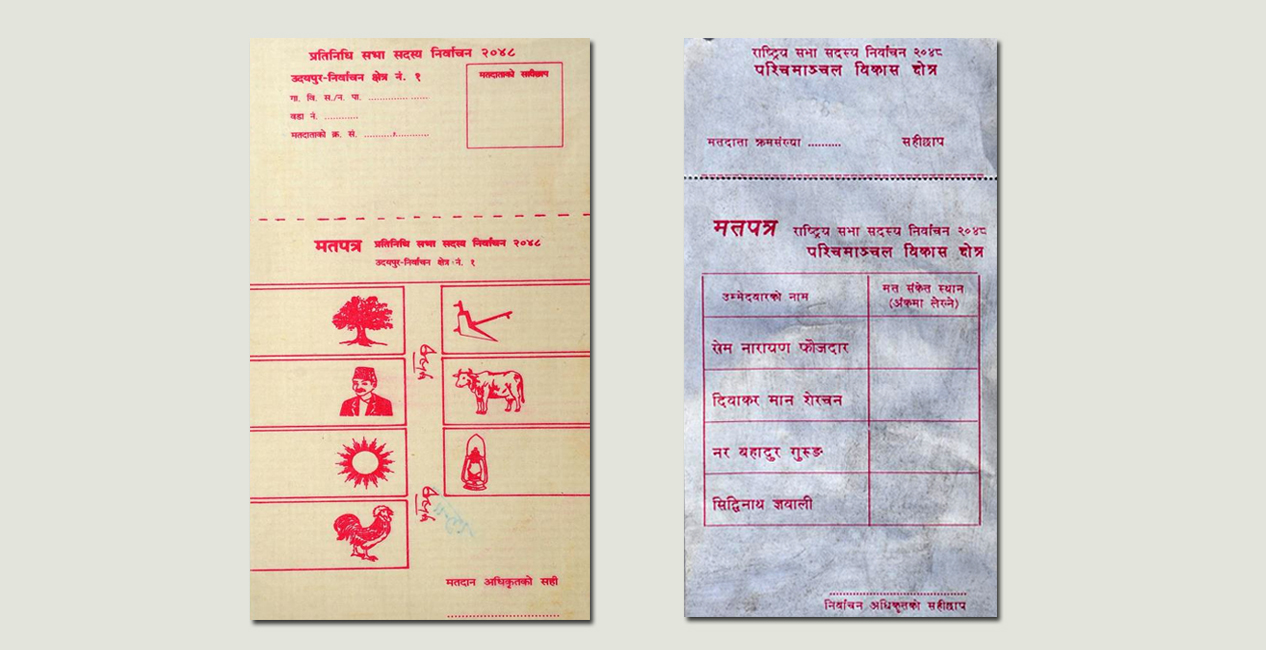
The ballot paper used in Udayapur Constituency Number 1 during the House of Representatives member election of 1991 and the ballot paper for the National Assembly member election of 1991 (Western Region). Photo courtesy: Election Commission
Midterm election of 1994
The midterm election was held on November 15, 1994, two days later than initially recommended by Prime Minister Girija Prasad Koirala because of ongoing festivals. Out of 12,327,329 registered voters, 7,625,348 cast their ballots, producing a turnout of 61.86 percent.
The election produced a hung parliament with no party securing a majority. The Communist Party of Nepal (Unified Marxist-Leninist) emerged as the largest party with 88 seats, while the Nepali Congress won 83 seats. The Rashtriya Prajatantra Party, formed through the unification of the Chand and Thapa factions of former Panchayat leaders, secured 20 seats. Independent candidates won seven seats, Nepal Majdoor Kisan Party four, and Nepal Sadbhawana Party three.
On November 29, 1994, a minority government was formed under the leadership of CPN (UML) Chairman Manmohan Adhikari, making him the first communist prime minister of Nepal. His government lasted nine months. After the Nepali Congress and RPP introduced a no-confidence motion, Adhikari dissolved parliament and recommended fresh midterm elections.
However, on August 27, 1995, the Supreme Court declared the dissolution unconstitutional and reinstated parliament. A no-confidence motion was then passed against Adhikari on September 11, 1995.
Following the vote, the Nepali Congress formed a coalition government with the RPP. Sher Bahadur Deuba, leader of the Nepali Congress parliamentary party, became Prime Minister on September 12, 1995.
The government soon faced another challenge when CPN (UML), supported by a faction of the RPP, filed a no-confidence motion. After failing to secure a parliamentary majority, the Deuba-led government collapsed on March 12, 1997.
On the same day, Lokendra Bahadur Chand of the Rashtriya Prajatantra Party formed a new coalition government with the support of CPN (UML) and became Prime Minister. His administration lasted less than seven months.
A new coalition government was formed on October 7, 1997, under Surya Bahadur Thapa with the support of the Nepali Congress. Thapa attempted to dissolve parliament, but the Supreme Court reinstated it, leading to the fall of his government after about six months.
Later, divisions within CPN (UML) over the Mahakali Treaty led to a split in the party. Amid the shifting alliances, Nepali Congress leader Girija Prasad Koirala became Prime Minister on April 15, 1998. During that tenure, he first governed in cooperation with CPN (ML) and later with CPN (UML).
Election of 1999
In the 1999 election, Nepali Congress secured a majority with 111 seats, fielding Krishna Prasad Bhattarai as its prime minister candidate. The divided CPN (UML) won 71 seats, while the RPP shrank to 11 seats. CPN (Sadbhawana Party) and Rashtriya Janamorcha won five seats each, and Samyukta Janamorcha and Nepal Majdoor Kisan Party won one each. CPN (ML) and RPP (Chand) failed to win any seats.
Out of 13,518,839 voters, 65.89 percent (8,618,896) cast their votes. Despite the majority, internal party conflicts forced Bhattarai to resign after nine months. Girija Prasad Koirala then became prime minister, but after a rift with King Gyanendra Shah, who ascended after the Royal Palace Massacre, he resigned, and Sher Bahadur Deuba assumed the post.
At that time, the CPN (Maoist) insurgency intensified, and pro-parliamentary parties faced internal divisions. Deuba’s proposal to extend emergency powers against the Maoists was opposed within his party. Amid deepening disputes, he recommended parliament’s dissolution on May 22, 2002. After postponing elections due to violence, King Gyanendra dismissed Deuba as incompetent on October 4, 2002, beginning direct rule.
The King appointed Lokendra Bahadur Chand and then Surya Bahadur Thapa as prime ministers. Deuba returned on May 25, 2004, but was again dismissed on February 1, 2005, as the king assumed direct rule.
A 12-point agreement between pro-parliamentary parties and the Maoists was reached on November 22, 2005. The parties boycotted the local elections announced by the King on February 2, 2006, and a mass movement against royal rule began on April 6, 2006. Facing pressure, King Gyanendra reinstated parliament on April 24, 2006, which then issued the interim constitution, curtailing the king’s powers to a ceremonial role and granting executive authority to the prime minister and the Council of Ministers.
First Constituent Assembly election
The first Constituent Assembly election was held on April 8, 2008. From that Constituent Assembly election, the CPN (Maoist), which had come to peaceful politics from the armed rebellion, became the largest party. In the 601-member Constituent Assembly, among the 240 seats under the first-past-the-post (FPTP), also known as the direct category, the CPN (Maoist) won 120 seats. In the proportional category also, it brought the highest 30 percent of votes. Among the 333 assembly members selected through the proportional system, 100 were elected from the CPN (Maoist).
Major parties like Nepali Congress and CPN (UML) fell to second and third places. Nepali Congress won 110 seats, 37 directly and 73 proportionally, while CPN (UML) won 103 seats, 33 directly and 70 proportionally.
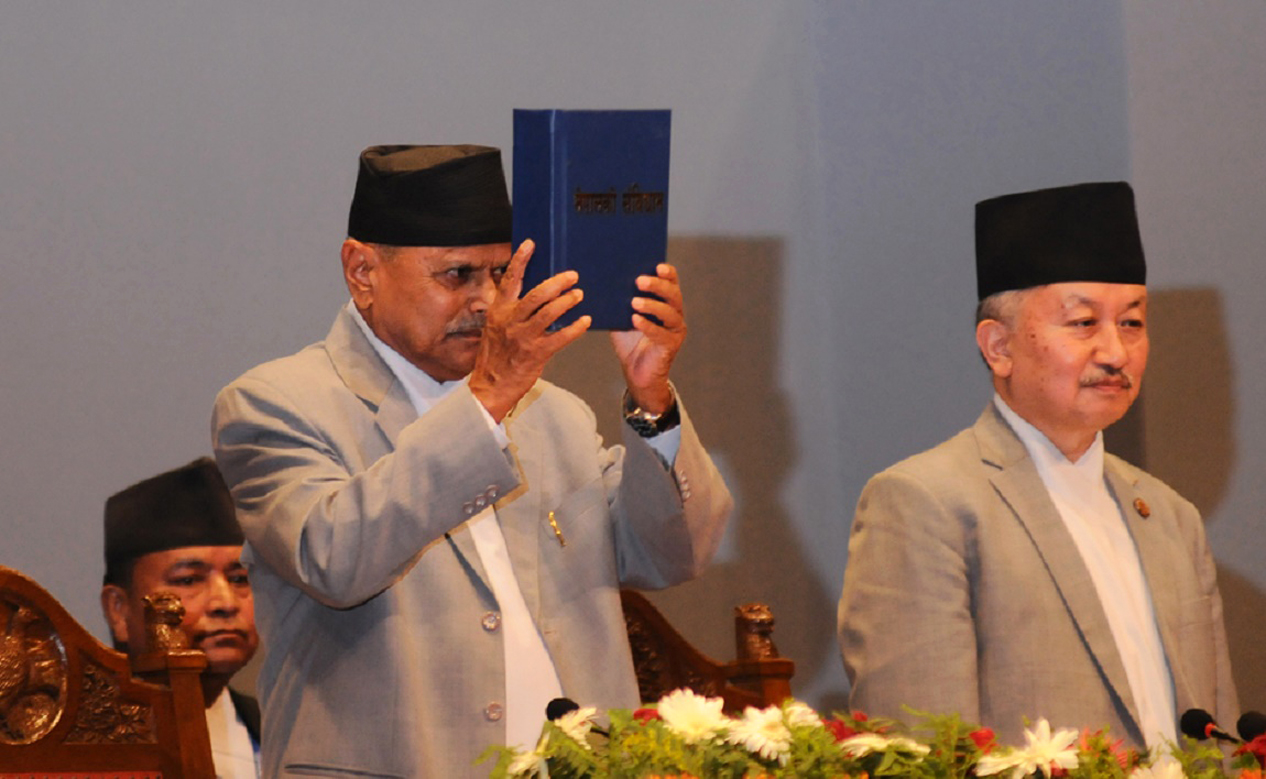
The then President Ram Baran Yadav issuing the Constitution of Nepal, 2015 in the Constituent Assembly on September 20, 2015
The election also brought regional parties in Madhesh into prominence. The Madheshi Jana Adhikar Forum won 22 direct and 20 proportional seats, while the Terai Madhesh Loktantrik Party (TMLP) secured nine direct and 11 proportional seats. RPP and CPN (ML) won eight proportional seats each. Sadbhawana Party, Janamorcha Nepal, and CPN (Unified) each won five proportional seats. Additionally, RPP Nepal won four seats, and Rashtriya Janamorcha and Rashtriya Janashakti Party won three each. Other parties represented in the assembly included Nepal Majdoor Kisan Party, Sanghiya Loktantrik Manch, Nepal Sadbhawana Party (Anandi Devi), Rashtriya Janamukti Party, Nepali Janata Dal, CPN (United), Dalit Janajati Party, Samajbadi Prajatantrik Janata Party Nepal, Chure Bhawar Rashtriya Ekta Party Nepal, Nepal Loktantrik Samajbadi Dal, and Nepal Pariwar Dal.
Immediately after the election, a joint government of CPN (Maoist) and CPN (UML) was formed under Pushpa Kamal Dahal, which lasted nine months. Subsequently, Madhav Kumar Nepal, Jhala Nath Khanal, and Baburam Bhattarai each served as prime minister. Despite this, the first Constituent Assembly was dissolved without issuing a constitution, as consensus could not be reached on the size and structure of the federal system.
Second Constituent Assembly
After the first Constituent Assembly was dissolved without issuing a constitution, Nepal faced a period of political deadlock. With the consensus of major political parties, a Council of Ministers led by Chief Justice of the Supreme Court, Khil Raj Regmi, oversaw the second Constituent Assembly election on November 19, 2013. Out of 12,147,865 registered voters, 9,044,908 votes were cast.
In this election, Nepali Congress emerged as the largest party, followed by CPN (UML). Of the 601 seats in the assembly, Nepali Congress won 196 seats, 105 directly and 91 proportionally, while CPN (UML) won 175 seats, with 91 directly and 84 proportionally. The CPN (Maoist), which had led the first Constituent Assembly, dropped to third place, securing only 26 direct seats and 54 proportional seats.
Regional and smaller parties also made notable gains. RPP Nepal, which previously held four seats, became the fourth-largest party with 24 proportional seats. The Madhesi Jana Adhikar Forum, Nepal (Loktantrik), won 14 seats, RPP 13, and Madhesi Jana Adhikar Forum 10. The Terai Madhesh Loktantrik Party won 11, and the Sadbhawana Party won six seats. CPN (ML) and Sanghiya Samajbadi Party Nepal won five seats each. Nepal Majdoor Kisan Party secured four seats, while Rashtriya Janamorcha, CPN (United), Terai Madhesh Samajbadi Party, and Terai Madhesh Sadbhawana Party won three each. Rashtriya Janamukti Party, Tharuhat Terai Party Nepal, Nepal Pariwar Dal, and Dalit Janajati Party won two seats each. Other parties represented included Akhanda Nepal Party, Madhesi Jana Adhikar Forum Ganatantrik, Nepali Janata Dal, Khumbuwan Rashtriya Morcha Nepal, Nepa Rashtriya Party, Jan Jagaran Party Nepal, Sanghiya Sadbhawana Party, Madhesh Samata Party Nepal, and Sanghiya Loktantrik Rashtriya Manch (Tharuhat).
The second Constituent Assembly successfully issued the constitution on September 20, 2015. It was then transformed into the Legislature-Parliament. After the constitution was promulgated, India imposed a blockade, and the parliament elected K.P. Sharma Oli as prime minister. Oli formed a government with support from about a dozen parties. Within the next two years, Pushpa Kamal Dahal and Sher Bahadur Deuba also served as prime ministers.
House of Representatives of 2017
Two years after Nepal adopted its new constitution, the first general election under the constitution was held. The House of Representatives election of 2017 took place in two phases on November 26 and December 7, 2017. Out of 15,427,731 registered voters, 68.63 percent (10,587,571) cast their votes.
In the election, the Left Alliance of CPN (UML) and CPN (Maoist Center) received nearly a two-thirds majority. Alongside the House of Representatives, Provincial Assembly elections were held, with the alliance securing a clear majority in six of the seven provinces.
The CPN (UML) became the largest party, winning 80 of 165 direct seats and 41 proportional seats. Nepali Congress fell to second place, with 23 direct seats and 40 proportional, totaling 63 seats. The CPN (Maoist Center) became the third party, winning 36 direct seats and 17 proportional seats. Other results included the Rashtriya Janata Party with 11 direct seats, the Sanghiya Samajbadi Forum with 10, and one seat each for the RPP, the Rashtriya Janamorcha, the Nepal Majdoor Kisan Party, and an independent candidate.
On May 17, 2018, CPN (UML) and CPN (Maoist Center) formally unified to form CPN. Despite holding nearly a two-thirds majority, internal disputes escalated. On December 20, 2020, Prime Minister K.P. Sharma Oli dissolved the House of Representatives, but the Supreme Court reinstated it on February 23, 2021.
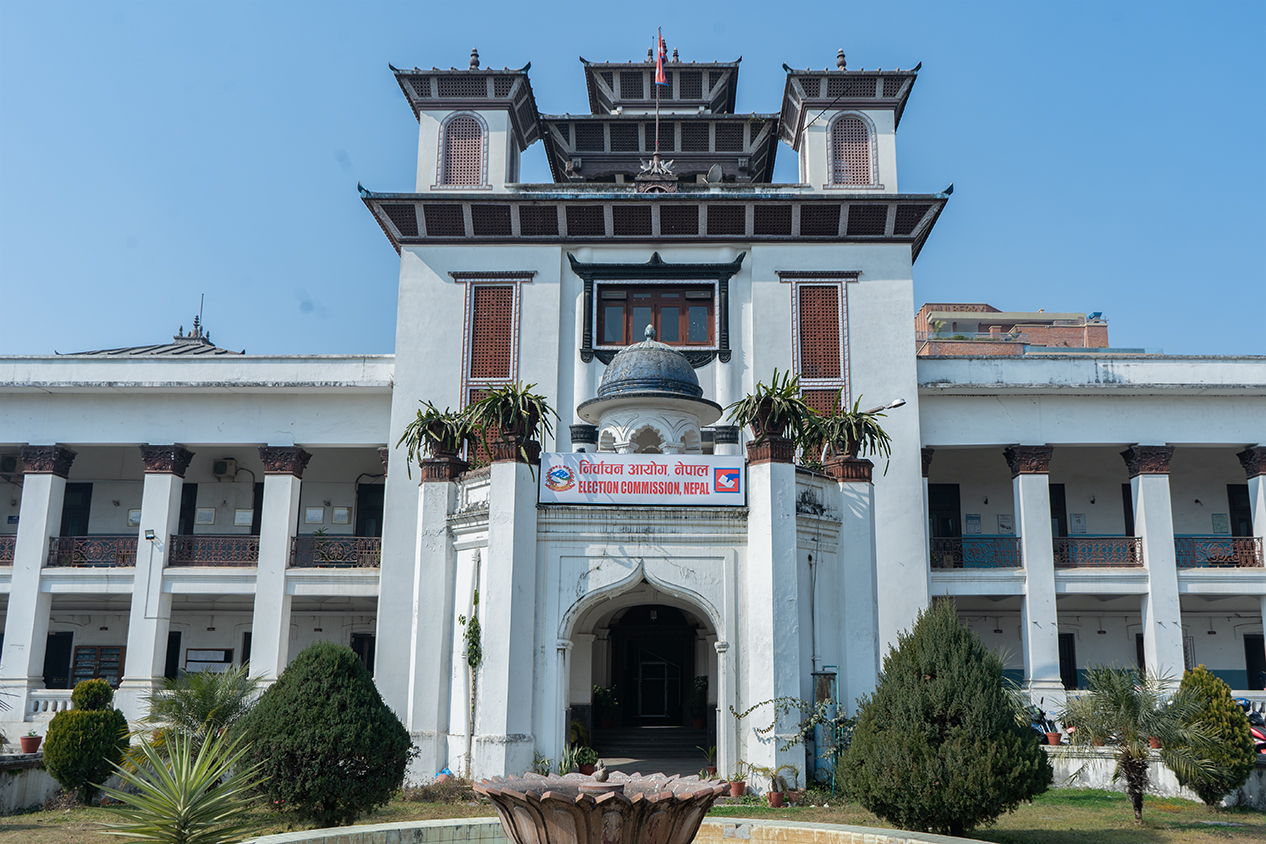
Election Commission. Photo: Bikram Rai/Nepal News
The disputes within CPN continued, and on March 7, 2021, the Supreme Court ruled that the CPN’s formation was unlawful, leading to the division of UML and the Maoist Center. On May 21, 2021, the House was dissolved a second time on Oli’s recommendation; the Supreme Court declared the dissolution unconstitutional. On July 12, 2021, the Constitutional Bench of the Supreme Court ruled in favor of Nepali Congress President Sher Bahadur Deuba, who became Prime Minister under the court’s mandamus.
Later, UML split again. On August 18, 2021, Madhav Kumar Nepal’s group left UML to form CPN (Unified Socialist). The House of Representatives, reinstated twice by the Supreme Court, then ran its full term.
The election of 2022
In the House of Representatives election of 2022, there were 17,988,570 registered voters. The election was held on November 20, 2022, and 61.36 percent (11,047,034) of voters participated.
The contest was primarily between the five-party coalition, including Nepali Congress, CPN (Maoist Center), CPN (Unified Socialist), and CPN (UML). While the main competition was between the Nepali Congress and CPN (UML), new political parties such as the Rashtriya Swatantra Party (RSP), Janamat Party, and Nagarik Unmukti Party entered the parliament.
Nepali Congress secured first place with 89 seats, winning 57 directly and 32 proportionally. CPN (UML) became the second-largest party with 78 seats, 44 direct and 34 proportional. The CPN (Maoist Center) won 32 seats, with 18 direct and 14 proportional. RSP became the fourth-largest party, winning 20 seats: seven direct and 13 proportional.
Other results included RPP with seven seats each in the direct and proportional categories, and Janata Samajbadi Party with 12 seats, five direct and seven proportional. CPN (Unified Socialist), though not a national party, won 10 direct seats. Nagarik Unmukti Party won three seats, Janamat Party six, Loktantrik Samajbadi Party four, and Nepal Majdoor Kisan Party one seat.