Kathmandu
Monday, July 13, 2026





The fall of Bhanubhakta's statue in Janakpur was not a rejection of the poet but a symptom of decades of exclusionary state policies. True national unity, the author argues, lies in embracing Nepal's multilingual and multicultural heritage.
KATHMANDU: Amid the monsoon rains of July, the mud, and the rush of rice plantation, when the birth anniversary of Adikavi Bhanubhakta Acharya arrives, Nepali hearts scattered not only within Nepal but across various corners of the world unite. At this time, Bhanu Jayanti celebrations are taking place across different geographies of the world inhabited by Nepal and the Nepali community.
In Nepal, amidst today’s political consciousness, changing social discourse, and identity movements, it is natural for identity advocates, including this writer, to have grievances regarding Bhanubhakta’s single linguistic and ethnic identity. However, that alone does not determine the evaluation of his literary contribution. The moment one steps outside the country’s borders, Bhanu ceases to be confined within the boundaries of a single geography or ethnicity; he becomes a shared symbolic figure for the entire global Nepali community (Mahajati). It is by being woven into Bhanu’s poetic verses that Nepalis globally have established their self-identity. In fact, a strong and emotional “Nepali Mahajati” has been built through this very process around the world.
Personally, this is a reality I have directly witnessed and felt when visiting many regions in India, including Assam, Manipur, West Bengal, and Dehradun. Not only in India, but this image of Nepalis is also visible to a greater or lesser extent in countries where Nepalis reside temporarily, such as Malaysia, Qatar, the UAE, Saudi Arabia, and Kuwait. Furthermore, in countries like the United States, Australia, and the United Kingdom, the Bhanubhakta element plays an even greater role in forming the Nepali Mahajati. Based on these examples, we can say that Bhanubhakta is not just a historical poet, but also a strong cultural pillar protecting Nepali identity, culture, and existence.
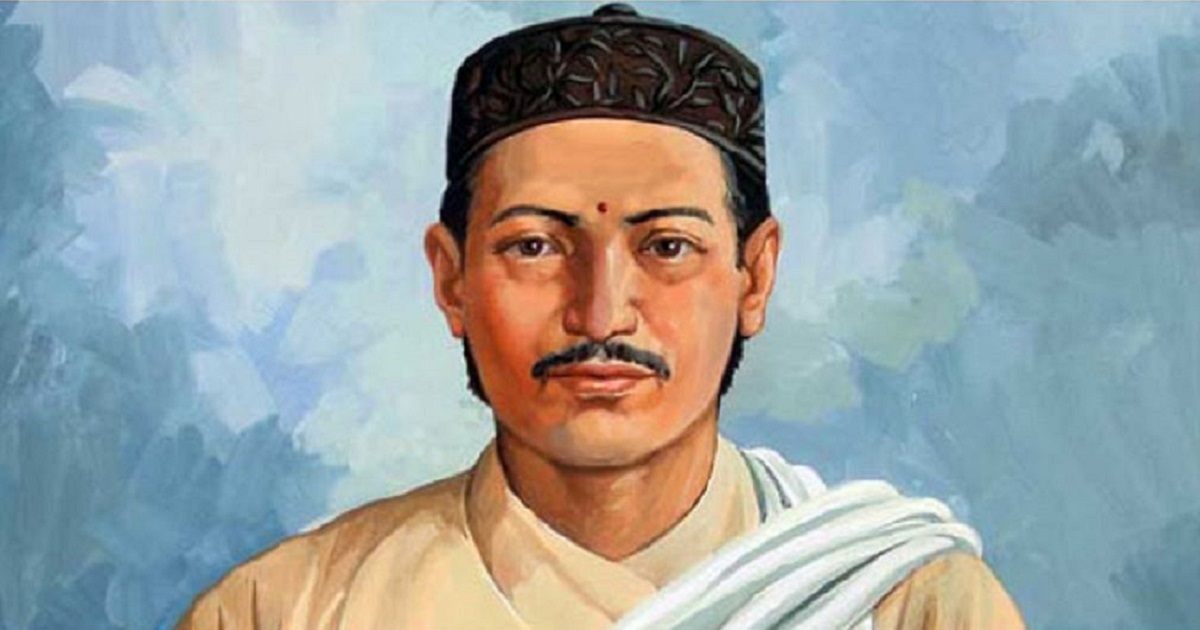
Adikavi Bhanubhakta Acharya of the Nepali language.
However, this situation does not mirror within Nepal itself. Bhanubhakta, who has risen in the hearts and minds of Nepalis worldwide, has had to face homelessness in parts of his own country. I am speaking of a distinct cultural city in Nepal, which has preserved the peak, wisdom, philosophy, and grandeur of the ancient Mithila civilization within its chest for ages. There, Bhanu has been suffering the fate of a displaced squatter for two decades. Two decades ago, amidst a whirlwind of protests and anger, Bhanu’s statue was demolished at Bhanu Chowk in Janakpurdham. The symbolic form of a poet was turned into a target for political discontent.
The irony is that even after two decades, Bhanu Chowk has not been managed or revived. Instead, it remains an neglected ruin. Seeing his broken statue and that location deserted, dusty, and in ruins for two decades, how Bhanu’s soul must weep!
The politics of single identity
No one can dispute that Bhanubhakta has become a strong identity for Nepali ethnicity and linguistic unity. However, we cannot ignore a ruthless and dark side of history that sowed the seeds of today’s alienation. From the Rana regime through the Panchayat era and even in the subsequent democracy, centralized and unitary cultural policies were imposed by the state in the name of creating a shared platform for “Nepali identity” and national unity. In that aggressive political campaign of “One Language, One Dress,” instead of protecting the native identities of Nepal’s other rich, historical, original, and vibrant linguistic and cultural communities, systematic efforts were made to marginalize and erase them. The children of that soil were driven to detach from their own roots.
The centralized and feudal state system of the time provided no institutional basis for the local residents of Janakpurdham, the heart of Mithila, to proudly remember Maithil Kokil Mahakavi Vidyapati, the supreme symbol of their cultural and creative identity. Instead of honoring Maithili language, art, and folk heroes like Salhesh, Dina-Bhadri, and Lorik, state entities viewed them with neglect.
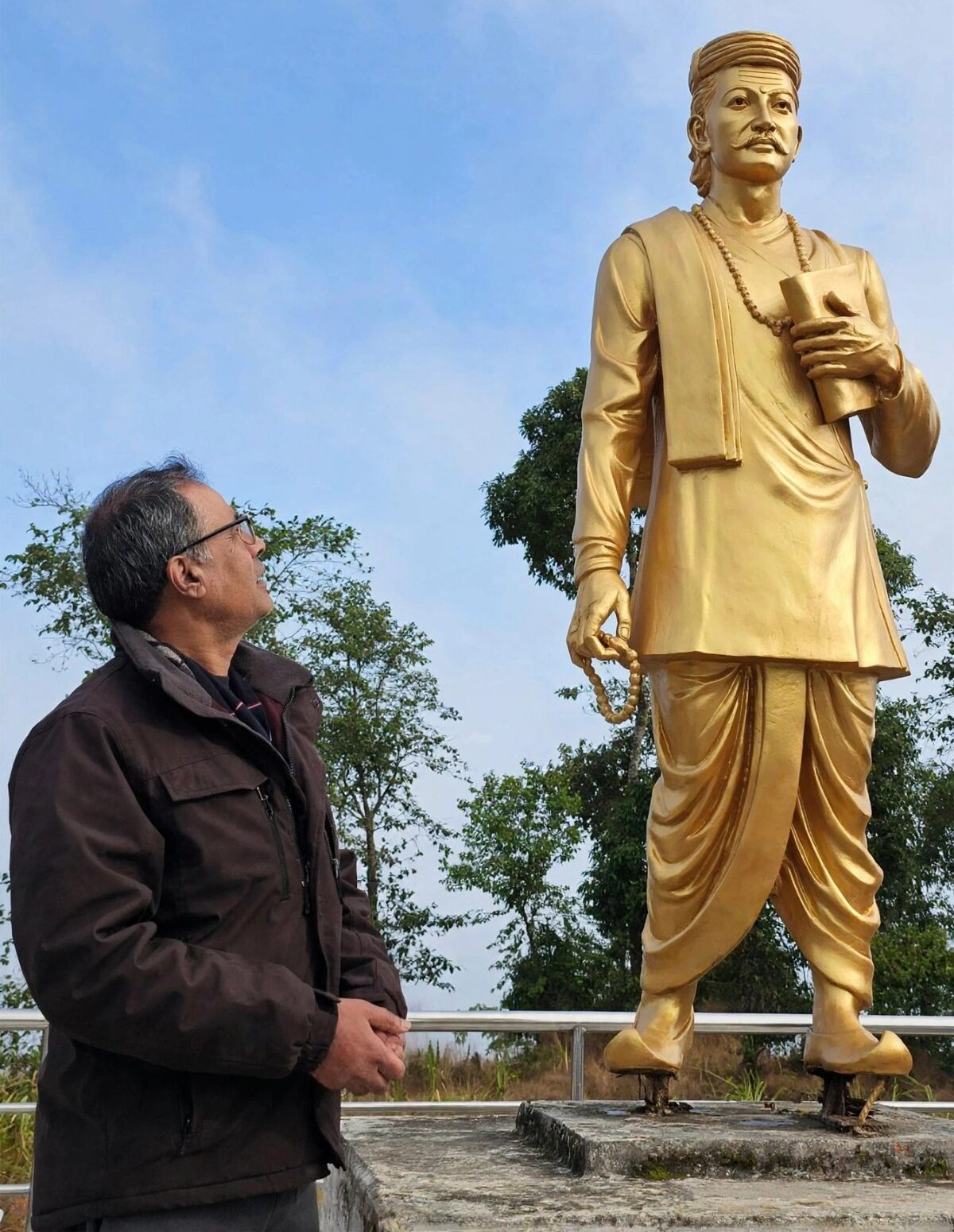
Author Premarshi observing the statue of Vidyapati at Panchakanya in Suryodaya Municipality, Ilam.
A serious social and psychological question arises here: how can we expect a generation that cannot recognize or give proper place and respect to its own parents to embrace the pride of a society, neighborhood, or the entire state? When the local populace feels the state’s boot stamping down on their ancient and historical identity, their resistant anger sometimes pours out in the wrong place or onto the wrong figure. The toppling of Bhanu’s statue in Janakpurdham was certainly not due to personal dissatisfaction or literary hostility toward the Adikavi of the Nepali language; it was an expression of anger against the state’s single ethnic and linguistic oppressive policy.
Vidyapati: The main highway of popular language and linguistic strength
Looking back at history, the highway of folk language that Bhanubhakta Acharya walked to become a beloved poet of the people had already been cleared nearly 700 years ago by the Maithil poet Vidyapati (1350–1448 AD).
Vidyapati was a profound scholar of the Sanskrit language. He authored several timeless works in Sanskrit. However, despite his royal prestige and high reverence for Sanskrit, he recognized the power and sweetness of the native language of the common people. He broke the rigid tradition of the time, which dictated creating literature only in the “language of the gods” (Sanskrit), and established the practice of writing in the language of the masses. When Sanskrit and Prakrit appeared unable to express the hearts and emotions of the common people, he decided to write in the people’s tongue (Avahatta/Maithili), stating:
Sakka-a vaanii bahuan bhaaba-i
Paa-ua rasa ko mamma na paaba-i.
Desila vayana sabajana mitthaa
Tai taisana jampao avahattaa.
(Meaning: Even if the Sanskrit language is dear to scholars, it cannot capture the feelings of the common man. The Prakrit language cannot embrace the essence and core of literature. One’s native language tastes sweet to everyone, therefore, I write poetry in Avahatta.)
When closely examining this flow of Vidyapati’s language, the magical impact of his poetry, and his extraordinary linguistic capability, a perspective by writer/analyst C.K. Lal appears highly relevant. He states, “In Vidyapati’s time, Maithili was not struggling as a new language but had already established itself completely as a recognized language in the public psyche and intellect.”
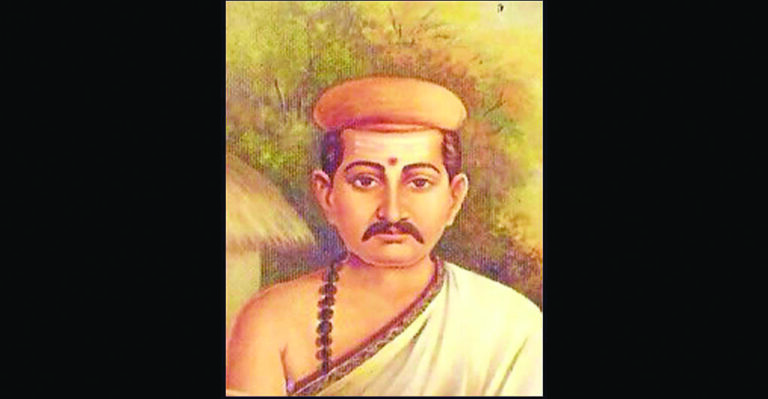
Mahakavi Vidyapati of the Maithili language. Photo: Social Media
Despite his profound scholarship in Sanskrit, Vidyapati had to face fierce criticism and opposition from the conservative pundits and classical traditionalists of his time simply because he composed poetry in Avahatta (Mithila Apabhramsha) and Maithili for the common people. However, those critics faded away on the touchstone of time, and because of those very Maithili verses, Vidyapati became famous as a pioneer and epoch-making poet of all Indo-Aryan languages. He was not confined within the borders of Mithila; he was respected across Bengal, Assam, Odisha, and the Nepal Valley.
The global footprint of ‘Desil Vayana’
The formula of “Desil Vayana” (native language) propounded by Vidyapati was essentially a revolutionary movement for using one’s mother tongue. In later times, following this maternal linguistic formula and walking the same path, epoch-making poets like Saint Tulsidas, Kabir Das, Mira Bai, and Sur Das attained their peak on the literary horizon of India. Realizing that the emotions of the human heart can only be truly felt and expressed through the mother tongue, the famous Hindi poet Harivansh Rai Bachchan wrote moving words addressing Maithil Kokil Vidyapati:
The na Kabir na Sur na Tulsi
Aur na thi jab babari Mira
Tab tum ne hi mukharit ki thi
Manav ke manas ki peeda.
(Meaning: While later poets of ancient India like Kabir Das, Sur Das, Tulsidas, and Mira Bai hold distinct importance and high status, Vidyapati was the first poet to voice the pent-up grief, pain, laughter, weeping, and sensitivity of the common people in their own language and environment.) The path of popular language carved initially by Vidyapati created the infrastructure to build a highway for subsequent writers.
We can place Bhanubhakta, the Adikavi of the Nepali language, in exactly the same category. Bhanubhakta also left behind Sanskrit scholarship to translate the Ramayana into simple Nepali that the common people could understand. This wove scattered Nepalis into a single linguistic thread, providing historical support for the construction of the “Nepali Mahajati” and establishing a linguistic foundation for Nepal.
The greatest proof of how vast the influence of Vidyapati’s poetic consciousness was is the global poet and Nobel laureate Rabindranath Tagore. In the early stages of his writing, Tagore was so influenced by Vidyapati that he wrote several excellent poems using the pseudonym “Bhanusingh.” A text of his titled Bhanusingher Padavali is published. Recent discoveries show evidence that Tagore himself set many of Vidyapati’s timeless songs to music. Tagore admitted, “The element that first stirred and awakened my poetic consciousness from deep within was the verses concerning the divine love and separation of Radha-Krishna by Maithil Kokil Vidyapati.”
The above contexts clarify that even in the formation of talents like Bhanubhakta, the paths created and creations scattered by Vidyapati in his time played an important role. For this reason, to truly respect Bhanubhakta, it was necessary for the identity of preceding literary figures of our region to remain alive in the public mind.
Respecting cultural plurality
If past rulers, policymakers, and state machinery possessed the minimum wisdom to understand Nepal’s vast multilingual and cultural plurality, no creative soul would have to suffer the tragic situation seen in Janakpurdham today. If the state had made an honest effort to establish the identity, history, and respect of figures like Maithili’s Mahakavi Vidyapati, Newari’s Mahakavi Siddhidas Mahaju, and Kirat culture’s Mahaguru Falgunanda as a matter of pride for the respective communities, no individual, no matter how ignorant or frustrated, would have ever dared to strip Bhanu Chowk in Janakpurdham of Bhanubhakta’s statue. Even if some disruptive element or political interest group had committed such a misdeed, the local community would have stepped forward, declared “Bhanu is ours too,” and reinstated him with respect in that very square. When people see the identity of their own parents secure and respected in their home, only then do they naturally express the generosity and global harmony to respect others’ identities, languages, and symbols.
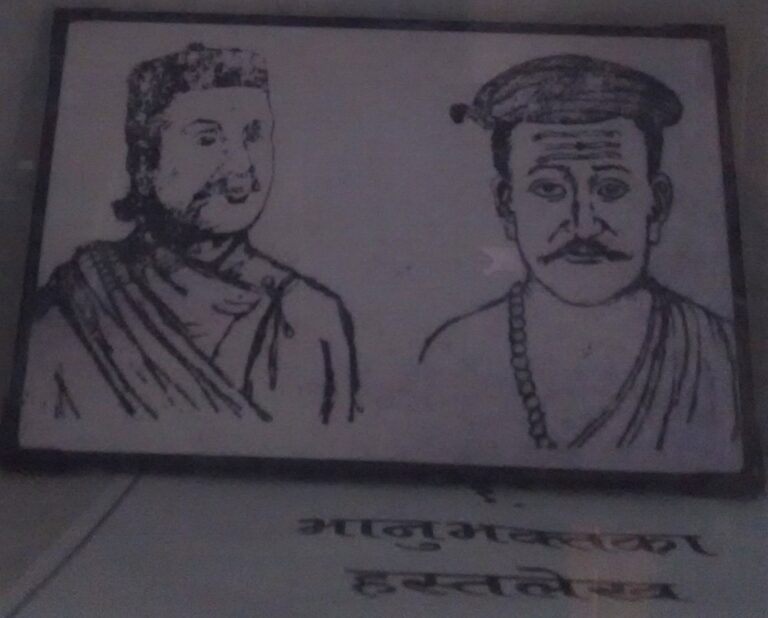
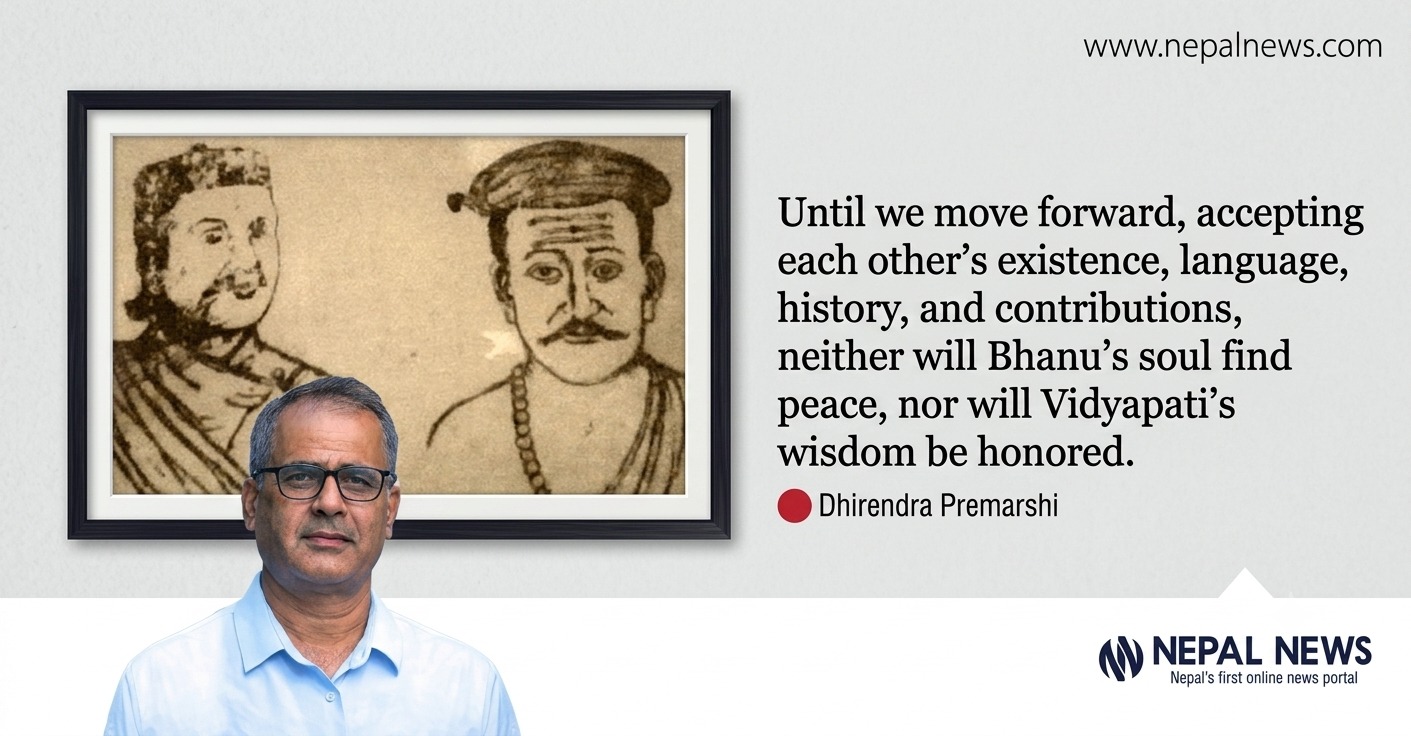
A combined framed portrait of Adikavi Bhanubhakta Acharya of the Nepali language and Adikavi Vidyapati of the Maithili language at the Bhanu Museum in Chundi Ramgha, Tanahun.
However, it is not that such positive and harmonious efforts have never occurred in Nepali society and history. Although the state failed to show that wisdom and foresight in Janakpurdham, the central part of Mithila, the local community in Biratnagar—a historical, industrial, and academic city of eastern Mithila—demonstrated an exemplary act with the active involvement of the state. A “Trimurti” (trio of statues) of Mahakavi Vidyapati, the distinct devotee of the Nepali language Mahananda Sapkota, and Adikavi Bhanubhakta has been established in Biratnagar. This Trimurti reflects a beautiful picture of multilingual and multicultural Nepal.
Similarly, in recent times, a grand full-size statue of Mahakavi Vidyapati has been erected on Panchakanya Hill in the beautiful eastern hill district of Ilam. The standing statue of the Maithil Kokil on a hill peak, alongside the search for Bhanu’s respect at the center of Mithila-Madhesh, serves as an exceptional example of intercultural harmony and respect.
Such constructive activities provide a sense that goodwill, mutual trust, and harmony are beginning to irrigate our social mindset, which had grown dry like a desert due to past state discrimination and neglect. This inspires strong hope for a new sprout of brotherhood.
The sour reality and the responsibility of future generations
No matter how unpalatable the truth may seem, we must accept a sour reality. It is becoming very difficult to return the public psyche—which was left deserted and barren by past wrong activities, politics of exclusion, and communal hatred—to its original rhythm of consciousness, intellect, and brotherhood. A single moment of political anger is enough to destroy, but years of dedication, forgiveness, and goodwill are required to build and connect hearts. Bhanu Chowk in Janakpurdham sits waiting for its full form and revival, which seems to display our lack of cultural blending and incapacity.
The present time is not for sitting back and repeating old mistakes, or holding the present and future hostage to past anger. Now, conscious individuals of the respective communities, civil society, and local as well as central state bodies must create a healthy environment to recognize and give proper respect to their historical figures. Whether it is Bhanubhakta Acharya, the immortal symbol of the identity of the Nepali Mahajati, or Mahakavi Vidyapati, the great hero of ancient eastern wisdom and popular language, the minds of the people are enlightened due to the creations, thoughts, and dedication of such figures.
Walking the path of popular language carved by Vidyapati 700 years ago, Bhanubhakta irrigated the Nepali language 200 years ago. Therefore, both are sources of light for the human mind. No one should make a malicious attempt to block such light with the palm of their corrupt, narrow, and communal-political interests, nor should an environment allowing it be tolerated. Insulting timeless creators in the name of political slogans is a suicidal step.
Let us now build a Nepal where Bhanubhakta smiles respectfully at Bhanu Chowk in Janakpurdham, while the sweet tune of Maithil Mahakavi Vidyapati’s “Desil Vayana” echoes as the heartbeat of the nation. Until we move forward by accepting each other’s existence, language, history, and contribution from the bottom of our hearts, neither will Bhanubhakta’s soul find peace, nor will Vidyapati’s wisdom receive true respect. This shared path of consciousness, intellect, and brotherhood is the highway to our happy future.