Kathmandu
Wednesday, July 1, 2026





Giri extorted Rs 9 million monthly through inmate allowances, clothing funds, a 6-telephone racket, stool-carpet sales, and prison mess control
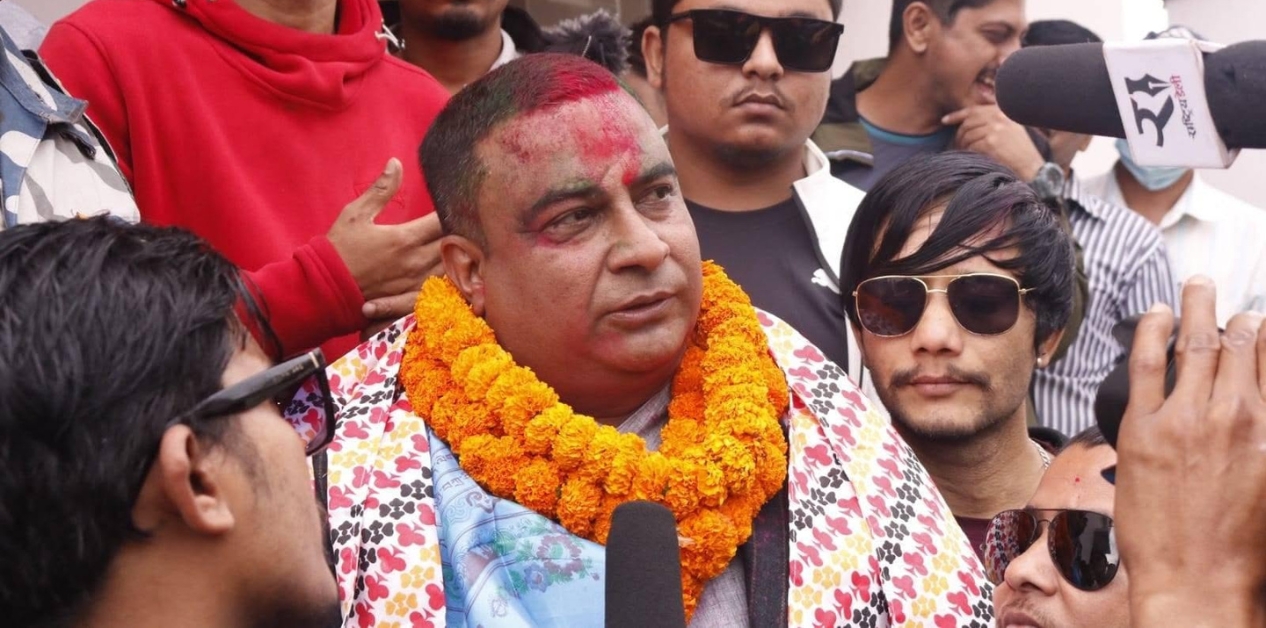
KATHMANDU: In the criminal underworld, Abhishek Giri is a notorious figure whose name is synonymous with murder, kidnapping, extortion, contract fraud, and illegal collections. Throughout his three-decade career in crime, Giri has seen the inside of a prison cell multiple times. Whether behind bars or out on the streets, he has consistently remained a headline fixture for his illicit activities. On Saturday, June 27, the 48-year-old Giri was arrested by Morang Police from his residence in Madhumara, Biratnagar Metropolitan City-8.
This time, Giri was not apprehended for murder, gangsterism, or traditional extortion, but for running a massive extortion racket targeting inmates by seizing control of the financial resources inside the Morang District Prison in Biratnagar. Additionally, police had information that he possessed three pistols—one on his person, one at his home, and another with an associate. Although the firearms were not recovered when police raided his home, a search operation is underway.
Giri had previously been released from prison on March 19, 2023, after serving a 10-year sentence for the kidnapping and hostage-taking of Achyut Prasad Regmi, an accountant for Kathmandu Upatyaka Khanepani Limited. However, his freedom lasted just over three years before landing back in police custody. According to investigating officers, Giri had been systematically extorting the daily allowances provided to inmates by the government. Preliminary investigations also reveal that even the wages earned by prisoners through hard labor inside the facility were funneled into Giri’s control. Essentially, his reach extended from government funds entering the prison to the hard-earned sweat of the inmates.
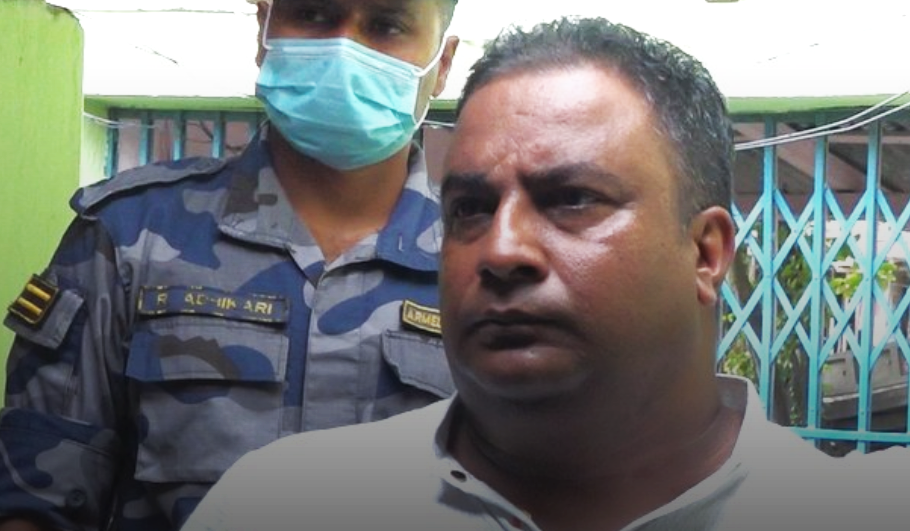
Abhishek Giri
According to Superintendent of Police (SP) Kabit Katwal, chief of Morang Police, the investigation focuses not only on Giri but also on the extensive extortion syndicate he built. Giri’s associates, Bijay Kamat and Deepak Karki, have already been arrested. Police are currently analyzing financial transaction details and interrogating inmates and prison-related personnel.
“We are conducting a detailed investigation into how long, how, and under whose protection Giri was running this extortion racket,” SP Katwal stated. “We are currently collecting complaints from victims, gathering evidence, and mapping out the financial transaction network.”
The underworld inside the prison gates
According to police investigations, Giri’s criminal trajectory began in the mid-2000s. He entered the underworld by investing in and extorting commissions from public procurement and infrastructure development contracts. He started with contracts for the Hulaki Highway (Postal Highway) and multi-purpose buildings within the metropolitan city. It was during these contract dealings that Giri formed an alliance with Parshu Ram Basnet of Biratnagar. However, their partnership was short-lived.
Police records show that rifts emerged between the two around 2008–2009 over partnership disputes. Between 2005 and 2008, they used to split the profits generated from criminal activities in Biratnagar. Investigations revealed that Giri had invested approximately Rs 110 million in Basnet during that period.
When their financial accounts failed to reconcile, Giri allegedly deployed hitmen from inside the prison to shoot Basnet. Since then, relations between the two have remained deeply hostile. In 2013, the Department of Money Laundering Investigation filed a case against Giri in the Special Court, claiming he possessed illegal assets worth Rs 29.4 million. Giri was subsequently acquitted in the case. Basnet, who faced a parallel lawsuit for allegedly holding Rs 114.1 million in illicit wealth, was also acquitted.
Giri’s prison journey initially began in 2008 when he was arrested for the murder of Karan Yadav in Biratnagar. The incident occurred when both Basnet and Giri’s factions clashed while attempting to hijack a tender at the then-District Development Committee. Yadav was hacked to death with a sword, leading to Giri’s arrest. According to SP Katwal, it was during this initial stint in Morang Prison that Giri first gained access to the facility’s internal financial resources.
Giri was acquitted and released in Yadav’s murder case in 2012. However, within less than a year, he was re-arrested in 2013 from Lalitpur on kidnapping charges. The court sentenced him to 10 years in prison for kidnapping and hostage-taking.
Even while serving time at the Central Jail in Kathmandu for the kidnapping case, Giri remained criminally active. After intelligence revealed he was plotting the abduction of Kathmandu-based businessman Dhyan Govinda Vaidya, authorities transferred him to Nuwakor Jail. Yet, his criminal operations did not stop. In Nuwakot, Giri allegedly collaborated with the Chhota Rajan armed faction inside the prison to set up a call-bypass network, using it to threaten and extort businessmen in Morang. A subsequent police raid of his jail cell uncovered illegal call-bypass equipment.
When his criminal activities persisted in Nuwakot, authorities attempted to transfer him back to Morang Prison. However, after Morang Prison authorities refused to admit him, he was sent to Jhumka Prison in Sunsari. Undeterred, Giri continued his operations from Jhumka. In February/March 2010, Giri orchestrated a hit from inside the prison, sending men to shoot his former associate Parshu Ram Basnet twice. Basnet survived after two months in intensive care. Seeking revenge, Basnet’s faction attacked Giri on June 1, 2011, when he was brought to the Morang District Court for a hearing. During his subsequent placement at Morang Prison, Giri faced mounting allegations of running extortion and protection rackets directly from his cell.
Furthermore, Giri is accused of beating to death Israil Miya, a resident near the Biratnagar Hatkhola Bridge, inside the prison facility. He is similarly accused of the fatal beating of Uttam Rai of Dharan within the same prison walls. Following the reign of terror he unleashed at Morang Prison, he was transferred to Dilli Bazar Prison on April 6, 2018.
However, Giri began heavy political lobbying to secure a transfer back to Morang. Utilizing his connections within the then-Nepali Congress-led government, he pressured the Ministry of Home Affairs. On November 2, 2021, the Department of Prison Management officially transferred Giri back to Morang Prison. This transfer occurred during the tenure of Bal Krishna Khand as Home Minister, given Giri’s close ties to the Nepali Congress.
When Giri initially arrived at Morang Prison, fellow inmates staged a protest and blocked his entry, forcing authorities to temporarily hold him at Saptari Prison. Finally, on November 25, 2021, Giri was successfully moved to Morang Prison, where he was subsequently appointed as the Chowkidar (inmate leader). Police confirm that his desperation to return to Morang Prison was entirely driven by the lucrative extortion prospects inside the facility.
A philanthropic facade hiding an active criminal network
Following his recent release from prison, Abhishek Giri launched a calculated campaign to clean up his public image. Attempting to discard his decades-long identity as a criminal, he sought to draft a narrative of a “reformed citizen.” He remarried to start a stable family life and began making frequent appearances at public events alongside his family. He then acquired an active membership in the Nepali Congress, attempting to project himself as a legitimate political figure. During the last House of Representatives elections, Giri was highly active, serving as the election commander for Nepali Congress General Secretary Guru Raj Ghimire.
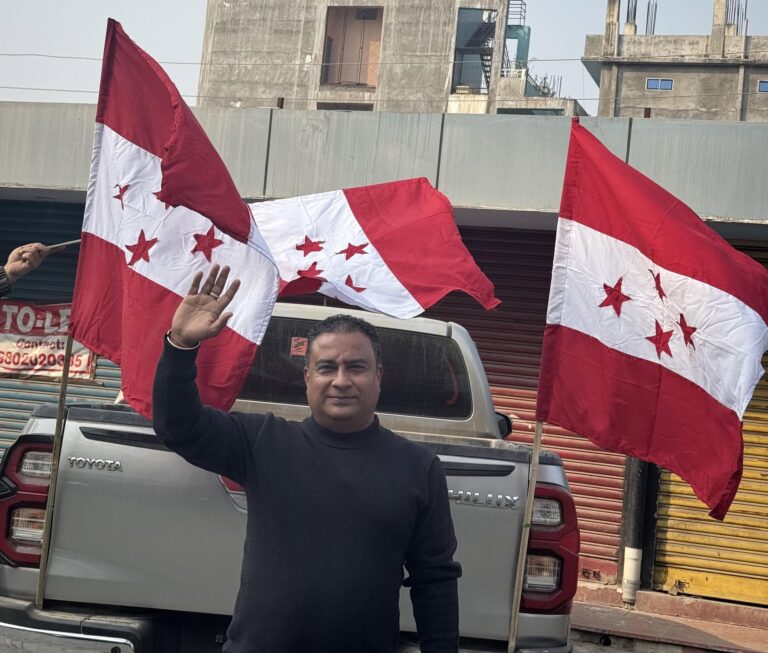
Abhishek Giri
Giri took his rebranding a step further by establishing the “Abhishek Giri Foundation.” Through this organization, he prioritized distributing school uniforms to students, donating sports equipment, handing out relief materials, and participating in various social service programs. To the casual observer, he appeared to have abandoned his criminal past in pursuit of social work.
However, police investigations reveal a starkly different reality. According to SP Katwal, while Giri’s public persona appeared transformed, his underlying criminal network remained intensely active. Using social service and political activism as a shield, Giri was covertly running a massive financial extortion racket inside the prison.
When a Morang Police team raided Giri’s residence on the morning of June 27, they recovered a commercial money-counting machine—equipment typically found only in banks or major commercial establishments. SP Katwal notes that keeping a money-counting machine at home while plundering the labor of inmates demonstrates how deeply Giri’s “crime empire” had rooted itself in Morang.
Preliminary police inquiries show that Giri’s grip on the financial operations of Morang Prison did not weaken even after his release. It has come to light that the earnings from the sale of muda (traditional bamboo stools) and carpets woven by over 500 inmates were deposited directly into Giri’s personal bank account. Morang Prison currently houses 1,199 inmates, out of which roughly 500 are employed in weaving stools and 100 in making carpets. These goods, crafted through the daily labor of inmates, are loaded onto trucks and shipped to markets in Chitwan and Kathmandu. However, the proceeds never reached the hands of the workers.
SP Katwal confirmed that a recent transaction of Rs 700,000, derived from the sales of these stools and carpets in Chitwan and Kathmandu, moved directly into Giri’s personal bank account.
“The fact that revenue generated from prison production is still flowing into the account of an individual who completed his sentence and left nearly four years ago is a textbook example of organized crime,” SP Katwal stated. “We are thoroughly dissecting Giri’s financial pipeline.”
Giri had been appointed as the Chowkidar of Morang Prison on November 29, 2021. By the time he was released on March 19, 2023, he had institutionalized his influence to ensure that every financial transaction inside the prison yielded either a steep commission or full revenue for him. By government regulation, inmates receive a daily subsistence allowance of NPR 80, alongside specialized government funds for clothing and summer allowances. Giri’s syndicate, however, systematically plundered these funds.
On June 26, a formal police complaint was lodged alleging that Giri had extorted Rs 1.36 million allocated as summer allowances for 544 inmates housed in ‘Block B’ of Morang Prison. The police state that prison assistants, vegetable supplier Bijay Kamat, and Giri’s aide Deepak Karki played pivotal roles in collecting this money at a rate of Rs 2,500 per inmate. It was the leakage of this specific information that led to Giri’s arrest from his residence on June 27.
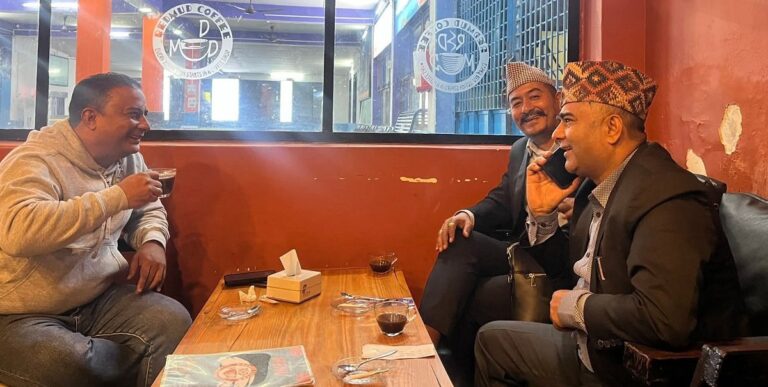
Abhishek Giri (left) with friends
During Giri’s tenure as Chowkidar, “Room Number 13” became a dreaded sector inside Morang Prison, striking terror into the hearts of inmates. Former prisoners reveal that Giri converted this room into a functional “torture center.” Newly arrived detainees remanded into custody by the court were initially placed in Room 13. There, Giri’s henchmen would interrogate them to profile their financial background.
If an inmate came from an affluent or wealthy family, they were subjected to intense physical and mental torture. To escape the abuse and secure a transfer to a safer cell, inmates were forced to pay a mandatory protection fee known as “Salami.”
“Salami was a fixed extortion rate dictated by Giri,” a recently released inmate disclosed. “Families were forced to wire between Rs 10,000 to Rs 100,000 monthly. Those who failed to pay faced brutal torture in Room 13.”
Giri’s dominion extended past extortion fees. He maintained a strict monopoly over internal prison shops, forcing inmates to purchase everyday goods at double the market price. Most remarkably, Giri even commercialized the inmates’ communication with their families, charging up to Rs 7 per minute for telephone calls. Police sources reveal that through the combined exploitation of inmate food and clothing allowances, exorbitant rates on six prison telephones, stool and carpet sales, and total control over the prison mess, Giri extracted an astounding Rs 9 million monthly. Even when new clothes were brought into the prison by relatives, an internal “tax” of up to Rs 300 per item was forcibly levied.
While Giri used his foundation to produce videos of his charitable activities to solicit donations, police strongly suspect that the foundation was merely a front used for money laundering to legitimize his illicit wealth.
The police are currently mapping out the asset profiles held under the names of Giri, his older sister Arpana Tuladhar, and other relatives. Investigations have revealed that Giri holds secret investments in 200 city safaris (electric rickshaws), 25 tipper trucks, two stone-crusher plants in Biratnagar, and the ‘Annapurna Oil Suppliers’ in Katahari. The police maintain that the primary source of funding for all these ventures is the extortion money squeezed from the prison.
Additionally, Giri is reported to own a house in Budhanilkantha, Kathmandu, alongside 10 ropanis of land acquired to construct resorts in Bhedetar, Dhankuta, and Ramite, Morang. These properties were intentionally registered under the names of various relatives. Because Giri operated using a “cut-off linkage” strategy to obscure direct ownership, police admit that establishing the exact extent of his criminal wealth remains challenging. Asset records have been formally requested from the Land Revenue Offices of the respective districts.
Giri is currently held in police custody under a court-approved extension as investigations proceed under criminal profit (extortion) charges.
“This is not just an isolated case of extortion; this represents a massive network of organized crime and money laundering,” SP Katwal concluded. “We have officially written to relevant agencies to trace his bank accounts, stock market investments, and proxy assets.”