Kathmandu
Wednesday, July 8, 2026





Introduced for ornamentation and landscaping, invasive alien plants are overrunning forests, wetlands, and farmland across Nepal. As scientists identify new threats every year, they say policy implementation has failed to keep pace with the growing ecological challenge.
KATHMANDU: Three years ago, Professor Bharat Babu Shrestha of the Central Department of Botany at Tribhuvan University visited Rukum for a specific assignment. In a local home, he noticed a potted Kande Banmara (Lantana/Wild Sage) kept as a decorative piece. He was astonished to see one of the world’s most destructive invasive alien species being nurtured in a flowerpot. Professor Shrestha, who has been researching invasive plant species for over a decade and a half, has extensively studied the damage caused by Kande Banmara as it spreads across open fields, arable lands, forests, meadows, walls, and parks, ravaging local ecosystems and biodiversity.
He informed the homeowner about the dangerous nature of the plant and suggested destroying it safely. However, the homeowner refused. “While the husband agreed to destroy it if it was truly harmful, the wife stubbornly refused,” Shrestha recalls. “She argued, ‘It bears fragrant flowers, it hasn’t spread beyond this pot, and it hasn’t caused any harm at all.'”
According to Professor Shrestha, Kande Banmara has spread to about 80 locations across Nepal, from East to West, spanning altitudes from 75 meters up to 2,000 meters. It is a medium-sized, aromatic, perennial shrub that grows between two to five meters tall. It is locally known by various names, including Wanfanda, Kirne Kanda, and Sutkeri Kanda. Blooming throughout the year, its flowers come in a vibrant array of yellow, pink, white, purple, and red.

Professor Bharat Babu Shrestha. Photo: Bidhya Rai
Native to Central and South America, Kande Banmara spread globally from one country to another and one region to another primarily as an ornamental potted plant. It propagates rapidly and easily through seeds, stems, and roots. Its roots, stems, and seeds are swept away by water currents, and its seeds are deposited in new locations through bird droppings, allowing it to germinate and thrive elsewhere.
Because it displaces native grasses, crops, and indigenous plant species, the International Union for Conservation of Nature (IUCN) has listed Kande Banmara among the world’s 100 worst invasive alien species. Similarly, the Intergovernmental Science-Policy Platform on Biodiversity and Ecosystem Services (IPBES) ranks it second on its list of the world’s top 10 most aggressively spreading invasive alien species.
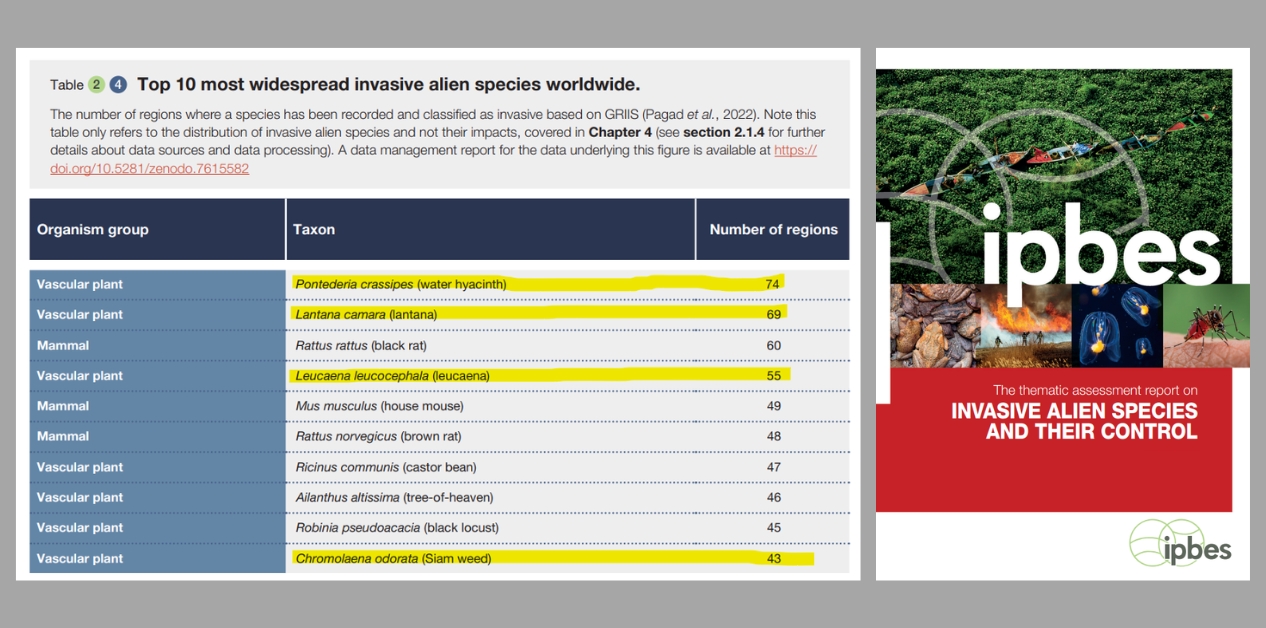
“Much like Kande Banmara, many plant species that were once prioritized globally for decorative and landscaping purposes have now turned into widespread invasive threats,” says Professor Shrestha. Kande Banmara has now successfully invaded nearly 60 countries.
Reshu Bashyal, a conservationist specializing in endangered flora, points out that foreign plants imported for aesthetics are actively harming indigenous ecosystems. She notes, “Exotic plants introduced purely for decoration and aesthetics are systematically outcompeting our native species.”
Six invasive species introduced for decoration
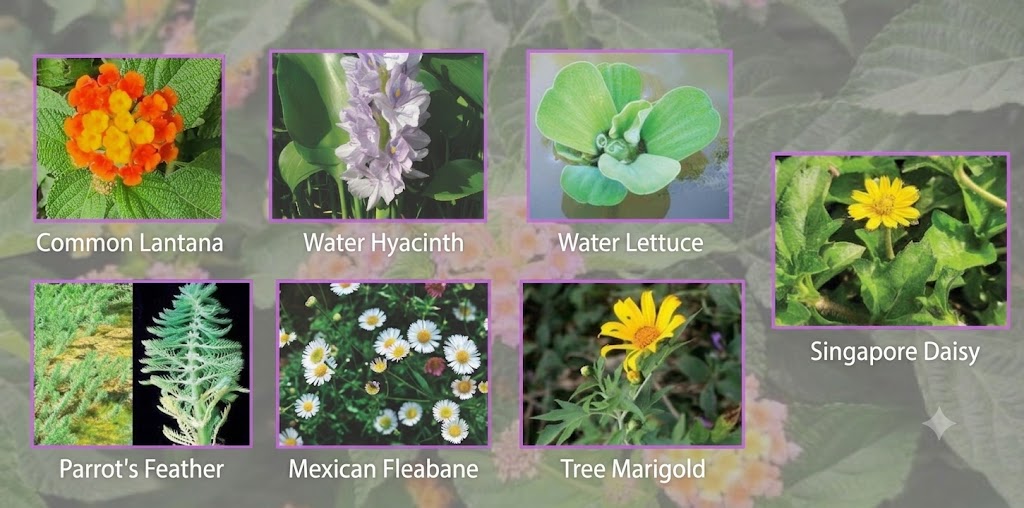
Thirty invasive alien plant species have been identified in Nepal. Among these, six specific species were originally introduced from abroad under the guise of ornamentation. These include Kande Banmara (Lantana), Jalkumbhi (Water Hyacinth), Phule Jhar (Mexican Daisy), Sugapwankhe (Parrot Feather), Kumbhika (Water Cabbage/Lettuce), and Jangali Suryamukhi (Wild Sunflower).
Among these, Kande Banmara, Jalkumbhi, Kumbhika, and Sugapwankhe are native to South America, while Phule Jhar and Jangali Suryamukhi originate from North and Central America. Professor Shrestha explains that these plants, brought into Nepal for decorative purposes, escaped from household pots and aquariums into natural habitats. Over time, these introduced ornamental plants morph into severe invasive threats. Initially planted for their attractive flowers and foliage, they gradually break free from domestic gardens to colonize the wild. Climate change has accelerated this spread, providing these invasive species with highly favorable climatic conditions to adapt and expand rapidly, notes Kalpana Sharma Dhakal, a Scientific Officer at the Department of Plant Resources who studies invasive species.
Jalkumbhi (Water Hyacinth) is a free-floating aquatic weed that grows up to 50 centimeters tall. In nutrient-rich environments, its biomass can double in just two weeks. Propagating via stem fragments and seeds, this weed thrives in lakes, ponds, rivers, and all types of wetlands. Today, Jalkumbhi has emerged as a major ecological crisis for Nepal’s wetlands.
Jalkumbhi is native to South America. Because of its striking appearance and beautiful flowers, it was imported into India around 200 years ago. It is believed that the plant entered Nepal from India for ornamental landscaping. This weed aggressively depletes dissolved oxygen levels in water bodies and accelerates sedimentation rates, effectively drying up vital water sources. Every year, massive amounts of Jalkumbhi are manually pulled out of Phewa Lake and other major wetlands, yet these seasonal cleaning drives remain insufficient to control its growth.
The impacts of other floating aquatic weeds, such as Kumbhika (Water Lettuce) and Sugapwankhe (Parrot Feather), mirror that of the Water Hyacinth. Kumbhika is an invasive plant that invades wetlands and paddy fields. It is a floating weed whose root structure resembles feathers, and it is locally referred to as Pani Banda. Native to South America, it is believed to have entered Nepal to decorate private homes, hotels, and gardens. When it forms dense mats across lakes and canals, it chokes water flow, halts boating activities, and disrupts fishing. Furthermore, its rapid spread across agricultural fields severely diminishes rice crop yields, a phenomenon currently impacting rice farming in the Chhahare region of Nuwakot.
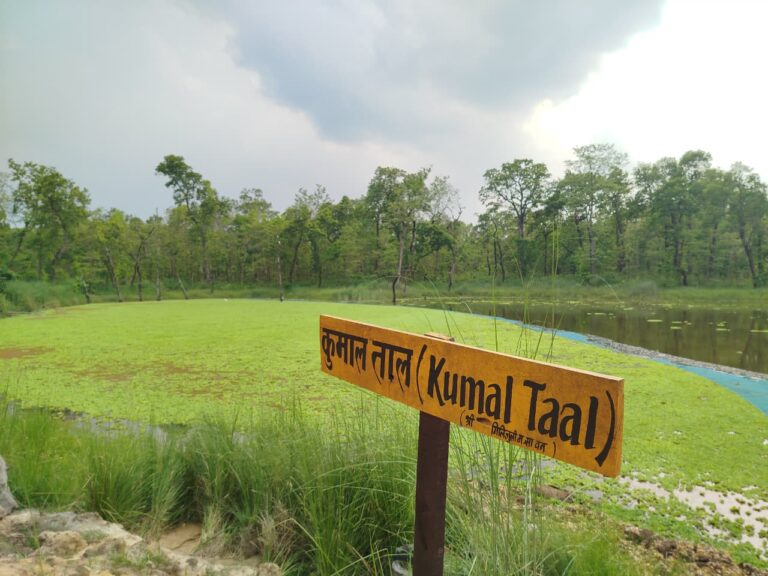
Jalkumbhi (Water Hyacinth). Photo: Bidhya Rai
Sugapwankhe (Parrot Feather) is another highly invasive aquatic weed. Native to South America, it spread internationally as a decorative element for aquariums and ponds. It is believed to have been brought to Nepal exclusively for aquarium decoration. Professor Shrestha suggests that it likely escaped into the wild during routine aquarium water changes. Currently, its distribution is confined to the Kathmandu Valley. “If we do not control it immediately, it could rapidly spread across the rest of the country,” Shrestha warns.
Similarly, Phule Jhar (Mexican Daisy), native to Central and North America, is believed to have spread to other nations for garden cultivation. Its flowers feature white or pink outer petals with a distinct yellow center. Because it forms thick, carpet-like mats on the ground, it gradually displaces adjacent native vegetation. Furthermore, because it readily sprouts within rock crevices, it increases the risk of localized landslides. The plant produces massive quantities of tiny seeds that are easily dispersed over long distances by the wind. Its ability to colonize barren land at an astonishing speed allows it to push out native species. Jangali Suryamukhi (Wild Sunflower), native to Central America, was also introduced to Nepal for aesthetic appeal and has now aggressively colonized the Makalu Barun region.
Singapore Daisy is another plant currently being used for ornamental purposes. Native to South America, it was originally brought to Panchkhal in Kavre for bio-engineering purposes. However, Professor Shrestha notes that it is now actively being used as a decorative plant in Kailali and Makawanpur.
Preparations to expand the official list
Several decorative plants that have not yet been formally listed as invasive species in Nepal—such as Tiktike, Anredera cordifolia, and Solidago canadensis—have already begun inflicting visible damage on agriculture, ecosystems, and local biodiversity. Writing in Himal Khabar on April 1, 2022, botanist Kamal Maden highlighted how the Tiktike weed (Polka Dot Plant), which falls under the Hypoestes genus, has severely disrupted farming in Ilam.
Native to Madagascar in East Africa, the Polka Dot Plant has already spread to at least 17 countries, including southeastern Brazil, Colombia, Costa Rica, Guatemala, India, and Nepal.
According to a study published on September 19, 2024, in the journal National Academy Science Letters, the Polka Dot Plant has already been formally listed as an invasive species in Uttarakhand, India. Professor Shrestha, who has been tracking the species for 15 years, notes that the Polka Dot Plant has heavily invaded the agricultural fields of Nepal’s eastern mid-hills. Despite this, it remains omitted from Nepal’s official list of invasive alien species. “We have traveled to various regions and gathered physical evidence, but due to a lack of systematically compiled data, it has not yet been included in the official register,” he explains. Shrestha and his fellow researchers identify invasive species by reviewing global literature, comparing flora with neighboring countries sharing similar climates, and gathering field-level data.
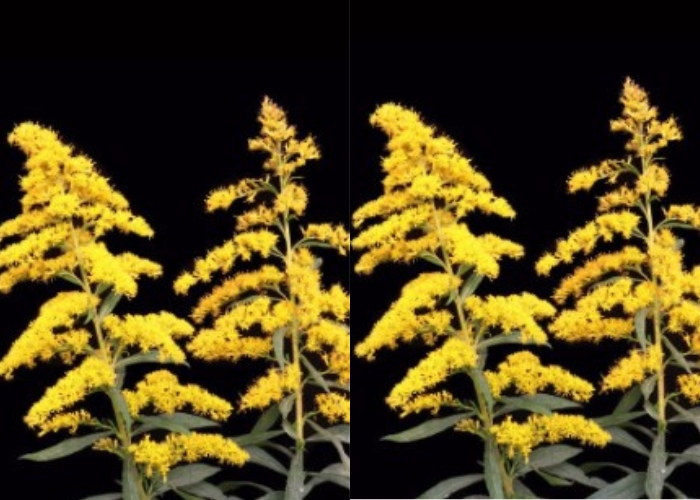
Solidago canadensis (Canadian Goldenrod). Photo: Bharat Shrestha’s Facebook
Similarly, Anredera cordifolia (Madeira vine) and Solidago canadensis (Canadian Goldenrod), which have already achieved notorious invasive status in other countries, have begun popping up across natural habitats in Nepal. Anredera cordifolia originates from South America, while Solidago canadensis is native to North America. Anredera cordifolia has been documented in Kathmandu, Lalitpur, Kavre, and Bardiya. Shrestha even discovered Anredera cordifolia wrapping itself around utility poles along Putalisadak in Kathmandu. Studies by his team reveal that the plant was spotted in Bardiya as early as 1995. “Someone likely bought it to decorate a hotel, and it subsequently escaped from its pot to begin reproducing naturally in the wild,” he says.
Meanwhile, Solidago canadensis has so far only been observed in Kathmandu. Shrestha adds, “It is being widely utilized to assemble floral bouquets and is heavily traded for commercial flower arrangements.”
Sunita Ulak, a Senior Research Officer at the Forest Research and Training Centre, explains that exotic plants introduced strictly for decoration are turning into aggressive weeds because importers fail to recognize their long-term ecological impacts. “Plants brought in for beauty have spread wildly as invasive species,” she notes. As various studies highlight the rise of alien flora, the rate of identifying ornamental invasives is also increasing.
The reign of invasive species
According to a comprehensive study on invasive alien species published by TU’s Central Department of Botany in November/December 2025, more than 225 flowering alien plant species have been recorded in Nepal to date. Among these, 30 species have firmly established themselves as invasive. Out of these 30, six have been identified globally as highly destructive weeds and are thoroughly entrenched in Nepal: Kande Banmara (Lantana camara), Lahare Banmara (Mikania micrantha), Seto Banmara (Chromolaena odorata), Jalkumbhi (Pontederia crassipes), Singapore Daisy (Sphagneticola trilobata), and Ipil Ipil (Leucaena leucocephala). Among these top six threats, Kande Banmara and Jalkumbhi were introduced to Nepal purely as ornamental plants.
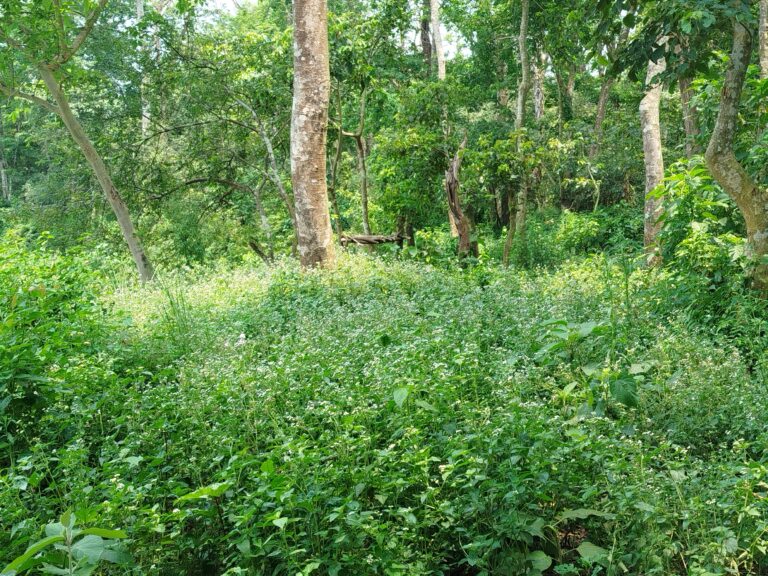
Nilo Gandhe (Blue Billygoat Weed). Photo: Bidhya Rai
Invasive alien species enter the country both intentionally and accidentally. Out of the 30 invasive species identified by the Central Department of Botany, 19 arrived completely by accident. This group includes Lahare Banmara, Seto Banmara, Kalo Banmara, Nilo Gandhe, Jal Jambu, Wan Silam, Pati Jhar, Gandhe, Kande Lunde, Thakal, Kalo Kuro, Chitlage, Karaute Ghas, Lajjamavati, Chari Amilo, Thulo Tapre, Sano Tapre, Alupate, and Bhede Kuro.
These plants typically sneak into the country mixed within soil or agricultural imports, hitchhiking on large transport shipping containers, or via wind, water currents, animals, and migratory birds. The remaining 11 species were intentionally introduced for ornamentation, bio-engineering, or livestock foraging. Species like Ulta Kanda and Besaram were imported specifically for bio-engineering. Meanwhile, the Singapore Daisy, which was initially imported for bio-engineering, is now widely misused as an ornamental plant.
Furthermore, Thangne Jhar and Ipil Ipil were brought into Nepal to serve as livestock fodder. Professor Shrestha claims that because the government continues to actively promote Ipil Ipil as a valuable fodder tree and a tool for bio-engineering, it has deliberately avoided classifying it as an invasive species, despite other nations labeling it a major ecological hazard. Researchers finally included Ipil Ipil in the domestic invasive register in 2024. The plant is currently causing massive ecological disruption in China. Though used as livestock feed, this plant is regenerating rapidly and unchecked across Nepal’s natural forests. Despite being blacklisted by the IUCN as a highly destructive invasive weed, the Government of Nepal has yet to officially list this South American native as an invasive species.
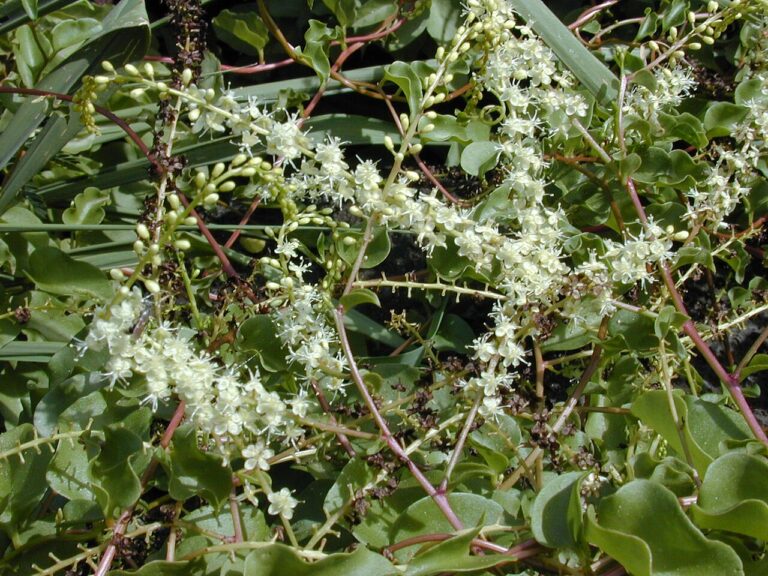
Anredera cordifolia. Photo Source: Wikimedia Commons
Invasive plant species heavily disrupt agriculture, grasslands, wetlands, natural ecosystems, and biodiversity. However, not all 30 invasive species pose an identical level of threat. In Nepal, Lahare Banmara, Ulta Kanda, Seto Banmara, Kande Banmara, and Jalkumbhi are categorized as highly destructive. Meanwhile, Kalo Banmara, Nilo Gandhe, Jal Jambu, Wan Silam, and Pati Jhar are classified as moderately destructive. Professor Shrestha explains, “Invasive species aren’t exclusively composed of negative traits; they can provide about a 10 percent benefit, but they carry a 90 percent disadvantage. Their primary destruction is inflicted upon the environment.”
Kalpana Sharma Dhakal, Scientific Officer at the Department of Plant Resources, defines invasive alien plants as species that are transported via human intervention or other vectors from their native geographic zones into entirely new regions, where they proliferate aggressively and inflict severe damage on native flora, fauna, and local ecosystems. She notes, “Native plants require highly specific climatic conditions, spatial territory, and sunlight to mature. Invasive plants, however, can sprout, survive, and dominate in almost any environment, spreading exponentially in open spaces with higher temperatures.”
Invasive plants exhibit vastly superior germination rates compared to native flora, their seeds retain viability for prolonged periods, they possess hyper-aggressive reproductive and dispersal capabilities, and they grow at an accelerated pace.
The uninhibited global movement of goods and flora, cross-border tourism, and climate change are driving up the number of invasive alien species worldwide. Rapid human migration in recent years has further accelerated this spread. Because these plants are highly resilient and can withstand extreme weather and harsh environments, they are incredibly difficult to eradicate through routine grazing or basic physical weeding, resulting in the systematic displacement of indigenous species. This creates a severe domino effect on native ecosystems. Scientific Officer Dhakal highlights, “Multiple scientific studies have firmly established that the spread of invasive alien species stands as the second leading driver of global biodiversity loss.”
When exotic plants settle into non-native countries, they compromise agricultural productivity, rangelands, wetlands, forests, and overall ecological balance. By degrading soil quality and breaking the balance of vital soil nutrients, they trigger sharp drops in crop yields, accelerating food insecurity. This directly compromises human survival, livestock health, and rural livelihoods. It is estimated that out of all the species that have gone extinct globally over the past 500 years, roughly 50 percent were wiped out due to the pressures exerted by invasive alien species.
Legal commitments exist, but implementation remains weak
The Intergovernmental Science-Policy Platform on Biodiversity and Ecosystem Services (IPBES) projects that the global influx and impact of invasive alien species are rising exponentially and will continue to worsen. The forum emphasizes that the negative consequences can only be mitigated through aggressive, coordinated management of these species.
Target 6 of the 23 global biodiversity targets established under the Kunming-Montreal Global Biodiversity Framework to be achieved by 2030 explicitly mandates reducing the introduction of known invasive alien species by at least 50 percent and significantly mitigating their negative impacts. Aligning with this international mandate, the Government of Nepal finally endorsed the Invasive Alien Species Management Strategy and Action Plan in March/April 2025 AD (Chaitra 2081 BS)—a policy document that had languished in bureaucratic pipelines for 15 years. Despite this breakthrough, Sunita Ulak, Senior Research Officer at the Forest Research and Training Centre, admits that new records of unlisted invasive weeds continue to emerge in Nepal every year.
To cultivate widespread public awareness regarding this biological threat, the First National Conference on Invasive Alien Species Management was organized in Kathmandu on December 12 and 13, 2025. The landmark convention concluded with the issuance of an 18-point declaration, which prominently included strict mandates to conduct thorough risk assessments at border import quarantines before permitting the entry of any exotic ornamental plants capable of turning invasive.
In ideal quarantine protocols, all plants imported from foreign countries must undergo a rigorous risk evaluation. Flora brought via air or land routes are held at specialized quarantine facilities for screening, and any plant displaying an invasive risk profile is strictly denied entry. Customs clearance is granted only after a plant successfully passes quarantine. This entire regulatory loop is overseen by the Plant Quarantine and Pesticide Management Centre, operating under the Ministry of Agriculture, Land Management, and Cooperatives (and relevant forestry wings).
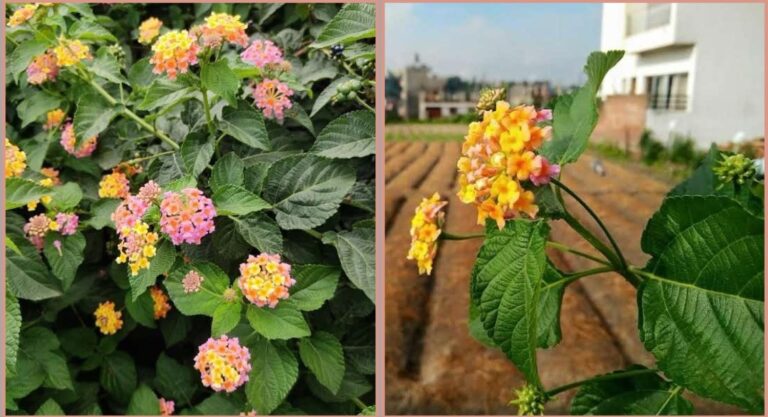
A kind of thorny plant in the Godawari Region locally known as Kande Banakara. Photo: Jivan Karki
The Centre operates quarantine checkpoints across several major border gateways, including Tribhuvan International Airport in Kathmandu, Kakarbhitta in Jhapa, Biratnagar in Morang, Bhantabari in Sunsari, Jaleshwor in Mahottari, Malangwa in Sarlahi, Birgunj in Parsa, Tatopani in Sindhupalchok, Timure in Rasuwa, Bhairahawa in Rupandehi, Krishnanagar in Kapilvastu, Nepalgunj in Banke, Lo Manthang in Mustang, Jhulaghat in Baitadi, and Gaddachauki in Kanchanpur.
However, Professor Shrestha underscores that because these quarantine inspections are irregular and ineffective, the volume of invasive species entering the country keeps compounding. “If the government simply enforced international risk assessment protocols, these invasive species would never have managed to spread so extensively,” he asserts. “In the United States, biosafety quarantines are placed under the strict jurisdiction of the Department of Homeland Security due to national security implications. In Nepal, it is tucked away under the ministries of agriculture, forests, and environment. The level of strictness required to execute this job effectively is entirely absent.”
Bhoj Raj Sapkota, Chief of the Plant Quarantine and Pesticide Management Center, counters by stating that his office conducts risk assessments and filters incoming exotic flora to the absolute limit of their available resources and manpower. “Nepal imports roughly 8,000 different categories of goods annually. For plants destined directly for soil cultivation, we only issue entry permits after verifying all phytosanitary certification processes,” he explains. He acknowledges, however, that Nepal’s open border with India presents a massive enforcement challenge. “Items hidden inside large containers, smuggled across, or brought in through unauthorized routes routinely bypass screening. Therefore, not every single biological product entering Nepal passes through our quarantine net. To make this truly airtight, we require the active cooperation of all stakeholders,” Sapkota says.
When invasive weeds are spotted in their initial stages of colonization, they can be easily eradicated to prevent a wider outbreak. However, Professor Shrestha notes that neglecting them during the early stages creates an unmanageable crisis once they spread over a large area. For instance, Pati Jhar (Parthenium weed), which was first spotted in its preliminary colonization phase inside Chitwan National Park in 2013 AD, has now formed thick, impenetrable blankets across the sanctuary.
“Even though we explicitly warned authorities at the time that this plant must not be allowed to spread, nobody showed any interest. Today, it has completely taken over major grasslands, triggering severe food shortages for wild herbivores,” he says.
Senior Research Officer Ulak maintains that the government is actively trying to curb the spread of invasive weeds. She notes that divisional and provincial forest offices continuously incorporate invasive weed removal into their annual forest management routines, though she concedes these measures are far from adequate. She shares that the Ministry of Forests and Environment is currently collaborating with the United Nations to launch a dedicated, large-scale invasive species management project.
Sabnam Pathak, Information Officer at the Department of Forests and Soil Conservation, points out that the management of invasive flora is crippled by a stark shortage of budget allocations and targeted programs. She adds that in certain districts, local communities have taken to harvesting specific invasive plants to use as livestock fodder, which has inadvertently aided containment efforts.
The government itself promoting invasive species
While Jalkumbhi (Water Hyacinth) is recognized globally as an ecological catastrophe, Nepal presents instances where the government itself has actively promoted its cultivation. There are documented events where the state orchestrated formal planting programs, effectively protecting and dispersing this hazardous weed. Under the premise that Water Hyacinths are ideal for natural water purification, the Bagmati Provincial Government launched an official program to plant Jalkumbhi at Deepjyoti Tole in Ward 7 of Bharatpur Metropolitan City during the Fiscal year 2018/19. Conducted under the banner of promoting urban sanitation and green beautification, the program actively incentivized local residents to plant Jalkumbhi inside small, domestic household ponds. The greening initiative was formally inaugurated by the then Provincial Chief Minister, Dormani Paudel.
Professor Shrestha expresses deep frustration over such state-sponsored actions, noting that they actively accelerate biological crises. “In Bharatpur’s immediate vicinity lies Beeshazar Lake, a world-renowned Ramsar tourist site that is being systematically choked by Jalkumbhi. The government spends massive sums of taxpayer money every year to manually clear that lake, as the weed inflicts devastating damage on the wetland. Yet, in a bizarre contradiction, the government simultaneously turns around and instructs urban locals to cultivate the exact same weed in their backyards,” Shrestha points out.
Furthermore, he highlights that due to a profound lack of ecological awareness, commercial nurseries continue to distribute Kande Banmara and Jalkumbhi to the public entirely free of charge. Handing out these hazardous plants for free only amplifies their destructive trajectory, he warns. “On one hand, the IUCN has blacklisted these as some of the most dangerous invasive weeds on the planet. On the other hand, commercial plant nurseries are handing them out for free, ensuring that their destructive footprint will continue to expand across Nepal.”