Kathmandu
Wednesday, June 17, 2026





As legal battles unfold, the film industry grapples with financial risk, social backlash, and the growing fear of creative restraint, even after the film cleared the Censor Board
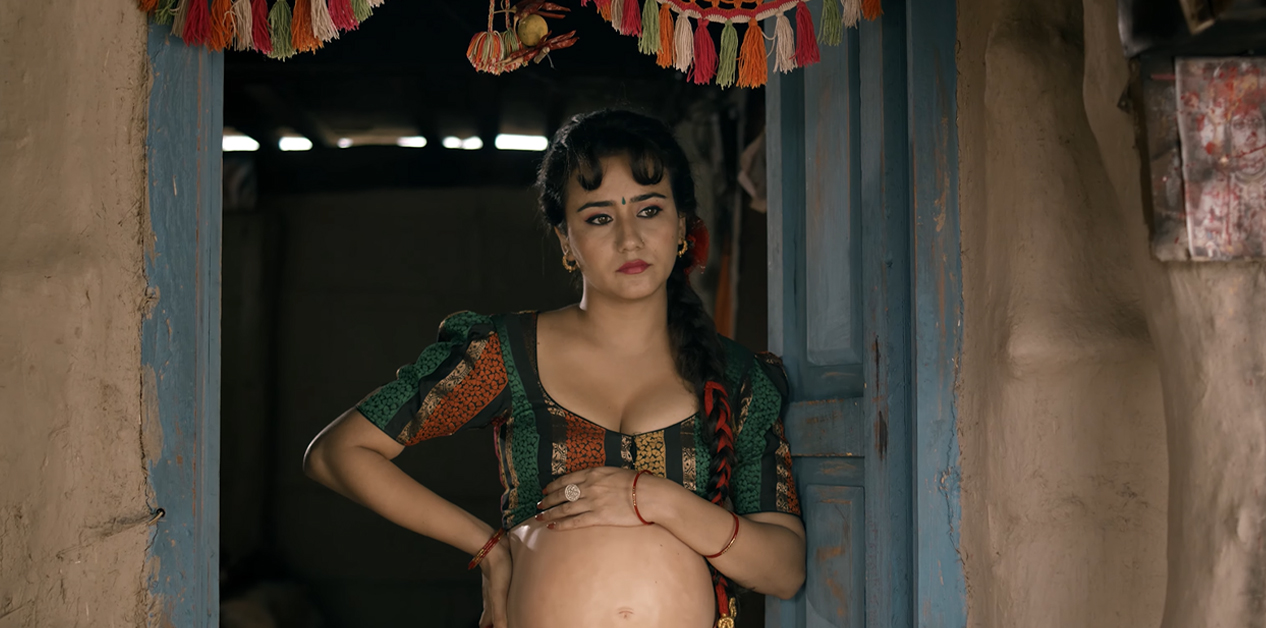
KATHMANDU: On the eve of its scheduled release, the movie Lalibazar was abruptly halted after the Patan High Court issued a stay order, thrusting the debate over creative freedom and its limits back into public focus. In response, filmmakers and writers gathered at Maitighar Mandala in Kathmandu on Wednesday, carrying placards that read, “Let Cinema and Literature Speak, Let Our Stories Out,” in protest against the court’s intervention.
The legal challenge was initiated by Roshani Nepali, who filed a petition at the Patan High Court on Tuesday, arguing that the film undermines the self-respect of the Badi community. Acting on the writ petition, the court issued a short-term interim order to immediately suspend the film’s screening. A follow-up hearing has been scheduled for the coming Monday.
The court’s decision has reignited a broader and long-standing debate in the country about the scope, practice, and limits of freedom of expression. It raises pressing questions about how creative freedom intersects with social responsibility and legal accountability. Yet, amid these ideological and legal arguments, one critical dimension often receives less attention: the substantial financial, psychological, and professional risks borne by film producers.
The producer’s risk
The timing of the court’s interim order, arriving just before release, has placed tens of millions of rupees of the producer’s investment in jeopardy. In Nepal today, producing a commercial film typically costs between Rs 20 million and Rs 30 million, and depending on the scale, talent, and technical ambition, budgets can climb to Rs 50 million or higher.
However, the financial risk of filmmaking does not end with the completion of shooting. In reality, it intensifies as the film enters its exhibition phase. It is at this stage that a producer either recovers their investment, earns a profit, or suffers losses. As the release date approaches, additional millions are poured into marketing efforts, including trailers, posters, digital campaigns, media promotions, premiere events, theater bookings, and distribution logistics. These costs are sunk expenses and cannot be recovered once spent.
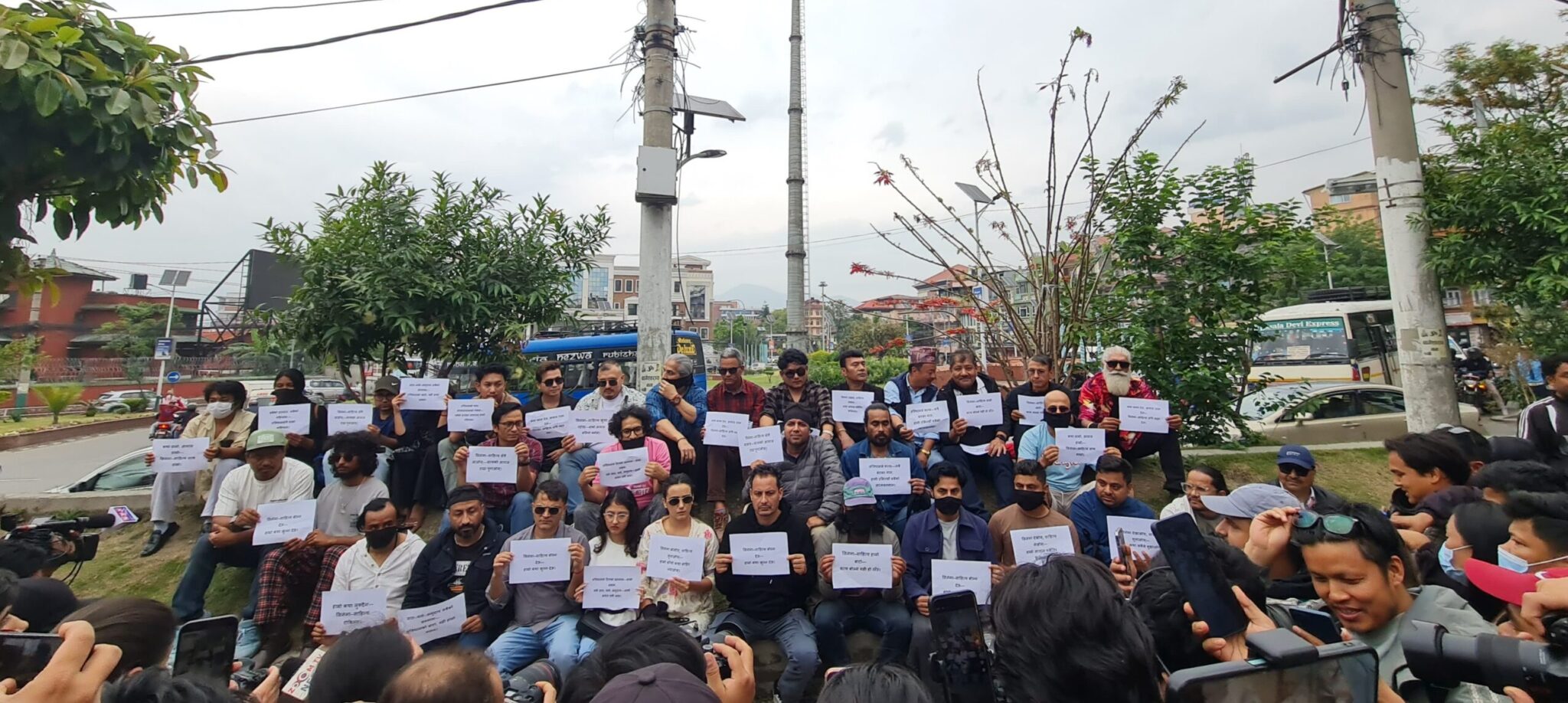
Demonstration held by the film fraternity at Maitighar after the screening of Lalibazar was halted. Photo: Bikram Rai/Nepal News
When a film like Lalibazar is halted at the final hour, the damage extends far beyond lost ticket sales. The investment in promotion, as well as the anticipation built among audiences, collapses instantly. While immediate financial losses can be calculated, the long-term consequences, including diminished trust and reduced future investment, are far harder to quantify.
In Nepal’s constrained film market, marked by limited audiences, challenging geography, and modest income levels, recovering production costs is already a formidable task. The country lacks sufficient cinema halls, and domestic films must compete aggressively with foreign releases for screen space. Under such conditions, theatrical release remains the primary and often only viable avenue for revenue.
In contrast, international markets offer multiple fallback options. Producers can offset risks by selling music rights, OTT streaming rights, and television satellite rights, ensuring partial recovery even if theatrical performance falters. In Nepal, however, such alternatives remain limited, with digital rights offering the only secondary revenue stream.
Consequently, when a film fails to release as scheduled, its promotional momentum stalls, audience interest wanes, and market energy dissipates. Over time, repeated setbacks of this nature can discourage producers, potentially driving them away from the industry altogether. At present, Lalibazar finds itself caught in precisely such a predicament. Ideally, disputes of this nature would be resolved before reaching this critical stage. Now that the matter is before the court, however, the industry has little choice but to wait.
Trauma porn and the creator’s social responsibility
While the producer’s losses warrant full sympathy, the controversy also underscores the need for a deeper examination of a creator’s social responsibility. Across the world, the question of who tells whose story, and under what conditions, has grown increasingly sensitive, particularly when it involves historically marginalized communities.
Central to this discussion is the concept of ‘trauma porn.’ This term refers to the tendency to amplify a community’s suffering, trauma, and hardship primarily for emotional impact and commercial gain. Such portrayals often prioritize audience engagement over genuine empathy or justice, raising ethical concerns about representation.
A significant milestone came after a 48-day protest beginning on August 16, 2007, when the community successfully campaigned to ban derogatory terms such as Bhand, Badeni, Patar, Randi, and Veshya, vulgar words historically used to demean women of the Badi community.
Scholarly accounts suggest that the Badi community historically played important cultural roles, performing music and dance during festivals and auspicious occasions. Members of the community were also skilled in crafting musical instruments, fishing, and various forms of handicraft. Living largely nomadic lives along riverbanks, however, many unmarried women from the community were subjected to systemic exploitation by ruling elites, which over time led to their stigmatization as sex workers.
In recent decades, the Badi community has actively worked to shed this imposed identity. A significant milestone came after a 48-day protest beginning on August 16, 2007, when the community successfully campaigned to ban derogatory terms such as Bhand, Badeni, Patar, Randi, and Veshya, vulgar words historically used to demean women of the Badi community.
It is against this backdrop that objections to Lalibazar have emerged. Community members argue that the film revisits and reinforces the very stigma they have long struggled to overcome. Roshani Nepali, who filed the case, has repeatedly stated in press briefings that the film harms the dignity of her community. Among her allegations is the claim that the film exposes the private lives of Badi individuals and presents their history in a way that is both insensitive and damaging.
According to her, the community seeks to move beyond its painful past and align itself with contemporary social and economic aspirations. By revisiting that past without sensitivity, she argues, the film risks undermining social harmony and reinforcing harmful stereotypes at a time when the community is striving for dignity and progress.
Freedom of expression, censorship, and the court
Freedom of expression is widely regarded as the lifeblood of democracy, and Nepal’s political history is deeply rooted in struggles against autocratic rule to secure this very right. Yet, in Nepal’s context, this freedom has never been absolute. It operates within the framework of social responsibility, requiring a careful balance between creative liberty and collective sensitivity.
This principle safeguards a creator’s right to make films, including works like Lalibazar. At the same time, it places an equally serious obligation on creators to understand the communities they portray and to approach representation with nuance and care. This responsibility becomes even more critical when the community in question is actively trying to reshape its identity and move beyond a painful chapter of its past.
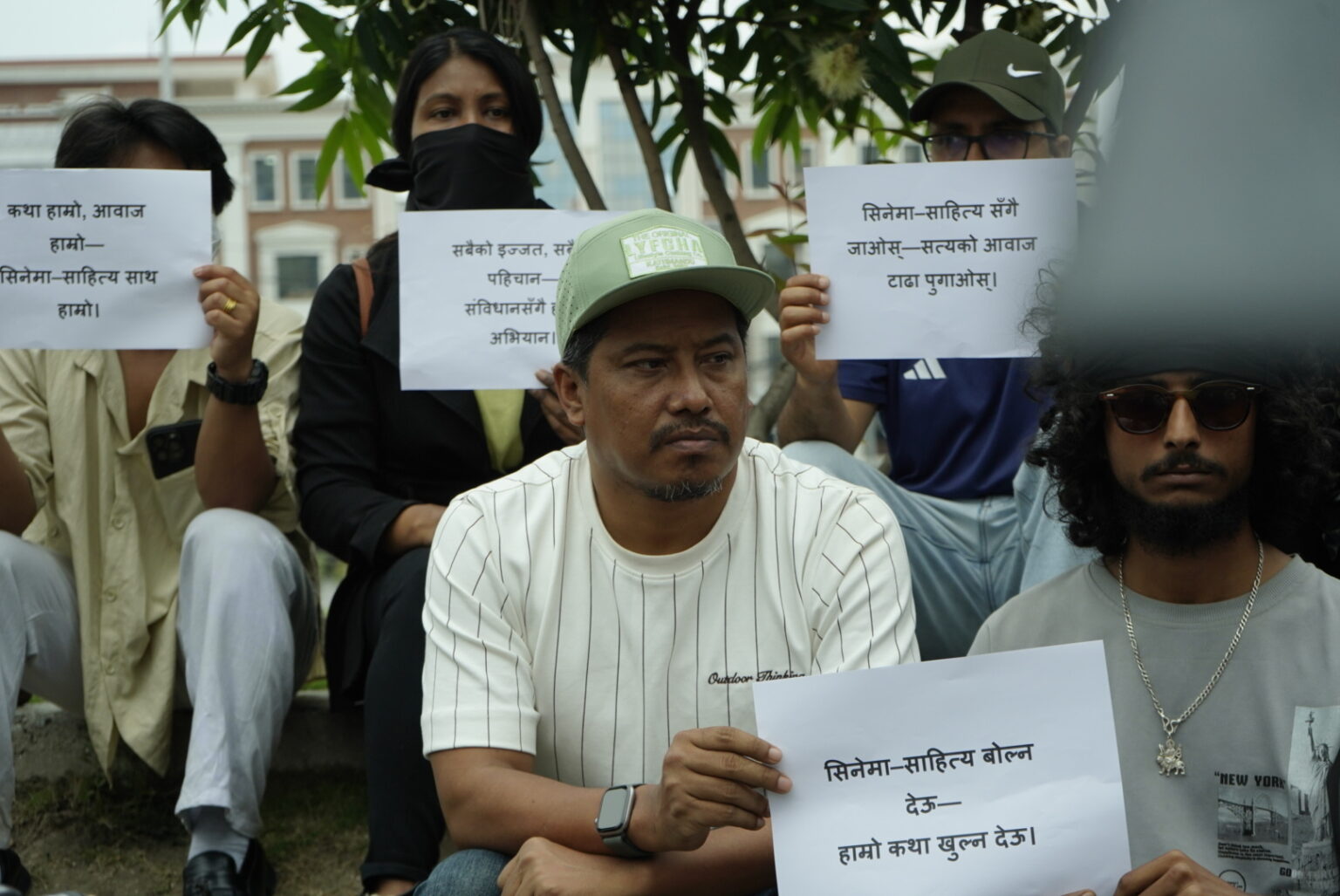
Demonstration held by the film fraternity at Maitighar after the screening of Lalibazar was halted. Photo: Bikram Rai/Nepal News
In the case of Lalibazar, the absence of a public screening makes it difficult to conclusively assess the extent of harm alleged by the Badi community. However, its promotional materials suggest an attempt to revisit a history that the community itself has been striving to leave behind.
Ideally, concerns of this nature should have prompted sustained dialogue between the filmmakers and representatives of the community to arrive at a mutually acceptable resolution. Instead, the matter moved swiftly to the courts, effectively freezing broader public debate and negotiation. Filmmakers are less concerned about a single court order than about the precedent it may set, fearing it could normalize similar legal challenges in the future.
The fear is not unfounded. If every community begins to challenge films in court over perceived misrepresentation, creators may increasingly retreat into self-censorship. In such an environment, meaningful and socially relevant storytelling risks being sidelined in favor of safer, commercially driven content. Over time, this could entrench cultural stagnation, limiting both artistic innovation and critical discourse. If creators, who are expected to push boundaries and provoke thought, are constrained in this way, the very essence of art stands to erode.
The controversy surrounding Lalibazar has also raised questions about the role and effectiveness of Nepal’s censorship mechanism. The film had already cleared the formal censorship process and was preparing for release when the court order intervened. Some within the film industry have criticized this as evidence of institutional failure, with calls to reassess the authority and function of the Censor Board.
Filmmakers are less concerned about a single court order than about the precedent it may set, fearing it could normalize similar legal challenges in the future.
However, such criticism often overlooks a fundamental distinction. The Censor Board and the judiciary operate as separate entities with different mandates. The court serves as the ultimate avenue for justice, and any individual or community dissatisfied with administrative decisions retains the constitutional right to seek legal remedy.
It is therefore a misconception that a film, once cleared by the censor board, is immune from further challenge. Nepali law allows authorities, including the District Administration Office, to halt the screening of a film even after its release if it is deemed harmful to public interest or social harmony.
In this context, while the Censor Board may have approved Lalibazar without fully accounting for the perspective of the Badi community, the community’s right to contest that decision through legal channels remains firmly protected. The current case is a direct reflection of that legal and democratic process in action.
A history of friction
Tensions between creative expression and authority, whether from the state or from communities themselves, are not new in Nepal’s cultural landscape. Musicians, writers, and filmmakers have repeatedly found themselves at the center of such conflicts. Rapper VTEN was once detained overnight for his lyrics, while singer Prakash Saput faced intense backlash over his song Pir. He was ultimately compelled to edit its video after objections from Maoists, who argued that it portrayed women who participated in the People’s War as being pushed into sex work.
Cinema, too, has a long record of clashes with censorship and public dissent. Yet, the Badi community’s grievances with literature and film predate Lalibazar. In 2018, members of the community, including Mina Nepali, Keshav Badi, Gopal Badi, Ranjita Nepali, and Nirmal Badi, filed a collective lawsuit against three works: Saraswati Pratikshya’s novel Nathiya, Bibek Ojha’s Alani, and the film Pandit Bajeko Lauri, directed by Dipak Oli.
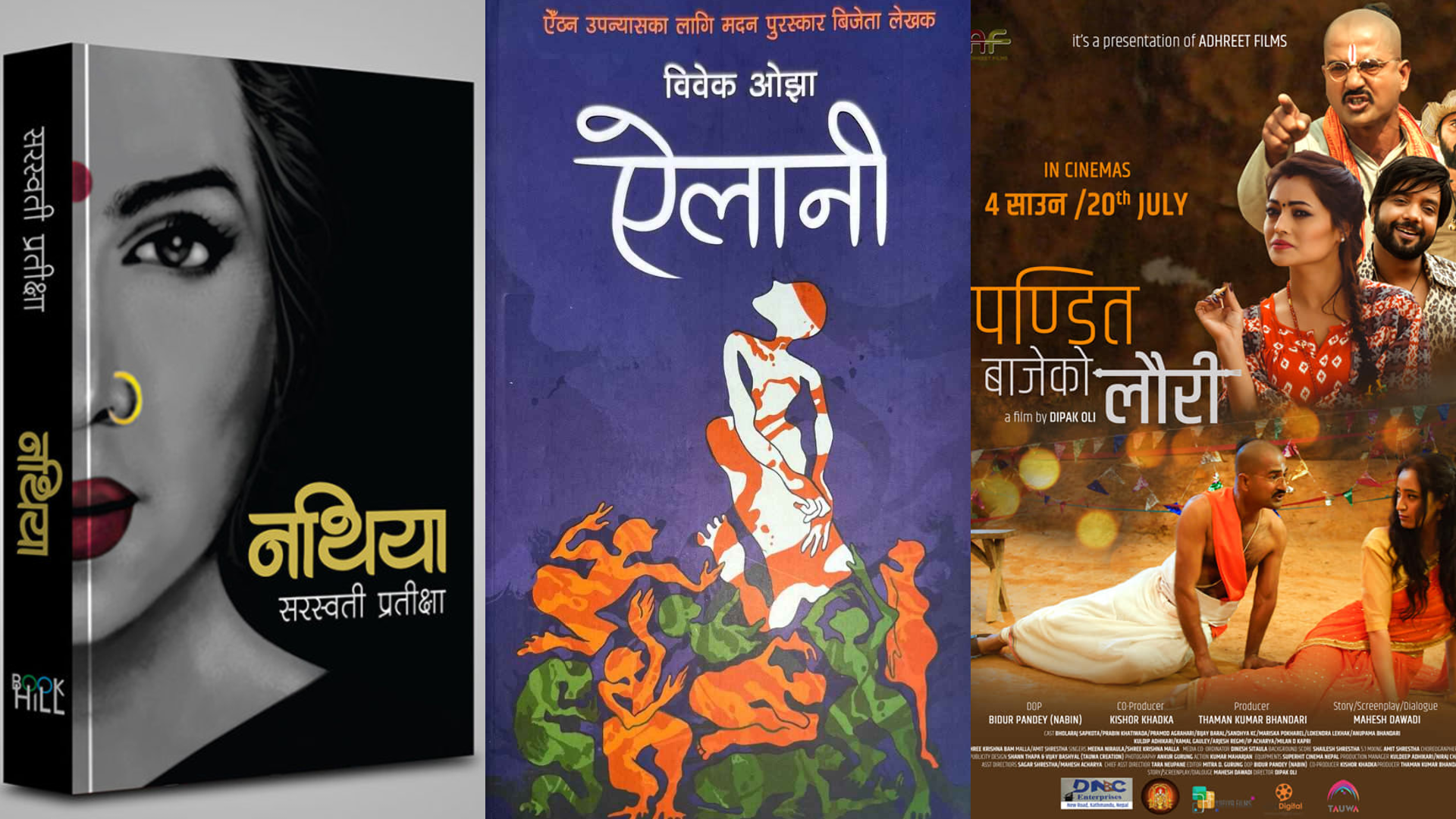
A photo collage of Saraswati Pratikshya’s novel Nathiya (left), Bibek Ojha’s Alani (center) and film Pandit Bajeko Lauri (right)
The objections were both symbolic and substantive. The community challenged even the title ‘Nathiya,’ arguing that the term was not used within their culture, where ‘Nathuni’ (nose ring) is the correct expression. Beyond terminology, they took issue with the novel’s characterization and language. One particularly contentious scene depicted a father removing his daughter’s Nathuni, which the community argued was not only inaccurate but deeply offensive. They maintained that such portrayals distorted their identity and perpetuated harmful stereotypes.
Similar concerns were raised about Ailani, which was accused of likening Badi women to Ailani or public land, implying accessibility and exploitation. In Pandit Bajeko Lauri, critics objected to the depiction of a man seeking clients for his own wife, arguing that it reduced men of the community to morally degraded figures.
In response, the Badi community organized phased protests against all three works. They appealed to institutions including the Film Development Board, the Ministry of Information and Communication, and the Human Rights Commission, demanding a halt to publication and screening. While the Human Rights Commission acknowledged their concerns and urged sensitivity, the absence of concrete action led the community to seek judicial intervention.
In 2019, the Supreme Court delivered a consolidated verdict on the cases, issuing a directive order to the government. The ruling emphasized that creative works must take into account the dignity and self-respect of communities.
In point 36(b) of the order, the joint bench of Justices Ishwar Prasad Khatiwada and Bam Kumar Shrestha stated:
“Perform an effective regulatory role within the framework of the Constitution of Nepal and prevailing laws to control the exhibition of films containing words or images that harm the dignity, honor, reputation, or self-respect of any caste, religion, region, or community, including the Badi, or that incite hatred, malice, or social discord.”
Similarly, point 35 expressed the court’s expectation that authors and publishers would exercise due sensitivity in future editions and creative works, ensuring that the sentiments of concerned communities are not harmed.
Both sides interpreted the ruling as a partial victory. According to producer Thaman Kumar Bhandari, Pandit Bajeko Lauri was withdrawn from theaters within a week of its release following the legal challenge. However, since the court did not impose an outright ban, the film was later released on YouTube after certain edits and revisions.
The larger question
The renewed legal challenge against Lalibazar has once again polarized opinion. For some, it represents a necessary assertion of dignity by a historically marginalized community. For others, it signals a troubling constraint on freedom of expression, raising concerns that the space for storytelling may be gradually narrowing.

Demonstration held by the film fraternity at Maitighar after the screening of Lalibazar was halted. Photo: Bikram Rai/Nepal News
The Badi community, long subjected to social exclusion and systemic exploitation, continues to seek distance from a painful and stigmatized past. Like any community, it carries a history, but not every past is one that people wish to revisit or publicly relive.
History, in its simplest form, is a record of events, dates, and facts, often stripped of emotional depth. Cinema and literature, by contrast, animate history, transforming it into lived experience through narrative, emotion, and imagery. This creative transformation, however, raises an essential question: who has the right to tell these stories, and for whom are they being told?
As this debate unfolds, one question becomes increasingly difficult to ignore. If a community consistently resists being portrayed through a particular lens and refuses to engage as the audience of that narrative, then whose story is ultimately being told, and to what end?
(The author is the president of the Film Critics Society of Nepal)