Kathmandu
Wednesday, June 17, 2026





Figures from film, music, and social media are attempting to convert their public popularity into political influence
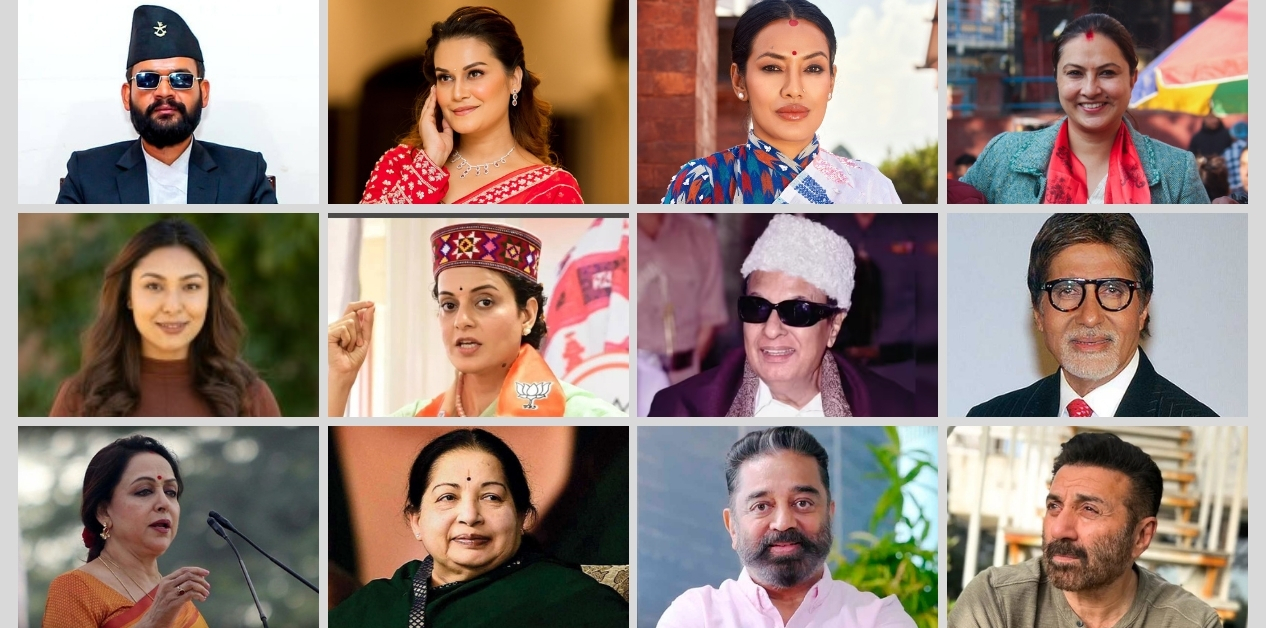
KATHMANDU: Released in 2017, Toilet: Ek Prem Katha portrays the widespread problem of open defecation in India while emphasizing the importance of household sanitation. The film was widely praised for raising a critical social issue, though it also faced criticism as a ‘propaganda’ vehicle promoting the Swachh Bharat campaign launched by Prime Minister Narendra Modi.
That criticism was not entirely baseless. Government involvement was evident in several developments surrounding the film, from the Uttar Pradesh government declaring it tax-free to appointing Akshay Kumar as the cleanliness ambassador of Uttar Pradesh. After the trailer was released, Indian PM Narendra Modi himself wrote, “A good effort to further the message of cleanliness. 1.25 billion Indians must continue the work of building a clean India together.”
In response, Akshay Kumar thanked the prime minister and expressed hope that the film would help bring real change to society. In 2019, when Kumar conducted an informal interview with Modi, the ‘Modi-bhakt’ label often attached to him appeared further reinforced.
During Modi’s tenure, dozens of films have been produced that critics say support government narratives. A notable example occurred in 2019, when the Election Commission of India barred the release of the biographical film of Indian PM Narendra Modi shortly before the elections. The incident illustrated how political narratives and cinematic storytelling often move in parallel.
A significant section of Indian society carries a lingering sense of historical subjugation under Islamic empires and British colonial rule. Many among them regard India as the sacred land of Hinduism. This historical consciousness, combined with the rise of Hindutva ideology, has been linked by critics to growing incidents of hostility and violence against minorities.
Such sentiments have also contributed to an increase in films that emphasize religious and historical pride while presenting a one-sided interpretation of history and society. At the same time, critics argue that the number of films promoting anti-minority narratives has grown. Movies such as Uri: The Surgical Strike, The Kerala Story, The Kashmir Files, Emergency, and Chhaava are often cited in this context.
In India, politics has not only become a subject for cinema; it often appears that a substantial part of the film industry has become intertwined with politics.
Actors and celebrities command enormous popularity among the public, making them attractive allies for political parties. When well-known faces appear in election campaigns, they easily capture public attention. For this reason, many political parties field actors as candidates or enlist them as prominent campaigners during elections.
This relationship between cinema and politics has a long history.
Prithviraj Kapoor is widely considered the first Bollywood star to enter the Rajya Sabha, the upper house of India’s Parliament, as a nominated member in the 1960s. Actor Dev Anand also formed a political outfit called the National Party, though he ultimately did not contest elections.
The political debut of superstar Amitabh Bachchan created a sensation when he contested the 1984 Lok Sabha, also known as the House of the People, is the lower house of the bicameral Parliament of India, election as a candidate of the Indian National Congress. He defeated former Uttar Pradesh Chief Minister Hemvati Nandan Bahuguna by a commanding 68.2 percent margin. Despite this historic victory, Bachchan stepped away from politics after just three years, describing it as an extremely demanding profession.
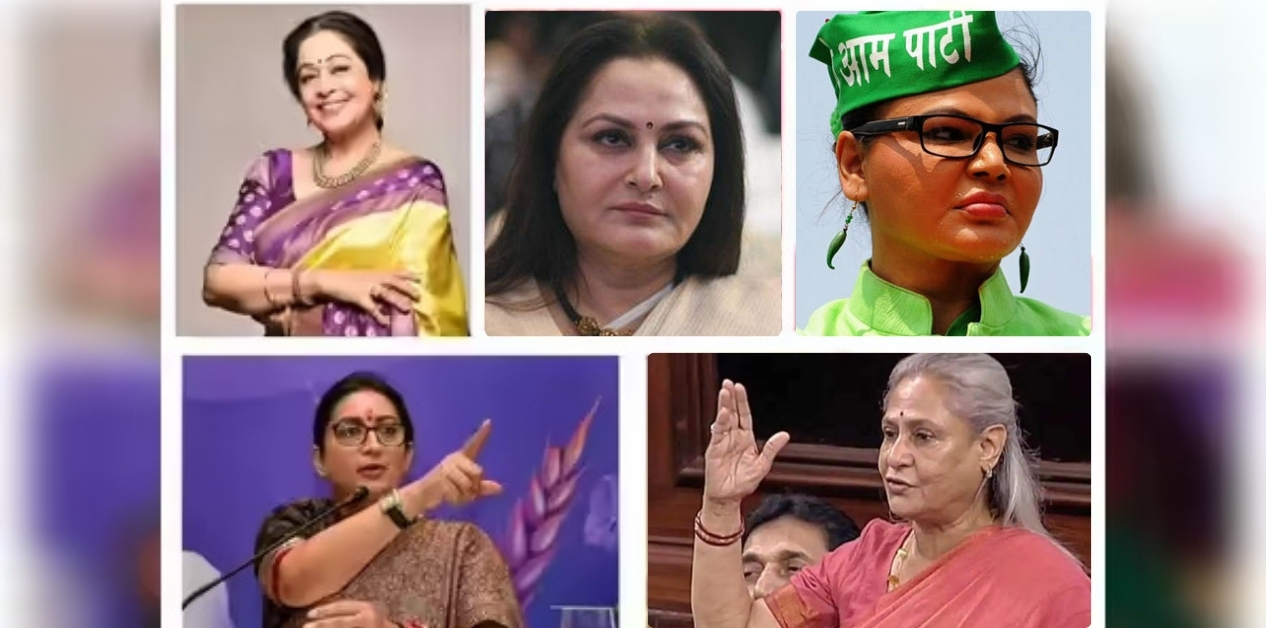
From top left respectively: Kirron Kher, Jaya Prada, Rakhi Sawant, Smriti Irani, and Jaya Bachchan
The list of Bollywood actors who have attempted to leverage their popularity for political influence is long. Prominent figures include Sunil Dutt, Rajesh Khanna, Raj Babbar, Shatrughan Sinha, Hema Malini, Dharmendra, Vinod Khanna, Jaya Prada, Govinda, Rekha, Javed Akhtar, Jaya Bachchan, Kangana Ranaut, Smriti Irani, Paresh Rawal, Sunny Deol, and Kirron Kher.
The relationship between cinema and politics appears even stronger in South India than in Bollywood. The heroic on-screen personas created by actors often translated into political success.
Tamil actor M. G. Ramachandran (MGR) became the first Indian film star to rise to the position of Chief Minister. He founded the All India Anna Dravida Munnetra Kazhagam (AIADMK) in 1972, a party that remains one of the major political forces in India today. Through his films, MGR consistently portrayed a hero fighting for the poor and the oppressed, shaping a powerful public image.
A similar trajectory can be seen in Tamil actress J. Jayalalithaa, who joined the AIADMK in 1982 and assumed leadership of the party after MGR’s death. She served as Chief Minister of Tamil Nadu six times, earning the affectionate title “Amma” (Mother) among supporters.
Another notable example is N. T. Rama Rao (NTR), a star of the Telugu film industry who founded the Telugu Desam Party and went on to become Chief Minister of Andhra Pradesh.
Other film personalities who entered politics include Vijayakanth, Vijayashanti, Nagma, Chiranjeevi, Kamal Haasan, and Nandamuri Balakrishna. Meanwhile, another Tamil superstar, Rajinikanth, despite expressing interest in active politics, did not ultimately achieve political success.
Compared with Bollywood, film actors in South India have generally enjoyed greater political success. M. Madhava Prasad, who examined the political role of film stars in South India in his book Cine-Politics, argues that the reorganization of states along linguistic lines and the rise of regional political movements have played crucial roles in shaping political life in the region. According to him, “This has been most effectively expressed by the parties founded by film stars.”
Other film personalities who entered politics include Vijayakanth, Vijayashanti, Nagma, Chiranjeevi, Kamal Haasan, and Nandamuri Balakrishna. Meanwhile, another Tamil superstar, Rajinikanth, despite expressing interest in active politics, did not ultimately achieve political success.
Despite such successes, many actors have experienced only partial or limited political achievements. Kamal Haasan is often cited as an example demonstrating that cinematic fame and a large fan base alone do not guarantee electoral success. He founded the political party Makkal Needhi Maiam in 2018, yet the party failed to win any seats in its first Tamil Nadu Assembly election.
In India, celebrities not only contest elections but also play active roles in making election campaigns more engaging and visually appealing. Athletes and social media influencers have also become increasingly visible in these campaigns.
Because artists enjoy widespread popularity, it is natural for political parties to attempt to bring them into their fold. At the same time, many celebrities themselves see politics as a pathway to expand their influence and public profile. However, political involvement can also carry risks, as failures in politics may negatively affect their careers.
Kangana Ranaut offers one such example. Although she won an election as a candidate of the Bharatiya Janata Party, her public image has become increasingly controversial since entering active politics.
The growing presence and sustained participation of celebrity politicians have sparked extensive debate about what this trend means for India’s democratic politics and governance.
In the case of Bollywood, the presence of celebrity politicians remains limited, with only a few notable exceptions. A 2024 survey by IndiaSpend, a nonprofit organization based in Mumbai, India, found that the attendance rate of celebrity Members of Parliament from acting and sports backgrounds is significantly lower than the national average.
The survey, which evaluated the term of the Lok Sabha (2019-2024), reported an average attendance of only 68 percent for celebrity MPs, compared with a national average of 79 percent. Their participation in parliamentary debates was even lower. While the national average stands at 56 percent, the participation rate among celebrity MPs was just 20 percent.
Kangana Ranaut offers one such example. Although she won an election as a candidate of the Bharatiya Janata Party, her public image has become increasingly controversial since entering active politics.
Their involvement in parliamentary activities, from raising questions to introducing bills, was also notably limited. Among those with particularly low attendance were actor Sunny Deol, actress Hema Malini, actress Kirron Kher, and singer Hans Raj Hans.
The ‘public identity’ built through professions such as acting, music, or sports is a defining characteristic of celebrities. This identity is shaped through continuous interaction between the public and the media. In the age of social media, almost anyone can become a celebrity. Through both direct and virtual platforms, such figures can influence the opinions of large audiences and, at times, even affect political outcomes.
However, while star power can help draw crowds, secure party nominations, or win public attention, it is not a guaranteed path to political success.
In India, there is also a noticeable trend of many artists entering politics during the later stages of their careers or during periods of declining popularity. Rather than demonstrating long-term ideological commitment, some rely primarily on their star image as a form of political capital. In recent years, another tendency has emerged in which artists appear to engage in politics partly to signal that they are not positioned against the ruling establishment.
‘Celebrity Culture’ Also Dominating Nepali Politics
Although the situation does not exactly mirror that of India, the relationship between artists, celebrities, and politics in Nepal is also longstanding. During the recently concluded House of Representatives election, this relationship appeared more pronounced than before.
Since the Panchayat era, there has been a tendency among artists to lean toward power and authority. This trend continued even after the restoration of the multi-party system. At times, some artists have also been viewed as opportunists, shifting between political parties.
Prominent film actresses Rekha Thapa and Karishma Manandhar are often cited as examples. When Thapa joined the CPN (Maoist) in 2013, the incident in which she danced with party chairman Pushpa Kamal Dahal drew widespread attention. In 2016, she again faced criticism after joining the Rastriya Prajatantra Party.
Similarly, Manandhar entered politics through the then Naya Shakti Nepal Party. When she joined the CPN (UML) in 2022, she attracted public attention by pointing out that her birth name, Suryakumari, corresponded with the party’s election symbol.
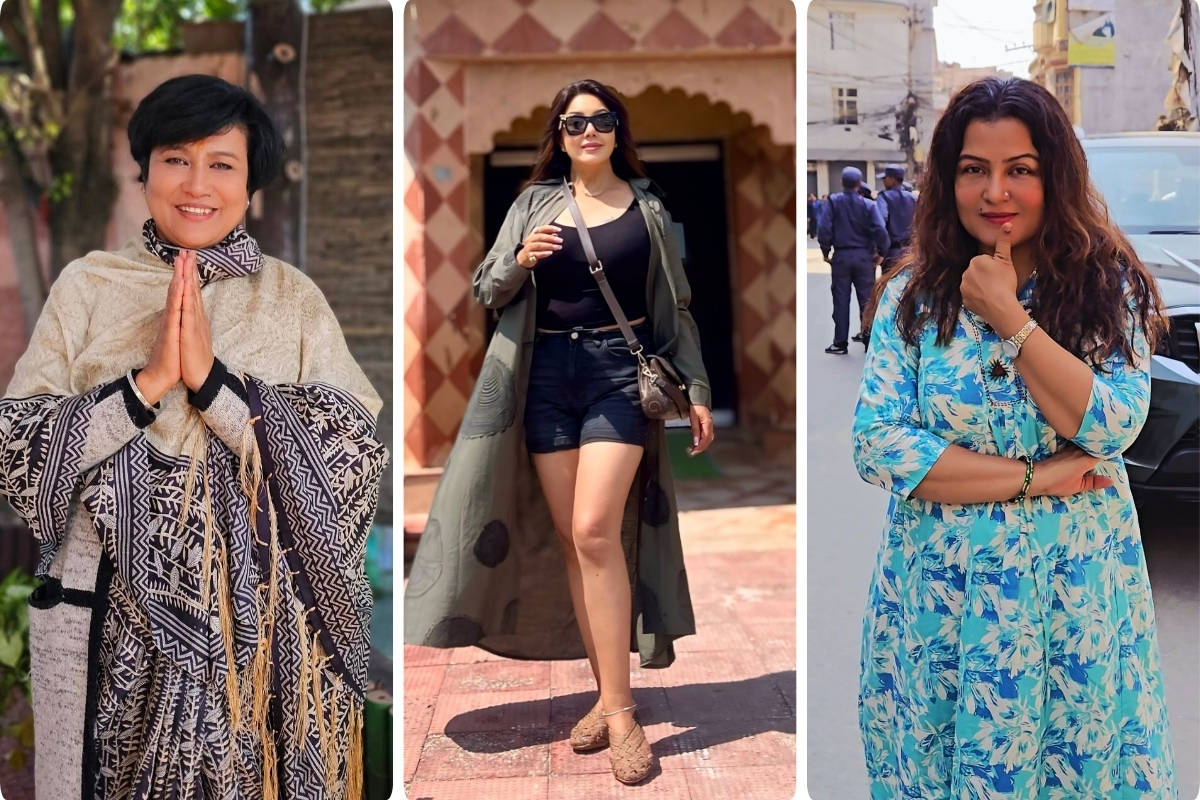
From left: Komal Oli, Karishma Manandhar, and Rekha Thapa
In the recent House of Representatives election, the participation of actors, actresses, athletes, Miss Nepal contestants, television presenters, models, and social media influencers was particularly visible. The inclusion of many well-known celebrities as both direct and proportional candidates sparked debate about the growing presence of celebrity glamour in politics.
At present, Balendra Shah (Balen), a senior leader of the Rastriya Swatantra Party (RSP), is being discussed as a potential figure in national leadership. After defeating former prime minister KP Oli from Jhapa-5 in the House of Representatives election held on March 5, he quickly became a widely discussed political figure both inside Nepal and abroad.
Social media influencer Ashika Tamang has already been directly elected from the RSP, while model and presenter Rima Bishwokarma and former Miss Nepal Anushka Shrestha are expected to enter parliament through the proportional representation system.
Karishma Manandhar joined the CPN (UML) in 2022, she attracted public attention by pointing out that her birth name, Suryakumari, corresponded with the party’s election symbol.
Since the Gen Z protest, artists and celebrities from various fields have actively supported efforts to present Balen and the RSP as an alternative political force.
During the protests, several celebrities, including Nischal Basnet, Oshin Sitoula, Eva Giri, Ishtu Karki, Sabin Shrestha, Paras Bam (Coolboy), and Sajina Khanal, were seen participating on the streets. The renowned Ma Ha duo, Madan Krishna Shrestha and Hari Bansha Acharya, expressed solidarity through social media. Singer and actor Prakash Saput contributed Rs. 50,000 to distribute drinking water during the demonstrations and mobilized two volunteers for the effort.
Other public figures, including Pradeep Khadka, Rachana Rimal, Samikshya Adhikari, Reecha Sharma, and Barsha Siwakoti, also encouraged people to participate in the Gen Z protest.
Actress Keki Adhikari even shared a poem on Facebook expressing solidarity with the movement.
From the Gen Z protest through the election results, cinema and music appear to have played a role in reinforcing narratives of political change and alternative leadership.
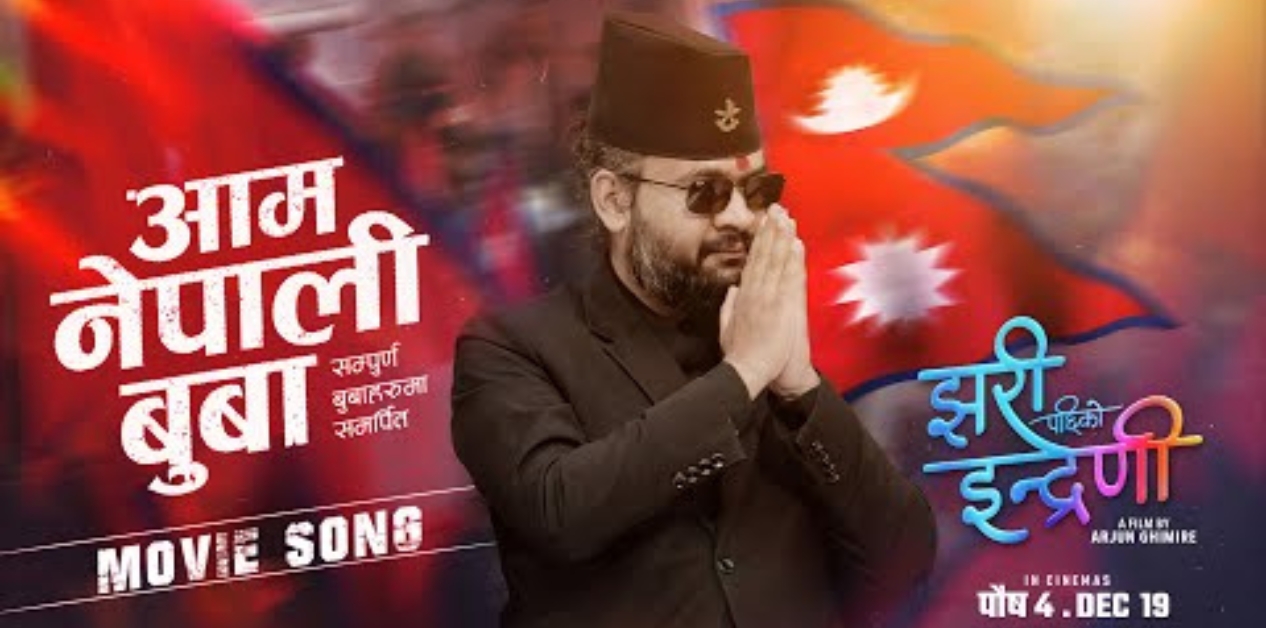
Following the protests, the film Jhari Pachhi Ko Indreni was released in theaters on December 19, 2025, incorporating themes related to the movement. Within just two months of its theatrical run, shortly before the election, the film was uploaded to YouTube through Balen’s official channel. RSP leader Ganesh Karki was involved in writing the film, while its production was carried out by a group close to Balen. As part of the promotion, Balen himself performed the song Aam Nepali Buwa.
Shortly before the election, another film, Dimaag Kharaab, directed by Nischal Basnet, who is considered close to Balen, was also released on YouTube. The film conveys a message that corruption, mismanagement, and entrenched political practices should be rejected and that the younger generation should lead the country.
Public discussion had previously emerged about the apparent parallels between the storyline of the film, originally released two years earlier, and the political ideology associated with Balen and the RSP. Over time, those connections have become increasingly evident.
For this reason, the release of films that could directly influence the electoral climate and its outcomes does not appear entirely coincidental.
During election periods, audiovisual media naturally influence public opinion and shape political agendas. Dialogue and songs from films often go viral on platforms such as TikTok and Instagram Reels, while even older content may be revived and circulated in new political contexts.
A common saying holds that what is seen sells. Social media is a space where visibility itself becomes power. The more frequently a figure appears online, the greater their influence. In this environment, emotional appeal and impulse can often shape public opinion more strongly than facts or careful analysis.
That dynamic became evident when the song Lekhau Bhawisya Afno Afai from Dimaag Kharaab went viral after being used in the RSP’s election campaign. Although it was not originally intended as an electoral song, its association with the campaign helped make it one of the most widely circulated tracks of the election period.
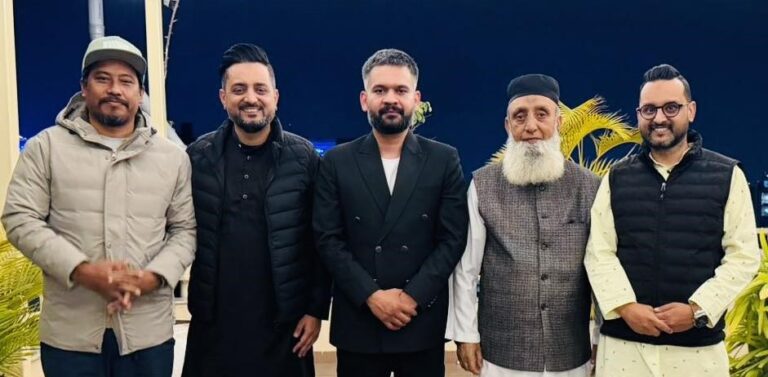
Nischal Basnet and Balen along with Asim Shah and Asif Shah
Supporters posting videos in favor of Balen widely used the song on social media. The track, composed by musician Jayan J. Waiba, also features vocals by Nischal Basnet. Meanwhile, Balen’s own song, Aam Nepali Buwa, effectively functioned as a campaign anthem. Around the same time, rapper Vyoma released a rap track titled ‘Jhapa 5’ in support of Balen, further reinforcing the campaign narrative.
These developments suggest that the narratives of politics, cinema, and music are increasingly intertwined in Nepal. Particularly after independent candidates such as Balen and Harka Sampang were elected mayors in the 2022 local elections, films have increasingly begun featuring characters such as mayors, local leaders, or federal officials as central figures.
The growing involvement of artists in politics suggests that such cinematic portrayals may become even more common in the future. If that trend continues, it is possible that a wave of propaganda films could emerge alongside broader political changes.
In the latest election, while Balen and several other celebrity figures secured victories, actress Nisha Adhikari faced a decisive defeat. Contesting as a candidate of the Gatisheel Loktantrik Party, she received only 91 votes. Meanwhile, for media personality Rishi Dhamala, who frequently goes viral on social media, the election appeared to serve more as a source of public spectacle and entertainment.
The growing involvement of artists in politics suggests that such cinematic portrayals may become even more common in the future. If that trend continues, it is possible that a wave of propaganda films could emerge alongside broader political changes.
Unlike in India, celebrities in Nepal have rarely succeeded in winning direct elections. This trend is unlikely to change dramatically in the immediate future. Without strong ideological grounding or cultural credibility, sustaining a long-term political career can prove difficult.
As a result, many Nepali celebrities still find it easier to enter politics through the proportional representation system. Yet without clear ideological commitments, their participation often remains largely symbolic.
Scholar and activist Dr. Dovan Rai argues that the very foundation of ideological political engagement has changed. In the past, political practice required participation in broader ideological debates. Today, she suggests, that is no longer necessarily the case.
“Politics has shifted from the center of political actors to a space dominated by entertainment, media influencers, virality, and shortcut dreams,” she says. “There is no longer even a need to give speeches or articulate clear ideas. Politics itself has become a space where society seeks shortcuts.”
In such a context, she believes the distinction between celebrities and politicians may increasingly blur.
“Now,” Rai says, “a situation is emerging where those who wish to enter politics may feel they must first appear as performers rather than as politicians.”