Kathmandu
Sunday, July 19, 2026





Prime Minister Balendra Shah's comments on Nepal-India border disputes have ignited controversy, with critics accusing him of undermining Nepal's official position.
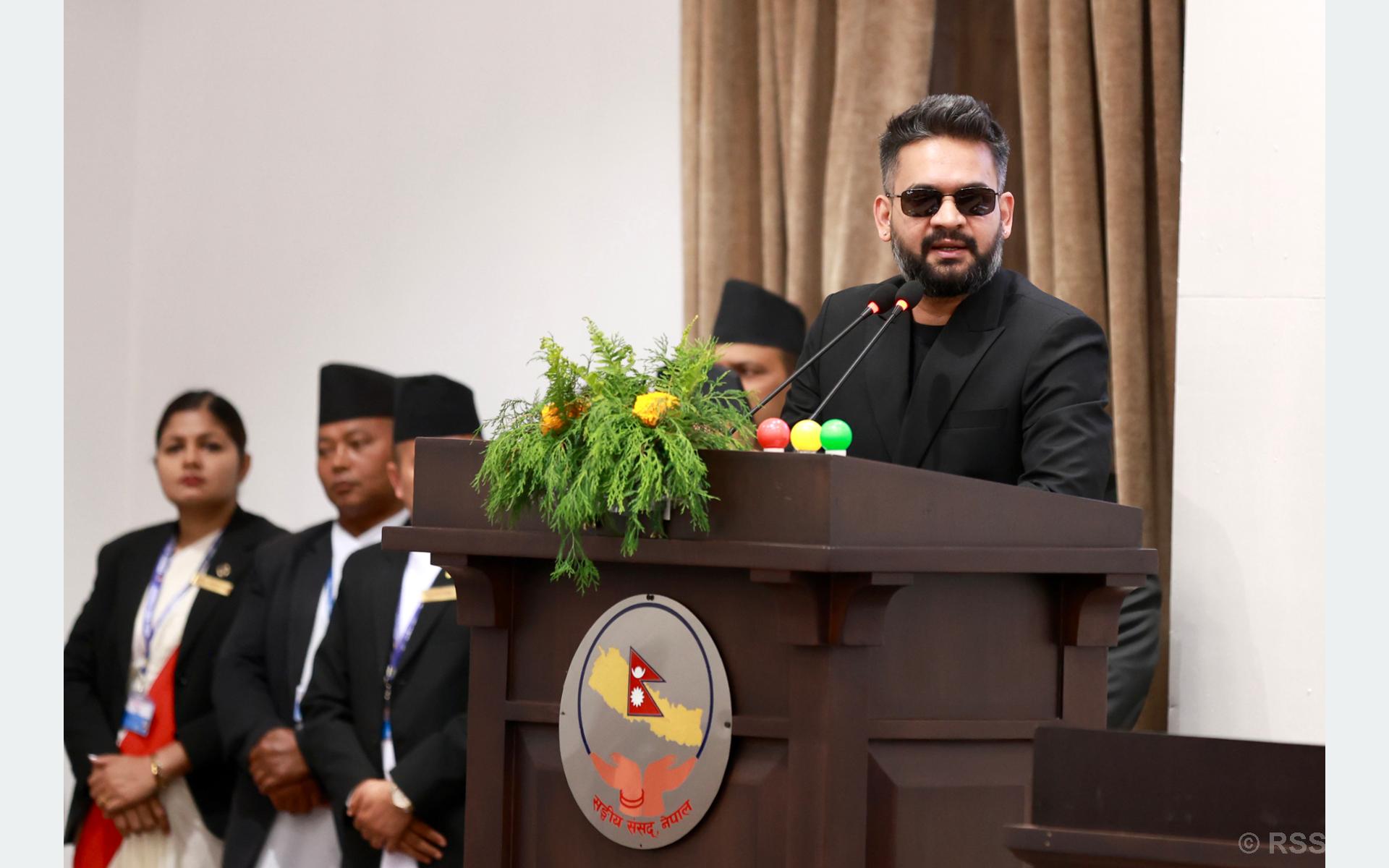
KATHMANDU: Prime Minister Balendra Shah, who spoke in the House of Representatives meeting for the first time after facing fierce criticism from opposition parties for not speaking in parliament, has landed in controversy. While responding to questions regarding Kalapani, Lipulekh, and Limpiyadhura, he expressed that Nepal too has encroached upon territory on the Indian side.
“One thing might surprise you, which I also found out only after becoming Prime Minister—it turns out it’s not just India encroaching on Nepal’s land, but Nepal has also encroached on India’s land in many places. I found this out just recently,” Prime Minister Shah said in parliament. “We have encroached as well, and they have encroached too. We are thinking of sitting down and solving this as friends.”
In the House of Representatives meeting on May 31, Prime Minister Shah had requested questions from MPs, saying he would provide answers. Opposition MPs immediately countered Shah’s remarks.

Intense reactions are pouring in regarding Prime Minister Shah’s statement on the border. Border experts and diplomats have expressed astonishment at the views expressed by Prime Minister Balendra Shah during the meeting. Various political parties and civil society have condemned Shah’s statement, calling it against the national interest.
Expert and diplomatic reactions
Nepal’s former ambassador to India, Nilamber Acharya, stated that the remarks made by Prime Minister Shah in parliament are ridiculous.
“The Prime Minister’s statement is wrong and contrary to facts. The notion that we have encroached on India’s land is indeed ridiculous,” Acharya says. “Indian soldiers are occupying Nepali territory by encroaching upon it. Which soldier of ours is on Indian territory, could the Prime Minister please show that too? The Prime Minister has mixed up two different things,” he said.
He explains that the situation in places where there is an active border dispute is different from the situation where citizens are simply utilizing land along the border. “This is something accepted by the governments of both sides,” Acharya says. “Efforts to finalize that have been made from both sides. There is no border dispute in such locations.”
The main border disputes between Nepal and India lie in the Susta and Kalapani regions, where proper demarcation has not taken place. In areas where demarcation has occurred, some Indian territory has fallen on the Nepali side, and some Nepali territory has fallen on the Indian side. Similarly, encroachment in the No Man’s Land remains a subject of dispute.
International border expert Prabhakar Sharma states that Prime Minister Shah’s understanding of the border issue between Nepal and India is weak.
“Nepal’s border problems are of two types. First is the problem in areas where demarcation has already been done, and the other is the problem in areas where demarcation could not take place,” Sharma says. “The Prime Minister seems to have an understanding problem on this matter. Nepal has not encroached on India’s border. We are the victimized party.”
The Chairman of the ruling Rastriya Swatantra Party (RSP), Rabi Lamichhane, is leaving for New Delhi on Monday at the invitation of India’s ruling Bharatiya Janata Party (BJP). On the eve of Lamichhane’s visit, Prime Minister Shah’s controversial statement regarding the border is being viewed meaningfully.
Due to the failure to resolve the Susta and Kalapani disputes, a formal border agreement between Nepal and India has not been reached. An Indian military camp remains located in the Kalapani region, which is the tri-junction point between Nepal, India, and China. India has also constructed a road through the encroached Nepali territory. Meanwhile, Nepal’s parliament updated its official map to include Limpiyadhura by amending the schedule of the Constitution on May 20, 2020.
Recently, after an agreement was reached between India and China to open the Kalapani border point for Indian pilgrims going to Kailash Mansarovar, the Government of Nepal protested by sending diplomatic notes to both countries.
“Regarding this matter, the Government of Nepal has already sent a diplomatic note to the Government of India, and a response has also been received. In that, talks have taken place between both governments to solve the problem through table talks by involving historians and surveyors who have knowledge about the land,” Prime Minister Shah said in parliament. “In this regard, we have spoken not only with India and China but also with the England government. Since the problem has been ongoing ever since they left India, our stance is that England should also concern itself with this matter.” He reiterated that the border dispute would be resolved through diplomatic dialogue.
While border expert Sharma agrees that the Prime Minister’s talk about finding a solution by forming a team of experts is positive, he emphasizes that immediate, active measures are required.
“We need active diplomacy rather than quiet diplomacy,” Sharma concludes.
The Chairman of the ruling Rastriya Swatantra Party (RSP), Rabi Lamichhane, is leaving for New Delhi on Monday at the invitation of India’s ruling Bharatiya Janata Party (BJP). On the eve of Lamichhane’s visit, Prime Minister Shah’s controversial statement regarding the border is being viewed meaningfully.
Although Indian Prime Minister Narendra Modi has extended an invitation to Prime Minister Shah to visit India, no final decision has been made on the trip yet.