Kathmandu
Saturday, June 6, 2026





Nepal's animal welfare laws exist on paper. Enforcement is another matter.

Samakhusi, October 2025: On a Saturday evening near Supreme College in Tokha Municipality, a group of young men beat a street dog to death with iron rods and stones. The act was captured on CCTV. One person was eventually arrested. The dog had no name. It had probably lived on that street for years, sleeping near the college gate, asking for nothing.
Khotang, November 2025: A 44-year-old man tied a dog to a tree in the eastern hill district of Khotang and hanged it until it died. Photographs spread online. Some community members praised the act. The case eventually reached court and the man received a sentence of one week in prison and a fine of Rs 5,000. It was the first animal abuse case to ever reach a court in Khotang. One week. For a life deliberately taken.
Satdobato 2019: A dairy farmer in Satdobato abandoned his cow on the street after she stopped producing milk. She could not walk. Her body was covered in wounds. A complaint was filed at the Satdobato Police Station against the farmer. Acting on the complaint, police held him in custody for five days then released him on bail. An organization rescued the cow, but she did not survive. “She had a lot of wounds on her body and she couldn’t move. We tried to help her but it was all in vain,” says Sneha Shrestha, founder of Sneha’s Care, the organization that had rescued the poor cow. The farmer got five days. The cow got nothing.
Kirtipur, 2024: A dog was found in Kirtipur with its eyes severely injured and bleeding after a brutal attack. Sneha Shrestha, who is also the president of FAWN, received the call and rushed to help. Rescuers went door to door through the entire village, sought police protection and spent more than ten days fighting to keep the dog alive. Then, while they were still fighting for it, the dog was taken and killed. “We did everything right,” Shrestha later said. “And it still wasn’t enough.”
These incidents should have never happened. The cruelty is visible. The numbers are not. Because Nepal still has no comprehensive system to track abandoned animals, abuse complaints, prosecutions, or shelter demand.
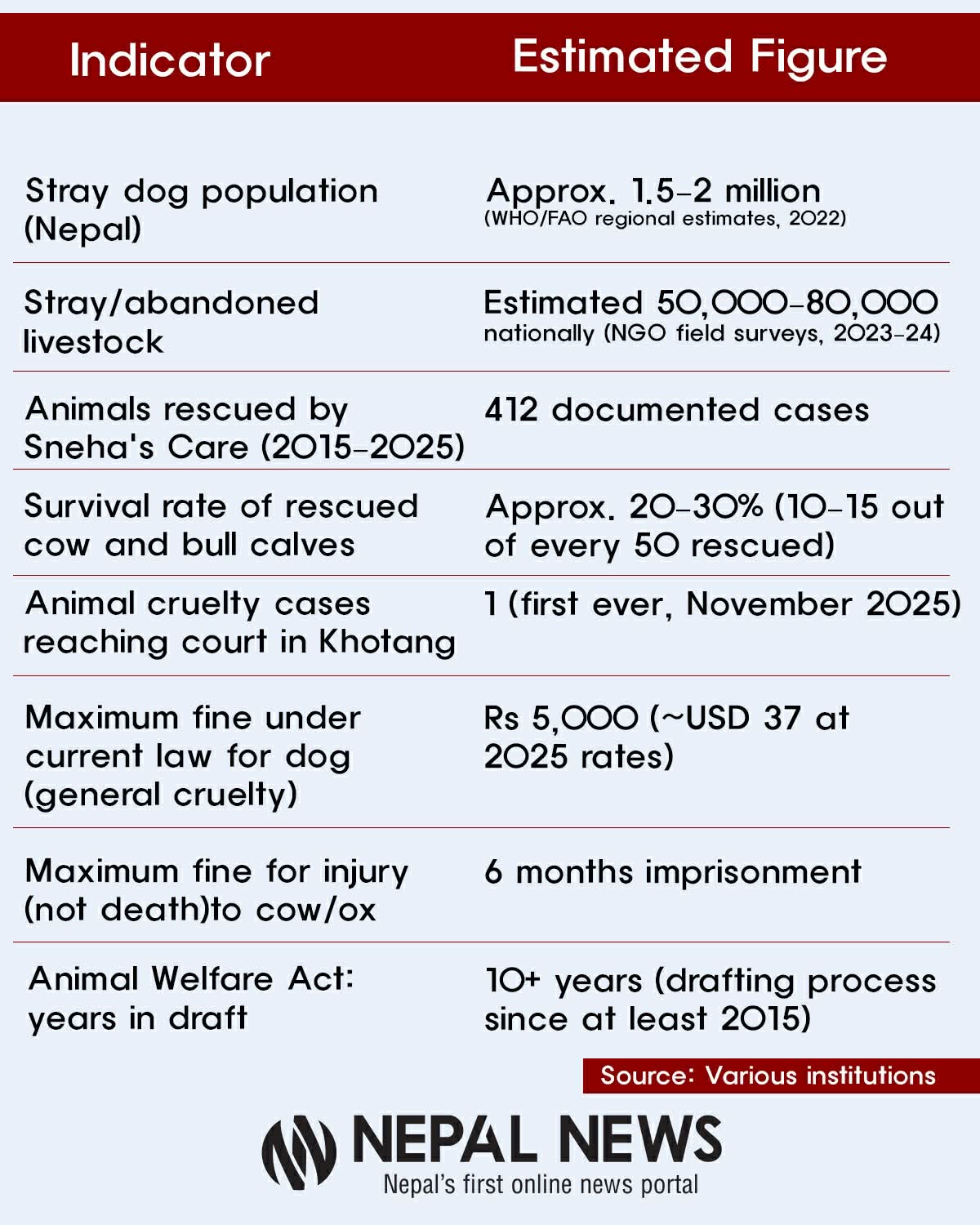
The scale of the problem: Estimated data
Nepal has no national database tracking stray animal populations, reported cruelty incidents, shelter capacity, or prosecution rates. The figures below are drawn from available NGO records, municipal surveys, and veterinary assessments. They should be treated as indicative rather than definitive.
A nation that loves animals on paper
There is something deeply confusing about Nepal when you look at how it treats its animals. During Tihar, dogs are draped with marigold garlands and fed sweets and other delicacies. The cow is the national animal, worshipped during festivals, called the mother of all living. Religious texts speak of kindness toward all living creatures. Buddhism, which runs deep through Nepali culture, is built on the principle of ahimsa, of doing no harm.

Dozens of rescued community dogs rest at the shelter of Sneha’s Care after being brought to safety, many recovering from injury and abandonment. Photo courtesy: Sneha Shrestha
And yet, stray animals across Nepal survive by feeding on garbage, drinking toxic water and suffering injuries on the road, some even harmed intentionally. Every day, somewhere in this country, an animal is being beaten to death, starved, abandoned or thrown from a running vehicle.
“Most of the time nobody reports it. When someone does, police often do not act. Some officers say they are unaware of the laws. Others say they do not know how to respond or what punishment applies,” says Shrestha. When a case somehow reaches court, the penalty is so small it barely registers.
The gap between what Nepal says it believes and what actually happens to its animals is not just wide. It is devastating.
Abandoned livestock: A structural and moral problem
Ram Bahadur Neupane, known to everyone as Gopal, has been rescuing abandoned cows and bull calves across parts of Nepal for many years. He works with small donations, personal savings and a stubbornness that refuses to let him look away.
When a dairy cow gives birth to a male calf, the farmer faces a problem. The solution, used frequently and quietly throughout Nepal, is to either abandon the calf at midnight or withhold milk for 72 hours and then allow unlimited feeding, causing the stomach to rupture and kill the animal. Gopal finds these calves with rope cuts deep in their skin, broken bones, too dehydrated to lift their heads.
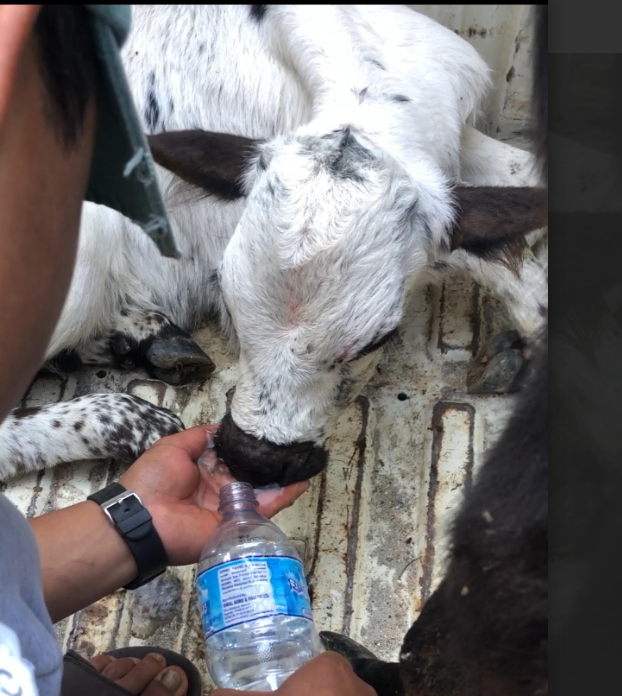
An abandoned calf drinking first sip of water after being rescued. Photo courtesy: Pradip Thapa
“To survive, these calves need their mother’s milk produced within the first 24 hours of birth,” he says. “Instead, they are separated and abandoned. Just because the family could not handle the burden of a calf for a few months.”
Rural development specialists note that approximately 60% of small dairy farmers in Bagmati Province report lacking access to any government livestock disposal or transition program. Without such programs, the burden of non-productive animals falls entirely on households with limited means, a structural problem that stronger enforcement alone will not solve.
Out of every 50 calves Gopal rescues, he saves 10 to 15. The rest do not make it.
Government budgets exist for stray livestock care. Courts have ordered shelters to be built. But Gopal has never seen that money reach the animals. Vaccines arrive late, near expiry. “Hundreds of thousands in budgets are allocated for street cows and calves,” he says. “But where is that money? It never reached these animals. They have not received the respect they are due.”
“We have to respect cows as mothers,” he says. “But today, they are left on the road to eat plastic and die. Those who abandon animals on the street are devils who have the face of a human.”
The dog that never came back to itself
Inside Sneha’s Care shelter in Lalitpur, more than 170 rescued animals currently live. Some have three legs. Some walk with a permanent limp. Some sit very still when a stranger approaches and only relax when they hear Shrestha’s voice.
One dog named Ranger used to sit outside a butcher shop every day. He was gentle, familiar, and known. One day the butcher attacked him with a cutting tool and sliced his leg so deeply that survival seemed impossible. Shrestha’s team found him in shock, barely conscious, bleeding heavily. He survived. But Ranger today flinches at sudden movements and does not trust easily.
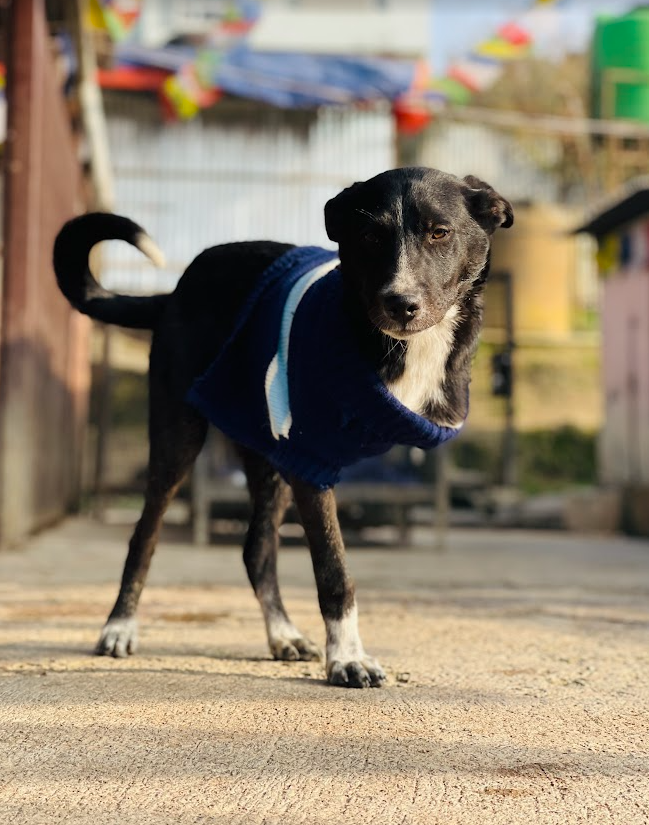
A formerly abandoned community dog, now safe and cared for, stands at Sneha’s Care shelter after being rescued. Photo courtesy: Sneha Shrestha
“He is not the dog he used to be,” Shrestha says. “The body healed but something inside him did not.”
Most animals in her shelter cannot be returned to the communities they came from. The people who hurt them are still there and they won’t hesitate twice before hurting them. The streets are still not safe. “After making them homeless, we are afraid of sending them back to the same place,” she says. “These animals are not just injured. They are traumatized. Some cannot jump. Some run when they see people.”
When culture becomes an excuse
Sneha Shrestha, who has spent over a decade working at the intersection of animal welfare and cultural sensitivity, does not shy away from the harder conversations.
“Slaughter and sacrifice are not the same thing,” she says. “In temples, people of all ages go to worship. Nobody likes to walk on the blood of an animal when entering a place of worship.”
She also speaks to cruelty that happens in homes and breeding centers and never makes the news. “Animals are abused, tortured, and even sexually assaulted. Nothing happens. The kind of law that exists for humans should exist for animals too.”
Then she says something that captures the heart of the whole problem. “In Nepal, where there is no awareness of animal welfare acts, where there is no awareness in the education system, how do we expect people to behave differently?”
If children are not taught that animals feel pain, that their lives have value beyond usefulness, then the adults they become will continue to see and act of cruelty as normal.
What the government says
Umesh Dahal, Director General of the Department of Livestock Services, acknowledged the vaccine delays that shelter workers describe but explained the process. Vaccines must pass 21 days of quality testing before distribution. He added that for diseases like lumpy skin disease, the vaccines are distributed free of cost.
On abandoned livestock and the absence of court-ordered shelters, Dahal pointed to Nepal’s three-tier government structure. “This is not only the federal government’s responsibility. Local government plays an important role too.” He added, “No one has the right to do anything wrong to animals. We have to fulfill their rights.”
Dahal was direct about its necessity: “When the law is strong, the police and administration will have to act. That mandatory force will create change. We need the Animal Welfare Act right now.” He expressed hope that under the new governance, the act will pass with increased consequences and penalties. The act has been in drafting since at least 2015 over a decade and has not yet been passed into law.
What the vets see
Dr Nabaraj Shrestha, a veterinarian involved in drafting the Animal Welfare Act, brings a clinical but deeply human perspective.
“If an animal has been beaten with a stick, that wound looks different from an accidental injury. If an animal is severely underweight, we use a body condition score from one to five. A score below two tells us the animal has been severely neglected.”
He was direct about punishment. “There should be monetary penalties and imprisonment. If there is no fear of consequence, behavior will not change. But beyond law, this is a matter of morality. If an animal has given you milk, labor or companionship, you have a responsibility toward it. That responsibility does not end when the animal stops being productive.”
Dr Aabhash Poudel, information officer of the National Livestock Resource Management and Promotion Office, working in animal welfare enforcement, speaks from the frustration of someone who knows exactly where the system breaks down.
In Nepal, the exact punishment for hurting a cow or an ox is stated in the National Penal (Code) Act, 2017: if the animal dies, up to 3 years in prison; for grievous injury, up to 6 months; for lesser injury, a fine of up to Rs 50,000. For a dog, the general cruelty law applies up to 3 months in prison, a fine of up to Rs 5,000, or both.
“An animal cannot file a complaint itself, and a case is not even registered unless someone initiates it.” Without a human willing to go to a police station and face social pressure from neighbors who see nothing wrong with what happened, the case simply does not exist.
He also points to a deeper problem. “What should be considered abuse and what should be considered normal is not defined.” His prescription is clear: “Advocacy should be done from the school level. Children should be taught how to care for animals. We need a welfare act as soon as possible, a separate department for animals, and a chip system for domestic animals with registration and death records.”
The current legal framework and its limitations
In Nepal, the exact punishment for hurting a cow or an ox is stated in the National Penal (Code) Act, 2017: if the animal dies, up to 3 years in prison; for grievous injury, up to 6 months; for lesser injury, a fine of up to Rs 50,000. For a dog, the general cruelty law applies up to 3 months in prison, a fine of up to Rs 5,000, or both.
The word “or” between imprisonment and fine is not a minor drafting detail. In practice, it allows accused persons to simply choose the fine and face no further consequence. At Rs 5,000 (~USD 37), this is not a deterrent.
Shrestha and her colleagues have been pushing for a dedicated Animal Welfare Act since 2015. Drafts have been prepared. Ministers have been met. Promises have been made and broken by government after government.
DG Dahal agrees the current penalties are outdated. “In 2055 BS, punishments were set according to that time. Today, 28 years later, the punishment for the same crimes is actually worth less in real value. The punishment must reflect the current time.”
A dedicated Animal Welfare Act, as drafted, would consolidate protections across species, raise penalties, require microchipping of domestic animals for owner traceability, and establish clearer definitions of what constitutes cruelty, giving both citizens and police a workable framework for reporting and enforcement.
The five who refuse to look away
What keeps a person going back to midnight roads, night after night, for animals that cannot thank him/her? The honest answer is that someone has to.
Gopal works constantly with no organization behind him. Every night he checks his phone for messages. “The nation has to allocate a budget and actually spend it on those innocent animals. Not just cows or dogs but every animal and every bird.”
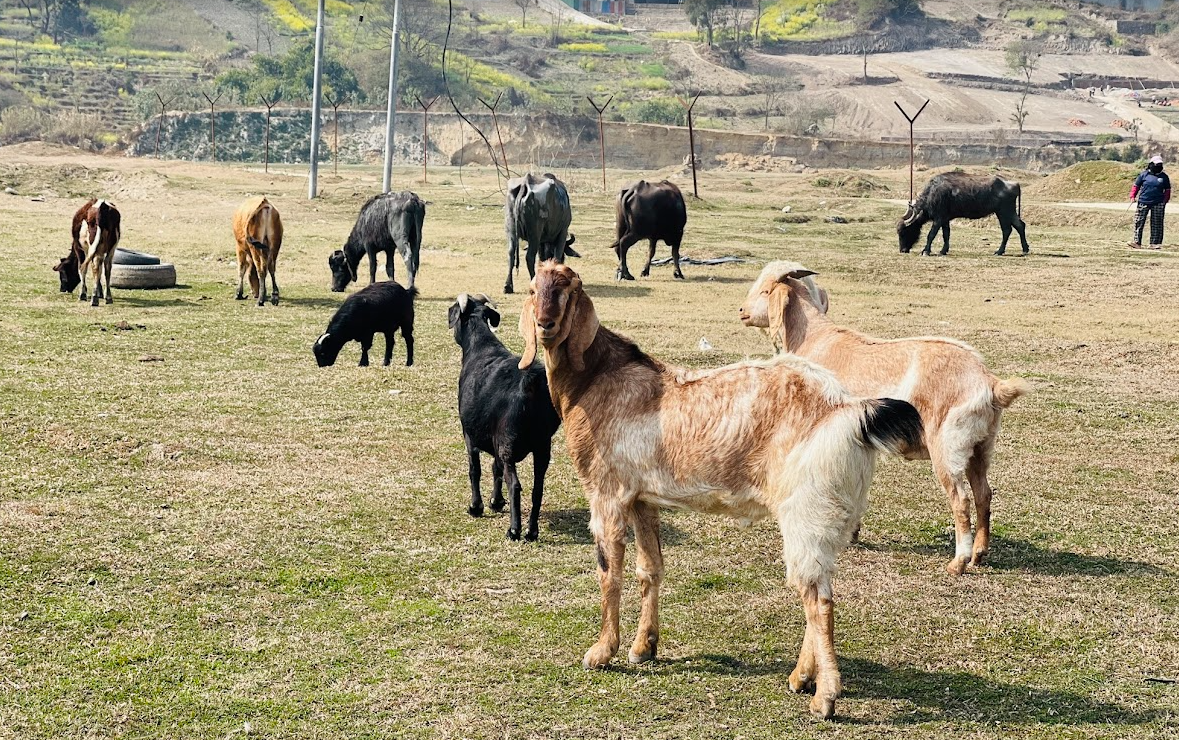
Rescued from ritual sacrifice, goats and cattle rest peacefully under protection at Sneha’s Care, highlighting a growing effort toward animal welfare and compassion. Photo courtesy: Sneha Shrestha
Sneha Shrestha runs a shelter housing more than 170 rescued animals. A handwritten ledger on her office wall tracks every rescue since 2015. It has 412 entries.
Dr Poudel’s frustration is the quiet kind that comes from knowing exactly where the system fails. “Without awareness from the ground level, without education, without law, nothing will change.”
Dr Nabaraj Shrestha has held injured animals with his own hands. When asked what he would do if he saw an animal being abused, he answered without hesitation. “Stop it. Stop the person doing it, right there. Not walk past. Don’t look away.”
Umesh Dahal keeps showing up to meetings and approving what budgets he can. “We cannot imagine a healthy society without fulfilling the rights of the animals that share it with us.”
The last thing they ask
Sneha Shrestha always comes back to the same simple place. “If you have a dog at home, treat it like a family member. If you can’t, please don’t bring one. Raise your voice for animals. And if you can’t love them, please don’t hurt them.”
Gopal says it with the directness of someone who has spent years watching animals suffer for no reason. “A cow is our mother and we have to respect that. Those who leave animals on the street are devils who have the face of a human.” The remark reflects the frustration of someone who has spent years working without institutional support, not an official characterization of farmers.
Dr Poudel brings it back to where it has to begin. “Without awareness, without education, without law, nothing will change. We have to build this from the bottom.”
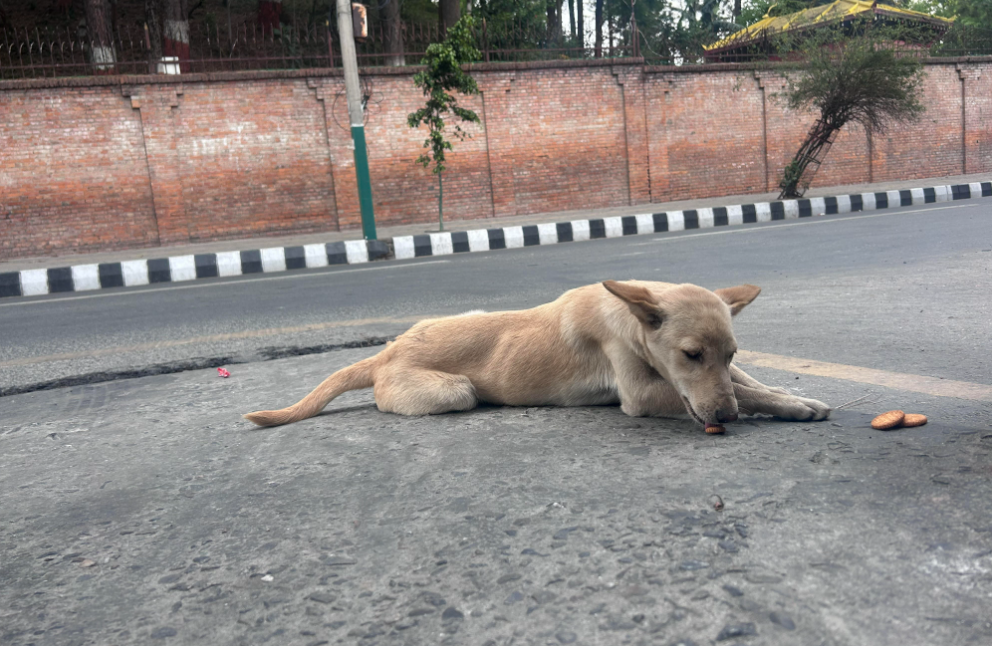
A community dog pauses by the roadside to eat what little food it finds, reflecting the everyday struggle for survival among community animals. Photo: Ankita Khanal
DG Dahal speaks as a government official who knows the machine is slow but believes it can move. “We should not abandon animals on the streets. We have human rights in this country. We also have animal rights. We cannot imagine a healthy society without fulfilling the rights of the animals that share it with us.”
Dr Nabaraj Shrestha says it as someone who has felt the weight of what a human being can do to something that cannot fight back. “Stop it. Stop the person doing it, right there. Find the cause. Get the animal help. That is what every one of us should do. Not walk past. Not look away. Stop it.”
These five people, a grassroots calf rescuer, a shelter founder, an enforcement officer, a veterinarian and a government director, have arrived at the same conclusion from five different directions. The animals of Nepal are suffering. Most people know it. The country has more than enough capacity to do something about it.
The Animal Welfare Act has been in drafting for over a decade. Whether the current government moves it forward will determine whether the consensus these five people share translates into enforceable change.
Animals cannot ask for our help. But they need it.
(Khanal is a trainee journalist.)