Kathmandu
Wednesday, June 17, 2026





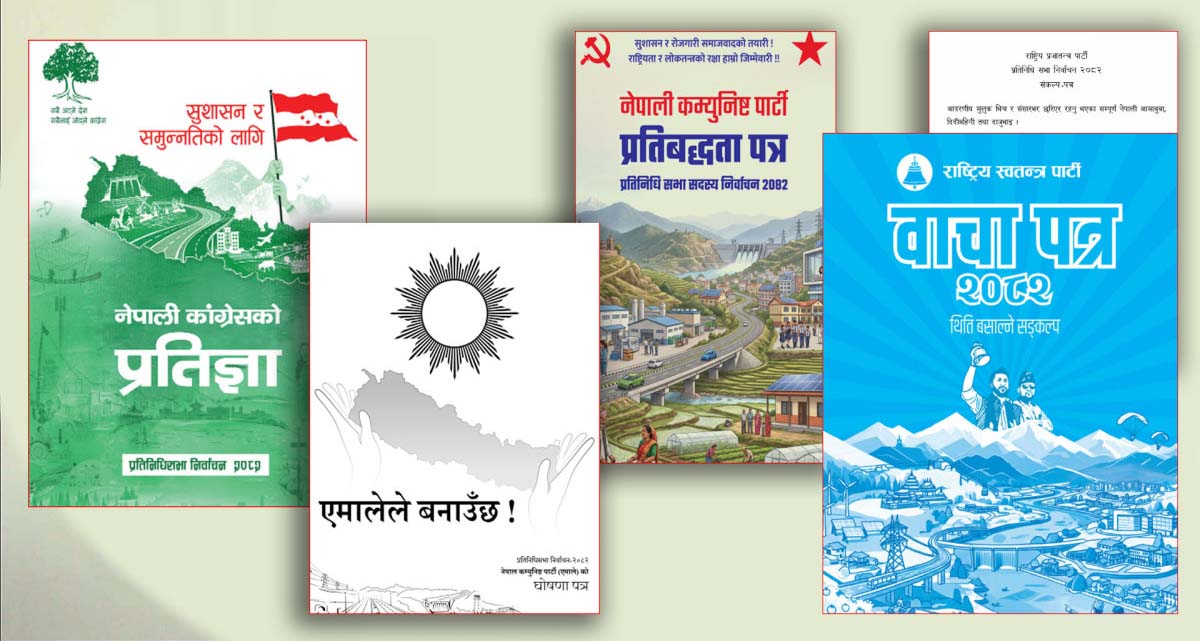
KATHMANDU: As Nepal heads to the House of Representatives elections on March 5, the country’s major political parties have released their manifestos, offering a glimpse of how they plan to respond to the seismic GenZ protests of September 8–9 and steer the nation forward.
Election manifestos, long a guide for voters in choosing parties and candidates, are increasingly treated as instruments of accountability. They signal a party’s priorities, outline policy agendas, and offer a benchmark against which citizens can measure promises. As Nepal prepares for the upcoming polls, analysts are scrutinizing the pledges of established parties-Nepali Congress, CPN-UML, Nepali Communist Party-alongside newer entrants like the Rastriya Swatantra Party, Ujyalo Nepal Party, Shram Sanskriti Party among others to see what they propose on issues that matter most: health, education, employment, and social security. This Nepal News analysis series offers a comprehensive examination of the election manifestos of major parties and their positions on key national issues.
Education: reform, access, and accountability
For Nepali Congress, education is a central pillar of its manifesto. The party has promised to allocate 20 percent of the national budget to the sector, accompanied by a slogan aimed at delivering textbooks on time: “New Year, New Book in Hand.” NC has committed to passing a new Education Act within a year, ending political quotas in universities and abolishing the provision that makes the Prime Minister the chancellor. Higher education will be supported through concessional student loans, with the government covering interest during the study period, signaling a blend of inclusivity and fiscal responsibility.
CPN-UML frames education as a tool to cultivate national pride. Its manifesto proposes contemporary, ethical, and digitally friendly curricula designed to foster patriotism and practical skills. Emphasizing the concept of “earning while learning, learning while earning,” UML seeks to curb the outflow of students abroad while promoting employment-focused technical education. Academic autonomy is highlighted as a key objective, reflecting the party’s vision for a more self-reliant education system.
The Nepali Communist Party pursues a more technologically ambitious agenda. Advocating a “one municipality, one smart school” policy, NCP plans to integrate digital literacy and technology-friendly education across the country. Private institutions will face capped fees, while community schools will adopt coding and digital literacy classes. Institutes of Technology are to be established in all seven provinces. The party also promises to depoliticize schools and universities, banning teachers’ political affiliations entirely, while creating accessible and inclusive model schools in each province. Beyond these measures, NCP aims to position Nepal as a regional hub for higher education.
Smaller parties offer their own distinctive approaches. The Rastriya Prajatantra Party seeks to legally end excessive politicization in education. Shram Sanskriti Party proposes a reduction of the school week from six to three days, alongside lighter curricula and fewer textbooks to ease the academic burden. Ujyalo Nepal Party promises free university education and plans to establish an education savings fund of NPR 15,000 for each newborn, providing interest-accrued support for higher education and skill development at age 18. The Janata Samajwadi Party envisions the complete public provision of education, making schooling free from pre-primary through higher education.
Across the spectrum, education emerges as a battleground of competing visions—between modernization and tradition, digital literacy and accessibility, political influence and institutional autonomy. Voters are presented not merely with promises of textbooks and classrooms, but with competing philosophies about the role of education in shaping Nepal’s future.
Health: expanding coverage and reducing burdens
For Nepali Congress, health spending is set to become a national priority, with at least 10 percent of the budget earmarked for the sector. The party proposes mandatory health insurance for all citizens, funded in part by levies on sugary products such as chocolate and sweets. Through this insurance, NC promises “unlimited and full” coverage for high-cost treatments, including cancer, kidney and liver transplants, and heart surgery. Under its 3/73 policy, citizens under three and over seventy-three years of age will receive free care at any hospital. The party also pledges to end subsidies for political leaders seeking treatment abroad, signaling a focus on domestic healthcare infrastructure.
CPN-UML emphasizes efficiency and integration. To eliminate overlapping costs, the party proposes merging the health insurance system with social health security programs. It also promises to regulate private hospitals through standardized pricing and quality caps, while integrating traditional and alternative medical systems with modern healthcare.
The Nepali Communist Party targets both cost reduction and universal coverage. Currently, citizens bear 54 percent of their healthcare expenses; the party pledges to reduce this to 35 percent by 2031–32. It aims to achieve full enrollment in health insurance, integrate mental health with primary healthcare, and raise the sector’s budget from five to eight percent within the same period.
The Rastriya Swatantra Party highlights technological solutions and accessibility. It plans to connect healthcare workers nationwide through a virtual network to prevent isolation for those posted in remote areas. Health insurance will be managed through a one-window system, while each province will host at least one advanced disability rehabilitation center. By 2087 BS (2030–31 CE), the party aims to minimize the personal, familial, and national burdens arising from preventable disabilities. Mental health services will also be made widely accessible.
Smaller parties offer targeted initiatives. Janata Samajwadi Party plans to establish a multi-specialty hospital in each province, while Ujyalo Nepal Party proposes providing mental health counselors in every ward, emphasizing community-level access to psychological support.
Across the spectrum, parties are converging on two themes: broadening access and reducing individual financial burdens. Yet their approaches vary—from insurance expansion and digital networks to integrated traditional medicine and mental health prioritization—reflecting contrasting visions of how to make Nepal’s healthcare system both universal and sustainable.
Employment: jobs at home, dignity abroad
Job creation sits at the heart of the Nepali Congress manifesto. The party promises to generate at least 1.5 million jobs over the next five years, largely by consolidating fragmented employment-promotion programmes. It plans to bring gig workers—such as delivery riders and ride-hailing drivers—into the Social Security Fund, extending formal protections to an informal workforce. NC also pledges to halve the number of citizens seeking foreign employment within five years. For those who do go abroad, the party proposes appointing health assistants in major labour-destination hubs and providing access to mental-health services, acknowledging the social costs of migration.
CPN-UML anchors its employment strategy in high economic growth. It claims that robust expansion will generate 400,000 jobs annually, with an additional 100,000 positions in the information-technology sector, bringing the yearly total to half a million. The party aims to raise annual labour productivity growth to 7 percent and to create domestic opportunities that could double workers’ incomes within five years. It also promises to end the compulsion to migrate abroad by borrowing at exorbitant interest rates.
The Nepali Communist Party places collective enterprise at the centre of its employment vision. It proposes creating 1.5 million jobs over five years through cooperative-based industries in agriculture, tourism, and information technology. The party also pledges to completely eliminate middlemen exploitation in foreign employment, a long-standing grievance among migrant workers.
The Rastriya Swatantra Party looks to the digital economy for solutions. It promises legal recognition for remote work, digital jobs, and cross-border service exports, alongside policies to attract digital nomads through appropriate visas, residency options, and shared workspaces. To honour the contribution of migrant workers, RSP proposes issuing special identity cards that would grant holders preferential access to public healthcare, education, and other social services.
Smaller parties bring more unconventional proposals. The Shram Sanskriti Party calls for compulsory labour and volunteer campaigns to cultivate a culture of work, while the Ujyalo Nepal Party promises to create 900,000 jobs annually.
Across party lines, employment is framed not merely as an economic imperative but as a social one—balancing the promise of jobs at home with the dignity and protection of those who continue to seek livelihoods abroad.
Social Security: from welfare to systems
For Nepali Congress, social security is framed as a life-cycle guarantee—supporting citizens “from the womb to mourning.” The party promises a range of protections calibrated to state capacity, citizen need, revenue strength, and long-term fiscal sustainability. Its manifesto seeks to expand the Social Security Fund beyond formal employment, bringing in urban workers as well as those in ride-hailing and food-delivery services, a recognition of Nepal’s growing platform economy.
CPN-UML adopts a more targeted, relief-oriented approach. It pledges to write off loans of up to NPR 25,000 taken from banks and financial institutions by households officially classified as poor by Bhadra 2082 BS. The party also promises free sanitary pads for schoolgirls, interest-free loans of up to NPR 2 million for women entrepreneurs, and a NPR 20,000 nutrition allowance for post-natal mothers. Pregnant women would additionally be covered by free life insurance of up to NPR 500,000, reflecting a welfare model focused on women and vulnerable households.
The Nepali Communist Party emphasizes institutional reform. It proposes strengthening contribution-based social security through awareness campaigns and digital platforms, while extending coverage to the informal sector through matching grants that support workers’ contributions. The party promises a social security card and universal health coverage for all citizens, alongside the implementation of a contribution-based pension scheme for farmers—an attempt to formalize protection in traditionally excluded sectors.
The Rastriya Swatantra Party focuses on efficiency and targeting. It proposes building a comprehensive database to make social security programmes more transparent and effective, redesigning the system to prioritise those with the greatest need while eliminating duplication and abuse. The emphasis is less on expanding benefits than on ensuring that existing resources reach the right recipients.
Smaller parties offer narrower but distinct proposals. The Ujyalo Nepal Party promises direct subsidies to farmers based on digital identity cards. Janata Samajwadi Party pledges free tickets and visas for migrant workers seeking foreign employment. Meanwhile, the Rastriya Prajatantra Party proposes ration-card distribution centres in every municipality to ensure access to basic food supplies for citizens and families living below the poverty line.
Taken together, the manifestos reveal competing philosophies of social protection: expansive life-cycle welfare, targeted relief, system-driven reform, and efficiency-focused redistribution. What unites them is an acknowledgment that social security is no longer a peripheral concern, but a central pillar of political legitimacy in a country shaped by inequality, informality, and migration.
GenZ protests: diverging diagnoses
The GenZ-led protests have elicited sharply contrasting interpretations. Nepali Congress identifies two worrying tendencies post-September 8–9: dismissing the movement as trivial or conspiratorial, and exploiting youth unrest for political advantage—implicitly critiquing RSP. NC frames the protests as a call for good governance and accountability, equating them with major democratic movements since the 1950s.
By contrast, UML, which held power during the protests, describes the events as a serious challenge to national sovereignty, raising concerns about infiltration, attacks on private enterprises, and assaults on security forces. It rejects any simplistic dismissal of these concerns.
RSP acknowledges the protests primarily through a promise to implement the findings of a parliamentary probe, holding then-Prime Minister KP Sharma Oli accountable. The party’s broader stance on youth activism is understated. NCP briefly addresses the protests, signaling that constitutional changes will respond to youth demands. RPP attributes the unrest to the failure of major parties, systemic corruption, and poor governance, framing it as a preventable tragedy with real human and material costs.
Foreign policy: between prudence and ambition
Foreign policy sections are cautious across party lines, though nuances vary. UML emphasizes sovereign equality and independence, promising stronger regional ties, expanded labor agreements, and investment-led growth, while reaffirming principles of non-alignment, Panchsheel, and “friendship with all, enmity with none.”
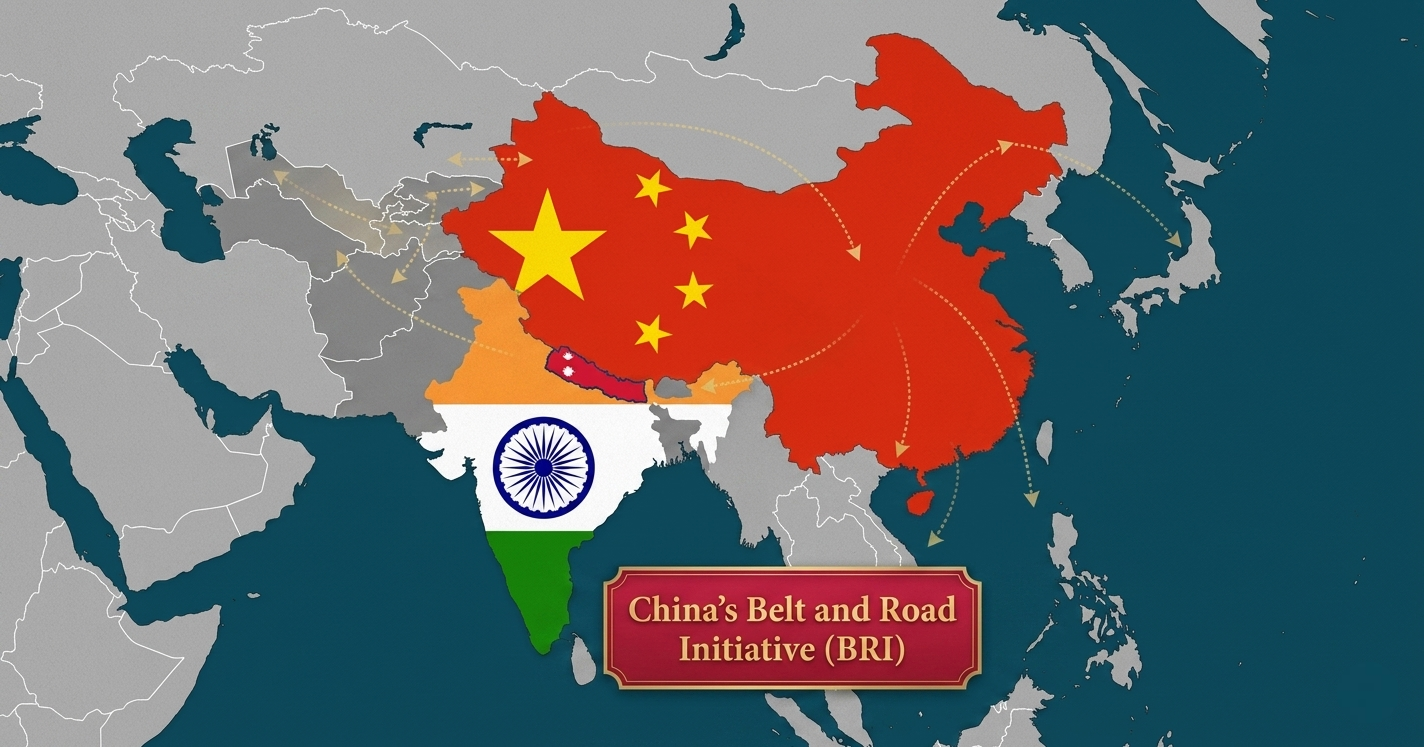
RSP advocates a more ambitious “balanced and dynamic diplomacy,” aiming to transform Nepal from a traditional “buffer state” into a “vibrant bridge” between India and China. NC envisions Nepal as a sovereign, dignified nation whose heritage sites—from Mount Everest to Pashupatinath—enhance its global image.
NCP outlines detailed foreign policy priorities: resolving border disputes diplomatically, strengthening participation in multilateral forums like the UN, SAARC, and BIMSTEC, reviewing unequal treaties, and advancing economic diplomacy. RPP calls for reviving the “Zone of Peace” doctrine of former King Birendra, and annulling unequal treaties, signaling a nationalist posture particularly toward India.
Economic strategy: private sector and social justice
Economic agendas reveal both convergence and contrast. Nepali Congress reiterates its liberal, market-oriented approach, positioning the private sector as the engine of growth while ensuring inclusion for marginalized groups. RSP mirrors this stance, advocating a socially responsible private-sector-led economy with the state as facilitator and regulator.
UML sets high growth targets: over 7% annual GDP growth and an economy of Rs 100 trillion in five years, supporting private-sector leadership alongside state investment in high-multiplier sectors. NCP champions a socialist-oriented model consistent with the 2015 Constitution, promoting structural reforms, job creation, and balanced development across private, cooperative, and public sectors. RPP emphasizes the private sector’s outsized role in GDP, employment, and production, while advocating for state oversight and revenue collection efficiency.
Constitutional amendments: promise without precision
All parties acknowledge the need for constitutional amendments, but specifics remain largely vague. NC calls for an Inter-Party Collaboration Framework to pursue its reform agenda. RSP promises a three-month review period post-election to propose measures such as a directly elected executive, proportional representation, and non-party local governance. UML seeks amendments through broad political consensus, softening previous calls for major overhauls. NCP defends the 2015 Constitution as a product of popular struggle, proposing targeted electoral and governance adjustments. RPP, meanwhile, proposes restoring the monarchy as a guardian institution, reforming the electoral system, and introducing non-party-based local governance.
Governance Reform: From Ambition to Implementation
Governance reform agendas highlight the parties’ differing levels of concreteness. NC lays out a comprehensive blueprint: probing assets of officials since 1990, empowering anti-corruption bodies, conflict-of-interest legislation, merit-based appointments, downsizing ministries, and state funding for political parties. RSP presents similar reforms, including dissolving government trade unions, independent civil service transfer boards, judicial independence, and transforming the National Planning Commission into a think tank.
UML emphasizes broad principles—rule of law, transparency, accountability—but provides fewer actionable proposals, focusing instead on defending its past governance record. NCP proposes an empowered commission to investigate corruption, a Lokpal body, and merit-based appointments. RPP pledges high-level investigations into past officials’ assets and conflict-of-interest legislation.
Diaspora voting: promises beyond the border
Despite intense debate this election cycle over guaranteeing voting rights for Nepalis living abroad-and introducing inter-district voting-the government ultimately stepped back. Officials cited inadequate legal, technical, and political preparation as reasons the plan could not be implemented in time. Yet the issue has not disappeared. Nearly all major political parties have incorporated commitments to diaspora voting rights into their election manifestos, turning a deferred reform into a campaign pledge.
For Nepali Congress, the diaspora occupies a central place in its political imagination. The party pledges to guarantee voting rights for all Nepalis living abroad, invoking the sentiment of “once a Nepali, always a Nepali.” It promises continuity of citizenship, rights to ancestral property, and electoral participation, arguing that the emotions, knowledge, skills, and capital of multiple diaspora generations must be harnessed for national development. Respecting Supreme Court directives, Congress commits to amending election laws to allow Nepali citizens residing overseas to vote directly from their countries of residence in national elections.
The manifesto of CPN-UML is notably silent on overseas voting rights. Instead, the party focuses on service delivery and labour diplomacy. It pledges to provide all state services for Nepalis abroad—including investment-related facilitation—through a single-window system. UML also promises to strengthen bilateral labour agreements in destination countries, incorporating social security provisions, and to extend state services beyond Nepal’s borders to wherever Nepalis reside.
The Nepali Communist Party adopts a more direct stance on voting rights. Its manifesto states that citizens living abroad due to work, study, or other obligations will be enabled to exercise their voting rights from their place of residence, signalling support for absentee or overseas voting mechanisms.
The Rastriya Swatantra Party goes further, explicitly backing both voting rights for overseas Nepalis and, in principle, dual citizenship—with limited exceptions. The party frames this as recognition of the enduring emotional bond between non-resident Nepalis and the homeland. Alongside voting rights, RSP promises to immediately remove administrative hurdles related to property ownership faced by non-resident Nepalis.
For Rastriya Prajatantra Party, the promise is more immediate. Its manifesto states that the voting rights of Nepali citizens living abroad will be ensured in the very next election, positioning diaspora enfranchisement as an urgent democratic reform rather than a long-term aspiration.
Madhesh: familiar promises, uncertain delivery
With its dense concentration of voters and constituencies, Madhesh Province once again sits at the heart of Nepal’s electoral calculus. Across party manifestos, the priorities sound familiar—education, health, drinking water, agriculture, employment, and infrastructure—revealing broad consensus but limited originality. Nepali Congress offers the most expansive vision, dedicating a full chapter to Madhesh with promises of job creation, agricultural investment, irrigation expansion, urban development, and collateral-free loans for youth and women entrepreneurs. CPN-UML focuses on basic service delivery, irrigation, remittance incentives, and turning the Postal Highway into an industrial and agricultural corridor. The Nepali Communist Party frames Madhesh as part of a broader structural transformation, pledging agricultural corridors, farmer protections, food security, and decentralised budget mobilisation. Meanwhile, the Rastriya Swatantra Party limits region-specific pledges, emphasising governance reforms, health insurance, Chure conservation, and religious tourism in Janakpurdham. Analysts note that while policy differences among parties are narrow, gaps in implementation remain wide—and that Madhesh, despite its electoral weight, continues to feature more prominently in manifestos than in measurable outcomes.
Miscellaneous: governance, incentives, and signals
For Nepali Congress, the focus is squarely on administrative reform and service delivery. The party pledges to enact a Public Service Act within a year to professionalise public administration. A two-year cooling-off period would be imposed before appointments to constitutional bodies, while delays in public services would trigger compensation under a proposed “service on time, compensation for delay” rule. NC also promises to exempt annual incomes of up to NPR 1 million from income tax, signalling relief for the middle class.
CPN-UML leans toward targeted incentives, particularly for youth and migrant workers. Citizens aged 18 to 28 would receive 10 GB of free mobile data each month for a year, while young entrepreneurs engaged in international trade would be eligible for payment cards worth up to USD 10,000. Migrant workers would receive an annual deposit of NPR 5,000 into their bank accounts, an acknowledgment of their contribution to the economy.
The Nepali Communist Party advances broader social and economic interventions. It promises to introduce unemployment insurance and declares its intention to label Nepal “hunger-free” within two years. Central to its regional development vision is the Gandaki Economic Triangle—linking Bharatpur, Butwal, and Pokhara—which it plans to develop into an industrial corridor and a hub for tourism and agro-enterprise.
For the Rastriya Swatantra Party, institutional reform and accountability take precedence. The party pledges to abolish party-affiliated trade unions within government offices and to introduce public funding for nationally recognised political parties based on their share of the popular vote. It also promises that within 100 days of forming a government, small depositors—particularly those affected by cooperative failures—will recover their savings. Road safety reforms, driven by technology, are expected to sharply reduce traffic accidents within the first year.
Smaller parties bring distinctive, sometimes symbolic, commitments. The Shram Sanskriti Party promises to depoliticise the police, civil service, media, and judiciary. The Rastriya Prajatantra Party emphasises engagement with the Nepali diaspora, pledging to harness their skills under the slogan “once a Nepali, always a Nepali,” alongside declarations of zero tolerance for corruption and an end to nationwide strikes. The Janata Samajwadi Party commits to recovering misappropriated cooperative funds and tightening controls on sand, gravel, and stone extraction to protect the fragile Chure range.