Kathmandu
Thursday, June 18, 2026





Even the army leadership is unaware of the current status of helicopters sent to India for repair two years ago
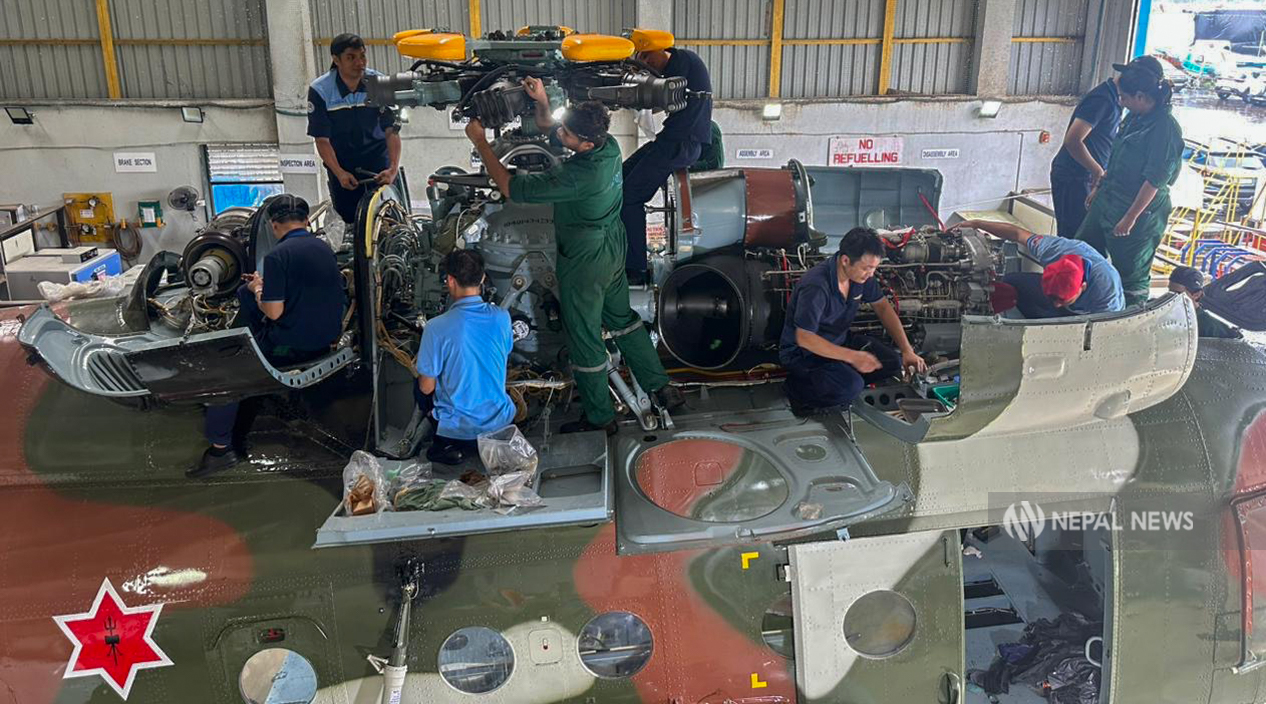
KATHMANDU: The government is preparing to deploy the Nepali Army (NA) a month ahead of the House of Representatives election slated for March 5. Throughout the election period, the NA will be responsible for securing ballot printing locations, transporting ballot papers, protecting key installations, monitoring unwanted activities, and providing third-tier security at polling stations.
For election security, the NA is planning helicopter patrols in some areas and foot patrols in others. In coordination with the Election Commission, preparations are also underway to transport ballot papers by helicopter, according to NA Spokesperson Brigadier General Rajaram Basnet. High-payload helicopters are considered indispensable for delivering ballot papers to remote and mountainous regions. However, during this sensitive election period, the army is facing a shortage of such helicopters required for aerial patrols and ballot transportation.
Out of the four Mi-17 helicopters owned by the NA, two were sent to India for maintenance. It is still uncertain when these helicopters will return to Nepal. One Mi-17 helicopter has reached a stage where it requires complete overhaul and is currently grounded in the parking area of Tribhuvan International Airport. At present, it appears that the NA has only one Mi-17 helicopter operational.
The shortage of high-payload Mi-17 helicopters has raised concerns about direct impacts on transportation to remote areas, emergency rescue operations, and election management. Army Spokesperson Brigadier General Basnet says, “For now, we are using whatever helicopters we have.”
Currently, the NA has three Sky Trucks and one air ambulance. In total, the army has 12 helicopters of various sizes. Of these helicopters, three small ones and one Mi-17 are currently flying.
The two Mi-17 helicopters sent to India for overhaul have remained stranded there. One helicopter was sent in Asoj 2080 BS (mid-Sept to mid-Oct 2023) and the other in Asar 2081 (mid-June to mid-July 2024). Both helicopters were sent during the tenure of the then Army Chief Prabhu Ram Sharma. Even after exceeding the repair period of nine months (270 days), neither helicopter has returned to Nepal. Both helicopters are at different private companies in India.
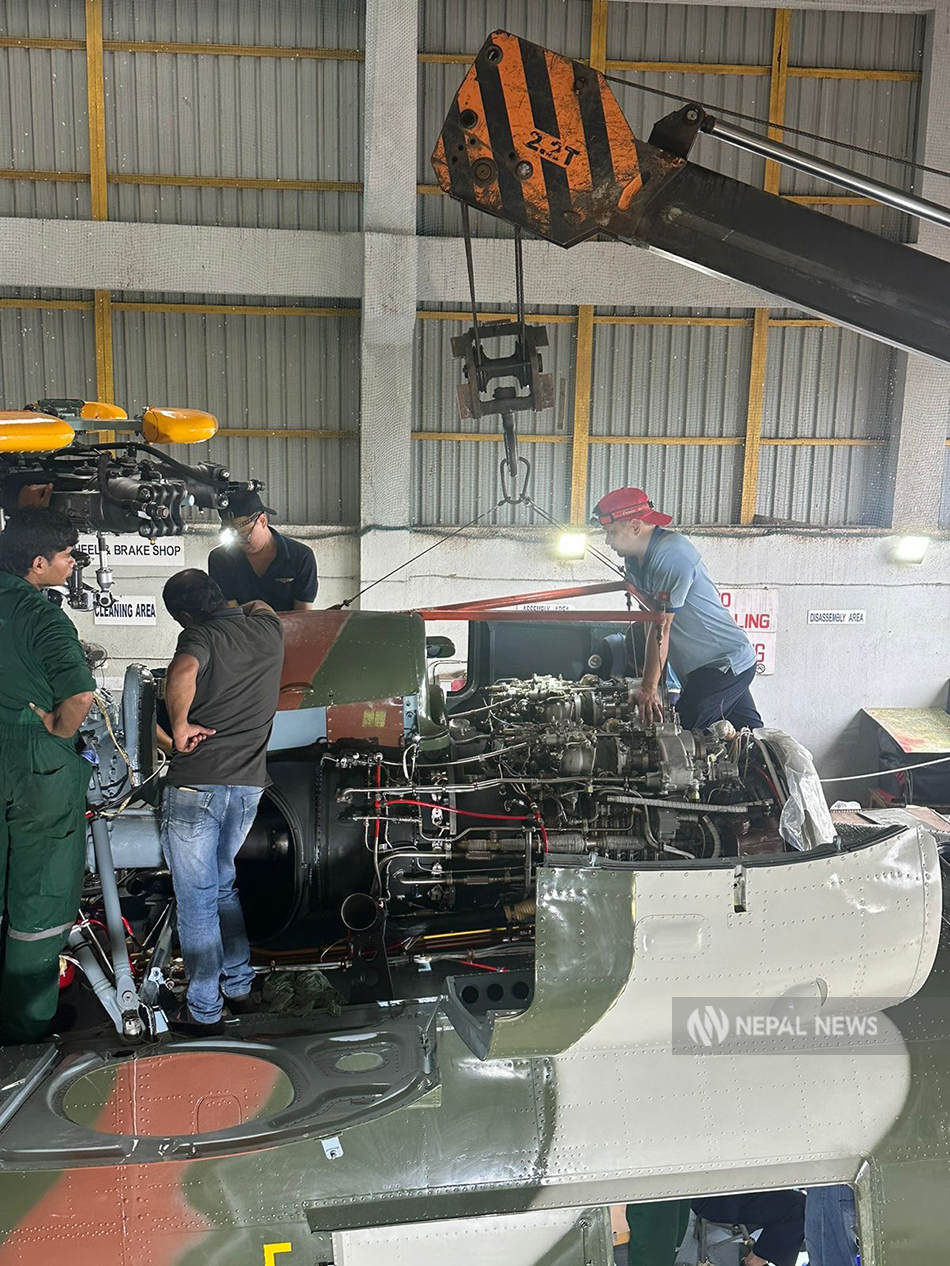
Nepal Army’s Mi-17 helicopter undergoing maintenance at Aman Aviation and Aerospace Company, India. Photo: NepalNews
The NA had sent the helicopters to India for repair under a government-to-government (G2G) agreement with Mazagon Dock Shipbuilders Limited (MDL), which operates under India’s Ministry of Defense. Among the two helicopters, repairs on one were completed more than a year ago, but there is no information on the status of the other. The army has also not provided details. Regarding this, Army Chief Ashok Raj Sigdel told Nepal News, “Ask the DPR (NA’s Public Relations Directorate) about this.”
Meanwhile, the Army Headquarters has been unable to ensure whether or when the helicopters will return from India. “The helicopters will come, but I cannot say when or how,” Army Spokesperson Basnet says. According to him, the G2G agreement and the fact that repairs are ongoing in India are true.
Both helicopters sent to India were originally purchased from Russia. The officially authorized company to repair these helicopters is Russia’s National Aviation Services Company (NASC), which is partly owned by the Russian government.
The G2G agreement story
In Asar 2080 BS (mid-June to mid-July 2023), one Mi-17 (NA-56 V-5) helicopter was grounded because it required a full overhaul. As the Russia-Ukraine war was ongoing, the army began searching for alternatives, fearing delays if the helicopter was sent to Russia. During this process, then Army Chief Sharma coordinated through Prashant Rana, a person involved in arms procurement for the NA. Rana has contacts with helicopter repair companies in India. After Rana assured cooperation, MDL coordinated with Vietnam-based Helicopter Technical Service Company (Heli-Techno) for repairs. Heli-Techno was the same company authorized by NASC to carry out helicopter maintenance.
Following this, on 30 June 2023, the NA signed a G2G agreement with MDL. The agreement was signed by MDL Director Biju George and then Major General Pradip Jung KC, chief of the army’s Office of the Ordnance General. After this agreement, the Mi-17 helicopter was taken to India on 16 October 2023. MDL handed over the helicopter to Aman Aviation and Aerospace Solutions, an MDL partner company in India. After repairs, Aman has kept the helicopter parked at Juhu Heliport, Mumbai. Despite more than one and a half years passing since the completion of repairs, the helicopter has still not returned to Nepal.
After the Ukraine war, Russia began tightening restrictions on foreign companies repairing Russian-manufactured helicopters.
As part of this, the Russian helicopter manufacturer revoked Heli-Techno’s authorization. This directly affected the NA’s helicopter.
Not only that, the Russian helicopter manufacturer also raised questions about the flight safety of the overhauled Nepali Army helicopter. In a letter sent by Rosoboronexport, the official exporter of Mi-17 helicopters, it was stated that “overhauls carried out at an unauthorized plant could lead to unpredictable consequences and the Russian side cannot guarantee the safe operation of the helicopter.”
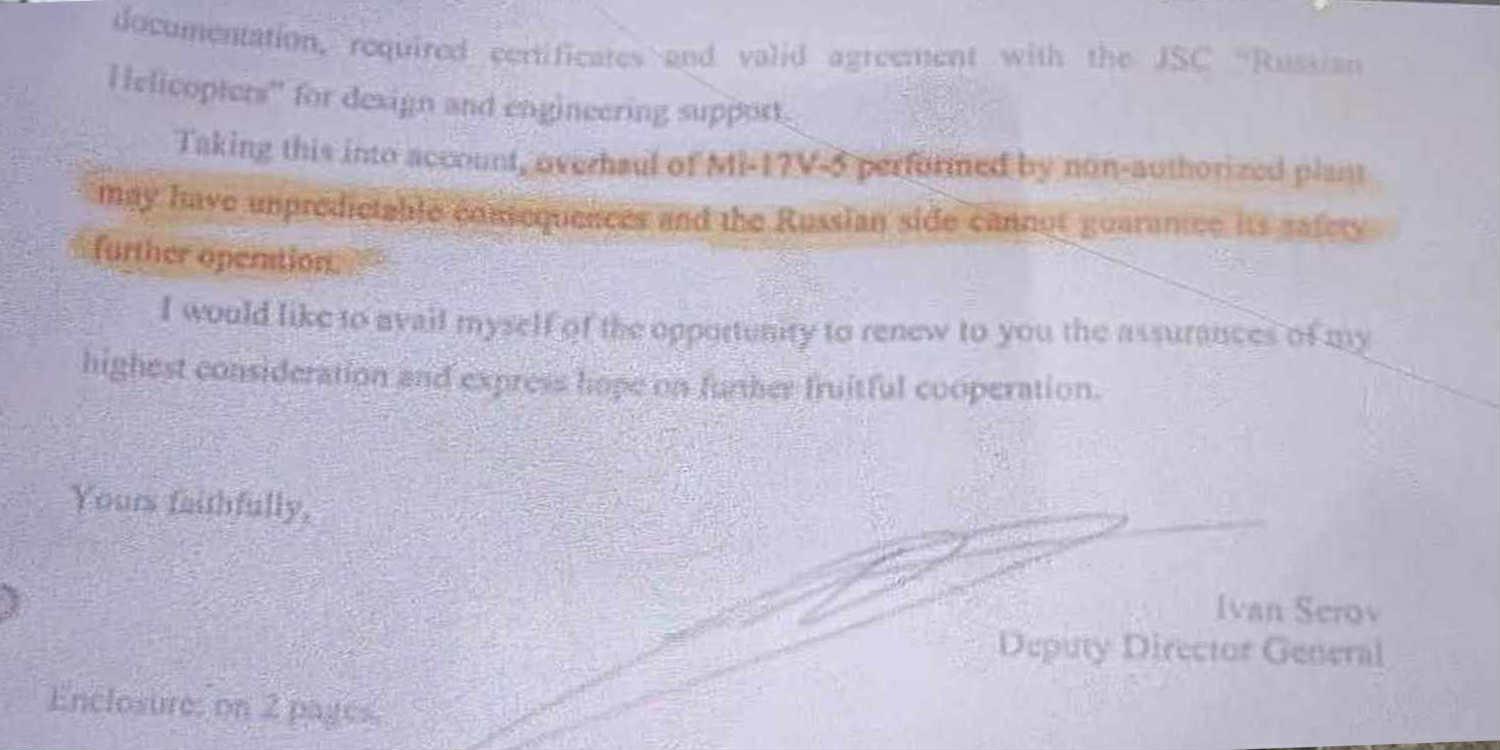
A letter written to the Nepali Army by a helicopter manufacturing company. Photo: NepalNews
Without approval from the official Russian maintenance company, the helicopter cannot even be flown—let alone brought back to Nepal. The repair contract for this helicopter was worth Rs 460 million, which the army has already paid. Parking charges for the heliport alone amount to approximately Rs 5 million per month.
The helicopter was originally purchased from Russia in 2015 for Rs 1.59 billion. The Cabinet meeting of 25 February 2013 had approved the purchase of security and defense helicopters for the Nepali Army. The helicopter arrived in Kathmandu on 9 June 2015.
Another Mi-17 in Delhi
While the first helicopter remained stranded in India, the army sent another Mi-17 for overhaul on 4 July 2024. This helicopter had been purchased from Russia in 2007 for around Rs 1.5 billion. It was handed over to Volga Overseas, another contractor working with MDL. A contract worth Rs 520 million was signed for its overhaul. The army has not been able to explain how much repair work has been completed on this helicopter. The helicopter is currently at Rohini Heliport, New Delhi. For this second helicopter, Rs 170 million has already been sent to India. It is estimated that repairing both helicopters will cost around Rs 1.25 billion. The army has refused to disclose additional costs. Army Spokesperson Basnet says, “There is information that repairs are ongoing, but I do not have further details. As this concerns national security, it cannot be disclosed.”
Out of the four Mi-17 helicopters, a third one is grounded at Tribhuvan International Airport due to lack of overhaul. To discuss repairs, Army Headquarters had invited representatives of NASC to Nepal. Eight months ago, NASC representatives visited Nepal, and the army requested facilitation to bring back the helicopters from India. “They listened but left without giving any positive assurance,” a source at the Army Headquarters said. “Now Army Chief Sigdel and the head of the Office of the Ordnance General are confused about what to do next.” Facilitator Rana claims that Vietnamese engineers came to India to repair the helicopters, spare parts were brought from Russia, and that NASC is unnecessarily creating obstacles.
Due to the prolonged delay, Rana says he is under stress. “Sometimes the Army calls me and pressures me, but I don’t even have a written contract. Based on my acquaintance with then Army Chief Sharma, I merely coordinated the transport of helicopters to India,” he says.
Current Army Chief Sigdel has not met Rana individually. They encountered each other once during a joint meeting with defense procurement contractors, but the helicopters in India were not discussed.
Statement of the former army chief
Former Army Chief Prabhu Ram Sharma told Nepal News, “This is not a big issue; it is being made into one. I sent helicopters that were grounded at the airport for repairs.”
He claims that since the helicopters were sent under a G2G agreement, it does not matter where MDL repaired them. “Who would allow an unauthorized company to repair them? Another Mi-17 is also grounded due to lack of repairs. This is being negatively publicized in the interest of some Nepali businessmen. Time may have passed; Russia may have delayed certification. Those helicopters are not going anywhere—they will return to Nepal.”
Sharma cites difficulties in procuring spare parts due to the Russia-Ukraine war, problems sending dollars to Russia, and US restrictions on dollar transfers. That’s why the army had to rely on third countries to buy spare parts of the army helicopter, he adds. “When this problem arose, I raised the issue during my India visit and asked ministers and the prime minister to request support. That’s how the G2G happened. No outsider is involved. I tried to work. Government property was sent to India through a government-to-government deal—how could it disappear?”
At the time of the G2G agreement, Kiran Raj Sharma was the Secretary at the Ministry of Defense. He says, “I am already out; don’t ask me—ask the Army Headquarters.”
The Nepali Army has long been facing difficulties in maintaining Russian helicopters and importing spare parts. Since the COVID-19 pandemic, the army has held discussions with multiple countries, including Bangladesh, Vietnam, Central Asian, and Middle Eastern nations, in search of parts.
When no solution was found, then Army Chief Sharma requested assistance from the Indian Army during his visit to India from 9 to 12 November 2021. The Indian Army, which operates 199 Mi-17 helicopters and has maintenance facilities, informed Nepal that without a formal agreement, repairs would need to be sent to a third country.
Ensuring the safety of military equipment and personnel is the primary responsibility of the Army Chief. The Army Act 2006 governs misuse of military weapons and transport equipment. Under Section 46 (b) of the Act, causing loss or damage to government property attracts legal action.
Former major general Ananta Karki states that keeping military equipment stranded abroad beyond the stipulated time constitutes a violation of the Army Act. “In the case of abandoned helicopters, the then Army leadership must be held legally accountable. Strategic state assets must not be left stranded for anyone’s personal interests.”