Kathmandu
Friday, July 24, 2026





A World Cup run that almost felled England, a blind women's team that reached a final, an international boxing bronze that made history, and a football federation so mired in politics it couldn't even let Hong Kong's players board a plane. Nepal's sporting year was as exhilarating as it was maddening.

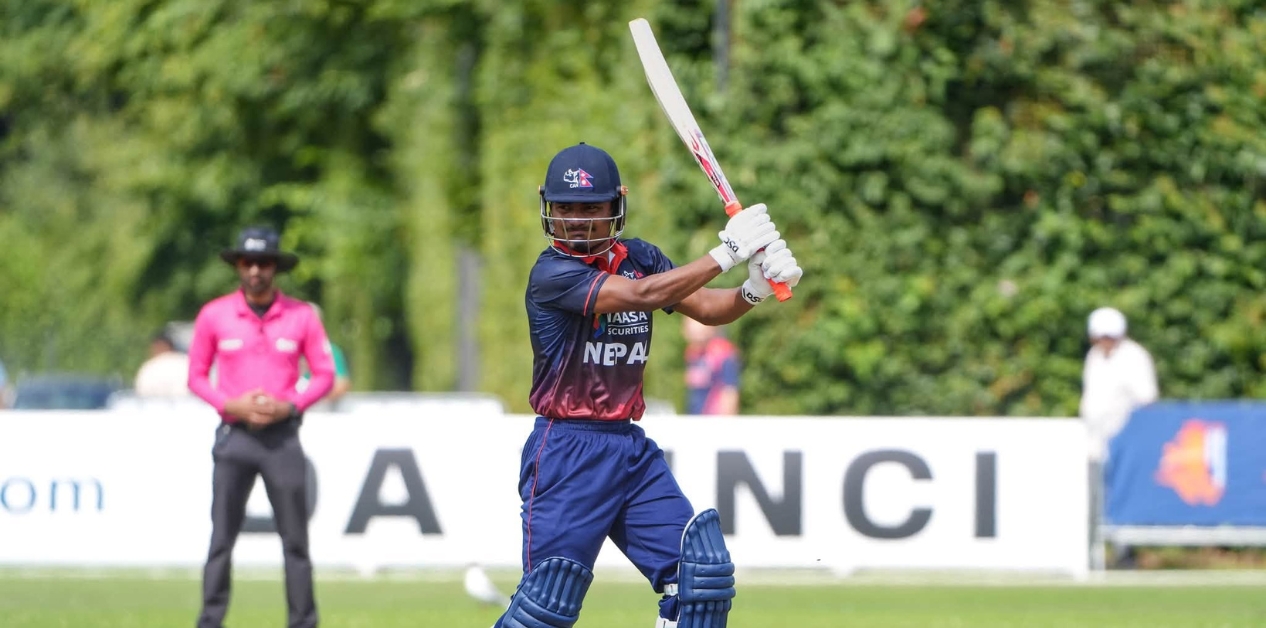
KATHMANDU: Participating in the ICC Men’s T20 World Cup for the second consecutive time and the third time overall, Nepal secured its first victory in 12 years against fellow associate nation Scotland. Nepal had already drawn attention with its performances before the tournament itself, having gone through the Asia and East Asia-Pacific regional qualifier undefeated. At the World Cup held in India, Nepal pushed two-time champions England hard.
In the match played at Wankhede Stadium in Mumbai on 8 February 2026, Nepal suffered a narrow four-run defeat, but the performance drew widespread praise. Against two-time world champions West Indies and debutant team Italy, Nepal could not maintain the same level of competition. Overall, the year was one of achievement and encouragement for Nepali cricket.
Cricket’s sustained success
The longer format did not serve Nepali cricket well this year. Having sensationally won 11 of their last 12 matches the previous year to preserve ODI status through 2027, Nepal failed to perform as expected in the ICC Cricket World Cup League 2 this year. Nepal played eight matches in League 2, winning three and losing five. Halfway through the tournament, Nepal stands seventh in an eight-team table with 12 points from 20 matches.
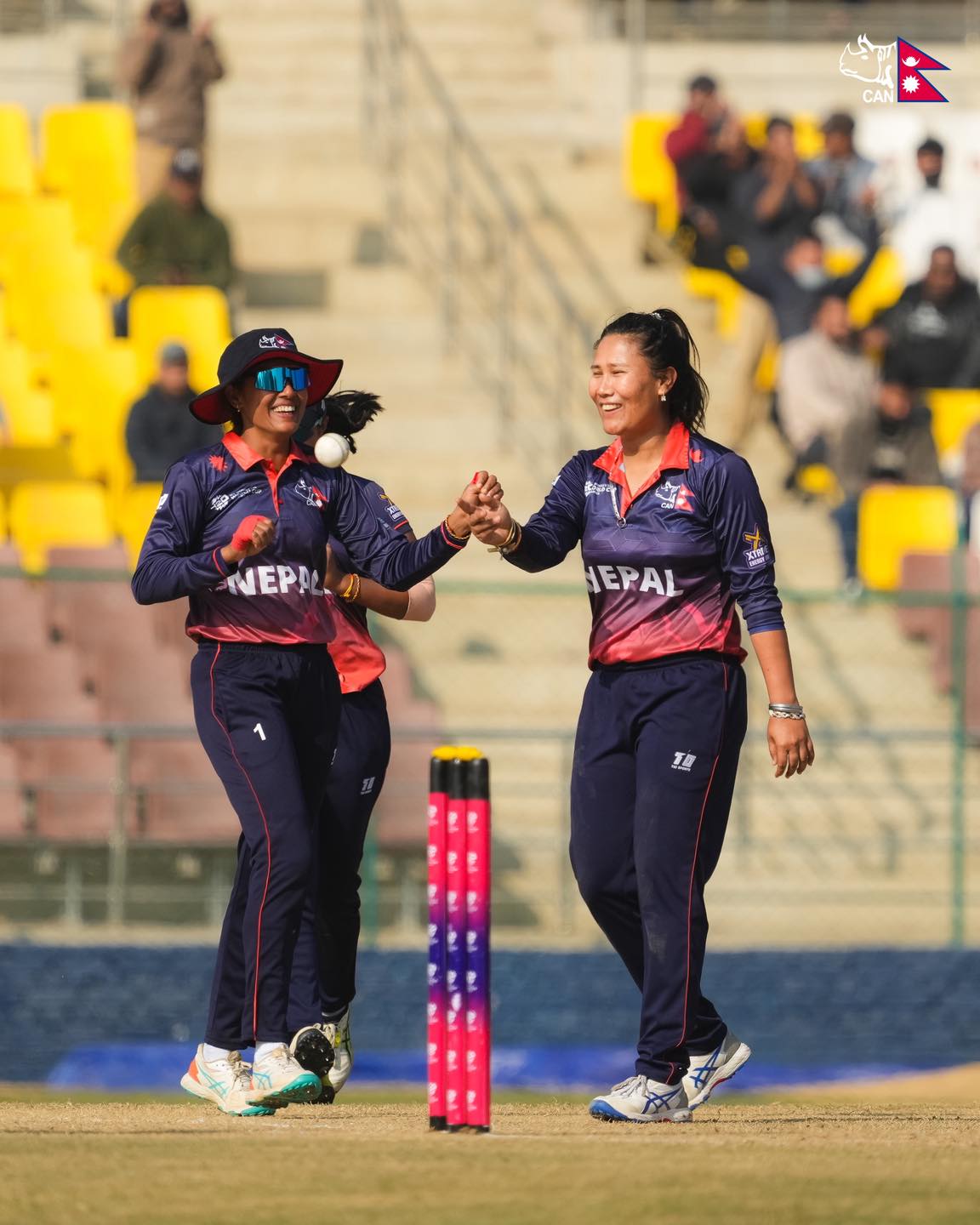
Captain Indu Barma and Rubina Chhetry (right) after taking a wicket in the ICC Global Qualifier. Photo: CAN
In the shortest format, however, Nepal produced remarkable performances. At the T20 World Cup Asia and East Asia-Pacific regional qualifier held in Oman from 8 to 17 October, Nepal started in impressive fashion in Group B, beating Kuwait by 58 runs and Japan by five wickets to advance confidently to the Super Six stage. Nepal maintained its momentum through the Super Six as well, winning all four matches convincingly. This outstanding campaign culminated in Nepal winning the title and securing a place in the T20 World Cup for the second consecutive time.
While the men’s team was unable to make the expected impact on the world stage, Nepal’s blind women’s cricket team achieved a historic feat in 2025, adding to the country’s glory.
During World Cup qualifier preparations, Nepal also achieved historic success at the Unity Cup held in Sharjah, UAE. In the tournament from 27 to 30 September 2025, Nepal defeated West Indies for the first time and won the three-match T20I series 2-1. This achievement boosted Nepal’s morale and provided an important opportunity to demonstrate their capabilities on the international stage. At the World Cup itself, however, Nepal could not reproduce those performances against the same side, suffering a heavy 30-run defeat. “The World Cup was memorable for us. We got to play against big teams. Losing to England was unfortunate, but we are treating this World Cup as preparation for League 2,” says captain Rohit Kumar Paudel.
While the men’s team was unable to make the expected impact on the world stage, Nepal’s blind women’s cricket team achieved historic feats in 2025, adding to the country’s glory. Nepal finished runners-up at the inaugural Blind Women’s T20 World Cup, jointly hosted by India and Sri Lanka from 11 to 25 November 2025. Nepal made a strong impression in the league stage of this first-ever edition, defeating Sri Lanka, Australia, the USA, and Pakistan.
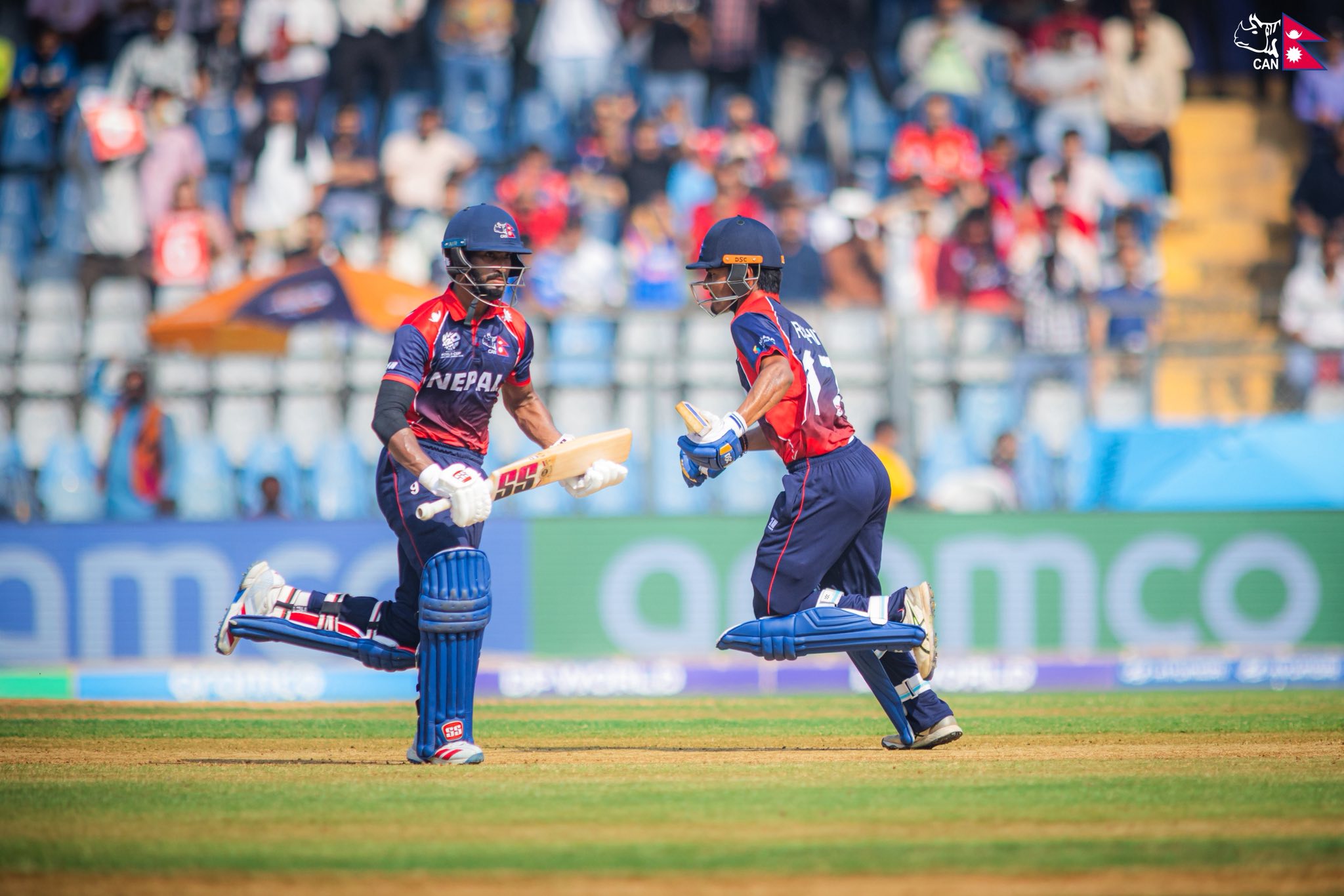
Asif Sheikh and captain Rohit Paudel batting against England in the T20 World Cup. Photo: CAN
Nepal was beaten by 85 runs against India in the group stage, but then reached the final by defeating Pakistan by seven wickets in the semifinal. In the final, however, facing India again, Nepal was defeated by a wide margin of seven wickets, falling short of a historic title.
In 2025, the Nepal women’s cricket team achieved a significant milestone by qualifying for the T20 World Cup Global Qualifier for the first time, a historic feat in itself, though the team was unable to perform as expected in the tournament.
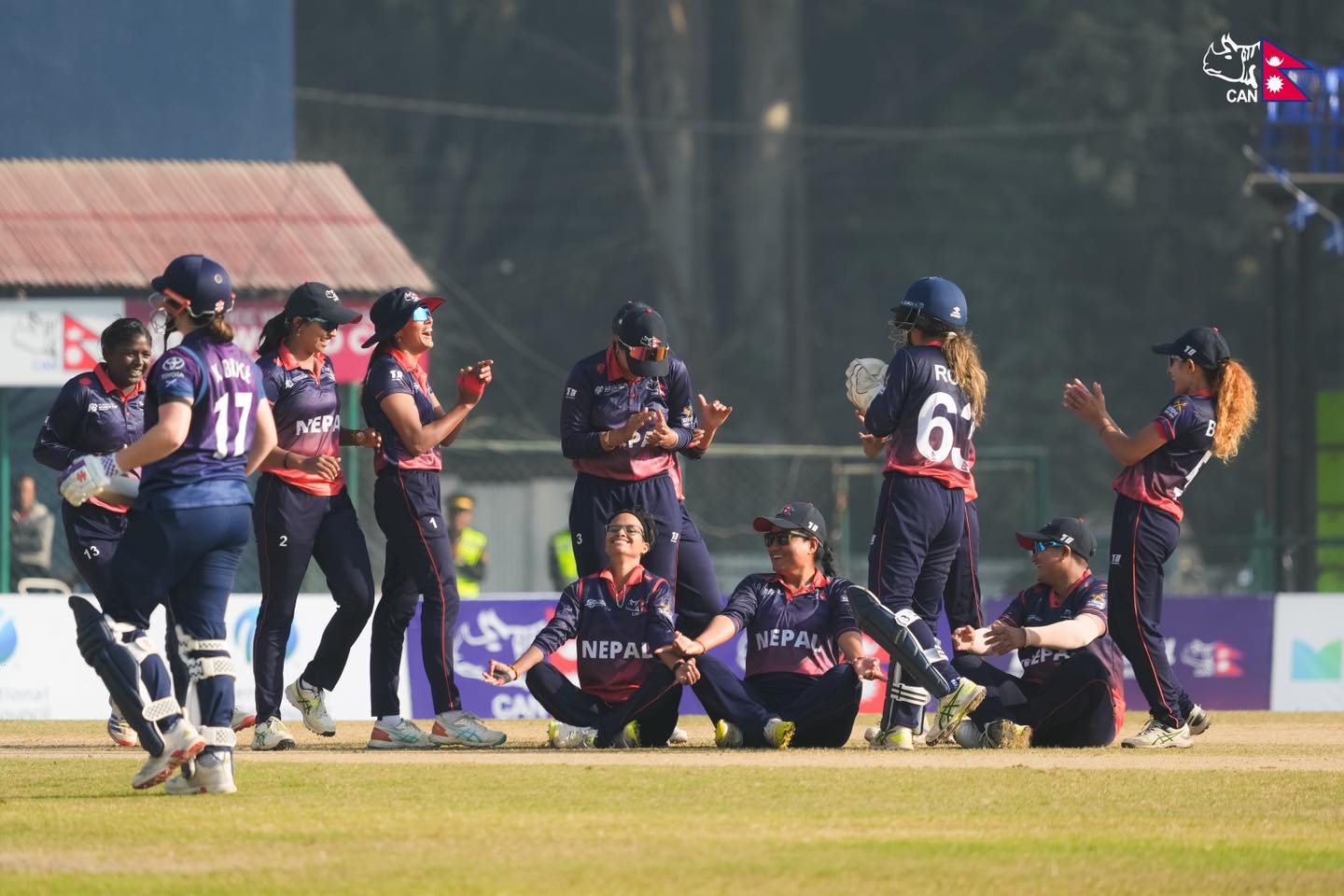
Nepal women’s team celebrating after taking a wicket against Scotland in the ICC Global Qualifier. Photo: CAN
The tournament held from 18 January to 1 February at Mulpani International Cricket Ground and Tribhuvan University International Cricket Ground in Kirtipur represented a special opportunity for Nepal; it was the first time such a major event had been hosted on home soil. Despite hopes of using the advantage of home support and familiar conditions, Nepal could not convert that into results.
Apart from a six-wicket win over Zimbabwe, Nepal lost their remaining matches. The consecutive defeats put the team under pressure. Nepal ultimately missed the golden opportunity to qualify for a World Cup from home soil for the first time, says captain Indu Barma. “This was a good chance for us. But we could not perform to the level we had hoped. We fell short in every department,” she says.
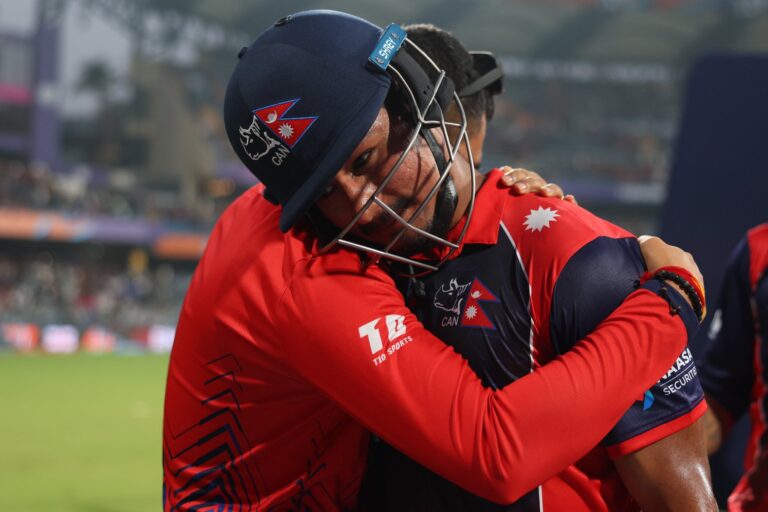
Nepali batter Lokesh Bam in tears after defeat to England in the T20 World Cup. Photo: CAN
Another major positive development for Nepali cricket was the second edition of the Nepal Premier League (NPL), which elevated Nepali cricket to new heights both financially and commercially. The participation of internationally renowned players such as Faf du Plessis, Martin Guptill, Wayne Parnell, D’Arcy Short, Sohail Tanvir, Chris Lynn, and Ravi Bopara made the league even more attractive.
The financial side
The second edition was also a financial success. According to figures released by the Cricket Association of Nepal (CAN), the second season of the NPL generated a profit of over Rs 92.1 million, Rs 67 .4 million more than the first edition, which had produced a net profit of Rs 24.6 million.
Expenditure was also somewhat higher than the previous season, up by Rs 18 million from the previous season’s over Rs 201.5 million.
This season CAN earned more than Rs 473.6 million and spent Rs 219.6 million on running the tournament. This gives a total income of Rs 253.9 million before revenue sharing. Of this, CAN is preparing to distribute Rs 161.8 million to the eight franchise teams.
Expenditure was also somewhat higher than the previous season, up by Rs 18 million from the first season’s Rs 201.5 million. Overall, the second edition of the NPL further strengthened the commercial potential, fan appeal, and international profile of Nepali cricket.
Disappointment in football
Football, like cricket, had the opportunity this year to raise its standing. In a year when CAN successfully ran a league generating nearly half a billion rupees in revenue, football instead struggled with instability. Not only was the A Division League, considered the backbone of football, nowhere to be seen, but also the national league, barely revived after a ten-year gap, had to be suspended before it could be completed.
More distressing still, the All Nepal Football Association (ANFA) itself was hit with a three-month suspension by the National Sports Council (NSC). On 25 March, NSC suspended ANFA for repeatedly failing to follow directives, attempting to proceed with an election process without approval, and providing unsatisfactory explanations, with proceeding contrary to executive committee decisions identified as the primary cause.
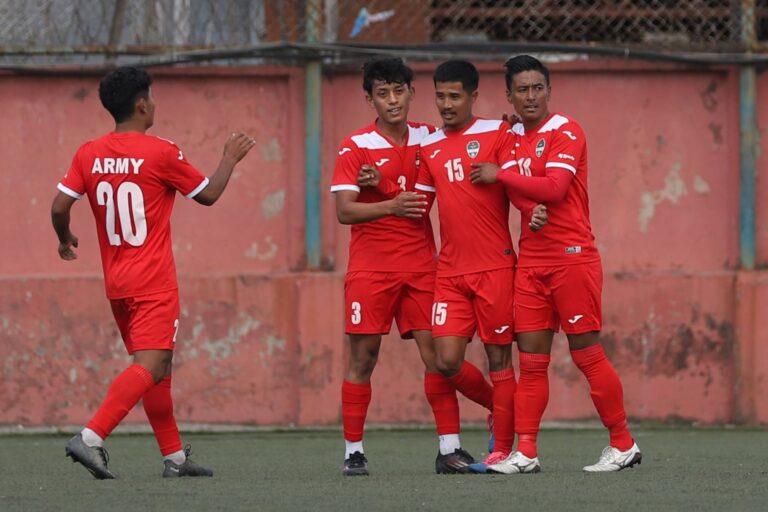
Army players celebrating after scoring against Satdobato in the National League. Photo: ANFA
ANFA had moved forward with its general assembly and election process without NSC approval. On 27 March, ANFA’s founding faction attempted to hold a general assembly and election in Jhapa despite NSC intervention. Finding the process contrary to applicable law, NSC suspended ANFA two days before the scheduled assembly and election.
With ANFA barred from any administrative or electoral activity during the suspension, the scheduled general assembly and election process had to be suspended via a press conference. More distressing still, three international fixtures were also called off. A friendly against Hong Kong had been scheduled for 26 March at Dasharath Stadium in Tripureshwar, arranged as preparation for the AFC Asian Cup 2027 qualifier against Laos. ANFA blamed NSC for not making the stadium available, stating that it had repeatedly requested the venue and necessary infrastructure but that approval had not come in time.
NSC for its part published letters as evidence that approval had already been granted, with the Organization and Institution Coordination Section disclosing that it had given approval through the General Administration Section as early as 17 March for use of the stadium, floodlights, scoreboard, and other infrastructure.
Once this came to light, ANFA stopped Hong Kong’s team, which had already purchased tickets to come to Nepal, from travelling. In reality, Nepali football had been in an unstable state even before this. Players had taken to the streets demanding that the A Division League, which had not been held since 10 June 2023, be run regularly.
Politics cast its shadow over sport too. If everything had been kept out of the political arena, or if there had been better leadership, some success would have been within reach.
On the initiative of then-Youth and Sports Minister Bablu Gupta, multiple rounds of talks were held between ANFA, clubs, and players. An agreement was reached to start the national league on 14 January 2026, followed by the A Division League one month later. But before the 12th round of the national league could be completed, ANFA found itself drawn into an investigation by the Department of Immigration over allegations that more than 38 foreign players had been fielded without approval. This deepened the problems, leading to the suspension of the 17-team league on 19 March. The ten-team ANFA Women’s League was also suspended before completing its first stage.
Despite all these problems, the Nepali national women’s team had been scheduled to play the FIFA Women’s Series beginning 12 April in Bangkok, Thailand. But ANFA withdrew Nepal’s name from the series citing its own suspension, forcing players who had been waiting four months for international action to return home from ANFA Complex in Satdobato with their boots and balls.
Beyond this, Nepal’s men’s team went through the AFC Asian Cup qualifier without winning a single match, apart from the 3-0 result awarded when FIFA penalized Malaysia. Nepal finished bottom of Group F in qualifying for the AFC Asian Cup to be held in Saudi Arabia in 2027. In the double round-robin tournament, Nepal picked up just three points from six matches, losing five. Most distressingly, Nepal had to play three matches supposed to be home fixtures on foreign soil because the venue was deemed unsuitable. “If all those matches had been played at home, the results might have been different,” says captain Kiran Kumar Chemjong.
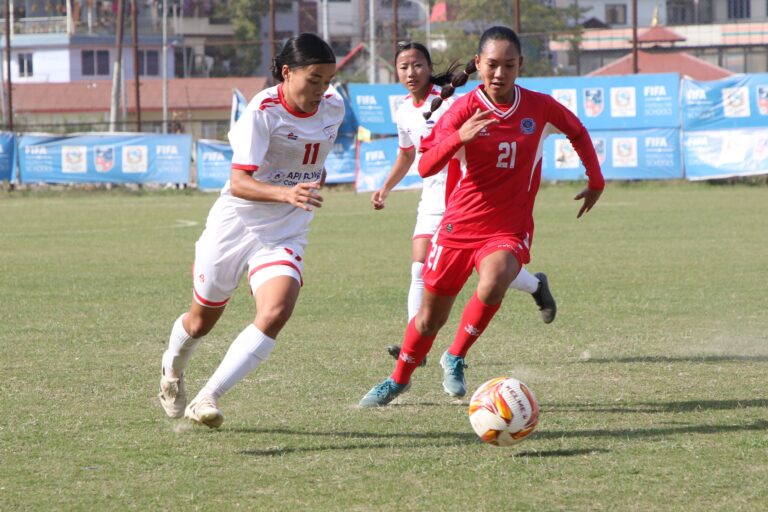
Army’s Susma Tamang (in red jersey) stealing the ball against Church Boys. Photo: ANFA
On the other side, the women’s team put in strong performances at the AFC Women’s Asian Cup qualifier in Uzbekistan from 7 to 19 July 2025 but was still eliminated at the group stage. Sabitra Bhandari ‘Samba’ had scored a tournament-high nine goals to bring Nepal close to qualifying, but after finishing level on points and goals with hosts Uzbekistan, Nepal lost the deciding tie-breaker 4-2. Sabitra herself, who had shared the tournament’s top scorer honor, missed in the tie-breaker.
Nepal also failed to make a significant mark in age-group competitions. The women’s team reached the SAFF U-20 Championship final but had to settle for runners-up, while the men’s team was eliminated at the semi-final stage after losing to Bangladesh at the SAFF U-20 Championship. Former Nepal captain and goalkeeper Upendra Man Singh sees this as ANFA’s failure. “Politics cast its shadow over sport too. If everything had been kept out of the political arena, or if there had been better leadership, some success would have been within reach,” he says.
Historic success in boxing
Nepal made history in boxing this year. Chandra Bahadur Thapa won a bronze medal at the IBA Men’s World Boxing Championships held in the UAE from 3 to 14 December 2025, writing a new chapter in Nepali sports history.
Competing in the 54 kg weight category, Chandra Bahadur defeated opponents from Armenia, Indonesia, and Iran to reach the semi-finals, also securing 75,000 US dollars in prize money. He was defeated in the semi-final by a Kazakhstan boxer ranked seventh in the world. With this achievement, Chandra Bahadur became the first Nepali boxer to win a medal at the World Boxing Championships.
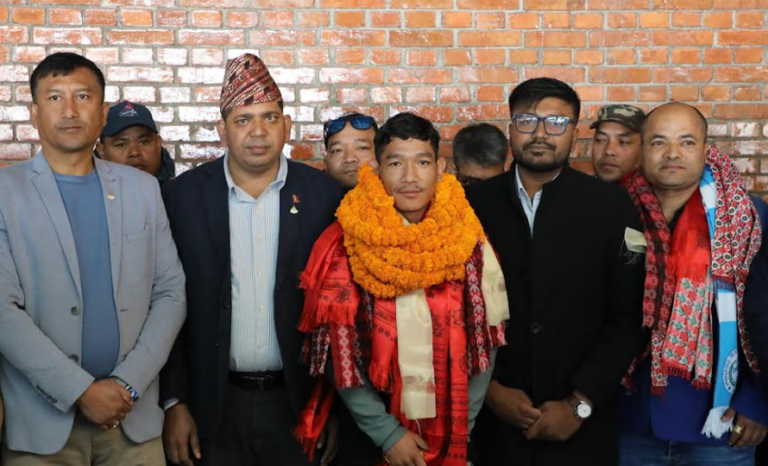
NSC officials, including then Minister Bablu Gupta, welcoming boxer Chandra Bahadur Thapa. Photo: NSC
Alongside Chandra Bahadur, five Nepali boxers competed in the tournament. Lal Prasad Upreti in the 48 kg category, Phunglang Kamwang at 51 kg, Khagendra Roka Magar at 60 kg, and Dipak Shrestha at 80 kg. Of these, Lal Prasad advanced to the quarter-finals and earned 10,000 US dollars, while the remaining boxers were eliminated in the first round.
Kabaddi’s disappointment
The Nepali team travelled to Dhaka with the target of reaching the final of the second Women’s Kabaddi World Cup, but once again fell short. The World Cup, being held for the first time in 13 years, was originally scheduled for Bihar, India in June 2025, but was repeatedly postponed and relocated, first to Hyderabad, then finally held in Dhaka, Bangladesh.
At the tournament in Dhaka from 15 to 25 November 2025, Nepal put in a generally solid performance in Pool B but failed to reach the semi-finals. Nepal started brightly with a 58-16 win over Zanzibar, followed by an impressive 63-25 victory over Poland.
A 31-15 defeat to Chinese Taipei in the third match made Nepal’s path more difficult. A 28-21 win over Kenya in the fourth match kept semi-final hopes alive, but in the crucial decider Nepal needed to beat Iran and instead suffered a heavy 39-11 defeat, ending their campaign.
The 10th national games – still not held
Had things gone as they should, the government would now be preparing for the 11th National Games. But the flag of the 10th National Games, passed from Pokhara on 20 October 2022, still has not reached Surkhet.
At the closing ceremony of the ninth National Games held in Gandaki Province, then-Prime Minister Sher Bahadur Deuba handed the flag to then-Karnali Province Social Development Minister Yagya Bahadur BC, with the 10th National Games designated for Karnali Province.
Even in the current fiscal year 2082/83 BS (2025/26), Rs 540 million had been allocated for the games. But then-Sports Minister Chaudhary resigned following the Gen Z movement of September 8 and 9 last year, leaving the games in limbo.
The games had been scheduled for 17 to 24 November 2024 before then-Sports Minister Teju Lal Chaudhary suspended them citing inadequate physical infrastructure. The 118th NSC board meeting then set a new date of 5 April 2025, which was again moved, citing financial reasons, to 18-24 May 2025. A secretariat and 11 subcommittees had already been formed, and a logo and mascot had been publicly unveiled, before once more being postponed.
In Jestha 2082 BS (mid-May to mid-June 2025), the main organizing committee’s secretariat for the 10th National Games was set up in Surkhet. A logo and mascot had been unveiled on 18 March 2025 for an event. A budget of Rs 600 million was allocated in fiscal year 2024/25, and Rs 540 million in the current year 2025/26. Yet the games were never held. Then-Sports Minister Chaudhary resigned following the Gen Z movement, further destabilizing the situation. The minister who took over on 26 October 2025, Bablu Gupta, obtained cabinet approval to hold the games from 13 to 19 February but with the House of Representatives election approaching, the games were once again deferred to a “suitable time.”
NSC acting member secretary Ram Charitra Mehta says the year can fairly be described as moderate for Nepali sport. “Everyone is aware of the current situation. We are working to address the shortcomings of the past. Looking at the achievements we have secured, it should be regarded as reasonable,” he says.