Kathmandu
Sunday, July 19, 2026





From ash and rubble left by the Gen Z movement, Kathmandu's District Administration Office has reinvented itself. With fixers gone, windows replaced by open rooms, and staff who smile instead of snap, service-seekers say it finally feels less like a government office and more like walking into a bank.

KATHMANDU: On Wednesday (April 8), Miki Lama of Balaju arrived at the Kathmandu District Administration Office to process some documents and was struck by what she found. She was telling fellow visitor Manoj Adhikari, who was seated in the next chair, “Before, you had to stand in a line outside the window. If you asked something you didn’t understand, staff would snap at you. You’d wish you never had to come here. Now everything has completely changed.”
Manoj, visiting the district administration office for the first time, agreed. “I’ve had a terrible time at other government offices. This doesn’t feel like a government office; it feels like walking into a private bank.”
A year earlier, Miki had experienced nothing but frustration at this very office. After standing in line all day without getting her work done, she would head to the canteen and find fixers waiting there with offers to sort things out. “Staff would send you from one window to another. Getting one thing done took two days. But if you used a fixer, it happened instantly,” she says.
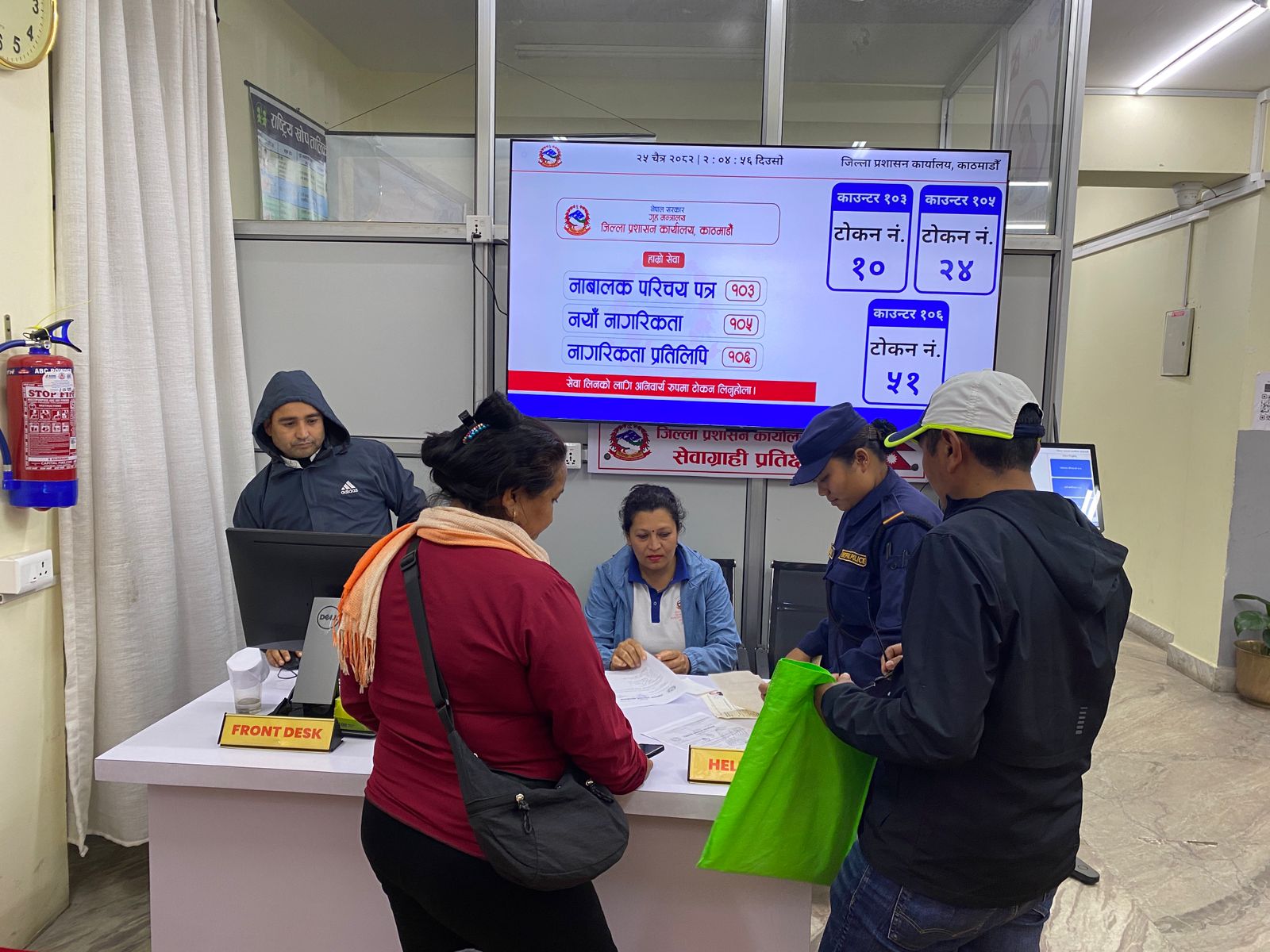
Officials verifying the documents of service-seekers. Photo: Gopal Dahal
This time her experience was entirely different. There was no standing outside a window, and no fixers to be seen. She walked straight into the room, showed her documents to a staff member, and when she asked things she didn’t understand, they answered patiently. After checking her papers, the staff member gave her a token, and she sat down on a chair provided for visitors right there in the room to wait for her turn. No queue, no sun or rain to endure.
Every visitor to the Kathmandu District Administration Office (popularly known as the CDO office) now has the same experience as Miki and Manoj. The transformation has been three months in the making. Before that, it was the same old story of delays and confusion.
Now, every morning at precisely 8:57, a voice addressing all staff in every room of the office issues instructions on providing good service to visitors. The national anthem then follows, and all staff and visitors rise.
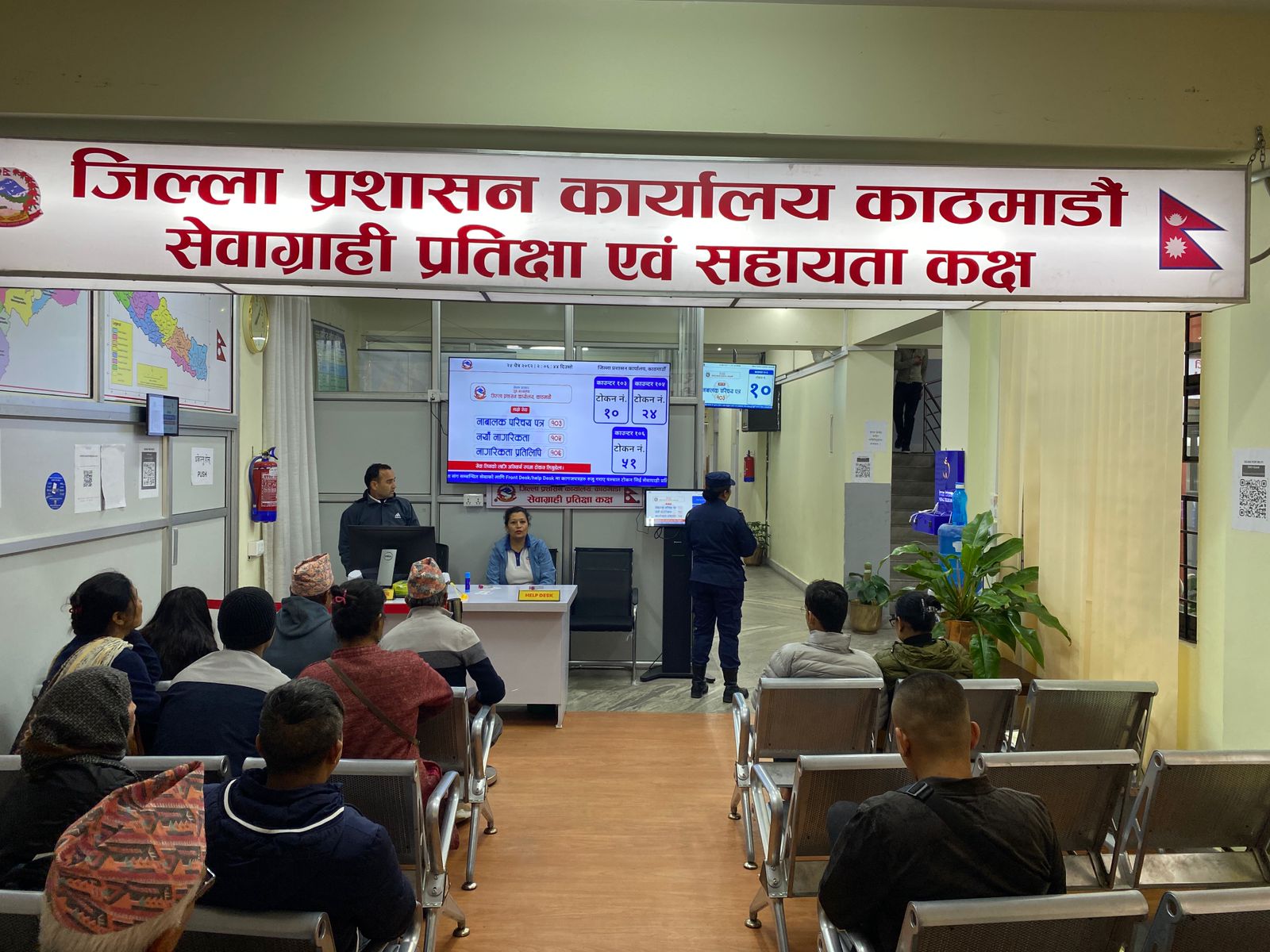
Service-seekers waiting for their turn after receiving tokens. Photo: Gopal Dahal
Work then begins. At 1 p.m., a lunch break announcement is made three times over the system, asking visitors to wait patiently for the 30-minute break. At 4:50, a final announcement thanks staff for the day’s service and directs them to verify the day’s work before leaving.
The Chief District Officer (CDO) monitors from his own office what is happening in every room throughout the day. If he sees a visitor looking confused, he immediately addresses staff over the microphone. When this reporter visited on Wednesday, CDO Ishwar Raj Paudel was watching his monitor and calling down to a lower-floor staff member, “Why is the next room crowded when yours is empty? Have a look.”
The staff member went to the other room, understood the problem, and returned to work. Moving from room to room through the office, one did indeed sense what visitors had described – something like a bank. Staff and visitors were close together. Staff demeanor was cheerful. CDO Paudel said, “This is exactly the transformation we are trying to bring about – making visitors happy.”
How did the change happen?
This office had a direct connection to the Gen Z movement of September 8 and 9 last year. Protesters had obtained permission from this very office for a peaceful demonstration on September 8. But the movement turned violent. After demonstrators broke through the barricade at New Baneshwar, then-CDO Chhabi Lal Rijal issued a curfew order from 12:30 p.m. to 10 p.m. Protests continued near the southern gate of the Federal Parliament building even during the curfew, and police opened fire, killing 19 demonstrators.
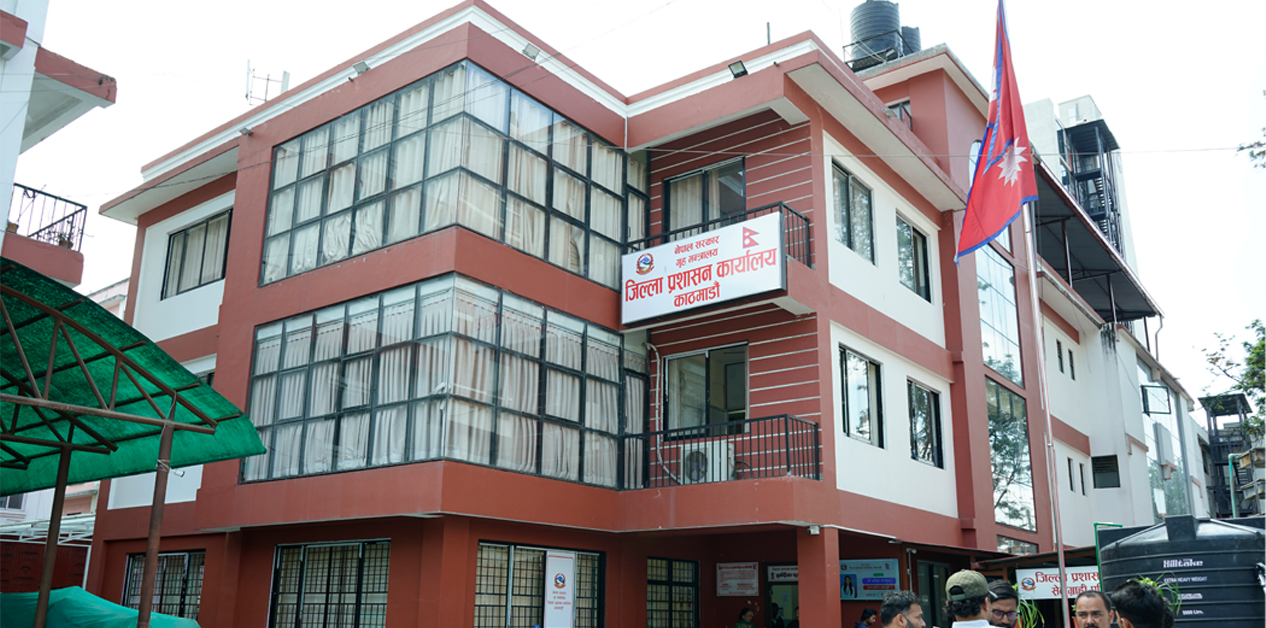
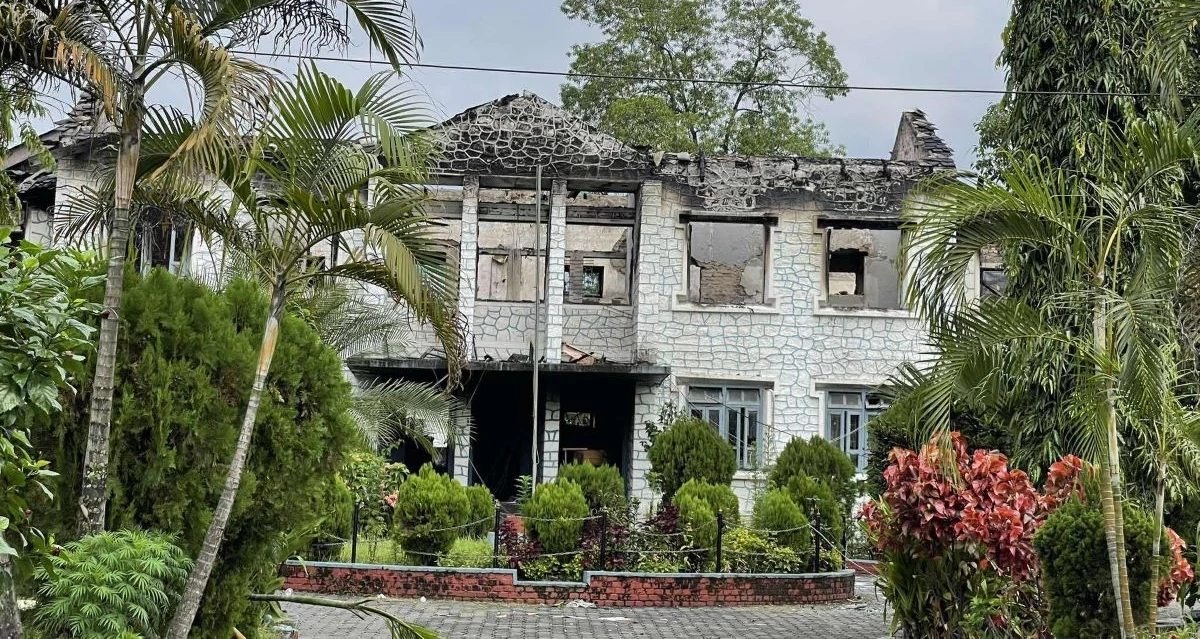
Kathmandu District Administration Office. Photo: Bikram Rai
On September 9, parliament, Singha Durbar, and many other government offices came under attack from Gen Z movement protesters. Demonstrators set fire to the Kathmandu District Administration Office and destroyed it. The office remained closed for many days. Then-CDO Rijal, accused of using excessive force during the movement, was recalled to the Home Ministry.
Ishwar Raj Paudel took charge as CDO in his place 25 September 2025. The office was in ruins; tables, chairs, and documents had burned down to piles of ash. His challenge was to sweep aside that ash and begin working. CDO Paudel chose to treat this challenge as an opportunity as well. Tents were pitched on the office premises as an immediate measure and work began. The central demand of the Gen Z movement had been good governance. He decided to start practicing good governance from his own sphere. “I started working with the thought that this is the opportunity to remove the old ways and habits and build a visitor-friendly office using technology appropriate to the times,” he says.
He envisioned a new model to make the service delivery of the office, which sees around 1,000 visitors a day, transparent, accountable, and governed well. He coined the model’s name himself – the Public Announcement System, or PAS.
He presented his plan to the Home Ministry and held discussions over several stages with IT specialists there. Implementing the model he had envisioned would cost between Rs 5 to 6 million, a difficult sum to raise at a time when Singha Durbar and most major government buildings had been reduced to ash. But he stepped forward to secure the resources himself. The Home Ministry and Kathmandu Metropolitan City contributed some funds, with further support from other municipalities in Kathmandu district, the Tilganga Foundation, and banks.
The old office having burned down, it was unworkable. Nearby sat the unused building of the Department of Food Technology and Quality Control. The building was completed four years earlier but never handed over and with the contractor still unpaid. CDO Paudel completed all necessary procedures and arranged to move the office into that building.
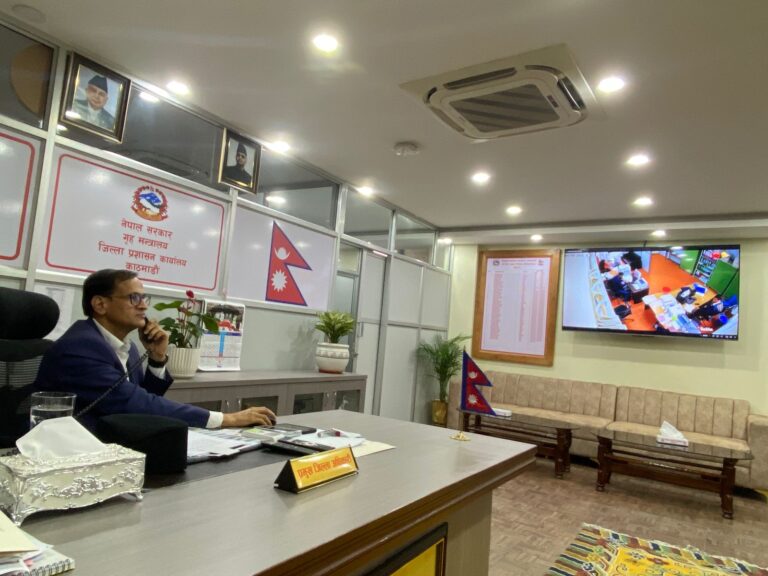
Chief District Officer Ishwar Raj Paudel observes service seekers from his office. Photo: Gopal Dahal
Once relocated, he began making every element of the office visitor friendly.
Previously, staff sat inside at their desks while visitors queued for hours outside at windows. This was changed so that visitors come inside the same room as the staff, with seating provided within the office. Staff verify visitor documents and issue tokens. Every room is designed so that staff and visitors are together. High-quality CCTV and sound systems are installed throughout.
A system was built that allows the CDO to monitor, issue directions to, and listen to all rooms from his own office, from the canteen to every room in the building. CDO Paudel says, “After the Public Announcement System was implemented, staff and visitors came closer together, and fixers kept their distance on their own. Once the fixers were gone, many things became easier.”
Inaugurated on 26 December 2025 by then-Home Minister Om Prakash Aryal, the PAS and token system bears a board dedicated by the district administration to the Gen Z good governance fighters of September 2025.
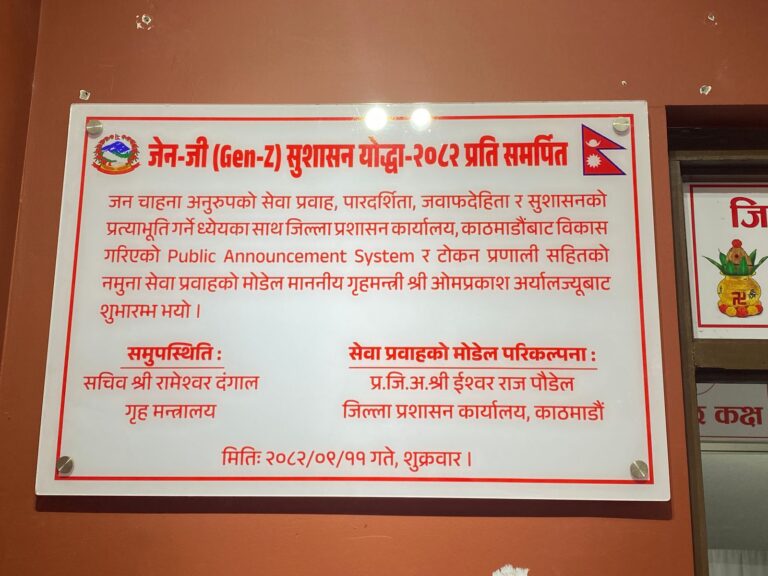
The board dedicated to the “Gen Z good governance fighters” hung at the Kathmandu CDO office. Photo: Gopal Dahal
After inspecting the transformation on 16 March 2026, then-Prime Minister Sushila Karki offered her praise, and CDO Paudel used the occasion to suggest the model could be applied to any high-traffic government office. He says the Home Ministry is now drawing up plans to roll out similar reforms at the CDO offices in the other 76 districts. “This model can be implemented down to every municipality and ward,” he says. “Even if costs are higher initially, it improves governance. Public trust can be won.”
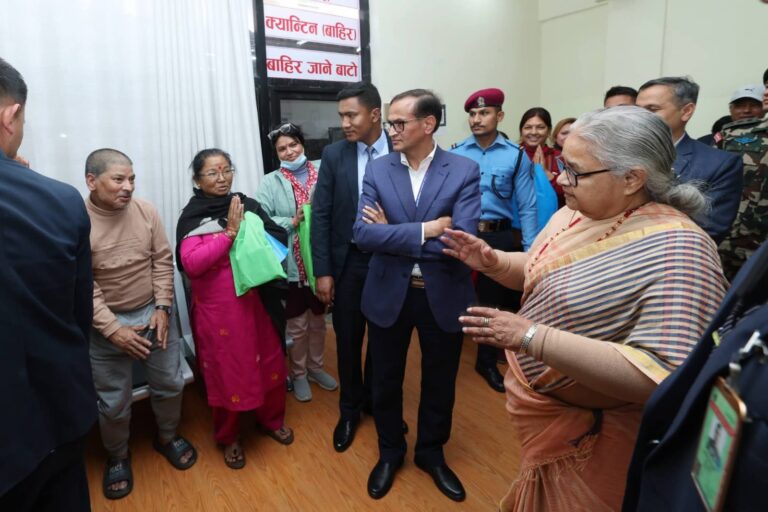
Then-Prime Minister Sushila Karki during an inspection of the Kathmandu District Administration Office on March 16, 2026. Photo: Kathmandu DAO website
When the CDO himself experienced the ordeal
Paudel entered administrative service as an officer in 2004, became under-secretary in 2010 and joint secretary in 2015. Over 22 years in service he has not simply occupied his posts; wherever he has served, he has made some effort at reform.
As director general of the Department of Immigration, he implemented a digital system called Nepali Port, after which immigration operations improved. He also introduced a digital system during his time at the Lumbini Province Chief Minister’s Office.
After four years as Nepal’s consul general in Kolkata, Paudel returned to Nepal and came to what is now his own office, the Kathmandu District Administration, to obtain his son’s citizenship certificate. It took him two days. During that time, he experienced the ordeal firsthand and witnessed other visitors going through it too.
Having worked across the Home Ministry and various other ministries, he placed himself in the position of an ordinary visitor and evaluated the government service. “The hardship I experienced going to a government office as a member of the public myself gave me knowledge of where and what needed to be reformed. The ideas for reform here came from my own experience,” he says.
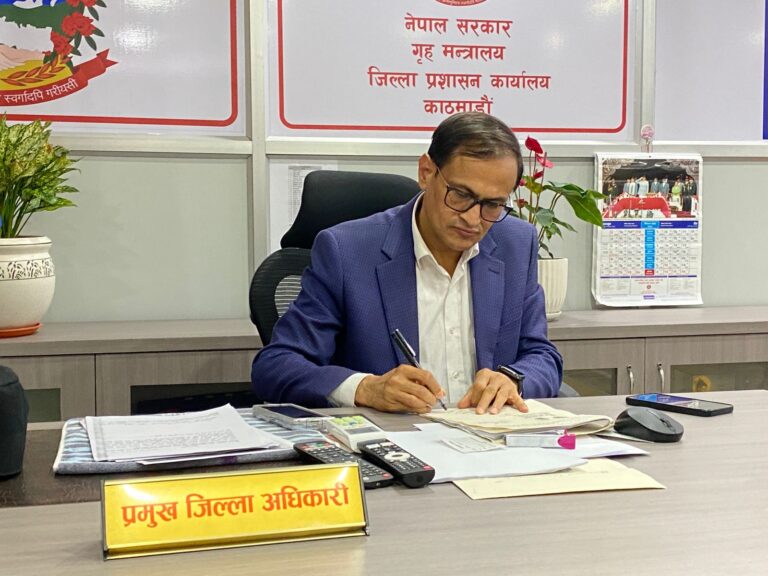
CDO Ishwar Raj Paudel. Photo: Gopal Dahal
He believes that poor service delivery at government offices stems from a lack of human empathy among staff, and that many treat their work purely as a job rather than as service. He sees modern technology as a tool for better governance and says that constantly thinking about how to make service easier for visitors generates new ideas. “I’d passed many exams in life. I thought I should now pass in service delivery too, and that thought gave rise to this system,” he says.
When CDO Paudel arrived at that way of thinking, visitors like Miki and Manoj found their own view of government offices changing. Miki, who once wished she never had to visit a government office, has had that view transformed by her experience at the CDO Office, Kathmandu. Seeing the change here reminds Manoj of the ordeal he still endures at the transport and land revenue offices. “If this model could be applied to other government offices, it would be a relief for visitors like us,” he says. “This example has already shown that reform is possible when the government chooses to make it happen.”