Kathmandu
Friday, June 12, 2026





While demands were made to declare Lakhan a martyr, the six individuals who achieved martyrdom alongside him were left out—which is an outright injustice.
KATHMANDU: Rebellions and movements have periodically erupted in the country to uproot and overthrow autocratic regimes. Due to state suppression during those uprisings, several participants have had to lay down their lives. Those who achieved martyrdom while plunging into movements for democracy and civil liberties remain eternally memorable.
Lakhan Thapa Magar is one such unforgettable martyr who not only raised his voice against the familial, autocratic regime sowed by Jung Bahadur Rana, but also organized citizens by running a parallel government. He belonged to the Ruchal clan of the Thapa Magar community.
Having once served in the military during Jung Bahadur’s own reign, Lakhan had closely observed the autocracy of that era. Later, taking refuge in spirituality, he proclaimed himself the reincarnation of Siddha Lakhan Thapa, a revered saint from the era of King Ram Shah. He called upon the public to join the rebellion, claiming that “Goddess Manakamana ordered him to kill Jung Bahadur and usher in a golden age in the country.”
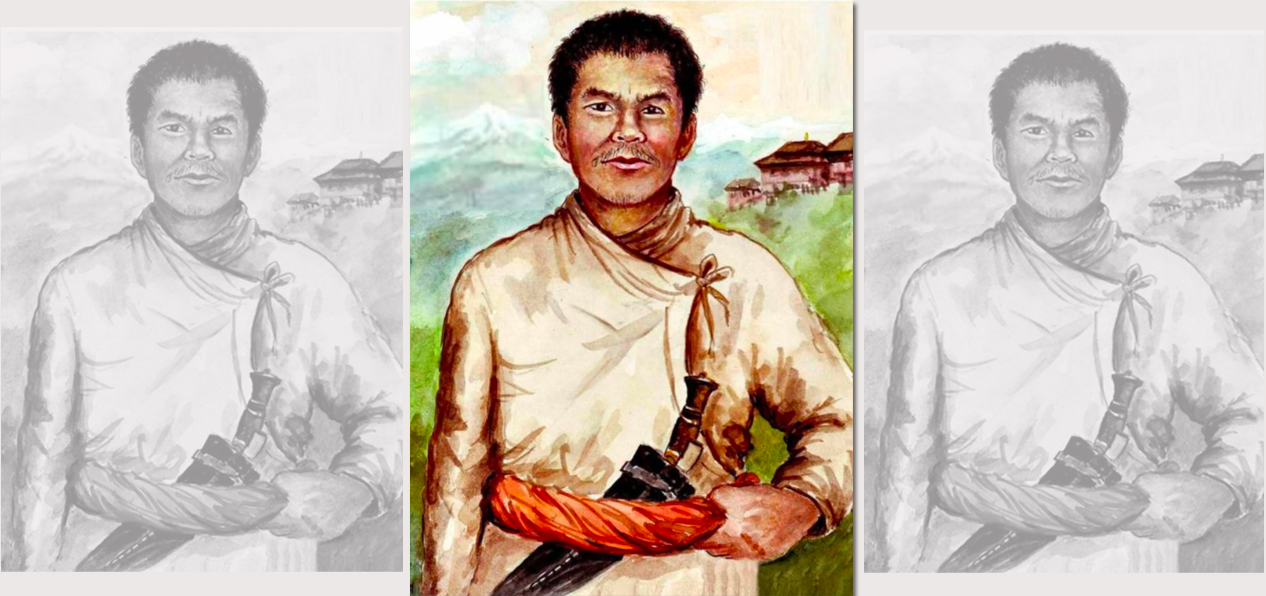
Imaginary portrait of Lakhan Thapa
According to an old note as well as the writings of Padma Jung, the son of Jung Bahadur himself, Lakhan had gathered around 1,500 fellow warriors with weapons in Bungkot, Gorkha, for an armed rebellion. Assembling such a large number of combatants in an era when the population was very sparse was a massive achievement for Lakhan.
Lakhan’s three policies
Lakhan Thapa put forward three distinct policies during his armed rebellion: spiritual, political, and military.
His spiritual policy relied on the command or blessings of Goddess Manakamana and his self-proclamation as the reincarnation of Siddha Lakhan Thapa. To implement this policy, he established an alternative shrine for Manakamana in Bungkot and conducted rituals there. According to a genealogy chronicle, after he began performing rituals there, devotees completely stopped visiting the original, ancient site of Manakamana.
Lakhan’s political policy was the declaration to assassinate Jung Bahadur and bring a golden age to Nepal. According to a historical letter from that period published in the Regmi Research Series, if his plan succeeded, Lakhan’s secret strategy was to declare Prince Upendra Bikram Shah as the King, while he himself would become the second-in-command of the state. This “second person” position can be understood as the Prime Minister.
To suppress Lakhan’s rebellion, Major Captain Shamsher Jung Thapa Chhetri, Subba Birman Jung Thapa Chhetri, and Subedar Badal Singh Basnyat reached Bungkot, Gorkha, alongside the Devidatta Battalion. In an official petition submitted by them in March 12, 1876, it is mentioned that the house where Lakhan lived resembled a fortress.
Lakhan’s third policy was armed military deployment. His strategy was to mobilize troops and assassinate Jung Bahadur at an opportune moment in Manangbesi or Tarkughat while the ruler was out hunting. For this purpose, he dispatched a troop of Bhote ethnic soldiers under his command toward the west on March 7, 1876, with the plan to infiltrate them by showing false loyalty to Jung Bahadur and then revolt from within. However, that military squad, equipped with shields and swords, never crossed paths with Jung Bahadur.
Had his plan failed, Lakhan’s backup policy was to flee toward Tibet, gather additional reinforcement from there, and ensure the rebellion’s success at any cost.
Under his military policy, he had created various ranks and assigned responsibilities. He had promised to appoint his comrade Jahare Chumi as General, and Biraj Thapa Magar, Juthya Thapa Magar, and Jitman Gurung as Colonels. During the suppression of the rebellion, Lakhan’s trusted aide, Ajap Singh Thapa Magar, was also arrested. According to the statements given by the detainees published in the Regmi Research Series, it is recorded that Lakhan had promised to distribute these military ranks.
This demonstrates that Lakhan’s military policy was highly organized. Since he was a former government soldier himself, it can be inferred that he was proficient in formulating such military frameworks.
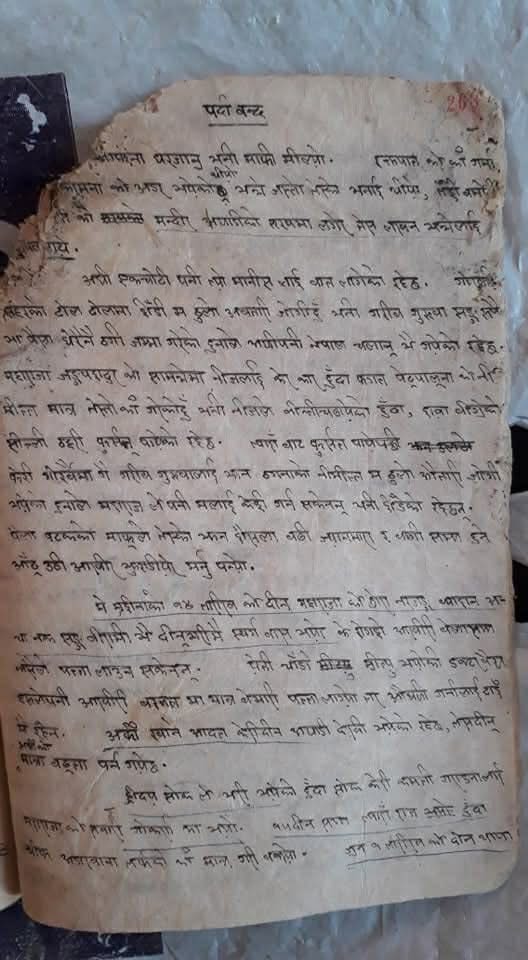
Old document containing remarks on Lakhan Thapa’s rebellion (Source: Purushottam Shamsher JB Rana)
However, Jung Bahadur crushed Lakhan’s rebellion by deploying an entire army battalion. The rebels were brought to the capital, Kathmandu, bound in chains. Legal proceedings against them lasted for a year. Ultimately, the core leaders, including Lakhan Thapa, were taken back to Bungkot, Gorkha, and executed.
Historians Gyanmani Nepal and Purushottam Shamsher JB Rana have noted that Lakhan and his comrades were executed in January 1877. However, following the restoration of democracy in 1990, an annual memorial day has been organized on February 14, though the exact historical basis for this specific date remains unclear. This has created confusion regarding the actual date of Lakhan’s martyrdom. It is crucial to review historical facts thoroughly to arrive at a definitive conclusion.
Comrades left out of the martyr list
Jung Bahadur’s son, Padma Jung, and historian Balchandra Sharma have recorded that seven individuals, including Jahare Chumi alongside Lakhan Thapa, were given the death penalty.
Who were the other rebels executed alongside Lakhan?
After studying the letter dated March 12, 1876 related to the Lakhan episode published in the Regmi Research Series, this author had deduced in an article a decade ago that those to whom Lakhan had promised high military ranks were the ones who achieved martyrdom with him. The martyrs deduced by this author were: Jahare Chumi, Biraj Thapa Magar, Juthya Thapa Magar, Jitman Gurung, and Ajap Singh Thapa.
Following that, activists and authors documenting Lakhan’s legacy began mentioning these names as the individuals who attained martyrdom alongside him. However, noticing that one name was still missing, Umesh Rana ‘Gorkhali’—the then Vice-Chairman of the Lakhan Thapa Memorial Foundation—discovered through local oral folklore prevalent in Bungkot, Gorkha, that Baleshwar Achhami Magar had also achieved martyrdom alongside Lakhan. He even met with Baleshwar’s descendants to gather vital information.
The Government of Nepal declared Lakhan a martyr on February 23, 2000. Later, as stakeholders continually demanded that he be recognized as the nation’s premier martyr, a cabinet meeting on September 20, 2015 formally declared him Nepal’s First Martyr.
Yet, whether it is because activists and stakeholders focused solely on Lakhan Thapa, the other six individuals who sacrificed their lives alongside him have faded into the depths of oblivion. When the demand to declare Lakhan a martyr was made, his six comrades were left behind. This is a blatant injustice to them.
Granted, the list of martyrs in our country is exceedingly long. Successive governments have declared numerous individuals as martyrs. While names continue to be added to the martyr list over time, neither the stakeholders nor the state have remembered the six individuals executed alongside Lakhan. Are they not martyrs? Based on historical evidence, are they not qualified to be included in the official list of martyrs?
Even today, the descendants of Jayasingh Chumi (or Jahare Chumi) can be found in Bungkot, Gorkha. In memory of their ancestor who attained martyrdom alongside Lakhan, they perform the Bhanyari ritual every year on the first Panchami of the month of Poush. Sadly, one rarely sees these descendants being recognized or honored as martyr families.