Kathmandu
Monday, July 27, 2026





A handful of villagers from Lama Gaun—a small settlement in Shrimanjyang, Dordi, Lamjung—worked through the night to serve more than 300 guests. In doing so, they presented a sublime model of hospitality, executing an exceptional modern-day traditional feast
KATHMANDU: The long, dried taro stalks hanging in the courtyard served as a clear sign that the village had finally arrived. This was the courtyard of a shop situated right in front of the Laxmi Secondary School in Shrimanjyang, Dordi Rural Municipality, Lamjung. The hill where the school stands is called Dhokedauda because it completely overlooks a section of Shrimanjyang. The purpose of this journey was to celebrate Annapurna Ascent Day.
On June 3, 1950, a French team led by Maurice Herzog and Louis Lachenal made history by completing the first successful ascent of the 8,091-meter Annapurna. Prior to that historic feat, no peak above eight thousand meters had ever been conquered. To identify and promote new trekking trails, the Trekking Agencies’ Association of Nepal (TAAN) Gandaki organized the Annapurna Ascent Day event in Shrimanjyang, Lamjung, on June 3 and 4, 2026, which is how we came to be guests there.
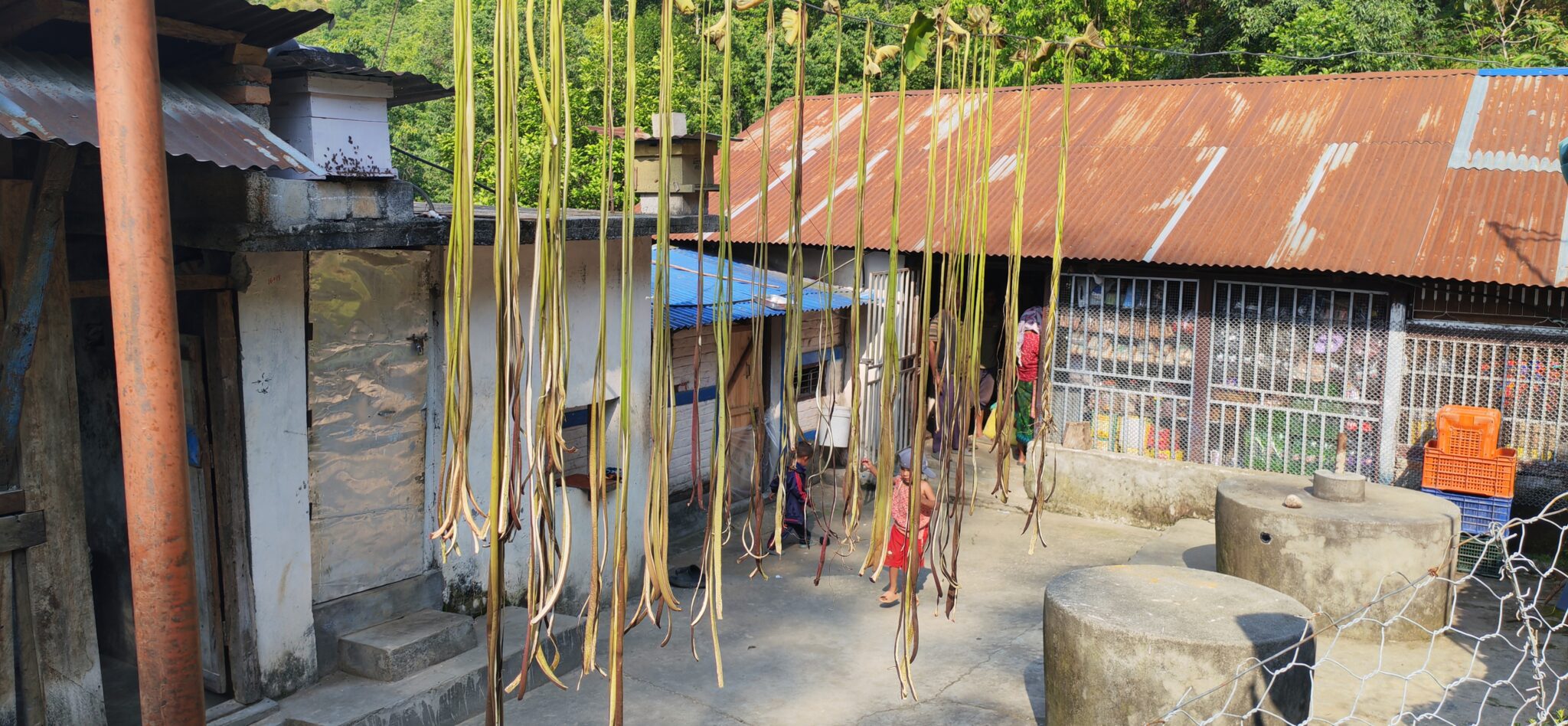
Dried taro stalks hanging on a string. Photo: Rajesh Ghimire
From the school at Dhokedauda, we had to travel to Lama Gaun on foot. However, since all the guests had not arrived yet, waiting became inevitable. And so began a deep reflection on dried taro (tandre karkalo). These dried taro stalks represent the traditional wisdom of our ancestors—a clever solution to bridge food scarcity when fresh green vegetables are unavailable. Depending on the region and community, dried taro is also referred to as Karkala ko lasa, lakanno or lakanna, late, and chulthi. The name chulthi comes from the practice of slicing the taro stalks into long strips and braiding them together like a woman’s hair before drying and storing them. The common method involves splitting the taro stalks and drying them thoroughly under direct sunlight. This prevents mold growth and preserves the taro for an extended duration. Once completely dried, it is safely stored in airtight containers. Before cooking, the dried stalks are finely chopped and soaked in hot water. A highly popular pickle is made by lightly pan-frying the soaked taro stalks and tossing them with roasted soybeans, boiled potatoes, cucumbers, charred tomatoes, salt, chili, fresh coriander, and lemon juice.
Taro stalk curry is also incredibly popular. In various parts of the Gandaki Province, a thick gravy called kalau—made by grinding soaked rice along with spices—is added to a curry of dried taro stalks, roasted soybeans, potatoes, and other available vegetables. Some people prefer using the water left over from rinsing rice instead of Kalau.
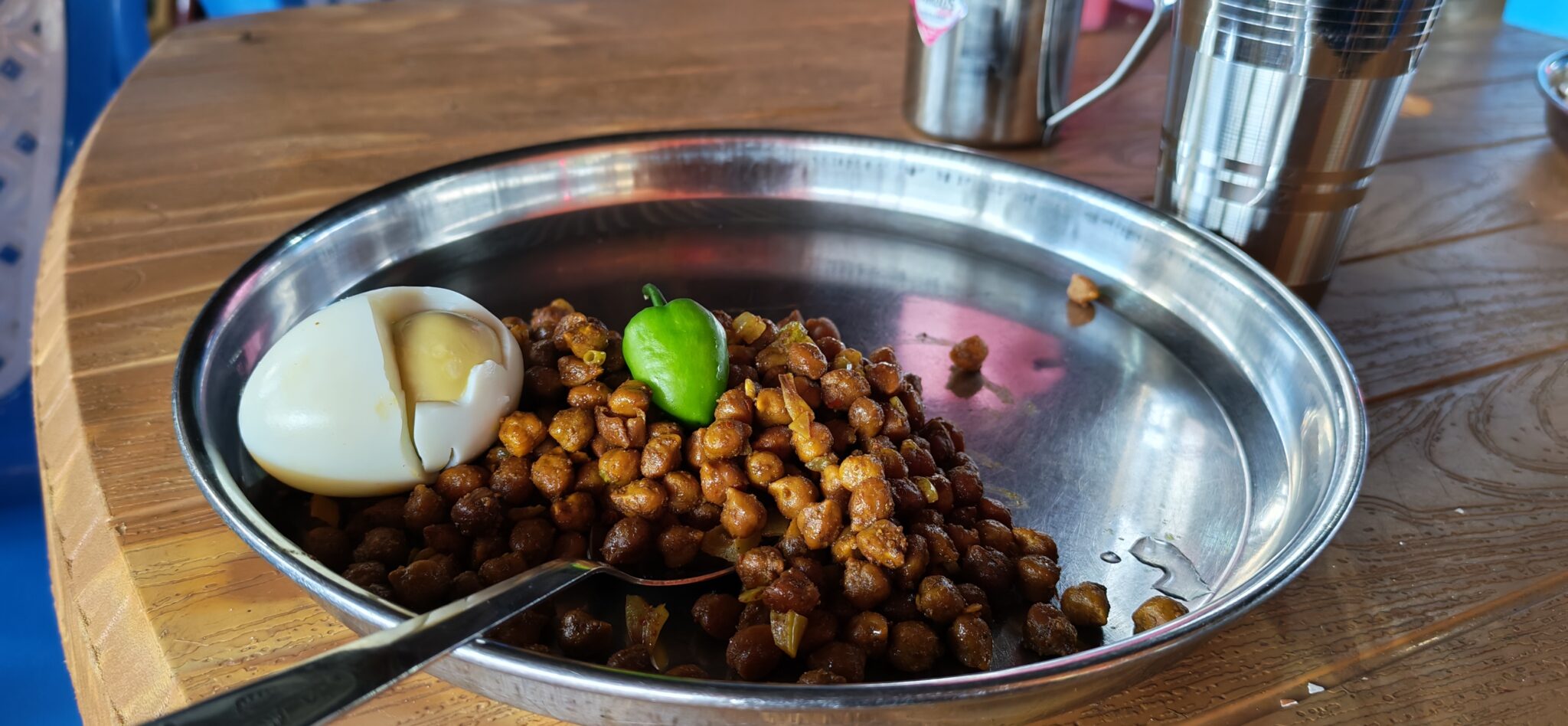
Morning breakfast. Photo: Rajesh Ghimire
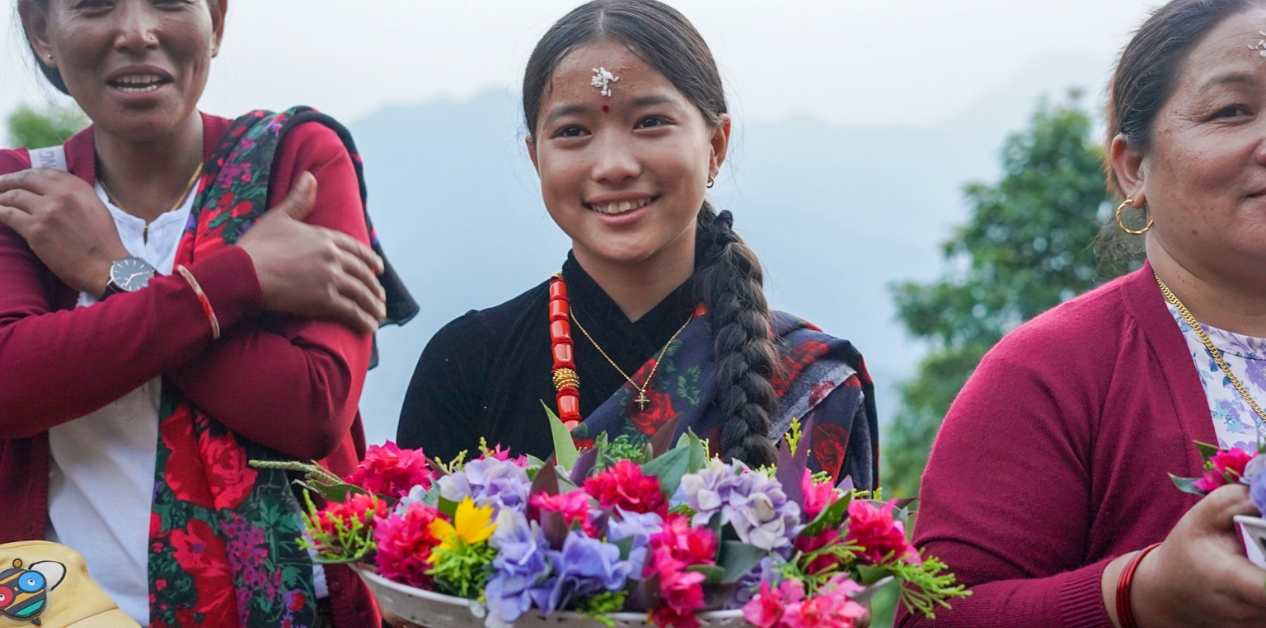
Following these reflections and casual chats with the schoolteachers and villagers, almost all the guests arrived and began the uphill trek toward Lama Gaun. As we climbed, someone asked, “Is this a village of Tamang Lamas?” It felt as though prior information had not been fully shared. Lama Gaun in Shrimanjyang is actually a Gurung village—one of the ancestral homelands of the Tamu community. “Lama” happens to be one of the surnames within the Gurung community, and it is also customary to address Buddhist monks as Lamas. The name Lama Gaun is likely derived from this connection. A traditional Panche Baaja ensemble played music to escort the guests to the main entrance of Lama Gaun. Members of the local mothers’ group then welcomed all the visitors from Pokhara, Besisahar, and Kathmandu by applying white tika (a traditional paste applied to the forehead in Hindu) on their foreheads and placing garlands woven from bougainvillea and chili flowers around their necks. Then came the turn to serve snacks to the famished guests.
The moment the members of the mothers’ group served the snack in stainless-steel plates, everyone was delighted. The plate featured selroti (traditional Nepali ring-shaped sweet bread), mutton, a thick mixed-bean and local bean curry, accompanied by the previously discussed pickle made from dried taro stalks and roasted soybeans. Many guests failed to recognize it as a taro stalk pickle, happily devouring it under the assumption that it was regular gundruk (fermented leafy greens).
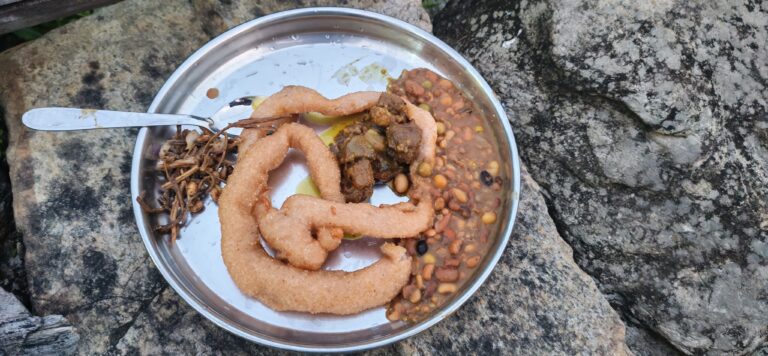
Traditional snacks of Lama Gaun. Photo: Rajesh Ghimire
In reality, taro gundruk is prepared in a slightly different manner. After washing the taro stalks and leaves (gava) thoroughly with clean water, they must be left in the sun or open air for a short while to dry out the surface moisture. The thin, fibrous outer layer of the taro stem must be peeled off by hand. Next, smaller pieces of the stems are placed inside the leaves and rolled tightly to form medium-sized bundles. Keeping the stems and leaves together ensures that the sour and savory flavors blend perfectly within the gundruk. Then, water is brought to a rolling boil in a large vessel, and the prepared taro bundles are carefully dropped into the hot water. The lower section is left to cook for about three minutes. Using tongs or a spatula, the bundles are flipped over to cook the other side for another three minutes. Blanching them for a total of six minutes softens the texture. The blanched taro is then lifted out, and any excess water is squeezed out. Following this, the tied taro bundles are gently unraveled by hand and spread across a cotton cloth or a straw mat to dry. After consecutive days of exposure to intense sunlight, the gundruk turns crisp. It can then be stored in airtight glass jars or plastic containers for months.
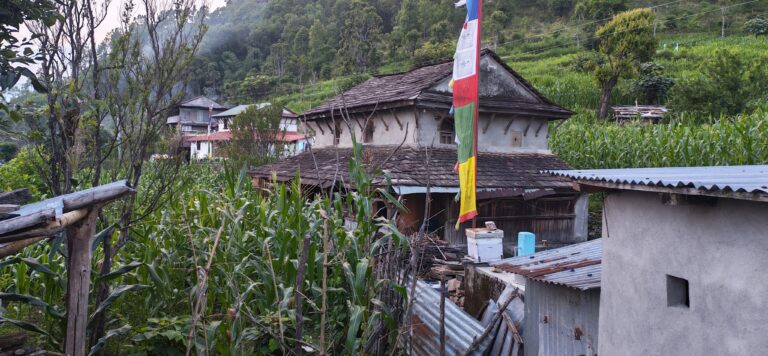
A traditional house in Lama Gaun. Photo: Rajesh Ghimire
One must appreciate the immense hard work put in by the mothers of Lama Gaun. To prepare selroti for over 300 people, the members of the mothers’ group must have toiled for days. The bean curry served alongside the selroti was perfectly cooked, melting effortlessly in the mouth. The mutton was beyond reproach—cooked so well that the meat fell away from the bone, featuring an exceptional blend of spices. Cooked under the leadership of Chitra Bahadur Gurung, who spent a significant amount of time working in the city of Ambala in Haryana, India, the culinary techniques were modern, yet the flavors and ingredients remained purely traditional Nepali.
Everyone ate heartily. While some guests contentedly sipped black tea served from kettles, the demand for something else was rising rapidly: local millet beer (jaand). Despite being a high-altitude location, the heat of June was stifling, made worse by the dense crowd of people packing the space. Serving jaand from plastic jugs quickly became impossible due to the sheer volume of requests. Consequently, they began pouring it directly from kettles, and when that still couldn’t keep up, it was brought out and distributed straight from buckets. For those preferring hard liquor, locally distilled millet alcohol was distributed in steel jugs. Seeing the massive consumption of alcohol, the organizers seemingly realized that the formal program was yet to take place, and promptly halted the food and beverage service.
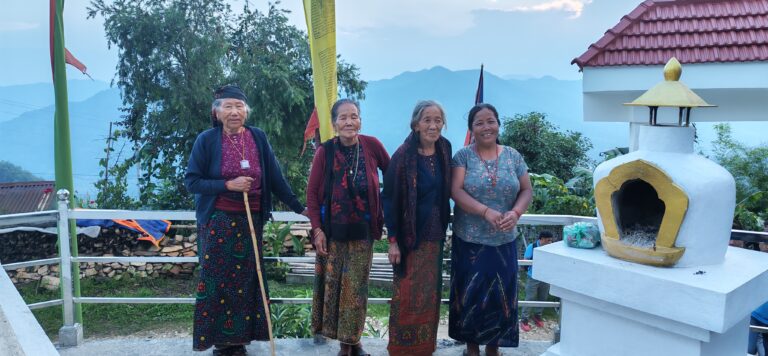
Mothers gathered to welcome the guests. Photo: Rajesh Ghimire
Following this, the formal program commenced. The Nepali cultural tradition of formal ceremonies had to be displayed—calling the prominent VIP guests to the stage and requesting the slightly less prominent dignitaries to take their designated seats in the audience. This was followed by welcome speeches, presentation of working papers, and various other procedures. After numerous speakers had delivered their addresses, the felicitation ceremony finally arrived. On the night of June 3, mountaineer Purnima Shrestha from Gorkha, Narendra Shahi from Rainas Municipality, Lamjung, and Man Raj Gurung were honored for their outstanding contributions to mountaineering. They received their awards from Yashoda Rimal, the Minister for Industry and Tourism of the Gandaki Provincial Government.
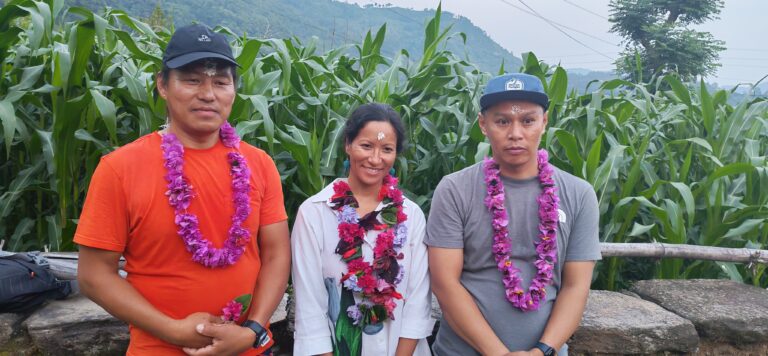
Man Raj Gurung (left), Purnima Shrestha (center), and Narendra (Naren) Shahi (right). Photo: Rajesh Ghimire
Purnima Shrestha is among the female mountaineers who have achieved extraordinary success within a short span in Nepal’s mountaineering sector. Born in Arughat, Gorkha, Purnima is a photojournalist by profession. After scaling Mount Everest for the first time in 201, she has successfully summited eight peaks above 8,000 meters, including Annapurna, Dhaulagiri, Manaslu, Kanchenjunga, Makalu, Lhotse, and K2. In 2024, Purnima set a new global record by summiting Mount Everest, the world’s highest peak, three times within a mere 13 days. She became the first woman in the world to climb Everest three times in a single climbing season, an achievement that earned her a spot in the Guinness World Records.
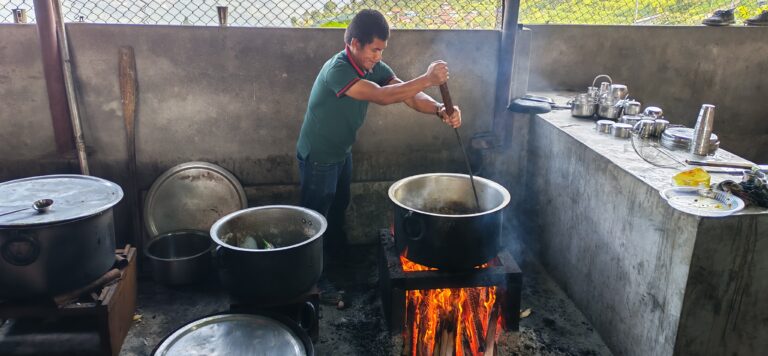
Photo: Rajesh Ghimire
Narendra Shahi, widely known among his peers as Naren, has been established as an international-level mountain guide, instructor, and skilled rescue expert in the Nepali mountaineering sector for the past two decades. Naren has successfully summited Mount Everest five times. He has also been training aspiring mountaineers, serving as an “Education Chief” and “Observer” for various mountain guide courses in both China and Nepal.
The third honoree, Man Raj Gurung, has carved out an identity as an “intellectual mountaineer” within Nepali mountaineering and adventure tourism. Renowned as an international mountain guide, Man Raj holds a Master’s degree from Shanker Dev Campus, alongside a Master’s degree in Buddhism and Himalayan Studies from Lumbini Buddhist University. Highly regarded as an international-level mountain rescue and navigation instructor, Man Raj actively advocates for incorporating formal education in tourism, adventure sports, and mountaineering as an elective subject in school curriculums starting from the secondary level.
By the time the felicitations, formal speeches, and distribution of tokens of love concluded, it was already 11 PM. Finally, it was time for dinner. The local residents had put immense effort into preparing that traditional feast, which featured wild fiddlehead fern curry, mutton broth made from local sheep, rice, and fresh green vegetables. Every single dish was superb. The rich, robust flavor of the mutton broth added a perfect finishing touch. A later count revealed that exactly 312 individuals had dined that evening. Finding accommodation for such a large number of guests in that tiny village was no minor challenge. Managing guests is a demanding task, and many remarked that the event would have been far more efficient had there been better prior preparation and time management.
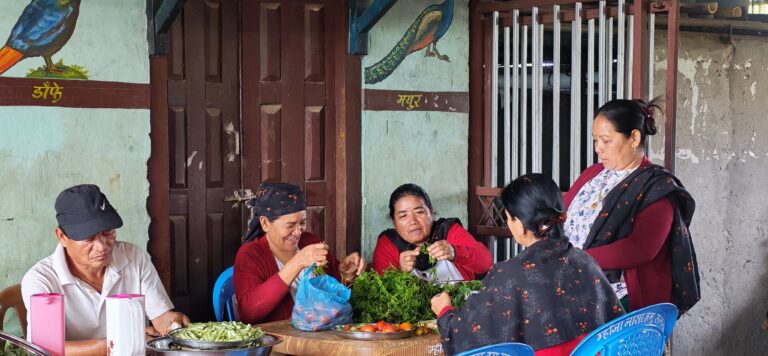
Photo: Rajesh Ghimire
According to Yuvraj Adhikari, the Chairman of Dordi Rural Municipality, the Mhanja Nasa Community Homestay in Lama Gaun is a relatively new venture. Currently, homestay services are operational across seven houses, and the operators require substantial further training. He states, “We have identified three distinct trekking routes here. The first is a three-day trail that starts from Nauthar Sera, passes through Shrimanjyang, Jorne, Ilampokhari, Lipelek, and Damrang, before returning to Nauthar Sera. Similarly, we have mapped out a 10-day route from Lipelek through Damrang, Notache, Ukhand, Memepokhari, Komrodauda, and Bahrapokhari to reach Hileataksar, alongside an eight-day trail that exits toward Bhulbhule via Peace Hill. It is imperative to develop infrastructure and homestay facilities across all these locations.”
He added that another new trekking trail has been identified, which connects Barpak-Sulikot, Ajirkot, Dudhpokhari, Dordi, and Thulagi in Gorkha to Ghermu in Lamjung. Chairman Adhikari mentions that the rural municipality is actively promoting this route under the name ‘Himachuli Great Lake Circuit’. He remarks, “If we can effectively market these long and short trekking circuits, we can successfully entice trekkers who wish to immerse themselves in nature.”
Jitu Gurung, who was born and raised in Lama Gaun, faced immense struggles to establish his tourism business in Pokhara. Driven by a desire to ensure that the younger generation does not have to endure similar hardships, he is fully dedicated to promoting tourism in his native village. Jitu shares, “The Dordi region holds immense potential for trekking tourism, yet it remains overshadowed due to a lack of adequate publicity. Promoting tourism here would help preserve local culture, create market linkages for local produce, and generate employment opportunities.”
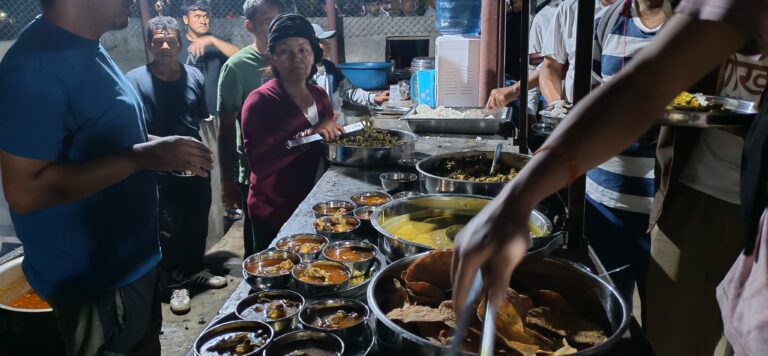
Food being distributed to guests at midnight. Photo: Rajesh Ghimire
According to Krishna Prasad Acharya, the President of TAAN Gandaki, developing new and camping-based trekking trails is essential to attract high-quality tourists. “We are in dire need of alternative trekking destinations now,” Acharya states. “If we can develop fresh routes suitable for camping treks, we can bring in high-spending international tourists.”
The morning of June 4 started with boiled eggs, chickpea curry, and black tea infused with fresh mint leaves. While the guests were kept engaged touring the village and visiting the local monastery, the residents of Lama Gaun busied themselves with preparing lunch. Members of the mothers’ group chopped vegetables and washed dishes, while the male chefs focused on cooking large batches of mutton and rice. We felt a deep pang of regret as we had to depart for Kathmandu before tasting the freshly cooked rice. Our hosts had gone to sleep at 4:00 AM and woken up at 6 AM to resume their duties. Yet, not a single trace of exhaustion was visible on their faces. They remained entirely energized to serve their guests. This, indeed, is the finest manifestation of Nepali hospitality, where a guest is revered as a deity.