Kathmandu
Wednesday, July 22, 2026





B.P. Koirala believed institutions must always prevail over individuals. As the Nepali Congress descends into factionalism, disputes over its general convention, and personality-driven politics, the party's biggest crisis is not leadership—it is its abandonment of BP's democratic principles.
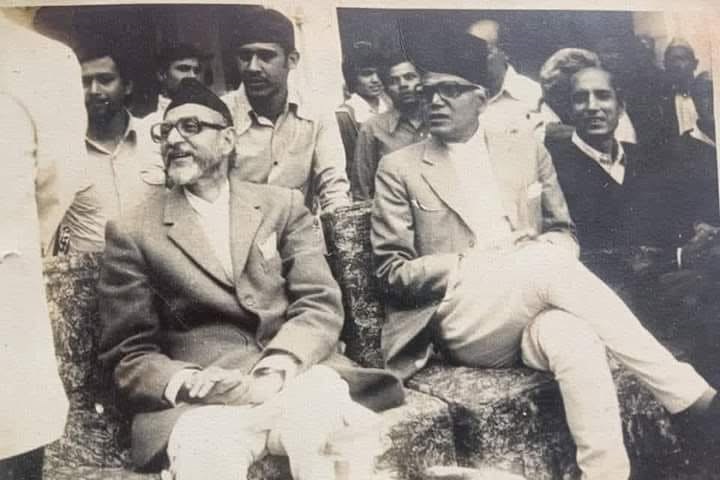
KATHMANDU: When the Panchayat system was in place, BP Koirala returned to Nepal from India in 1976 with a policy of national reconciliation. At that time, he was seriously ill himself. When asked to go abroad for medical treatment, BP’s response is still considered one of the most powerful expressions in Nepalese political history: “What does my health matter when the health of the nation itself is not good?”
BP eventually went to the United States for treatment. After returning from treatment, he called a conference of the Nepali Congress in Patna, India. Hundreds of representatives from Nepal reached there.
In the context of that same conference, I asked BP, “Why was such a large conference necessary? You yourself were the supreme leader of the party.”
In response, BP said, “You did not understand. The general convention is the body of the party; it is the supreme entity. It can even remove the president. A leadership approved by the general convention can only be changed by another general convention.”
This line of thinking makes it clear that BP was a leader who considered the institution greater than the individual and method greater than leadership.
Looking at the current state of the Nepali Congress, that very conversation with BP comes to mind.
Institution above individual
The founder leader of the Nepali Congress and promoter of democratic socialism, BP Koirala’s ideas are still considered relevant in Nepalese politics today. Paradoxically, the Nepali Congress itself—which makes BP’s name its political identity—has reached a state of division, ideological confusion, and leadership struggle.
At such a time, the vitality of BP’s thought has become even more meaningful, not only for the Congress, but also for democracy, good governance, and the aspirations of ordinary citizens.
BP interpreted politics not merely as a means to gain power, but as a tool to transform people’s lives. Nationalism, democracy, socialism, the rule of law, internal democracy, and public accountability were the core foundations of his political philosophy.
He considered the general convention, debates, dissenting opinions, and institutional decisions within the party as mandatory practices of democracy. Therefore, regarding the general convention as the supreme body of the party, he placed the institution above the individual.
However, in today’s Congress, person-centered politics dominates over institutional processes. Disputes regarding the regular general convention, leadership power struggles, factional competition, and ultimately the situation of party division show that the Congress is moving away from the organizational culture envisioned by BP.
The tendency to engage in politics in the name of BP without implementing his democratic values and organizational principles in practice has weakened the party’s credibility.
General convention controversy
The main reason for the current breakdown in the party is the dispute over the general convention. Sher Bahadur Deuba initially committed to holding the general convention on time. However, he did not fulfill his promise.
As the time for the general convention approached, he handed over the acting responsibility to Purna Bahadur Khadka and stopped attending central committee meetings. In the capacity of acting president, calling meetings and holding regular general conventions kept getting delayed. Meetings began to stretch over three-month periods.
Thus, when the regular general convention became uncertain, the demand for a special general convention moved forward. Had the signatures of representatives for the special general convention not been registered, the situation might have been different.
According to the Congress statute, if 40 percent of the general convention representatives submit a written demand, a special general convention must be called within three months. More than half of the representatives had signed the demand for a special general convention.
After new leadership was elected from the special general convention, the dispute reached the Election Commission and the court. The Election Commission gave official recognition to the new leadership. The Supreme Court has also upheld the Commission’s decision against the writ petition filed against it.
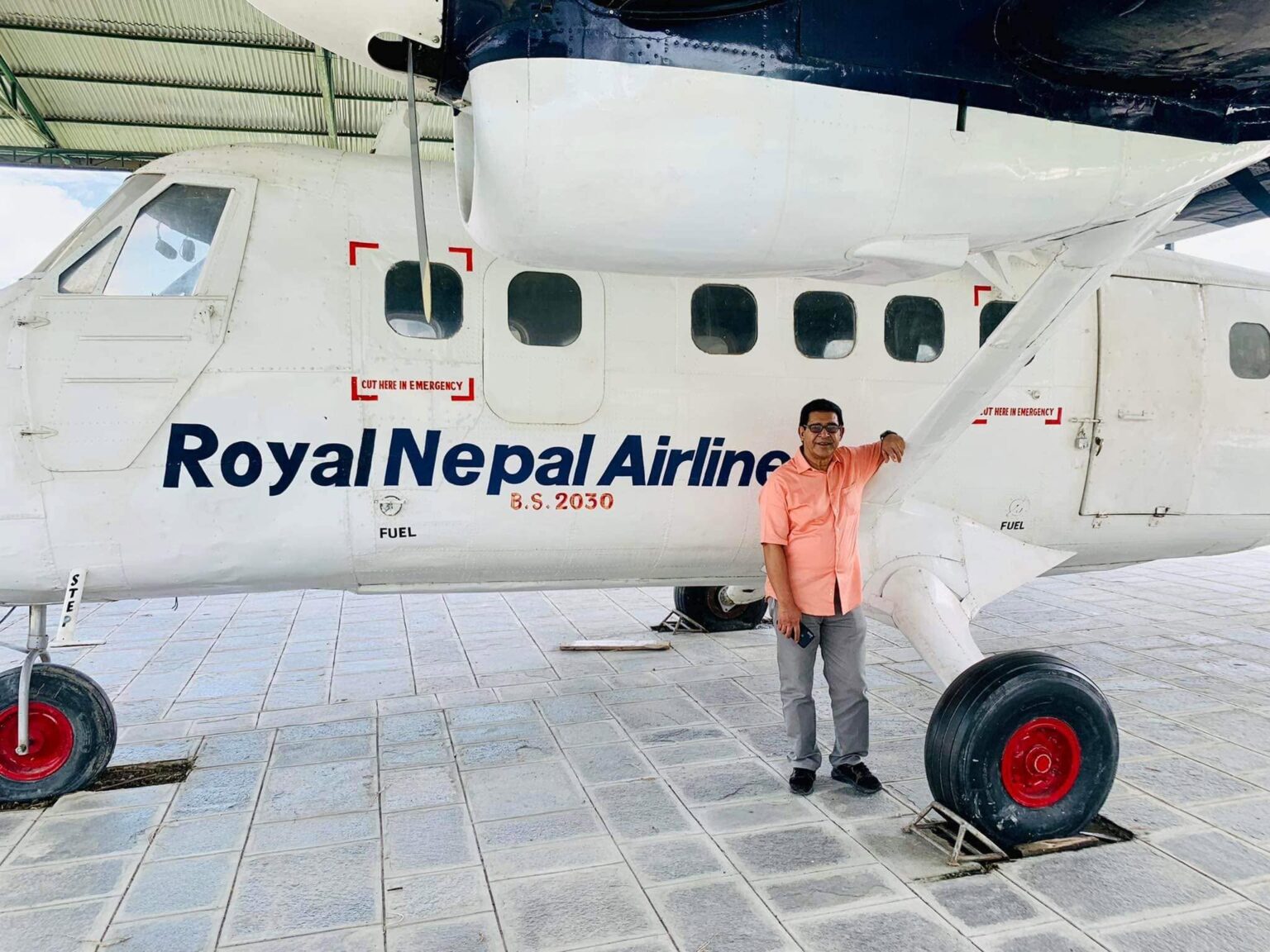
Basanta Bhattarai taking a picture with the Twin Otter aircraft hijacked in 1973, displayed at the BP Koirala Museum in Sundarijal.
Although the legal dispute has been settled, the political and emotional dissatisfaction has not ended. This shows that the problem lies in political willpower and the culture of accepting institutional decisions rather than in the statute.
In the organizational foundation of the Nepali Congress, the institutional tradition established by BP and the principle of considering the general convention supreme still remain.
Those who say they embrace BP’s thoughts cannot stop at merely giving speeches on theory. Where the official Congress exists according to the constitution, everyone must come there and present their views within the party.
Ironically, the very leaders who take the oath of the party constitution are today interpreting it differently and standing in parallel politics.
Those who say they embrace BP’s thoughts cannot stop at merely giving speeches on theory. Where the official Congress exists according to the constitution, everyone must come there and present their views within the party.
A special general convention had taken place during BP’s time as well. But that was completed on the basis of consensus and institutional culture. Currently, however, the Congress is divided into two poles of agreement and disagreement.
Leaders who made public statements that they would go for a special general convention if the regular general convention did not take place backed down once the process started. Participating in an institutional process but refusing to accept the outcome if it turns out unfavorable cannot be democratic.
Philosophy of reconciliation
Another important aspect of BP’s thought was national reconciliation. Even during the Panchayat rule, he pushed forward the politics of national consensus by taking personal risks. For him, politics was not about turning opponents into enemies, but about seeking national consensus through dialogue. In the current environment of polarization and mutual distrust within the Congress, BP’s philosophy of reconciliation seems all the more relevant.
BP’s message was that while there can be disagreement in ideas, institutional unity and the democratic process must be preserved. National reconciliation does not mean giving up one’s ideas and principles. It means keeping the door to dialogue open in the interest of the nation, democracy, and institutions, even amidst disagreements.
The unity of the Congress is not impossible. However, its foundation must be the respect for political decisions and the constitution, not an individual’s stance. Whoever is ready to join the party should be included with respect. But an individual cannot be above the institution.
Crisis of public trust
While deployed to various districts of the country as a central representative during the election campaign, I directly experienced that public trust in the Congress has weakened.
Among the public, a narrative had grown strong that KP Sharma Oli, Sher Bahadur Deuba, and Pushpa Kamal Dahal had weakened democracy. Even within the Congress, voices were rising that they could not go into the election with the old leadership. It was amid that dissatisfaction that a message of change went through the Congress after new leadership was elected.
The rise of new parties is the result of this public dissatisfaction. Candidates from the party carrying the bell election symbol won by large vote margins in many places, despite being unfamiliar faces. That gives a clear signal of declining public trust in traditional parties.
However, a change in leadership alone does not automatically bring back public trust. Changes must also be visible in the party’s behavior, policies, decisions, and relationship with the public.
The rise of new parties is the result of this public dissatisfaction. Candidates from the party carrying the bell election symbol won by large vote margins in many places, despite being unfamiliar faces. That gives a clear signal of declining public trust in traditional parties.
Citizens are currently frustrated by inflation, unemployment, lack of good governance, corruption, and political instability. In such a state, BP’s concepts regarding people-oriented democracy, social justice, economic equality, and civil liberty can still show the path to a solution today.
His view that democracy should not just be a system to win elections, but a means to improve the living standards of the people, still stands as an unfinished agenda.
Distance between thought and practice
BP’s theoretical and philosophical contributions are just as vital today. For a long time, the Congress moved forward using BP’s thoughts and principles as its foundation.
However, after the 14th General Convention, the party moved away from BP’s ideological path and began operating in an individual-centered and arbitrary style, triggering the current crisis. The name remained Congress, but BP’s thoughts were weakened. That is why an ideological crisis and organizational problems surfaced within the party.
Had the party operated according to BP’s principles, this state of affairs would not have arisen today. The principles of democracy, institutional decision-making, the rule of law, and internal democracy formulated by BP are guiding principles not just for a single party, but for every democratic system.
Regardless of what system of governance arrives, one must ultimately return to BP’s ideas to strengthen democracy. Today, the biggest test of BP’s ideas is taking place within the Congress itself. If the Congress limits BP to remembrance days, anniversaries, and slogans, his ideas will gradually be confined to mere formality.
If the Congress truly wants to honor BP, it will not be possible through memorial days, anniversaries, and speeches, but only through a culture of considering the general convention supreme, placing the institution above the individual, respecting dissenting views, and applying the constitution equally to everyone.
However, if the party can put internal democracy, institutional decisions, the rule of law, ideological clarity, and national reconciliation into practice, BP’s ideas can become vibrant once again.
At a time when the Congress has reached a state of division, BP’s thoughts can serve as a guide to make the party institutional once more, strengthen democracy, and restore public trust.
Modernization of the organization
Another dispute seen within the party is the digital updating of active memberships. This is an indispensable process for modernizing the organization. If around 800,000 active members can be connected with the center through digital means, party decisions and information can reach across the country immediately. Maintaining transparent and verifiable details of active members can also reduce disputes related to membership.
Opposing a system that connects the party directly with its members through digital media shows a failure to understand the need of the hour. However, such a system must be transparent, secure, and accessible to all members.
The modernization of the organization should also not be viewed through the lens of factional gains and losses.
BP is not the property of any family
The tendency to try to make BP a family property is also dominant. Being a family member of BP Koirala, Ganesh Man Singh, or Mahendra Narayan Nidhi alone is not a sufficient basis to become a political heir to the ideology of the Congress.
BP is an international leader, not the property of any family. The culture of seeking a share in politics by inheritance can no longer be accepted.
The real honor to BP lies not in placing a garland on his photograph, but in bringing the democratic values and principles he formulated into political practice.
Everyone has the right to commemorate BP. However, his memorial day should not be turned into an opportunity for factional displays of power.
Political succession is established not through birth or family relationships, but through ideas, sacrifice, and political action. Having a family relationship with BP’s name and representing BP’s political ideas are two different matters.
The true heir to his thoughts is the one who puts democracy, the rule of law, internal democracy, social justice, and national reconciliation into practice.
Democratic character, not a photograph
On the occasion of BP’s 44th memorial day, if all leaders had stood on the same stage and initiated dialogue, an atmosphere for party unity could have been created. Parallel programs can widen the distance even further.
Everyone has the right to commemorate BP. However, his memorial day should not be turned into an opportunity for factional displays of power.
Today, the crisis facing the Congress is not just one of leadership, but a crisis of institutional culture. The political culture established by BP is growing weak. This is why the controversy in the Congress has become more about whether to follow the constitution or not, rather than just about the general convention.
If the Congress truly wants to honor BP, it will not be possible through memorial days, anniversaries, and speeches, but only through a culture of considering the general convention supreme, placing the institution above the individual, respecting dissenting views, and applying the constitution equally to everyone.
The real honor to BP lies not in placing a garland on his photograph, but in bringing the democratic values and principles he formulated into political practice.
The greatest legacy left by BP is not the four-star flag, but democratic character. If the Congress fails to preserve that character, BP’s name and photograph will remain, but his politics will not.
(Based on a conversation conducted by Khilanath Dhakal with Basanta Bhattarai, who participated in the 1973 airplane hijacking carried out by the Nepali Congress against the Panchayat regime.)